

Inflation reduces the real value of your retirement savings by cutting what each dollar buys over time. A fixed nest egg that looks sufficient today will purchase less in five years, and significantly less in twenty. Retirees and near-retirees face the highest risk because many of their income sources are fixed in dollar terms and don’t grow with prices. The DOL’s report to Congress found that inflation erodes the real value of nominal assets and that a meaningful share of workers actually reduced their retirement contributions during periods of rising costs, compounding the long-term damage.
Three things to do right now:
- Check your emergency cash yield. If your savings account earns less than current inflation, you’re losing purchasing power every month. Move short-term cash to a high-yield savings account or short-term Treasury bills.
- Run a real-return check on your portfolio. Subtract your assumed inflation rate from each asset’s expected nominal return. If the result is near zero or negative, you need to rebalance.
- Consider adding TIPS or an inflation-adjusted annuity. These instruments are specifically designed to preserve purchasing power over time.
Pro Tip: Match each cash bucket to its time horizon. Money you’ll need within 12 months belongs in a liquid, high-yield vehicle. Money you won’t touch for 10 or more years can absorb more risk in exchange for real growth. Mixing those up is where most retirement plans quietly lose ground to inflation.
Key Takeaways
Inflation reduces the real purchasing power of fixed retirement savings, and retirees without inflation-indexed income face the greatest long-term risk to their financial security.
| Point | Details |
|---|---|
| Real return is what matters | Subtract your assumed inflation rate from nominal returns; a 3% nominal return at 2.5% inflation leaves only 0.5% real growth. |
| Cash loses value silently | Any savings account yielding less than current CPI is losing purchasing power; move short-term cash to higher-yield vehicles. |
| TIPS and I Bonds are direct hedges | These Treasury instruments adjust with inflation and belong in most retirees’ fixed-income allocation. |
| Delaying Social Security compounds protection | A higher starting benefit means every future COLA adjustment applies to a larger base, building a stronger income floor. |
| Middle-income retirees face the most risk | Fixed pensions without COLA, cash-heavy portfolios, and high healthcare spending create the greatest inflation exposure. |
Table of Contents
- Why inflation affects retirement savings: what you’re actually measuring
- How inflation drains your savings: a simple numeric example
- How inflation affects common retirement assets
- Why retirees are often hit harder than near-retirees
- Practical strategies to protect your retirement savings from inflation
- How to estimate inflation’s impact on your retirement plan
- Who is most vulnerable to inflation risk in retirement?
- Your inflation planning checklist: this month, this year, and before retirement
- A note on priorities and trade-offs
- Sources
Why inflation affects retirement savings: what you’re actually measuring
Inflation is a sustained rise in the general price level, which means each dollar you hold buys less than it did before. The official measure in the United States is the Consumer Price Index, published monthly by the Bureau of Labor Statistics. The BLS reported that the CPI rose 3.0 percent from January 2024 to January 2025, a meaningful moderation from pandemic-era peaks but still above the Federal Reserve’s 2 percent target.
Two versions of the CPI matter here:
- Headline CPI captures all goods and services, including food and energy, which are volatile.
- Core CPI strips out food and energy to show underlying price trends. It’s useful for policy, but it can understate what retirees actually experience because it de-emphasizes categories where retirees spend heavily.
Retirees often face a gap between headline CPI and their personal inflation rate. Medical care and housing, two of the largest expense categories for older Americans, have historically risen faster than the overall index. A retiree whose budget is weighted toward prescription drugs and assisted living will feel inflation more sharply than the headline number suggests.
The Social Security Administration applies an annual Cost-of-Living Adjustment to benefits based on the CPI-W, a variant of the CPI that tracks urban wage earners and clerical workers. This provides partial inflation protection for Social Security recipients, but it doesn’t cover private pensions, personal savings accounts, or fixed annuities without a COLA rider.
Key measurement takeaway: When planning for inflation in retirement, use headline CPI as your baseline, then add a buffer if your spending is concentrated in healthcare or housing. The BLS and SSA publish the underlying data you need to run those numbers yourself.
How inflation drains your savings: a simple numeric example
The core concept is real return: your nominal return minus the inflation rate. If your portfolio earns 3.0 percent per year and inflation runs at 2.5 percent, your real return is just 0.5 percent. That gap sounds small, but compounding turns it into a serious problem over a 20- or 30-year retirement.
Here’s what happens to $500,000 in purchasing power at different real return rates:
The middle column represents a portfolio that earns exactly what inflation costs, preserving purchasing power but not growing it. The right column, a portfolio that earns 1 percent less than inflation annually, loses nearly $131,000 in real value over 30 years on a $500,000 starting balance. For a retiree drawing down that portfolio, the shortfall arrives much faster because withdrawals accelerate the depletion.
A few compounding realities worth keeping in mind:
- A 2.5 percent annual inflation rate cuts the purchasing power of a fixed dollar amount by roughly half over 28 years.
- Healthcare costs have historically risen faster than general CPI, so retirees who budget using headline CPI alone may underestimate their actual spending needs.
- Sequence-of-returns risk amplifies this: poor investment returns early in retirement, combined with elevated inflation, can force larger withdrawals that permanently reduce the portfolio’s recovery potential.
How inflation affects common retirement assets
Not all assets respond to inflation the same way. Cash is the most vulnerable. A savings account earning 0.5 percent while inflation runs at 3 percent loses purchasing power every single day. Nominal bonds (fixed-rate Treasuries, corporate bonds) face a similar problem: their coupon payments are fixed, so rising prices erode their real value, and rising interest rates push their market prices down simultaneously.
The table below compares major asset categories on the dimensions that matter most for retirement planning.
| Asset | Inflation protection | Liquidity | Risk/volatility | Expected real return | Fees/costs | Best timing |
|---|---|---|---|---|---|---|
| Cash / savings | Very low | High | Very low | Negative to near-zero | Minimal | Short-term only |
| Nominal bonds | Low | Moderate–high | Low–moderate | Low; negative in high inflation | Low | Near-retiree with short horizon |
| TIPS / I Bonds | High (inflation-linked) | Moderate | Low–moderate | Low positive | Low | Both near-retiree and retiree |
| Equities / stock index funds | Moderate–high long-term | High | High | Historically positive real | Low (index funds) | Near-retiree with 10+ year horizon |
| Real estate / REITs | Moderate | Low–moderate | Moderate–high | Moderate positive | Moderate | Both, with liquidity caveat |
| Inflation-adjusted annuities | High (with COLA rider) | Very low | Very low | Low–moderate | High (insurance load) | Already retired |
| Pensions with COLA | High | None (income stream) | Very low | Depends on COLA formula | None | Already retired |
Cash and nominal bonds offer the least inflation protection. Holding too much in either during a period of sustained inflation is one of the most common ways retirement savings quietly shrink.
TIPS and I Bonds are the most direct tools. TIPS adjust their principal based on CPI, so your interest payments and redemption value rise with inflation. You can buy TIPS directly through TreasuryDirect or hold them via a low-cost fund or ETF. Building a TIPS ladder, where you buy bonds maturing in successive years, gives you rolling liquidity with inflation protection built in. I Bonds offer a similar guarantee but have an annual purchase limit per taxpayer and a minimum one-year hold period, plus a three-month interest penalty if redeemed before five years.
Equities have historically outpaced inflation over long periods, but they carry sequence-of-returns risk. A sharp market decline in the first few years of retirement, combined with ongoing withdrawals, can permanently impair a portfolio even if markets recover later. Stock index funds with low expense ratios are the most cost-effective way to maintain equity exposure.
Real estate and REITs provide partial inflation protection because property values and rents tend to rise with prices. REITs offer liquidity that direct property ownership doesn’t, though they carry their own volatility.
Inflation-adjusted annuities trade liquidity for certainty. A COLA rider on an annuity raises your monthly payment each year, protecting your income stream. The trade-off is a higher upfront cost and the permanent loss of access to that capital. For retirement income planning, an annuity with a COLA rider can make sense as a floor for essential expenses.
Pro Tip: Don’t rely on a single instrument. A TIPS ladder covering your essential expenses for the next 10 years, paired with a stock index fund allocation for long-term growth, gives you both near-term inflation protection and the real returns you need over a 20- to 30-year retirement.
Why retirees are often hit harder than near-retirees
The structural difference is straightforward: near-retirees still earn wages, which tend to rise with inflation over time. Retirees draw from fixed income sources, and most of those sources don’t automatically adjust for price increases.

Research from the Center for Retirement Research shows that retirees are more exposed because their income is less likely to be price-indexed. Social Security has a COLA, but most private pensions do not. Personal savings in CDs, money market accounts, or nominal bonds earn fixed rates. When inflation rises, the real value of those income streams falls.
Consider two households:
A near-retiree still working carries a mortgage with a fixed monthly payment. During an inflationary period, that fixed payment becomes cheaper in real terms as wages rise. They can also increase their 401(k) or IRA contributions to take advantage of higher nominal interest rates on new bonds.
A retiree on a fixed pension has no wage growth to offset rising costs. Their grocery bill, utility costs, and medical premiums all rise, but their monthly check stays the same. They must either draw down savings faster or cut spending.
Specific pressures retirees face that near-retirees don’t feel as acutely:
- Healthcare inflation. Medical costs have historically risen faster than general CPI, and retirees spend a disproportionate share of their budget on healthcare.
- Housing costs. Property taxes, maintenance, and insurance tend to rise with inflation, even for homeowners who have paid off their mortgage.
- Fixed pensions without COLA. A pension that paid well in 2005 has lost a substantial portion of its purchasing power by 2026 if it carried no inflation adjustment.
- Portfolio drawdowns. Retirees withdrawing from savings during high inflation face a double pressure: their costs rise while their portfolio may be declining in real terms.
The distributional effect is also worth noting. Wealthier households often hold more real assets, business equity, and equities, which provide natural inflation hedges. Middle-income retirees, who hold more cash and fixed-income assets, tend to be more exposed. The DOL’s Secure 2.0 report to Congress found that survey evidence showed 25 percent of employed adults reduced their retirement savings contributions in 2022 due to higher living costs, a pattern that disproportionately affected middle-income households.
Practical strategies to protect your retirement savings from inflation
The goal isn’t to beat inflation on every dollar. It’s to protect your essential spending first, then position the rest of your portfolio for real growth over time.
-
Raise the yield on your short-term cash. Any money you’ll need within the next 12–24 months should be in a high-yield savings account, a money market account, or short-term Treasury bills. Leaving it in a low-yield account is an unnecessary, avoidable loss. Check current rates at your bank and compare them to the current CPI. If your yield is below inflation, move the funds.
-
Add TIPS or I Bonds to your fixed-income allocation. TIPS are available through TreasuryDirect or via low-cost ETFs. For a near-retiree, consider building a TIPS ladder that covers five to ten years of essential expenses. I Bonds are capped at $10,000 per year per taxpayer but carry no market risk and are backed by the U.S. government. Both are explained in detail at TreasuryDirect. For a broader look at how Treasury instruments fit a senior’s portfolio, Savings Grove’s Treasury bonds guide for seniors walks through the mechanics.
-
Maintain a stock allocation for long-term real growth. Equities have historically outpaced inflation over periods of 10 years or more. A low-cost stock index fund (broad U.S. market or total world) gives you that exposure without the drag of high management fees. The key is sizing the allocation to your time horizon: if you’re 65 and in good health, you may have a 25-year investment horizon, which justifies a meaningful equity sleeve even in retirement.
-
Delay Social Security if you can. Every year you delay past your full retirement age increases your benefit by roughly 8 percent, and that higher base is what future COLAs are calculated on. Delaying from 62 to 70 can more than double your monthly benefit. Because Social Security is COLA-adjusted annually, a higher starting benefit compounds into significantly more inflation protection over a long retirement.
-
Consider an inflation-adjusted annuity for essential expenses. A COLA rider on an annuity raises your monthly payment each year, typically tied to CPI or a fixed percentage. The upfront cost is higher than a flat annuity, but for retirees who lack a pension, it can replace the inflation-indexed income floor that Social Security alone may not fully provide. Consult a retirement income specialist to compare riders and understand the trade-offs.
-
Adjust your withdrawal rate for current inflation. The traditional 4 percent rule was calibrated on historical averages. In a period of elevated inflation, withdrawing 4 percent of a portfolio that’s earning less in real terms can accelerate depletion. Run your withdrawal scenarios at 2 percent, 3 percent, and 4 percent inflation assumptions to see how your plan holds up. Savings Grove’s guide on stretching retirement savings longer covers withdrawal tactics in detail.
-
Reduce tax drag on inflation-protected returns. TIPS interest and I Bond interest are subject to federal income tax. Holding TIPS inside a tax-deferred account like a Traditional IRA reduces the annual tax bite. Roth IRA conversions can also be worth considering: paying taxes now at a known rate protects future withdrawals from tax increases that often accompany inflationary periods. Savings Grove’s guide on reducing taxes in retirement explains the asset location strategies in plain terms.
Pro Tip: If your retirement is 5 or more years away, your most powerful tool is time. Increasing your 401(k) or IRA contribution rate by even 1 percent now, and directing new contributions toward inflation-linked or equity assets, compounds into a meaningfully larger real balance by the time you retire. The Federal Reserve’s policy stance directly influences the real yields available on new bonds and savings products, so revisit your allocation whenever the Fed signals a major shift.
How to estimate inflation’s impact on your retirement plan
You don’t need a financial planner to run a basic inflation scenario. The formula is simple: real return = nominal return minus inflation rate. From there, you can calculate how much your portfolio needs to grow in nominal terms just to maintain purchasing power.
Here’s a step-by-step process:
-
Set your baseline real return. Look at your current portfolio allocation and assign a nominal return estimate to each asset class (e.g., bonds at 4.5 percent, equities at 7 percent, cash at 4 percent). Then subtract your assumed inflation rate to get the real return for each.
-
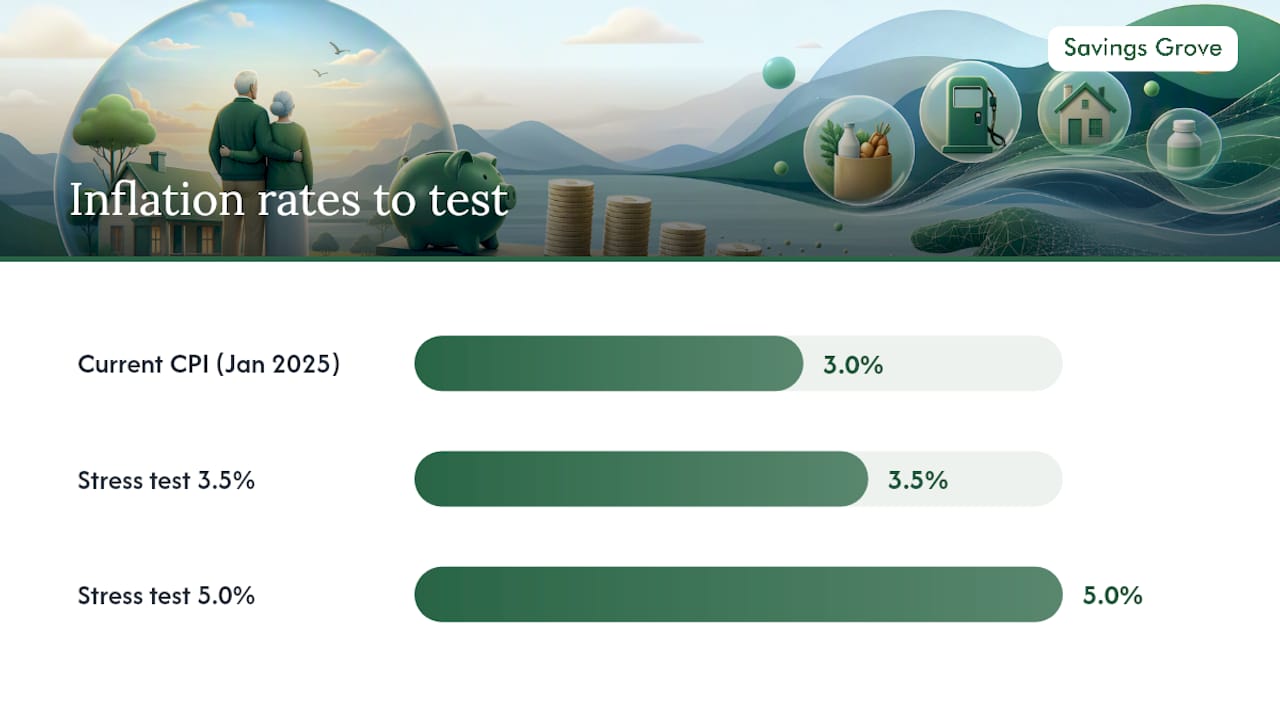
Run three inflation scenarios. Use 2 percent (low), 3.5 percent (moderate), and 5 percent (high). For each scenario, recalculate your real return and see how your projected portfolio balance changes over 20 and 30 years.
-
Adjust your required nest egg. If your target spending is $60,000 per year in today’s dollars, calculate what that spending level costs in nominal terms at each inflation scenario. At 3.5 percent inflation, $60,000 today costs roughly $119,000 in 20 years. Your portfolio needs to be large enough to fund that higher nominal spending.
-
Recalculate your safe withdrawal rate. A portfolio earning 5 percent nominally with 3.5 percent inflation has a real return of 1.5 percent. That’s a much tighter margin than the historical assumptions behind the 4 percent rule. Adjust your withdrawal rate down or your savings target up accordingly.
-
Use official tools to check your assumptions. The BLS publishes current CPI data monthly. The SSA’s COLA page shows historical adjustments. The Federal Reserve publishes inflation projections in its Summary of Economic Projections. These are free, authoritative, and updated regularly.
Key inputs to track:
- Current CPI (BLS, updated monthly)
- Your portfolio’s nominal return by asset class
- Your expected Social Security benefit and COLA history
- Your projected healthcare and housing costs (both tend to exceed headline CPI)
- Your planned withdrawal start date and estimated retirement duration
Who is most vulnerable to inflation risk in retirement?
The research consensus is clear: middle-income retirees with limited real assets and fixed income sources face the greatest inflation risk. Wealthier households hold more equities, real estate, and business equity, which provide natural inflation hedges. Lower-income retirees often rely more heavily on Social Security, which at least carries a COLA. The middle group, those with modest savings in CDs and nominal bonds and a private pension without a COLA, is the most exposed.
The Center for Retirement Research documents this pattern directly: retirees’ income sources are less likely to be price-indexed, and their spending is skewed toward healthcare and housing, two categories that have historically outpaced headline CPI. That combination creates a structural vulnerability that doesn’t show up in simple portfolio return calculations.
The DOL’s Secure 2.0 report adds a behavioral dimension: when inflation rises, households reduce retirement contributions, which shrinks the future nest egg precisely when inflation protection is most needed. The 25 percent of employed adults who cut contributions in 2022 will carry a smaller real balance into retirement as a result.
| Household type | Primary inflation risk | Key structural hedge (or lack thereof) |
|---|---|---|
| Middle-income retiree | Fixed pension, cash savings, limited equities | Minimal: most income is nominal |
| High-income retiree | Sequence risk on large equity portfolio | Strong: real assets, equities, business equity |
| Near-retiree (still working) | Wage growth may lag inflation short-term | Moderate: wages adjust; can increase contributions |
| Social Security-dependent retiree | COLA may not match personal inflation rate | Partial: COLA covers some but not healthcare/housing gap |
Pro Tip: Use this distributional picture to prioritize your own plan. If your income is mostly nominal (fixed pension, CDs, savings accounts), cover your essential monthly costs first with inflation-protected instruments. Then address discretionary spending. That sequencing protects your standard of living even if your portfolio underperforms in a high-inflation year.
Your inflation planning checklist: this month, this year, and before retirement
Protecting your savings from inflation doesn’t require a complete overhaul. It requires a few targeted actions, done in the right order.
This month:
- Check the yield on your emergency fund and any cash savings. Compare it to the current CPI (3.0 percent as of January 2025 per the BLS). If your yield is lower, move funds to a higher-yield account or short-term T-bills.
- Review your Social Security statement at SSA.gov to see your projected benefit and understand how delaying would change it.
- Note your current portfolio allocation and identify any large cash or nominal bond positions that may be losing real value.
This year:
- Rebalance your portfolio to include at least some TIPS or I Bonds in your fixed-income allocation. Start with a small allocation if you’re new to these instruments.
- Run your retirement calculator at two additional inflation assumptions (3.5 percent and 5 percent) to see how your plan holds up under stress.
- Review your projected healthcare costs and housing expenses separately from general CPI. Budget for those categories to rise faster than the headline number.
- Consider consulting a financial planner to review your withdrawal strategy and asset location for tax efficiency.
Before retirement:
- Adjust your asset allocation to match your time horizon. Savings Grove’s guide on why asset allocation matters for seniors provides a practical framework.
- Decide on your Social Security claiming strategy. Delaying to 70 maximizes your COLA-protected income floor.
- Evaluate whether an inflation-adjusted annuity makes sense for covering essential expenses.
- Review your budget for housing costs. If downsizing is on the table, Savings Grove’s guide on downsizing walks through the financial trade-offs.
Pro Tip: Write down the inflation rate assumption you used in each planning session (for example, “ran scenarios at 2%, 3.5%, and 5% on March 2026”). When you revisit your plan next year, you’ll know exactly what changed and why your projections shifted. This documentation habit takes two minutes and saves hours of confusion later.
A note on priorities and trade-offs
The conventional advice to “just hold more equities” to beat inflation is incomplete. Equities do provide long-term real returns, but sequence-of-returns risk means a retiree who holds 80 percent stocks and hits a bear market in year two of retirement may be forced to sell at a loss to cover living expenses. That loss is permanent in a way that a younger investor’s loss is not.
The smarter frame is to match instruments to time horizons and to protect essential costs first. Your grocery bill, utility payments, and healthcare premiums are non-negotiable. Cover those with inflation-linked income (Social Security, TIPS, COLA annuity) before you allocate to growth assets. What’s left can take on more risk in pursuit of real returns.
Readers who prefer low complexity have a straightforward path: maximize Social Security by delaying, hold TIPS or I Bonds for the fixed-income portion of the portfolio, keep a modest equity index fund allocation, and move short-term cash to a high-yield account. That four-part structure doesn’t require active management or sophisticated products, and it addresses the core reasons why inflation affects retirement savings more than most people expect.
Sources
These are the primary sources behind the data and recommendations in this article. Each one is free to access and regularly updated.
- Impact of inflation on retirement savings — Report to Congress (Secure 2.0) — U.S. Department of Labor
- How does inflation impact near retirees and retirees? — Center for Retirement Research
- The consumer price index rose 3.0 percent from January 2024 to January 2025 — BLS
- Cost-of-Living Adjustments (COLA) — Social Security Administration
This article is general information, not a substitute for advice from a qualified financial advisor. Consult a qualified financial professional about your own circumstances before acting on anything here.
0 comments
Leave a comment
Reviewed before they appear. Your email is not shown.