

The fastest ways to stretch retirement savings longer
Making your retirement savings last through a 20, 30, or even 35-year retirement requires more than just cutting back on spending. It takes a coordinated approach across withdrawals, taxes, income sources, and risk. Here are the core strategies that make the biggest difference:
- Delay Social Security as long as possible, ideally to age 70, to lock in a higher guaranteed monthly benefit for life.
- Use a flexible withdrawal rate rather than a fixed percentage, adjusting annually based on portfolio performance and spending needs.
- Sequence your withdrawals tax-efficiently by drawing from taxable accounts first, then tax-deferred accounts, and preserving Roth accounts for last.
- Build an income floor with Social Security, pensions, or annuities to cover essential expenses without touching your investment portfolio.
- Set up a liquidity bucket of two to three years of living expenses in cash or short-term equivalents to avoid selling investments during market downturns.
- Plan for healthcare costs early, including long-term care insurance or a dedicated savings account, since most retirees will need some form of care.
- Protect against inflation by holding assets like Treasury Inflation-Protected Securities (TIPS), dividend-paying stocks, or real estate.
- Eliminate high-interest debt before or early in retirement to reduce your monthly cash outflow.
- Review your plan annually, stress-testing it against poor market sequences and longer-than-expected lifespans.
- Consider part-time or gig income in early retirement to reduce portfolio withdrawals during the years when sequence of returns risk is highest.
Each of these strategies works on its own, but they work far better together. The sections below break down each area in practical detail.
How spending discipline and withdrawal rates protect your savings
The withdrawal rate you choose in year one of retirement sets the tone for everything that follows. The traditional 4% rule, which suggests withdrawing 4% of your portfolio in the first year and adjusting for inflation each year after, is a useful starting point. But sustainable withdrawal rates actually range from 3% to 5%, depending on your retirement age, health, and how long you expect to live. Women, who statistically live longer than men, are often advised to start at the lower end of that range.

A rigid withdrawal rate can be dangerous. If markets drop sharply in your first few years of retirement and you keep pulling out the same dollar amount, you sell more shares at depressed prices, permanently shrinking your portfolio’s ability to recover. That is the core of sequence of returns risk, and it is one of the most underappreciated threats to long-term savings. A flexible spending framework, one that reduces withdrawals by 10% to 15% during down markets and allows modest increases when portfolios perform well, can add years to your savings.
Delaying Social Security is one of the highest-return decisions available to retirees. Waiting from age 62 to age 70 increases monthly benefits by approximately 77%, and those benefits are inflation-adjusted for life. For many retirees, that guaranteed income stream reduces the pressure on their investment portfolio, allowing it to grow longer before withdrawals begin.
Practical spending tips to extend your savings:
- Track monthly spending by category and identify which expenses are fixed versus discretionary.
- Build a “guardrail” system: set a ceiling withdrawal rate (say, 5%) and a floor (say, 3%), and adjust annually based on portfolio value.
- Separate essential expenses (housing, food, healthcare) from lifestyle expenses (travel, dining) so you know exactly where to cut if needed.
- Consider a “spend more early, less later” approach if your health is good and you want to enjoy early retirement, but model it carefully with a financial planner.
- Review your Social Security statement at ssa.gov to understand your projected benefit at different claiming ages.
A note on longevity: Retirement plans should be stress-tested against 90th-percentile longevity scenarios, not just average life expectancy. Planning only to the average means roughly half of retirees will outlive their money.
Tax-smart strategies to maximize retirement income
Tax planning in retirement is not a one-time event. It is an ongoing process of deciding which accounts to draw from, when to convert funds, and how to minimize the tax bite on every dollar you spend. Done well, it can add years to your portfolio’s life.
The most effective sequencing strategy draws from taxable brokerage accounts first, then tax-deferred accounts like traditional IRAs and 401(k)s, and saves Roth accounts for last. This approach keeps taxable income lower in early retirement, which creates a window for Roth conversions during years when your tax bracket is low, typically before Social Security and required minimum distributions (RMDs) kick in. Converting traditional IRA funds to a Roth IRA during those low-income years means future withdrawals from the Roth are tax-free, extending the after-tax life of your portfolio.
For 2026, the IRS sets the 401(k) contribution limit at $24,500, with an additional catch-up contribution of up to $11,250 for savers aged 60 to 63. If you are still working and approaching retirement, maxing out these contributions, especially in a Roth 401(k) if your employer offers one, can meaningfully boost your tax-free savings before you stop working.
Key tax strategies to put into practice:
- Time Roth conversions in years when your income is low, such as after retiring but before claiming Social Security.
- Manage RMDs proactively. Required minimum distributions from traditional IRAs begin at age 73 and can push you into a higher tax bracket if not planned for.
- Use a Health Savings Account (HSA) if you are still eligible. HSA funds grow tax-free and can be withdrawn tax-free for qualified medical expenses, making them one of the most tax-efficient vehicles available.
- Coordinate withdrawals with Medicare premiums. Higher income in retirement can trigger IRMAA surcharges, which increase your Medicare Part B and Part D premiums.
- Compare fees against value in your 401(k) plan. The Department of Labor advises evaluating fees alongside services and investment risk alignment, not in isolation.
Working with a fee-only financial advisor can help you map out a multi-year tax strategy. The role of a financial advisor in retirement is often most valuable in this area, where the decisions are complex and the stakes are high.
How to plan for healthcare and long-term care costs in retirement
Healthcare is the expense most retirees underestimate. Medicare covers a significant portion of medical costs, but it does not cover everything, and long-term care is largely excluded. About 70% of Americans aged 65 and older will need some form of long-term care during their lifetime, whether that is in-home assistance, assisted living, or a nursing facility.

The cost of that care is substantial. A semi-private nursing facility room averages approximately $111,325 per year. Even a few years of that expense can deplete a retirement portfolio that took decades to build. About 70% of Americans aged 65 and older will need some form of long-term care during their lifetime. Planning for it is not pessimistic. It is one of the most practical things you can do.
| Long-term care type | Approximate annual cost | Typical coverage |
|---|---|---|
| In-home aide (part-time) | — | Rarely covered by Medicare |
| Assisted living facility | — | Not covered by Medicare |
| Semi-private nursing room | ~$111,325 | Limited Medicare coverage |
| Memory care unit | — | Not covered by Medicare |
Steps to protect your savings from healthcare costs:
- Maximize HSA contributions while you are still on a high-deductible health plan. HSA balances carry over indefinitely and can be invested.
- Research long-term care insurance in your 50s or early 60s, when premiums are lower and you are more likely to qualify.
- Consider hybrid life insurance policies that include a long-term care rider, offering a death benefit if care is never needed.
- Set aside a dedicated healthcare reserve within your portfolio, separate from your general retirement funds, to cover out-of-pocket costs.
- Understand Medicare gaps. Original Medicare does not cover dental, vision, hearing, or long-term custodial care. A Medicare Supplement (Medigap) plan or Medicare Advantage plan can fill some of those gaps.
Pro Tip: If you are married, consider a joint long-term care policy. These often cost less than two individual policies and provide shared benefits.
How to protect your savings against inflation and market risk
Inflation is a slow, quiet threat to retirement savings. At just 2% annually, the purchasing power of $1 million in cash falls to roughly $603,465 over 25 years. That is a loss of nearly 40% in real value without a single bad investment decision. For retirees on fixed incomes, that erosion is felt directly in the grocery store, at the gas pump, and in utility bills.
Sequence of returns risk compounds the problem. When markets fall sharply in the early years of retirement, selling assets at depressed prices to fund withdrawals permanently reduces the portfolio’s ability to recover. A retiree who experiences a 30% market drop in year two of retirement and continues withdrawing at the same rate faces a fundamentally different outcome than one who retires into a rising market, even if long-term average returns are identical.
A liquidity bucket strategy directly addresses both risks. By setting aside two to three years of living expenses in cash or short-term bonds, you can cover spending needs without selling growth assets during downturns. The rest of the portfolio stays invested and has time to recover.
Strategies to guard against inflation and volatility:
- Hold TIPS (Treasury Inflation-Protected Securities) in your fixed-income allocation. TIPS adjust their principal with inflation, preserving purchasing power. Savings Grove’s guide on Treasury bonds for seniors covers how to use them effectively.
- Include dividend-paying stocks in your equity allocation. Companies with long histories of dividend growth tend to raise payouts over time, providing a natural inflation hedge.
- Diversify into real assets such as real estate investment trusts (REITs) or commodities funds, which often move independently of stocks and bonds.
- Rebalance annually to maintain your target allocation and avoid drifting into excessive risk or excessive conservatism as markets move.
- Avoid holding too much cash beyond your liquidity bucket. Cash loses purchasing power every year and is not a safe long-term strategy.
For a deeper look at how to balance risk and return in retirement, Savings Grove’s guide on senior investment risk management walks through the key decisions.
Housing, lifestyle adjustments, and income diversification to extend savings
Where you live and how you spend your time in retirement has a direct impact on how long your savings last. Downsizing from a large family home to a smaller property reduces mortgage or rent costs, property taxes, utilities, and maintenance. Relocating to a state with no income tax, such as Florida, Texas, or Nevada, can meaningfully reduce your annual tax burden, especially if you are drawing from tax-deferred accounts.
Part-time work in early retirement is one of the most effective tools available for extending savings longevity. Even modest income, say $15,000 to $20,000 per year from consulting, freelancing, or a part-time role, can dramatically reduce the amount you need to withdraw from your portfolio. That matters most in the first five to ten years of retirement, when sequence of returns risk is highest and your portfolio has the most to lose from large withdrawals.
Income diversification beyond your portfolio also adds resilience. Dividend income from a well-constructed equity portfolio can cover a portion of living expenses without requiring you to sell shares. Annuities, particularly income annuities that begin payments immediately, can secure essential living costs with a guaranteed income floor, freeing the rest of your portfolio to stay invested in growth assets.
Lifestyle and income diversification steps worth considering:
- Audit your fixed monthly expenses and identify which ones you could reduce without affecting quality of life, such as unused subscriptions, excess insurance coverage, or an oversized home.
- Explore geographic arbitrage. Moving to a lower cost-of-living area, whether within the U.S. or abroad, can stretch the same dollar significantly further.
- Build a gig income stream before you retire so it is already generating revenue when you stop working full-time. Consulting in your former field is often the fastest path.
- Use a dividend-focused portfolio sleeve to generate regular cash flow without selling principal.
- Consider a deferred income annuity that begins payments at age 80 or 85. These “longevity annuities” are relatively inexpensive and protect against the risk of outliving your savings in very old age.
- Rent out a room or accessory dwelling unit if your home allows it. Rental income can offset housing costs and reduce portfolio withdrawals.
Balancing lifestyle and finances does not mean sacrificing what matters to you. It means being deliberate about where your money goes and making sure the spending reflects your actual priorities.
Regular reviews, risk management, and debt elimination for savings longevity
A retirement plan written at age 65 will not be accurate at age 75. Markets change, health changes, spending patterns shift, and tax laws evolve. Annual reviews are not optional maintenance. They are the mechanism that keeps your plan aligned with reality.
Each review should include a portfolio performance check, a spending versus budget comparison, a tax projection for the coming year, and a stress test against adverse scenarios. Stress-testing your plan against poor early market returns, sustained inflation, and longer-than-expected lifespans gives you a realistic picture of where vulnerabilities exist before they become crises. Plans built only on average-case assumptions tend to fail precisely when retirees can least afford it.
Debt elimination deserves more attention than it typically gets in retirement planning conversations. Carrying high-interest debt into retirement, whether credit card balances, personal loans, or a large mortgage, forces you to withdraw more from your portfolio each month just to service that debt. Paying off a credit card charging 20% interest is equivalent to earning a guaranteed 20% return on that money. No investment reliably matches that.
Pro Tip: If you carry a mortgage into retirement, run the numbers on whether paying it off early makes sense given your interest rate, tax situation, and portfolio return expectations. For many retirees, the psychological and cash-flow benefits of a paid-off home outweigh the math of keeping the mortgage.
Practical steps for ongoing plan management:
- Schedule an annual review with a fee-only financial advisor or, at minimum, conduct a structured self-review using a retirement planning tool.
- Adjust your asset allocation as you age, gradually shifting toward more stable, income-generating investments while keeping enough growth exposure to outpace inflation.
- Eliminate high-interest consumer debt before retiring, or as quickly as possible in early retirement.
- Revisit your insurance coverage annually, including life insurance, long-term care insurance, and Medicare plan selection.
- Update your estate plan whenever your financial situation, family circumstances, or tax laws change significantly.
Savings Grove’s guide on retirement budget adjustments covers how to build a flexible spending framework that adapts as your situation evolves.
2026 insights from Savings Grove to lengthen your retirement savings
Several developments in 2026 make this a particularly important year to revisit your retirement income strategy. The enhanced catch-up contribution rules for ages 60 to 63, the continued evolution of Roth 401(k) rules, and updated Social Security projections all create new opportunities and new risks for retirees and near-retirees.
One of the most consistent findings in recent retirement research is that retirees who combine a guaranteed income floor with a flexible investment portfolio fare better than those who rely entirely on either approach. Guaranteed income from Social Security, pensions, or annuities covers essential expenses and removes the pressure to sell investments at the wrong time. The remainder of the portfolio can then be invested more aggressively for growth, because it is not needed for day-to-day survival.
Behavioral discipline matters as much as financial mechanics. Retirees who follow a structured bucket approach and set spending guardrails are less likely to panic-sell during market downturns, which is one of the most costly mistakes in retirement. Research consistently shows that disciplined spending guardrails improve long-term sustainability by preventing emotionally driven decisions during volatile periods.
Key 2026 tactics for retirees:
- Maximize the new catch-up contribution window if you are between ages 60 and 63. The $11,250 limit is higher than the standard catch-up and applies only for these four years.
- Review your Roth conversion strategy now, before RMDs begin at age 73. The window between retirement and RMD age is often the most tax-efficient time to convert.
- Check your Social Security earnings record at ssa.gov for errors. Incorrect earnings records can reduce your benefit permanently.
- Reassess your asset allocation in light of current interest rates and inflation expectations. Higher bond yields in recent years have made fixed income more competitive than it was for much of the previous decade.
- Model your plan with a fee-only advisor using current 2026 tax brackets, Medicare premium thresholds, and updated longevity tables from the Social Security Administration.
- Consider a partial annuity purchase to fill the gap between Social Security income and essential expenses, reducing your dependence on portfolio withdrawals.
The flexible retirement income strategies that Morningstar and other researchers highlight consistently outperform rigid approaches, particularly during periods of market stress. The goal is a plan that bends without breaking, one that adjusts to what the market and your life actually deliver.
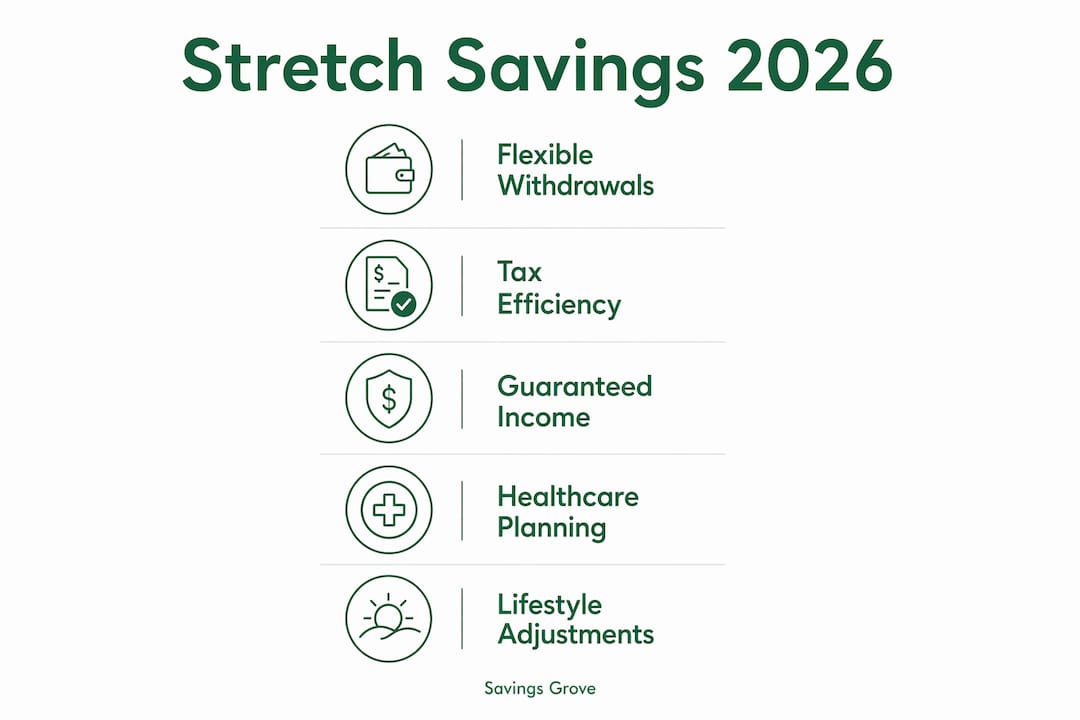
Key Takeaways
Stretching retirement savings longer requires combining flexible withdrawals, tax-efficient sequencing, guaranteed income, and proactive healthcare planning into a coordinated strategy that adapts over time.
| Point | Details |
|---|---|
| Delay Social Security | Waiting until age 70 increases your monthly benefit substantially compared to claiming at 62. |
| Use flexible withdrawal rates | Sustainable rates range from 3% to 5%; adjust annually based on portfolio performance and longevity expectations. |
| Plan for long-term care | About 70% of Americans over 65 will need some form of long-term care; a semi-private nursing room costs approximately $111,325 per year. |
| Guard against inflation | At typical inflation rates, $1 million loses a significant portion of its purchasing power over 25 years. |
| Review and adjust annually | Stress-test your plan against poor market sequences and longer-than-average lifespans, not just average-case assumptions. |
0 comments
Leave a comment
Reviewed before they appear. Your email is not shown.