

Tax-loss harvesting means selling investments at a loss on purpose so you can offset capital gains, or up to the allowable IRS limit of ordinary income, and carry any leftover loss forward to future years. It can meaningfully lower your current tax bill. The catch that trips up most investors is the wash-sale rule: buy back a “substantially identical” security too soon, and the IRS disallows the loss entirely.
TL;DR:
- Tax-loss harvesting is most beneficial when you have short-term losses that can offset higher-taxed income or gains, especially in the 32% marginal bracket.
- The wash-sale rule disallows losses if you repurchase the same security within 30 days before or after the sale, which requires careful timing and replacement strategies.
- Offsetting $8,000 in short-term gains at a 32% tax rate can save approximately $2,560 in federal taxes, with losses carried forward to offset future gains or income.
- Harvesting losses in retirement accounts like IRAs or 401(k)s yields no tax benefit, so strategies should focus solely on taxable accounts.
- Always document every trade, verify against broker reports, and avoid harvesting losses that are too small to outweigh trading costs or replacement expense ratios.
Table of Contents
- What Is Tax-Loss Harvesting and How Does It Work?
- Wash-Sale Rule: The 61-Day Window That Wrecks Your Deduction
- How to Execute Tax-Loss Harvesting Step by Step
- What Tax-Loss Harvesting Actually Saves You in Dollars
- Where Tax-Loss Harvesting Applies (and Where It Doesn’t)
- Reporting Harvested Losses: 1099-B, Form 8949, and Schedule D
- The Real Costs and Risks of Harvesting Losses
- Savings Grove’s Tax-Loss Harvesting Checklist
- Where Tax-Loss Harvesting Fits in a Real Financial Plan
- How Savings Grove Helps You Put This Into Practice
- Where to Verify These Rules Yourself
- Sources
- FAQ
What Is Tax-Loss Harvesting and How Does It Work?
Tax-loss harvesting only works once a loss becomes real. A stock sitting 15% underwater in your brokerage account does nothing for your taxes until you actually sell it. That distinction between an unrealized loss (a paper loss you’re still holding) and a realized loss (one locked in by a sale) is the entire foundation of the strategy.
Once you sell, the IRS requires a specific netting order before you can use that loss. Short-term losses (on positions held one year or less) first offset short-term gains. Long-term losses offset long-term gains. If one category still has a loss left over after netting within itself, it crosses over to offset the other category.
Here’s how the offset hierarchy plays out:
- Short-term losses net against short-term gains first.
- Long-term losses net against long-term gains first.
- Any leftover loss in either bucket crosses over to offset the other type of gain.
- If total losses still exceed total gains, up to $3,000 of the excess offsets ordinary income for that tax year.
- Anything beyond that $3,000 carries forward indefinitely to future tax years, according to the IRS.
That carryforward has no expiration date. A large enough loss from a bad year can keep offsetting gains for a decade or more, which is why some investors think of accumulated losses as a kind of tax insurance policy they can draw on later.
Tax-loss harvesting delivers the most value under specific conditions: you’re in a high marginal tax bracket, you’ve realized meaningful capital gains elsewhere in your portfolio (from a rebalance, a fund sale, or a stock windfall), and you’re harvesting short-term losses, which offset income taxed at your regular rate rather than the lower long-term capital gains rate. Investopedia’s own examples show why short-term losses tend to pack a bigger punch. Someone in the 32% bracket saves considerably more per dollar of short-term loss than a long-term loss taxed at 15%.
Wash-Sale Rule: The 61-Day Window That Wrecks Your Deduction
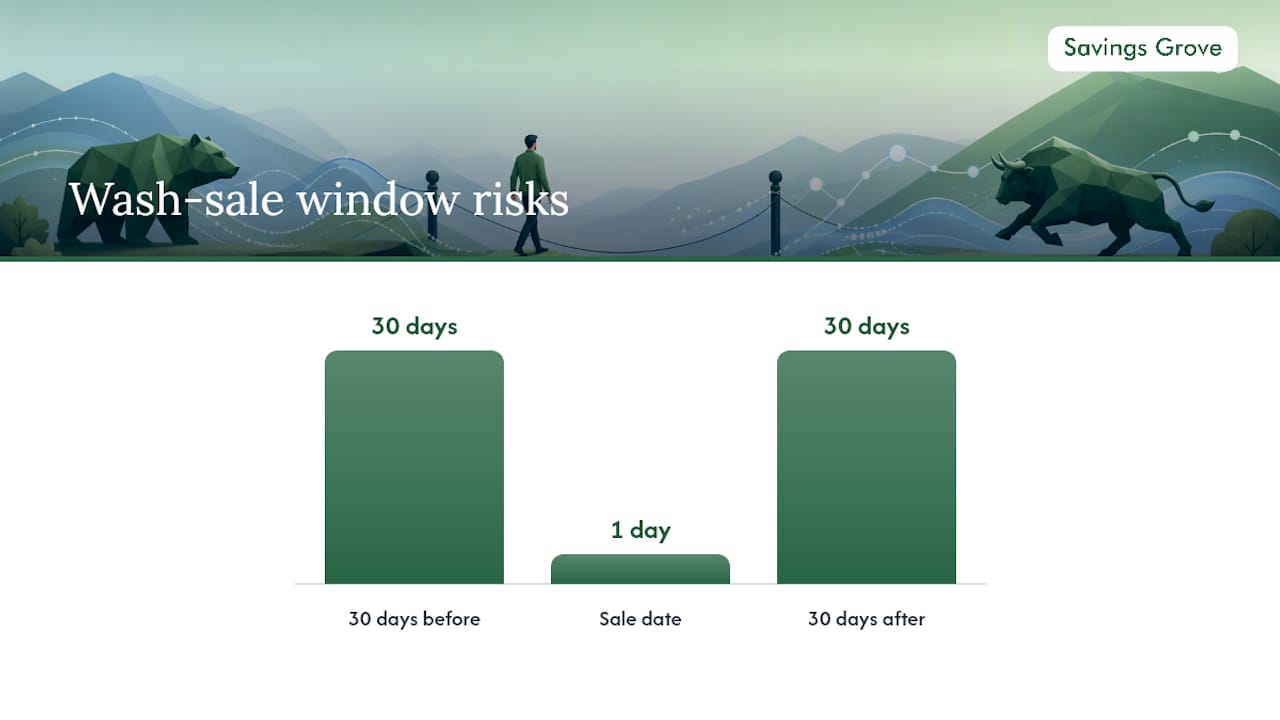
The wash-sale rule is the single most common way investors accidentally lose a tax deduction they thought they’d already earned. IRS Publication 550 disallows your loss if you buy the same or a “substantially identical” security within 30 days before the sale or 30 days after it. Add the sale date itself, and you get a 61-day window where a repurchase kills the deduction.
Four situations catch investors off guard more than any other:
- Automatic dividend reinvestment. A dividend reinvestment plan (DRIP) can quietly repurchase shares of the exact stock or fund you just sold at a loss, triggering a wash sale you never intended.
- Purchases in a different account. Buying the same security in a spouse’s account, a joint account, or even your own IRA still counts, according to TurboTax’s explanation of cross-account wash sales.
- IRA repurchases. Buying the same holding inside a retirement account after selling it at a loss in a taxable account disallows the loss, and unlike a taxable-account wash sale, the disallowed loss doesn’t even get added back to your basis.
- Spouse’s independent trades. If you file jointly, your spouse buying the identical security in their own account triggers the same disallowance, even without any coordination between you.
The fix is straightforward: replace the sold position with something similar in exposure but not identical in structure, like swapping one S&P 500 index fund for a different provider’s S&P 500 fund, or wait the full 31 days before buying back the original.
Pro Tip: Turn off automatic dividend reinvestment on any position you’re considering for tax-loss harvesting at least a month before you plan to sell it. A $40 dividend reinvestment you forgot about can quietly void a $4,000 loss.
Your broker’s 1099-B tracks wash sales within that single account, but it has no visibility into your spouse’s account, your IRA, or a different brokerage entirely. The reporting responsibility for cross-account wash sales falls on you, not your broker.
How to Execute Tax-Loss Harvesting Step by Step
Start by pulling a full inventory of your taxable accounts: every position with an unrealized loss, and every gain you’ve already realized this year that a loss could offset. This is the single step investors skip most often, and it’s the one that determines whether harvesting is even worth doing.
- List every realized gain year-to-date. Check statements or your brokerage’s tax center for gains already locked in from sales, fund distributions, or rebalancing trades.
- Rank your unrealized losses. Prioritize short-term losses first since they offset the highest tax rate you pay.
- Screen out high-cost replacements. Compare the expense ratio of your current holding against a substitute; a fund with a 0.60% expense ratio eating into returns every year isn’t worth avoiding just to dodge a wash sale.
- Pick a replacement that isn’t “substantially identical.” A different index provider tracking the same benchmark usually works; a share class of the exact same fund does not.
- Time the trade for settlement. Trades must settle within the tax year to count, so don’t wait until December 30 to sell if you want the loss on this year’s return.
- Document everything. Save the trade confirmation, the resulting 1099-B, and lot-level cost-basis detail the moment the trade executes.
A few things matter more than others in that sequence:
- Short-term losses beat long-term losses in tax value per dollar harvested.
- Transaction costs and bid-ask spreads can quietly erode a small harvest’s benefit.
- Settlement timing near year-end is where most missed deductions happen.
Keep every 1099-B your broker sends and cross-check it against your own lot records. The Instructions for Schedule D require that level of detail when you file, and reconstructing it in April is far harder than saving it in real time.
What Tax-Loss Harvesting Actually Saves You in Dollars
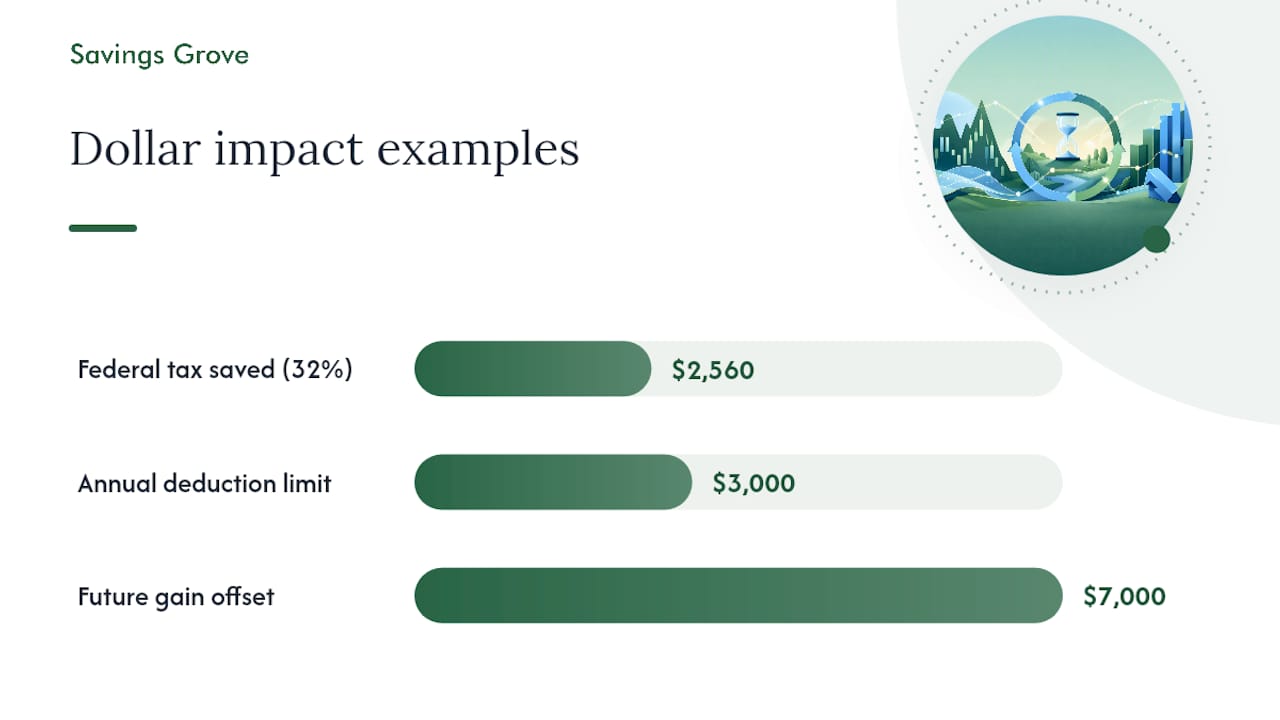
Numbers make the strategy concrete in a way rules never do. Say you’ve realized $8,000 in short-term gains this year from rebalancing your portfolio, and you’re in the 32% marginal federal bracket. You harvest $8,000 in short-term losses from a handful of underperforming positions. That fully offsets the gain, and at a 32% rate, you keep $2,560 that would otherwise have gone to federal tax. State tax adds more savings depending on where you live; California or New York investors see a bigger swing than residents of a no-income-tax state.
Now consider a year with no gains to offset at all. You harvest losses anyway. The IRS lets you deduct up to $3,000 against ordinary income each year, with any remaining losses carrying forward indefinitely into future years, per IRS guidance. If next year brings a $7,000 capital gain from selling an appreciated position, that carried-forward loss wipes it out completely.
A quick math check on the assumptions: these examples use the 32% federal marginal bracket and don’t factor in the 3.8% Net Investment Income Tax (NIIT), which applies to some higher earners on top of ordinary capital gains tax, or state-level capital gains treatment, which varies widely. Your actual savings will differ based on your bracket, your state, and whether NIIT applies to your income level. Treat these figures as illustrations of the mechanism, not a promise of what you’ll personally save.
Where Tax-Loss Harvesting Applies (and Where It Doesn’t)
Tax-loss harvesting only works in taxable brokerage accounts. Selling a losing position inside a 401(k), traditional IRA, or Roth IRA generates no deductible loss at all, because those accounts already grow tax-deferred or tax-free; there’s no capital gains tax to offset in the first place.
A handful of account types and holdings create their own complications:
- Mutual funds distribute capital gains near year-end, sometimes creating a taxable gain even in a fund that’s down for the year; check projected distribution dates before you decide what to harvest.
- DRIP-enrolled positions can trigger accidental wash sales through automatic reinvestment, as covered above, so consider disabling DRIP ahead of any planned harvest.
- Employer stock and ESPP shares often carry concentrated, low-basis positions; harvesting losses elsewhere in the portfolio can help offset gains you eventually realize when diversifying out of that concentration.
- Retirement accounts never generate a usable tax loss, so don’t waste time trying to harvest inside a 401(k) or IRA.
Reporting Harvested Losses: 1099-B, Form 8949, and Schedule D
Every sale in a taxable brokerage account generates an entry on Form 1099-B, which your broker sends both to you and the IRS. That form reports proceeds and cost basis, and it’s the raw data you transfer onto Form 8949, then summarize on Schedule D.
A few details on that 1099-B deserve close attention:
- Box for wash sale disallowed. Brokers flag wash sales they detect within the same account, adjusting the disallowed loss into the cost basis of your replacement shares.
- Covered vs. noncovered securities. Basis reporting rules differ depending on when you acquired the security; older holdings sometimes lack broker-reported basis entirely.
- Cross-account wash sales won’t show up here. If the repurchase happened in a different account, you’re responsible for tracking and reporting the adjustment yourself.
- Short-term and long-term transactions get reported separately on Form 8949, matching the netting order the IRS requires.
Reconciling your own lot records against what the broker reports catches errors before they become a problem on your return. Organizations like SIPC exist to protect the assets held at your brokerage, but they have no role in tax reporting accuracy; that part is entirely on you and your preparer. If you’re juggling multiple accounts, a spouse’s holdings, and several years of carryforward losses, that’s the point where a CPA earns their fee.
The Real Costs and Risks of Harvesting Losses
Tax-loss harvesting isn’t free money. Every benefit comes with an offsetting cost that’s easy to overlook when you’re focused on the tax savings alone.
- Benefit: immediate tax savings this year, plus a “bank” of carried-forward losses to offset gains in future years.
- Cost: trading commissions, bid-ask spreads, and any expense-ratio gap between your original holding and its replacement.
- Risk: drifting from your target asset allocation if replacement funds don’t match your original exposure closely enough.
- Risk: the temptation to time the market around the harvest, turning a tax strategy into a speculative bet.
A simple decision rule helps: harvesting a $200 loss to save $64 in taxes probably isn’t worth the trading friction and recordkeeping hassle. Harvesting a $10,000 loss against a $10,000 realized gain almost always is.
Pro Tip: Before harvesting, check whether the loss is big enough to clearly outweigh the trading cost and any expense-ratio difference in the replacement fund. If the math is close, it’s usually not worth the paperwork.
Savings Grove’s Tax-Loss Harvesting Checklist
Run through this before you place a single trade:
- Confirm the position sits in a taxable account, not a 401(k), IRA, or Roth.
- List every realized gain you’ve already booked this year.
- Select loss candidates, prioritizing short-term losses first.
- Verify you haven’t purchased the same or a substantially identical security in the past 30 days, in any account you or your spouse controls.
- Choose a replacement ETF or fund that maintains your risk exposure without being identical.
- Execute the trade with enough time to settle before year-end.
- Save the resulting 1099-B, trade confirmation, and lot detail immediately.
This checklist reflects ongoing review based on current IRS rules. For anything involving concentrated stock positions, inherited accounts, or multi-account wash-sale tracking, talk to a CPA before you act; the checklist above handles the common cases, not every edge case.
Where Tax-Loss Harvesting Fits in a Real Financial Plan
Treat harvesting as a year-round discipline, not a December scramble. Reviewing unrealized losses every quarter alongside your regular rebalancing catches opportunities a once-a-year panic misses entirely, and it keeps you from making rushed replacement decisions in the last week of the year.
Professional help earns its cost fast once you’re dealing with concentrated employer stock, an inherited account with a stepped-up basis, or wash-sale tracking across three or four accounts you and a spouse both touch. Below that complexity threshold, most investors can run this themselves.
One reminder above all others: never let a tax deduction talk you into selling a position that still belongs in your long-term plan. The tax savings should follow your investment decisions, not drive them.
— Mika L.
How Savings Grove Helps You Put This Into Practice
This guide is designed to provide you with a checklist you can use before your next trade, rather than overwhelming tax code. That’s the gap between most tax content and what you need at year-end.

Beyond this guide, Savings Grove keeps a growing library of practical tax and retirement content, including a breakdown of how to reduce taxes in retirement that walks through how realized losses interact with retirement income planning, and a guide on asset allocation for seniors if you’re worried about drifting from your target mix while harvesting. Savings Grove isn’t a tax preparer and won’t file your return, but its monthly-updated checklists and money-saving guides are built to help you walk into that conversation with your CPA already knowing the right questions to ask. Start with the Savings Grove homepage to browse the full library of tax and investing guides, and bookmark the ones that match your account setup before year-end planning season gets busy.
Where to Verify These Rules Yourself
The core rules covered here come straight from federal sources: IRS Tax Topic 409 on capital gains and losses, IRS Publication 550 on the wash-sale rule specifically, and the Instructions for Schedule D for how to actually report a harvested loss on your return. Brokerage-side explainers, including Vanguard’s guide to tax-loss harvesting, add useful context on replacement strategies and year-round timing.
State tax treatment of capital gains varies significantly. Some states tax capital gains as ordinary income, others offer no break at all, and a few have no income tax whatsoever. Check your own state’s Department of Revenue guidance before assuming the federal math above applies dollar for dollar to your state return.
This article is general information, not a substitute for advice from a qualified financial advisor. Consult a qualified financial professional about your own circumstances before acting on anything here.
Sources
FAQ
What Is the Downside of Tax-Loss Harvesting?
The main downsides are trading costs, the risk of drifting from your target asset allocation if replacement investments don’t match closely enough, and the wash-sale trap if you repurchase a substantially identical security too soon. Harvesting also uses up losses now that might have offset a larger gain later, so it’s not automatically the right move in every situation.
What Is the Best Strategy for Harvesting Tax Losses?
The strongest approach is harvesting short-term losses first, since they offset income taxed at your higher ordinary rate rather than the lower long-term capital gains rate. Pair that with year-round monitoring instead of a single year-end push, and always replace sold positions with something similar but not substantially identical to avoid a disallowed loss.
Can I Tax-Loss Harvest in a 401(k)?
No. Tax-loss harvesting only applies to taxable brokerage accounts, because that’s where you actually owe capital gains tax on a sale. A 401(k), traditional IRA, or Roth IRA already grows tax-deferred or tax-free, so there’s no capital gain to offset and no deductible loss to claim.
Can You Write Off 100% of Stock Losses?
Against ordinary income, though, the IRS caps the deduction at $3,000 per year, and anything beyond that carries forward to future tax years indefinitely.