

Financial minimalism is defined as the deliberate practice of spending only on what aligns with your personal values, cutting out financial clutter, and directing your money toward what genuinely matters. It is not about living on rice and beans or refusing to spend money. According to SoFi, financial minimalism is a “less is more” approach to personal finance that emphasizes intentional spending over deprivation. The result is less money stress, faster progress toward goals, and a financial system simple enough to actually maintain. Tools like budgeting apps, automated savings platforms, and consolidated accounts at institutions like Fidelity or Vanguard make this approach practical for everyday people.
What is financial minimalism and why does it matter?
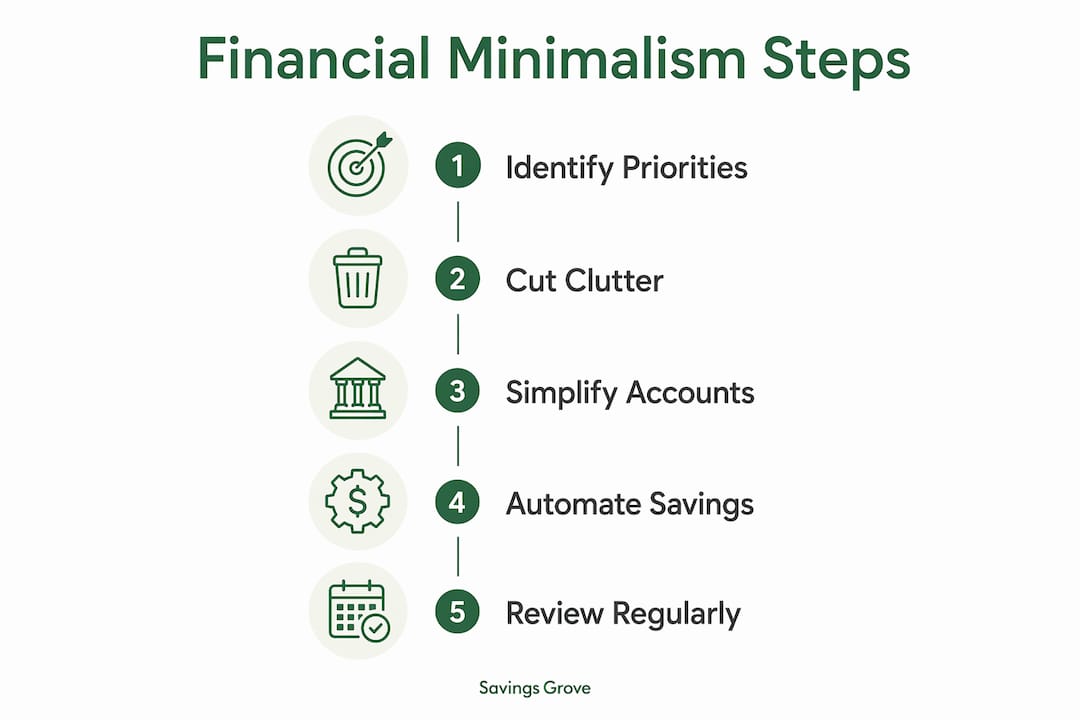
Financial minimalism is the practice of reducing unnecessary financial complexity so your money works for your priorities, not against them. The core idea is intentional spending: every dollar you spend should either improve your wellbeing or strengthen your financial stability. When you question each purchase this way, impulse buying drops and money awareness rises.
Most people carry financial clutter without realizing it. That means duplicate subscriptions, multiple bank accounts with small balances, credit cards they rarely use, and insurance policies spread across three different providers. Each of these adds a small mental load. Together, they create the kind of low-grade financial stress that makes people avoid looking at their accounts altogether.

Financial minimalism addresses this directly. It asks you to strip your financial life down to what you actually need and use, then build reliable systems around those essentials. The goal is a financial setup simple enough that you can manage it in under an hour per month.
What are the main principles and benefits of financial minimalism?
The foundation of financial minimalism rests on one idea: spend generously on your priorities and cut everything else. This is not the same as being cheap. Sustainable financial habits combine present satisfaction with future security, which means you can spend freely on what matters while saving consistently.
The core principles include:
- Intentional spending over impulse buying. Every purchase gets a question: does this add real value to my life?
- Quality over quantity. One well-chosen credit card beats five mediocre ones.
- Fewer financial products. Fewer accounts, fewer subscriptions, fewer decisions.
- Automation over willpower. Systems replace monthly discipline.
- Periodic review over constant monitoring. A quarterly check beats daily anxiety.
The benefits are concrete. Readers who adopt this approach report faster debt payoff because discretionary spending drops. Savings rates climb because money that used to leak into forgotten subscriptions now goes to a high-yield account. Mental clutter decreases because there are fewer financial decisions to make each week. The reduced mental load from fewer impulsive purchases also lowers financial anxiety over time.
Pro Tip: Write down your top three financial priorities before you cut anything. Knowing what you are protecting makes it easier to cut what you are not.
One common myth is that financial minimalism means austerity. It does not. You can spend $200 on a dinner that matters to you and still be a financial minimalist. The point is that the $200 was chosen, not defaulted into.
How does financial minimalism simplify your financial system?
A cluttered financial system creates real costs, not just inconvenience. Fewer accounts and products lower administrative complexity, reduce fees, and cut the chance of missed payments. Simplifying your accounts is one of the highest-return moves in personal finance.
A practical minimalist financial system looks like this:
- One checking account for income and bills. Choose a bank with no monthly fees and a strong mobile app.
- One high-yield savings account for your emergency fund and short-term goals. Institutions like Marcus by Goldman Sachs or Ally Bank offer competitive rates with no minimums.
- One or two retirement accounts. A 401(k) through your employer plus a Roth IRA at Fidelity, Vanguard, or Schwab covers most people’s needs. The best minimal systems use 3–4 essential accounts at reputable institutions for simplicity and reliability.
- One primary credit card with rewards that match your spending. A second card for backup is fine. More than two creates complexity without proportional benefit.
| Complex system | Minimalist system |
|---|---|
| 4+ bank accounts | 1–2 accounts |
| 3+ credit cards | 1–2 cards |
| Insurance across multiple providers | Bundled policies (saves 5–15%) |
| Manual bill payments | Fully automated payments |
| No set review schedule | Annual review of all accounts |
Bundling insurance policies is a specific win worth noting. Consolidating insurance not only cuts complexity but can produce 5–15% multi-policy discounts. That is real savings with less paperwork.
Automation is the other half of this equation. Setting up automatic transfers to savings and automatic bill payments removes the need for monthly decisions. Automated systems free mental bandwidth and ensure good financial behaviors happen consistently, not just when you remember.
Pro Tip: Set up one automatic transfer to savings the day after your paycheck lands. You will not miss money you never see in your spending account.
What are common misconceptions about financial minimalism?
The biggest misconception is that financial minimalism means spending as little as possible on everything. That is austerity, not minimalism. Financial minimalism means choosing intentionally what to keep and spend on, based on your values. A financial minimalist might spend $150 per month on a gym membership and zero on cable. Both choices reflect priorities.
Other misconceptions worth clearing up:
- “I need to track every penny.” Minimalist budgeting focuses on big categories, not granular line items. If your fixed costs and savings are automated, the rest is discretionary.
- “Willpower is enough.” Most personal finance failures come from relying on monthly willpower rather than automated systems. Willpower runs out. Automation does not.
- “More accounts means more control.” Spreading money across many accounts feels organized but creates confusion. Fewer accounts with clear purposes give you more actual control.
- “Financial minimalism is a one-time fix.” Maintaining simplicity is an active process. A regular annual review of accounts, automations, and subscriptions keeps the system working.
The trap many people fall into is adding complexity in the name of optimization. A second rewards card for a 1% bonus on gas sounds smart. But if it adds a monthly payment to track and a fee to remember, the math rarely works out in your favor.
How to start practicing financial minimalism
Starting is simpler than most people expect. You do not need a perfect budget or a financial advisor. You need a clear picture of where your money goes and a willingness to cut what does not serve you.
- List every account, subscription, and recurring charge. Go through your last two bank statements. Write down everything. Most people find at least two or three charges they forgot about.
- Rank your spending by value. Ask yourself: does this improve my life or my financial position? Cut anything that scores low.
- Consolidate accounts. Close accounts you do not use. Move retirement savings to one institution like Fidelity or Vanguard. Separate business and personal finances clearly, since mixing the two adds complexity and increases the risk of errors.
- Automate everything you can. Set up automatic payments for bills. Schedule automatic transfers to savings and investments. Remove the need for monthly decisions.
- Apply the 48-hour rule for discretionary purchases. Wait 48 hours before buying anything that was not planned. Most impulse purchases disappear after a day.
- Schedule a quarterly review. Spend 30 minutes every three months checking that your automations still work, your subscriptions still serve you, and your savings are on track.
Pro Tip: Use a simple spreadsheet or a free tool like Mint or YNAB for your first account audit. You only need to do this deep review once. After that, the annual check keeps things tidy.
Minimalist budgeting does not require a complex spreadsheet. A simple framework works: fixed costs, savings contributions, and discretionary spending. If your fixed costs and savings are automated, you only need to manage one category actively.
Key takeaways
Financial minimalism works because it replaces willpower and complexity with clear priorities, automated systems, and fewer financial products to manage.
| Point | Details |
|---|---|
| Core definition | Financial minimalism means spending intentionally on priorities and cutting everything else. |
| Simplify accounts | Use 3–4 essential accounts at institutions like Fidelity, Vanguard, or Schwab. |
| Automate first | Set up automatic savings and bill payments to remove reliance on monthly willpower. |
| Bust the austerity myth | Minimalism is about intentional spending, not spending as little as possible. |
| Review regularly | An annual review of accounts, subscriptions, and automations keeps the system working. |
Why I think most people overcomplicate their finances on purpose
I have spent years watching people add financial products the way others add clutter to a garage. Another credit card for the airline miles. A second brokerage account because a friend recommended it. A budgeting app on top of a spreadsheet on top of a notebook. Each addition felt like progress. None of it was.
The uncomfortable truth I have found is that financial complexity often functions as a substitute for financial clarity. When your system is complicated, you can blame the complexity for your lack of progress. A minimalist system removes that excuse. You either saved this month or you did not. The simplicity makes results undeniable.
Automation changed everything for me personally. Once savings transfers and bill payments ran on their own, I stopped dreading the first of the month. The mental load dropped. I made fewer impulsive decisions because I was not constantly thinking about money. That psychological shift is the real benefit of financial minimalism, and most articles about it bury that point under spreadsheet templates.
The hardest part is not cutting subscriptions. It is accepting that a simpler system is a better system, even when it feels like you are giving something up. Start with one consolidation. Close one account you do not use. Automate one transfer. The momentum builds from there.
— Mika L.
How Savings Grove supports your financial simplicity goals
Putting financial minimalism into practice is easier when you have reliable resources in one place.
Savings Grove is built for exactly this. The site provides monthly-updated guides on credit card rewards, high-yield savings accounts, and money-saving strategies, all fact-checked and organized so you are not hunting across a dozen sites. Whether you are looking to consolidate your credit cards, find a better savings account, or cut unnecessary fees, Savings Grove gives you the curated information to act on. Visit Savings Grove to find practical tools that align with a minimalist approach to building real financial progress.
FAQ
What is financial minimalism in simple terms?
Financial minimalism means spending intentionally on what matters to you and cutting out everything else. It focuses on reducing financial clutter, not on spending as little as possible.
Is financial minimalism the same as being frugal?
No. Frugality focuses on spending less across the board. Financial minimalism focuses on spending less on things that do not align with your values, while spending freely on things that do.
How many bank accounts does a financial minimalist need?
Most people need 3–4 accounts: one checking account, one high-yield savings account, and one or two retirement accounts at institutions like Fidelity, Vanguard, or Schwab.
How do I start minimalist budgeting?
Start by listing every recurring charge and account you have. Cut what does not serve your priorities, consolidate accounts, and automate savings and bill payments. A quarterly review keeps the system on track.
Does financial minimalism work for people with debt?
Yes. Reducing unnecessary spending frees up cash to pay down debt faster. Automating a fixed monthly debt payment removes the decision fatigue that causes people to skip payments or pay only the minimum.
0 comments
Leave a comment
Reviewed before they appear. Your email is not shown.