

The best senior savings accounts in 2026 come down to a short list: Regions Bank 62+ LifeGreen Checking (best overall for branch-oriented seniors), Lake Michigan Credit Union Checking (best for checking with a competitive APY), FitnessBank Savings (best for high-yield savings), Ally Spending Account (best no-fee online option), Schwab Investor Checking (best for global ATM access), and Axos Golden Checking (best rewards for online-first seniors). For most retirees, the smartest setup is three accounts: a no-fee checking for monthly bills, a high-yield savings account holding 3–6 months of reserves, and one or two CDs for longer-term security.
A practical three-account model keeps things simple and covers every need without chasing complexity. Here is the short verdict by category:
- Best overall: Regions Bank 62+ LifeGreen Checking — branch access, fee waivers, and senior perks in one account
- Best for high-yield savings: FitnessBank Savings — competitive APY for senior savings accounts based on activity
- Best checking APY: Lake Michigan Credit Union Premier Checking — competitive APY on balances up to a defined limit
- Best no-fee online: Ally Spending Account — no monthly fees, strong digital tools, no minimums
- Best for branch access: Chase Total Checking — over 4,700 branches nationwide
- Best for rewards/online: Axos Golden Checking — zero maintenance fees, ATM reimbursements, no opening balance required
Rate context: Top high-yield savings APYs at online banks and select credit unions commonly run in a moderate range, while national traditional-bank averages remain substantially lower.
Table of Contents
- How do the best senior accounts compare at a glance?
- Top picks: which account fits your situation?
- What should seniors look for when choosing an account?
- Checking vs. high-yield savings vs. CDs: which does what for retirees?
- How we chose these accounts: criteria and data date
- Key Takeaways
- What the rate chase gets wrong for most seniors
- Where Savings Grove fits into your retirement planning
- Where to verify rates, protections, and terms
How do the best senior accounts compare at a glance?
| Account | Best for | Account type | APY (note) | Monthly fee / waiver | Min. deposit | Access | Senior perks / age cutoff | FDIC/NCUA |
|---|---|---|---|---|---|---|---|---|
| Regions 62+ LifeGreen Checking | Branch-oriented seniors | Checking | Low / not rate-focused | — | $50 | 15 states, branches | Age 62+; free checks, loan discounts, safe deposit box discount | FDIC |
| Axos Golden Checking | Online-first seniors | Checking | 0.10% APY | $0 | $0 | Online, 91,000 ATMs | Age 55+; up to $8/mo ATM reimbursements, free checks | FDIC |
| Lake Michigan CU Checking | Checking with competitive APY | Checking | 4.00% on balances up to $15,000; 0.40% above | $0 (Advantage 50) | $0 | Branches + online | Age 50+ (Advantage 50); no monthly fee, no per-check fee | NCUA |
| FitnessBank Savings | High-yield savings | Savings | Up to 4.45% APY (activity-based) | $10 (waived: $100 avg daily balance) | $100 | Online only, all 50 states | Senior savings tier; rate tied to documented exercise | FDIC |
| Ally Spending Account | No-fee online banking | Checking | Competitive (check site) | $0 | $0 | Online/phone | No age cutoff; strong digital tools | FDIC |
| Schwab Investor Checking | Global ATM access | Checking | Low | $0 | $0 | Online + brokerage | No age cutoff; unlimited ATM fee reimbursements worldwide | FDIC |
| Discover Cashback Debit | Debit rewards | Checking | N/A | $0 | $0 | Online + phone | No age cutoff; 1% cash back on debit purchases | FDIC |
| Ponce Bank 50+ Premium Interest Checking | Interest-bearing checking | Checking | Interest paid (check site) | Check site | Check site | Branches + online | Age 50+; interest on checking balance | FDIC |
| Chase Total Checking | Nationwide branch access | Checking | N/A | $15 (waived: $500+ direct deposit) | $0 | 4,700+ branches, 15,000+ ATMs | No age cutoff; Social Security qualifies for fee waiver | FDIC |
| KeyBank | Multiple account options | Checking | Interest (Key Select) | $0 (Key Smart) / $25 (Key Select, waivable) | Check site | ~1,000 branches, 15 states, 40,000 ATMs | No age cutoff; $100 annual cash bonus (Key Select, qualifying deposits) | FDIC |
| First Federal Bank | Fee waivers | Checking | Low | $6 (waived: $1,000 daily balance + e-statement) | $50 | Community branches | Age 55+; explicit age-based fee relief | FDIC |
| Bank of America | Financial care resources | Checking/savings | Low | Varies by account | Varies | Nationwide branches + online | Financial Care for Older Adults program; beneficiary/trust setup help | FDIC |
| East West Bank Senior Savings | Regional bank relationship | Savings | Check site | Check site | Regional branches | Senior savings options | FDIC | |
| Cadence Heritage Checking | Regional legacy service | Checking | Check site | Check site | Regional branches | Relationship-focused perks | FDIC | |
| Valley National Bank Milestone Checking | Local branch users | Checking | Check site | Check site | Regional branches | Milestone benefits, clear waiver conditions | FDIC | |
| Old National Bank ONB Classic Checking | Established regional bank | Checking | Check site | Check site | Regional branches | In-branch service, standard checking | FDIC |
Pro Tip: Always check the APY directly on the bank or credit union’s official rate page before opening an account. Rates on comparison sites can lag by days or weeks, and promotional APYs often have balance caps or activity conditions buried in the fine print.
Data note: Fee and APY figures above reflect publicly available information as of mid-2026. Verify current rates and terms at each institution’s official website before applying.
Top picks: which account fits your situation?
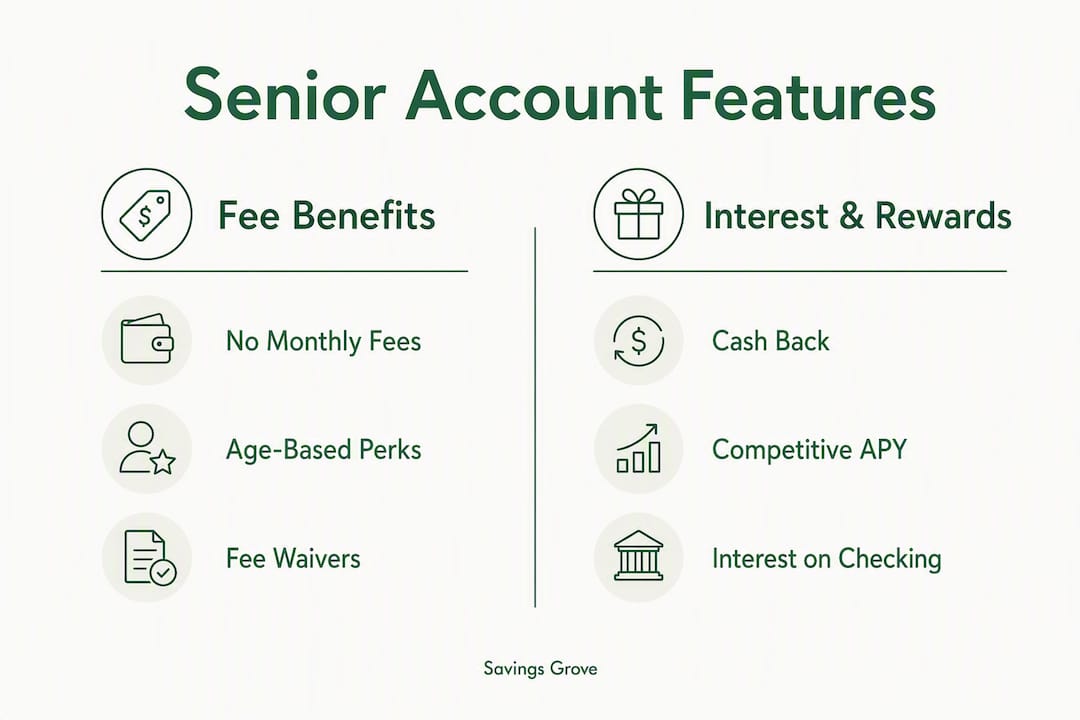
Senior-branded checking accounts are primarily a fee and feature play, not a yield play. Keep that in mind as you read these profiles.
Regions Bank 62+ LifeGreen Checking
Regions earns the top overall spot for branch-oriented retirees. The LifeGreen Checking account, available to customers 62 and older, offers unlimited check writing, no monthly fee when you maintain a $1,500 average monthly balance or set up $500 in direct deposits, and access to a companion LifeGreen savings account with no monthly fees. Loan discounts and safe deposit box discounts add real value for seniors who still use physical banking services.
The catch: Regions operates in only 15 states, so check availability first. The account does charge overdraft fees, though an Overdraft Grace program gives you extra time to cover shortfalls. The $50 minimum opening deposit is modest.
- Pros: Branch access, age-based perks, fee waiver via direct deposit, companion savings account
- Cons: 15-state footprint, low APY, overdraft fees apply
- Best for: Seniors who want in-person service and a relationship with a local branch
Axos Golden Checking and Axos cash products
Axos Golden Checking targets customers 55 and older with zero maintenance fees, no opening balance requirement, and complimentary personal checks. The current APY is 0.10%, which is not the draw here. The real value is the 91,000-ATM network plus up to $8 per month in domestic ATM reimbursements when you can’t find a fee-free machine. For seniors who bank almost entirely online, the lack of fees and the ATM cushion make it a practical primary checking account.
Axos also offers combined checking and high-yield savings products (Axos ONE) with competitive blended APYs when bundle conditions are met. Those conditions matter: verify what activity is required before assuming the top rate applies.
- Pros: No monthly fee, no minimum, free checks, ATM reimbursements
- Cons: 0.10% APY on Golden Checking, bundle conditions required for top Axos ONE APY
- Best for: Online-first seniors who want fee-free checking with basic ATM coverage
Lake Michigan Credit Union Checking
Lake Michigan Credit Union’s Advantage 50 Checking is designed for members 50 and older and is free from top to bottom: no monthly maintenance fee, no per-check charge, and no minimum to open or earn interest. The Premier Checking account goes further, offering 4.00% APY on balances up to $15,000 and 0.40% on balances above that threshold. For seniors who want a checking account that actually earns a meaningful rate without moving money to a separate savings account, this is one of the strongest options available.
Credit union membership eligibility applies, so confirm you qualify before applying.
- Pros: No fees, competitive APY on Premier Checking, member-focused service
- Cons: Membership eligibility required, credit union model may have fewer branches than national banks
- Best for: Seniors who qualify for membership and want a checking account with a real yield
FitnessBank Savings
FitnessBank’s senior savings accounts can earn up to 4.45% APY, and its senior checking accounts up to 5.25% APY, both tied to documented daily exercise tracked through the bank’s step-tracker app. The $100 minimum opening deposit and $10 monthly fee (waived with a $100 average daily balance) are manageable. Account balances are capped at $250,000.
This account suits active seniors who already use a fitness tracker and are comfortable with an online-only bank. If tracking steps to earn a rate sounds like a chore rather than a benefit, a no-condition HYSA is a better fit.
- Pros: Up to 4.45% APY for savings, available in all 50 states, FDIC-insured
- Cons: Rate is activity-based, online only, balance cap at $250,000
- Best for: Active seniors who document exercise and want to earn higher yields for it
Schwab Investor Checking
Schwab Investor Checking pairs a checking account with brokerage access and offers unlimited ATM fee reimbursements worldwide. There is no monthly fee and no minimum balance. For seniors who travel, split time between states, or simply want to withdraw cash anywhere without worrying about surcharges, this account removes a real friction point. The APY on the checking balance is low, so pair it with a separate HYSA for savings.
- Pros: Unlimited worldwide ATM reimbursements, no fees, brokerage integration
- Cons: Low checking APY, requires a linked Schwab brokerage account
- Best for: Seniors who travel or want seamless brokerage and banking in one place
Discover Cashback Debit
Discover’s debit account earns 1% cash back on eligible debit card purchases with no monthly fee and no minimum balance. There is no APY to speak of, but for seniors who prefer simple debit rewards over chasing rate requirements, it removes all the complexity. FDIC-insured, accessible online and by phone.
Chase Total Checking
Chase’s branch network of over 4,700 locations and 15,000+ fee-free ATMs makes it the go-to for seniors who need in-person support. The $15 monthly fee is waived when you set up qualifying direct deposits of at least $500, and Chase explicitly counts Social Security, pension, and government benefit payments as qualifying. The APY on savings is low, so Chase works best as a primary checking account paired with a high-yield savings account elsewhere.

Pro Tip: Before committing to any bank, call its customer service line with a specific question, such as “How do I waive the monthly fee if my direct deposit amount varies?” The quality and speed of that answer tells you more about day-to-day service than any marketing page.
Ponce Bank 50+ Premium Interest Checking
Ponce Bank’s 50+ Premium Interest Checking pays interest on checking balances and includes age-based perks for customers 50 and older. It is a solid option for seniors who want a checking account that earns something without moving to a credit union. Verify current APY and fee details directly with Ponce Bank, as rates are subject to change.
KeyBank account options
KeyBank offers two paths for seniors. Key Smart Checking has no monthly fee and no minimum balance but does not earn interest. Key Select Checking is interest-bearing and offers a $100 annual cash bonus with qualifying direct deposits, but carries a $25 monthly fee waived by maintaining $15,000 across all KeyBank accounts or making $3,000 in deposits per statement cycle. With nearly 1,000 branches across 15 states and 40,000 fee-free ATMs, KeyBank suits seniors who want regional branch access alongside multiple account choices.
First Federal Bank (fee waivers)
First Federal Bank’s Essential Seniors checking account is available to customers 55 and older. The $6 monthly fee breaks into two waivable parts: maintain a $1,000 daily balance to save $4 per month, and opt for e-statements to save the remaining $2. The $50 minimum opening deposit is low. For seniors who value community banking and want explicit, age-based fee relief, this is a straightforward option.
Bank of America (Financial Care)
Bank of America’s scale and its Financial Care for Older Adults program set it apart from most competitors. The program offers educational resources, help setting up account beneficiaries, trust services, and power of attorney guidance. For seniors managing estate planning or helping a family member navigate finances, that structured support is genuinely useful. APYs on Bank of America savings products are not competitive, so use it for checking and financial-care resources, not yield.
East West Bank, Cadence Heritage Checking, Valley National Bank, and Old National Bank
These regional and community bank options serve seniors who already have a relationship with a local institution or prefer a familiar name. East West Bank offers senior savings options with a regional bank feel. Cadence Heritage Checking and Valley National Bank Milestone Checking both emphasize local service and clear fee structures. Old National Bank ONB Classic Checking is a straightforward choice for seniors in its footprint who prefer an established regional bank. For all four, verify current rates and fee schedules directly with the institution, as publicly available details vary.
What should seniors look for when choosing an account?
Simplicity comes first. A predictable fee structure with a clear, age-based waiver beats a marginally higher APY that requires tracking monthly debit swipes or e-statement enrollment. Conditional APYs can backfire when a missed requirement drops your rate without warning.
Work through this checklist before opening any account:
- Fee structure: Is the monthly fee waived by age, direct deposit, or balance? Can you meet that condition reliably every month?
- APY conditions: Does the advertised rate require debit-card swipes, direct deposits, or e-statements? If yes, are you comfortable tracking those requirements?
- Access: Do you need branch access, or are you comfortable with phone and online support? Check the branch footprint for your state.
- ATM coverage: Does the bank reimburse out-of-network ATM fees? Is there a monthly cap on reimbursements?
- Fraud protection: Does the bank offer real-time alerts, easy freeze options, and a dedicated fraud line? This matters more as phone and online scams targeting seniors increase.
- Customer support: Is there a phone line with real agents, not just a chatbot? Extended hours matter if you need help outside business hours.
- FDIC or NCUA insurance: Confirm the institution is a member. The FDIC insures deposits up to $250,000 per depositor, per institution, per ownership category; NCUA provides equivalent protection at credit unions.
“Chasing the highest advertised APY can backfire for seniors when rates require monthly actions. Simplicity and predictability frequently trump marginally higher returns.” — SavingAdvice, 2026
For Social Security recipients, setting up direct deposit into your checking account is the fastest way to waive monthly fees at Chase, Regions, and many other banks. Do this by phone or in branch with your Social Security number and account details ready. Once direct deposit is active, confirm the fee waiver in writing or by calling the bank’s customer service line.
To avoid overdraft fees, link your checking account to a savings account at the same institution for automatic overdraft transfers. Keep a small buffer of $200–$500 in checking above your expected monthly expenses.
Checking vs. high-yield savings vs. CDs: which does what for retirees?
Each account type serves a different job. Use checking for daily spending, a high-yield savings account for your liquid emergency reserve, and CDs for money you won’t need for 12–36 months.
A simple three-account setup works well for most retirees:
- No-fee checking account (Axos Golden Checking, Ally Spending Account, or Chase Total Checking): handles monthly bills, Social Security deposits, and everyday spending. Keep one to two months of expenses here.
- High-yield savings account (FitnessBank Savings, Lake Michigan CU, or a competitive online HYSA): holds your 3–6 month emergency reserve. Top HYSA rates commonly run 4.00–5.00% at online banks in 2026, far above the 0.3–0.6% average at traditional banks.
- CDs (optional): lock a fixed rate for 12, 24, or 36 months on money you won’t need soon. CDs protect against market risk and guarantee a return, but you pay an early withdrawal penalty if you need the funds before maturity. Ladder two or three CDs at different terms to preserve some liquidity.
Pro Tip: If mobility or cognitive concerns make monthly activity requirements risky, choose a no-condition HYSA. A slightly lower rate with zero requirements beats a higher rate you might accidentally lose.
Linking your HYSA to your checking account via ACH transfer takes one to three business days and becomes routine after the first few transfers. Set up the link when you open the accounts, then test it with a small transfer before moving larger sums. For guidance on stretching retirement savings across these account types, Savings Grove’s retirement guides walk through the allocation in detail.
High-yield checking accounts that pay 4%+ APY do exist, but they almost always require monthly activity. For many retirees, a no-conditions checking account paired with a separate HYSA is simpler and more reliable than a single high-yield checking account with complex requirements.
How we chose these accounts: criteria and data date
Savings Grove’s editorial team reviewed publicly available account information from bank and credit union rate pages, FDIC and NCUA membership records, and industry trackers including Bankrate and CNBC Select. The selection criteria prioritized:
- APY clarity: Is the rate clearly stated, and are conditions transparent?
- Fee structure: Is the monthly fee waivable, and is the waiver condition realistic for a retiree?
- Minimum opening deposit: Preference for accounts with $0–$100 minimums
- Senior-specific perks: Age-based fee waivers, free checks, ATM reimbursements, or dedicated senior programs
- Branch and phone access: Availability of in-person or phone support, not just digital-only service
- FDIC or NCUA insurance: All recommended accounts are insured
- Simplicity of requirements: Accounts with complex monthly activity requirements are flagged or deprioritized for seniors who prefer set-it-and-forget-it banking
Rate and fee data was verified in mid-2026. Because APYs change frequently, always confirm the current rate directly on the bank or credit union’s official website before opening an account. Savings Grove updates this list on a monthly editorial cadence.
Rate check reminder: FDIC national rate data and institution-specific rate pages are the most reliable sources for current APYs. Industry trackers like Bankrate and CNBC Select are useful for comparison but may lag official rates by days.
Key Takeaways
The strongest setup for most retirees in 2026 is a no-fee checking account for daily expenses, a high-yield savings account earning 4.00–5.00% APY for emergency reserves, and optional CDs for longer-term security.
| Point | Details |
|---|---|
| Three-account model | Use no-fee checking for bills, a HYSA for 3–6 months of reserves, and CDs for locked savings. |
| HYSA rates in 2026 | Top online bank and credit union HYSAs commonly offer 4.00–5.00% APY, far above traditional bank averages. |
| Simplicity over APY | Conditional APYs requiring monthly activity can backfire; a no-condition HYSA is often the better senior choice. |
| FDIC/NCUA protection | Confirm your institution is insured; coverage is up to $250,000 per depositor, per institution, per ownership category. |
| Savings Grove resources | Savings Grove’s monthly-updated guides on retirement savings and senior money tips help you apply these picks to your full financial picture. |
Immediate action checklist:
- Open a no-fee checking account if your current account charges fees you can’t waive
- Open a high-yield savings account with no activity conditions and link it via ACH to your checking
- Set up direct deposit (Social Security or pension) to trigger fee waivers automatically
- Enable e-alerts for all accounts to catch unauthorized transactions early
- Call your bank to confirm in writing that your fee waiver is active
- Keep a printed copy of account numbers and customer-service phone numbers in a secure location
Do this week: open the checking and HYSA accounts and link them. This month: move 3–6 months of expenses into the HYSA and set up direct deposit.
What the rate chase gets wrong for most seniors
The conventional wisdom in personal finance pushes seniors toward the highest advertised APY. That framing misses something important: for retirees on a fixed income, the cost of accidentally losing a rate is higher than the benefit of earning it in the first place.
Here is what that looks like in practice. A checking account advertising 5.25% APY with a requirement for 15 debit transactions per month sounds attractive. But if you travel for two weeks, forget to use the debit card enough times, or simply prefer to pay by check, you lose the rate for that month. The penalty is invisible until you check your statement. For a senior managing multiple accounts, medications, and family obligations, that kind of mental overhead adds up.
The accounts that hold up best over time for retirees are the ones that require nothing extra to maintain their core value: no monthly fee regardless of activity, FDIC or NCUA insurance, and a customer service line staffed by real people. A 4.00% HYSA with no conditions beats a 5.00% account that requires tracking 12 debit swipes every month. The math is close; the peace of mind is not.
For seniors who want to go deeper on how cash accounts fit into a broader retirement plan, Savings Grove’s guide on senior investment risk management covers the full picture, including when to hold cash versus move into low-risk instruments.
Where Savings Grove fits into your retirement planning
Savings Grove is not a bank, and it does not compete with the accounts listed above. What it offers is something the banks themselves don’t: independent, monthly-updated research that cuts through the marketing language and tells you plainly which accounts are worth your time and which ones bury the real conditions in the fine print.

If you opened this article wanting a clear answer on where to put your money in 2026, you now have it. The next step is putting it into practice. Savings Grove’s retirement budget guides and senior money tips walk you through how to size each account, set up transfers, and keep your finances organized without needing a financial advisor for every decision. Visit Savings Grove to explore the full library of retirement and savings resources, updated monthly so the information you act on is current.
Where to verify rates, protections, and terms
Before opening any account, confirm the details directly from primary sources. Here is where to look:
- FDIC.gov national rate data: Check the current national average savings and checking APYs to benchmark any offer you receive. If a rate is far above the national average, read the conditions carefully.
- Each bank or credit union’s official rate page: Search “[bank name] savings rates” and go directly to the institution’s site. Look for the APY disclosure table, which lists balance tiers and any qualifying conditions.
- NCUA.gov: Confirm credit union membership and insurance status. The NCUA’s online tool lets you search any federally insured credit union.
- Bankrate and CNBC Select: Useful for side-by-side rate comparisons, but treat them as a starting point, not a final source. Rates on aggregator sites can lag official pages.
- Your state’s banking regulator: For community banks and regional institutions, your state’s department of financial institutions can confirm licensing and complaint history.
Save or print the confirmation page after opening any account. Write down the customer-service phone number and store it somewhere accessible. If you ever need to freeze an account or report fraud quickly, having that number on hand matters.
Rate tracker note: Industry trackers report top HYSA rates commonly in the 4.00–5.00% range at online banks in 2026. Use those figures as a benchmark when evaluating any offer, and verify the current rate on the provider’s own site before applying.
This article is general information, not professional financial advice. Confirm current rates, fees, and eligibility with each institution and consult a qualified financial professional for guidance specific to your situation.
0 comments
Leave a comment
Reviewed before they appear. Your email is not shown.