

Downsizing is the process of selling a larger home and moving to a smaller, less expensive one to reduce living costs and free up cash for retirement. It is one of the most direct ways to close the gap between what you have saved and what you actually need. Many retirees face a $540,000 retirement savings gap between their actual savings and what they need to retire comfortably. Understanding why downsizing saves retirement money starts with recognizing that your home is likely your largest asset, and keeping it may cost more than it gives back.
Why downsizing saves retirement money: the core financial case
Downsizing cuts retirement expenses in multiple ways at once. Moving to a smaller home can save $1,000 or more monthly by reducing mortgage payments, property taxes, and maintenance costs combined. That adds up to $12,000 or more per year that stays in your pocket instead of going toward a house you no longer need.
The savings go deeper than the mortgage. Eliminating a mortgage entirely by buying a smaller home outright could save about $11,500 annually, and reducing other housing expenses adds another $7,000 per year on top of that. Together, those two figures represent nearly $18,500 in annual savings. That is real money that can fund travel, healthcare, or simply give you a financial cushion.
The standard industry term for this strategy is “housing cost optimization,” but most financial planners simply call it right-sizing your housing to match your retirement income. Whatever you call it, the math is hard to argue with.
How downsizing lowers your monthly retirement expenses
Smaller homes cost less to run in almost every category. Here is where the savings show up most clearly:
- Mortgage or rent payments. A less expensive home means a lower or eliminated mortgage. Buying a smaller home outright with the proceeds from your sale removes a monthly payment entirely.
- Property taxes. Property taxes are tied to assessed home value. A home worth $200,000 carries a significantly lower tax bill than one worth $500,000, regardless of your state.
- Homeowners insurance. Premiums drop when your home’s replacement value drops. A smaller structure with fewer square feet costs less to insure.
- Utility bills. Heating, cooling, and lighting a 1,200-square-foot home costs far less than running a 3,000-square-foot one. Smaller spaces are simply cheaper to maintain year-round.
- Maintenance and repairs. Fewer rooms, a smaller roof, a smaller yard, and less plumbing all mean lower repair bills. Maintenance costs scale with home size.
Retirees who sell excess furniture and belongings during a move can also generate one-time cash and reduce storage costs. That extra income, even if modest, can go directly toward retirement budget adjustments that stretch fixed income further.
The combined effect of all these reductions is a monthly budget that works harder for you. When your housing costs drop by hundreds or thousands of dollars each month, your Social Security income and retirement account withdrawals go much further.
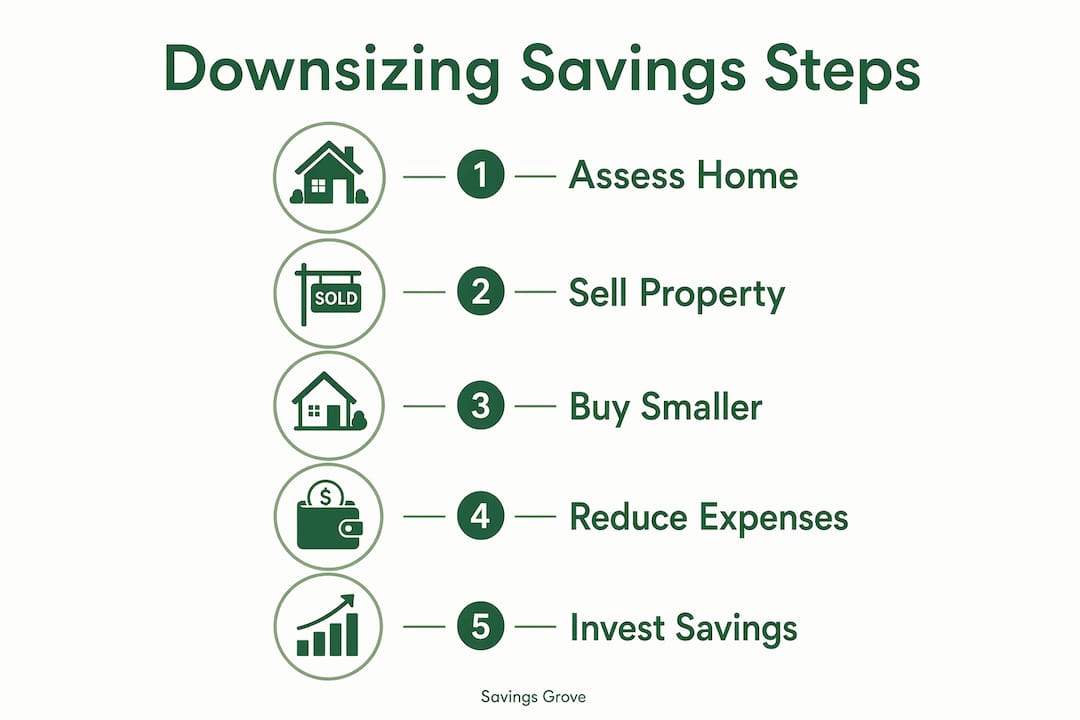
Unlocking home equity: turning your largest asset into retirement funds
Home equity is the difference between what your home is worth and what you still owe on it. For many retirees, this equity represents the single largest pool of wealth they own. Downsizing converts that illiquid asset into cash you can actually use.
When you sell a larger home and buy a smaller one for less, the difference in sale price minus purchase price becomes available cash. That cash can be redeployed into a diversified investment portfolio to generate income throughout retirement. Redeploying home equity into a diversified portfolio can meaningfully improve your retirement outlook, especially when done early enough for the investments to grow.

The key risk is taking on a new mortgage at a high interest rate on the smaller home. A new mortgage at high rates can significantly reduce or eliminate the financial benefits of downsizing. The goal is to buy the smaller home outright or with a minimal loan, so the equity you release actually works for you.
Pro Tip: If you plan to invest the proceeds from your home sale, consider low-risk investment options like Treasury bonds or dividend-paying stocks that provide steady income without exposing your retirement funds to excessive volatility.
| Equity scenario | Likely outcome |
|---|---|
| Sell large home, buy small home outright | Maximum cash released; no mortgage payment |
| Sell large home, take small mortgage | Partial savings; some cash released |
| Sell large home, take large mortgage | Minimal savings; equity largely consumed |
| Sell large home, rent instead | Full equity released; ongoing rent expense |
Understanding asset allocation for seniors is critical once you have that cash in hand. Putting it all in one place creates new risk. Spreading it across bonds, dividend stocks, and cash equivalents protects your retirement income.
Common misconceptions and hidden costs of downsizing in retirement
Downsizing is not automatically cheaper. Several costs catch retirees off guard and can reduce or eliminate the expected savings.
- Real estate commissions and closing costs. Selling a home typically involves a commission of around 5%–6% of the sale price, plus closing costs on the purchase side. On a $400,000 home, that is $20,000–$24,000 gone before you move.
- Moving company fees. Professional movers for a full household can cost several thousand dollars. Long-distance moves cost significantly more.
- HOA fees in condos or retirement communities. Many retirees move into condos or planned communities that charge monthly homeowners association fees. HOA fees and shifted maintenance costs can offset or exceed what you saved on the mortgage.
- Storage costs. Downsizing often means getting rid of belongings. If you are not ready to sell or donate, storage unit fees add up quickly.
- Higher costs in a new location. Moving to a different city or state can mean higher property taxes, higher insurance rates, or a more expensive cost of living than your current area.
Moving costs, commissions, and storage fees frequently reduce the net financial gain of downsizing. The savings are real, but they take time to materialize after the upfront costs are paid.
Pro Tip: Calculate your break-even point before you move. Divide your total moving and transaction costs by your expected monthly savings. If the break-even is five or more years away, downsizing may not make financial sense given your timeline.
Retirees also underestimate ongoing costs after the move. Utilities in a newer but smaller condo may not be cheaper if the building uses older systems. Ongoing costs post-move like HOA fees and inefficient utilities can quietly erode the savings you expected.
Is downsizing the right strategy for your retirement goals?
Not every retiree should downsize. The right answer depends on your specific financial picture, lifestyle needs, and local housing market.
- Assess your actual space needs. If you have unused bedrooms, a large yard you no longer maintain, or rooms that sit empty, your home size no longer matches your lifestyle. Financial experts confirm that downsizing benefits those whose homes no longer match their lifestyle.
- Calculate your true net savings. Subtract all transaction costs, moving expenses, and new ongoing costs from your projected monthly savings. Use a 10-year horizon to get an accurate picture.
- Research your destination’s tax environment. Some states have no income tax or offer property tax exemptions for retirees. Moving to a tax-friendly state can multiply your downsizing savings significantly.
- Consult a financial planner and a real estate agent together. A financial planner can model how your equity proceeds would grow if invested. A real estate agent can tell you what your home is worth and what a smaller home will cost. You need both perspectives.
- Consider alternatives if downsizing does not fit. Renting out a room, refinancing to a lower rate, or relocating to a lower cost-of-living area without buying can achieve similar savings without a full move.
Avoiding blind moves is the most consistent advice from financial professionals. Taxes, fees, and maintenance in a new location can outweigh the benefits if you have not done the math first. Use a money tips framework for homeowners to run through the full cost comparison before committing.
Key Takeaways
Downsizing saves retirement money by cutting housing costs and converting home equity into investable cash, but only when transaction costs and new expenses are carefully accounted for first.
| Point | Details |
|---|---|
| Monthly savings potential | Downsizing can save $1,000 or more per month across mortgage, taxes, and maintenance. |
| Annual housing cost reduction | Eliminating a mortgage and reducing housing expenses can free up nearly $18,500 per year. |
| Home equity as retirement fuel | Selling a larger home and buying smaller outright converts illiquid equity into investable cash. |
| Hidden costs matter | Commissions, HOA fees, and moving costs can take years to recover; calculate your break-even first. |
| Early action improves outcomes | Starting the downsizing process before full retirement gives equity proceeds more time to grow. |
My honest take on downsizing as a retirement strategy
I have seen retirees treat downsizing as a guaranteed win, and I have seen others avoid it entirely out of emotional attachment to their home. Both extremes cost money.
The retirees who benefit most from downsizing are the ones who plan it like a financial transaction, not a lifestyle event. They run the numbers two or three years before they plan to move. They research destination markets, tax rules, and HOA structures before they fall in love with a condo. They work with a fee-only financial planner who has no incentive to push them toward any particular decision.
What most articles miss is the timing dimension. Downsizing at 62 versus 72 produces very different financial outcomes. At 62, the equity you release has a decade or more to compound in a diversified portfolio. At 72, that window is shorter, and the math changes. Early planning is not just helpful. It is the difference between a comfortable retirement and a stressful one.
The emotional side is real, too. Leaving a family home is hard. But I have found that retirees who frame the move as gaining freedom rather than losing space adapt faster and report higher satisfaction with the decision. The financial benefits follow more naturally when the mindset is right.
My recommendation: do not wait until you feel financially pressured to downsize. Make the move from a position of choice, not necessity.
— Mika L.
How Savings Grove can support your retirement planning
Planning a move this significant requires more than a gut feeling about your home’s value.

Savings Grove publishes monthly-updated guides on senior investment risk management and retirement budgeting that give you the specific numbers and strategies you need to evaluate a downsizing decision clearly. Whether you are figuring out where to invest your home equity proceeds or trying to understand how to cut monthly expenses after a move, Savings Grove offers practical, research-backed resources built for retirees. Visit Savings Grove to find tools and guides that help you make confident, informed decisions about your retirement finances.
FAQ
How much money can you save by downsizing in retirement?
Downsizing can save $1,000 or more per month, with annual savings potentially reaching $18,500 when mortgage elimination and reduced housing expenses are combined.
What are the biggest hidden costs of downsizing?
Real estate commissions, closing costs, moving fees, and HOA fees in new communities are the most commonly overlooked expenses that can reduce your net savings.
When is the best time to downsize before retirement?
Financial experts recommend downsizing earlier rather than later, ideally before full retirement, so that equity proceeds have more time to grow when invested in a diversified portfolio.
Does downsizing always lower your monthly bills?
Not always. HOA fees, less efficient building systems, and higher costs in a new location can shift or increase expenses, so a full cost comparison is required before moving.
What should you do with the money from downsizing?
The proceeds should be invested in a diversified portfolio rather than tied up in a new mortgage, using low-risk options like Treasury bonds or dividend-paying stocks to generate steady retirement income.
0 comments
Leave a comment
Reviewed before they appear. Your email is not shown.