

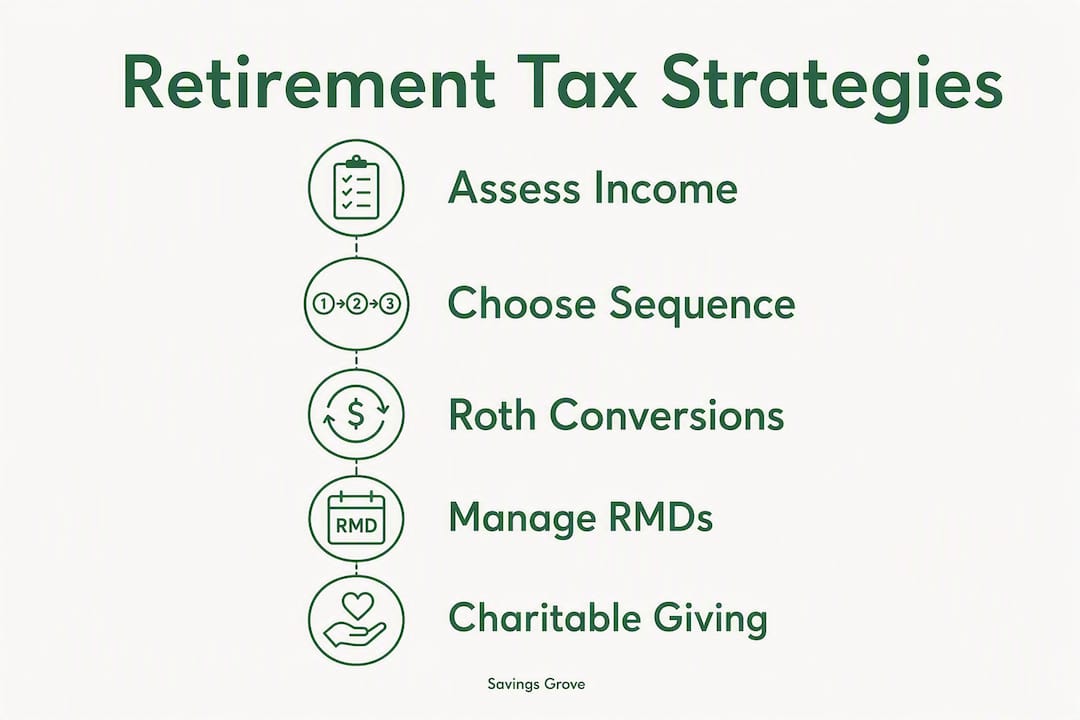
The fastest ways to reduce taxes in retirement are withdrawal sequencing, planned Roth conversions timed to your tax bracket, Qualified Charitable Distributions, and proactive Medicare IRMAA planning. Get these four levers right, and you can meaningfully lower your lifetime tax bill without changing your spending at all.
Here is your quick-start checklist:
- Sequence withdrawals intentionally. Draw from taxable accounts first in low-income years, then tax-deferred, then Roth. (Full breakdown in Section 3.)
- Run a Roth conversion in early retirement. Convert just enough to fill your current bracket before RMDs force larger taxable withdrawals. (Section 4.)
- Use Qualified Charitable Distributions if you are 70½ or older. Give directly from your IRA to charity, satisfy your RMD, and keep the amount out of your AGI. (Section 6.)
- Map your IRMAA exposure two years ahead. A single large conversion can raise Medicare premiums for the following two years. (Section 9.)
- Check your state’s retirement tax rules. Some states exempt Social Security and pension income entirely; others tax everything. (Section 10.)
- Consult a CPA or CFP before any major move. Roth conversions, large asset sales, and RMD planning all interact in ways that are hard to model alone. (Section 11.)
The sections below explain each tactic in detail, with worked examples and comparison tables you can use to model your own situation.
Table of Contents
- How retirement income is actually taxed
- How to choose the right withdrawal sequence to reduce taxes in retirement
- Roth conversions: when they help and how to run one
- RMDs and QLACs: managing forced withdrawals before they spike your taxes
- Charitable giving strategies that lower your AGI
- Managing taxable accounts: capital gains, tax-loss harvesting, and asset location
- How Social Security claiming timing affects your taxable income
- Medicare IRMAA: how extra income can raise your premiums
- How your state of residence affects retirement taxes
- When to consult a CPA or CFP about retirement tax planning
- Your year-by-year action plan to lower retirement taxes
- Tools and calculators to model your retirement tax scenarios
- Key Takeaways
- The tax planning mindset most retirees overlook
- Useful sources and further reading
How retirement income is actually taxed
Not all retirement income is taxed the same way, and the difference between a dollar from a traditional IRA and a dollar from a Roth IRA can be significant. Understanding which sources create taxable income is the foundation of every tax-saving strategy.

The main taxable income categories in retirement:
| Income Source | Federal Tax Treatment | Notes |
|---|---|---|
| Traditional IRA / 401(k) withdrawals | Ordinary income rates | Every dollar is taxable; no capital-gains preference |
| Roth IRA / Roth 401(k) distributions | Tax-free (if qualified) | No federal income tax on qualified distributions |
| Required Minimum Distributions (RMDs) | Ordinary income rates | Forced withdrawals starting at IRS-specified age |
| Social Security benefits | 0%, 50%, or 85% taxable | Depends on provisional income |
| Taxable brokerage accounts | Long-term capital gains rates (0%, 15%, 20%) or ordinary income on dividends | Holding period and income level determine rate |
| Pensions | Ordinary income rates | Usually fully taxable unless after-tax contributions were made |
| HSA distributions for qualified medical expenses | Tax-free | Non-medical use taxed as ordinary income after age 65 |
Social Security and provisional income. The IRS uses a formula called “provisional income” to determine how much of your Social Security benefit is taxable. Provisional income equals your adjusted gross income plus nontaxable interest plus half of your annual Social Security benefit. If that total falls below $25,000 (single filer) or $32,000 (married filing jointly), none of your benefit is taxed. Between $25,000 and $34,000 for singles (or $32,000 to $44,000 for joint filers), up to 50% of benefits are taxable. Above those upper thresholds, up to 85% of your benefit is included in taxable income. The IRS Publication 915 covers these rules in full.
The same $10,000 can carry a very different tax cost depending on its source. A $10,000 Roth distribution adds nothing to your taxable income. A $10,000 traditional IRA withdrawal is taxed at your marginal rate. A $10,000 long-term capital gain may be taxed at 0% if your total income stays within the applicable bracket. Choosing which account to draw from is one of the most direct ways to control your annual tax bill.
TurboTax notes that limiting withdrawals from pretax retirement plans to what you actually need and leaning on Roth distributions as a tax-free income source are among the most effective practical steps retirees can take.
How to choose the right withdrawal sequence to reduce taxes in retirement

Three main sequencing strategies exist, and each serves a different goal. The right one for you depends on your current bracket, your projected RMD size, and how much Social Security you expect to collect.
The three approaches
| Strategy | Draw Order | Primary Goal |
|---|---|---|
| Conventional (taxable first) | Taxable → Tax-deferred → Roth | Preserve tax-advantaged growth; defer taxes |
| Tax-deferred first | Tax-deferred → Taxable → Roth | Reduce future RMD burden; smooth bracket exposure |
| Proportional | All three simultaneously, in proportion | Stabilize annual taxable income; extend portfolio life |
Conventional sequencing works well when your taxable account holds assets with large unrealized gains you want to let grow, or when you expect to be in a lower bracket later. The risk: tax-deferred accounts keep compounding, which can produce very large RMDs that push you into higher brackets at 73.
Tax-deferred first is useful when you retire early and have a window of low income before Social Security and RMDs begin. Drawing down your traditional IRA or 401(k) in those years fills lower brackets cheaply and shrinks future RMDs.
Proportional withdrawals take a blended approach. Fidelity’s modeling shows that proportional withdrawals can extend portfolio longevity compared with the conventional sequence in many scenarios, because they smooth taxable income across years rather than concentrating it.
Two quick scenarios
Scenario A: Early retiree, age 62, no Social Security yet. Taxable income is low. This is the ideal window to draw from tax-deferred accounts or run Roth conversions at the 12% or 22% bracket before RMDs begin at 73. Fidelity also illustrates that using taxable accounts inside the 0% long-term capital gains bracket can be preferable before starting tax-deferred withdrawals.
Scenario B: Age 71, approaching RMDs. The priority shifts to modeling how large RMDs will be and whether a partial Roth conversion now reduces the forced taxable income later. Drawing from tax-deferred accounts to fill the current bracket can prevent a larger spike at 73.
Pro Tip: Model lifetime taxes, not just this year’s return. A strategy that saves $2,000 in taxes today but adds $15,000 in RMD-driven taxes over the next decade is not a win. Vanguard’s tax-efficient retirement strategy tool models thousands of projections to evaluate whether withdrawal-order changes lower lifetime taxes for each household.
You can find more on managing withdrawals alongside spending in Savings Grove’s guide to stretching retirement savings longer.
Roth conversions: when they help and how to run one
A Roth conversion moves money from a traditional IRA or 401(k) into a Roth IRA. You pay ordinary income tax on the converted amount now, but future growth and qualified withdrawals are tax-free, and Roth accounts have no RMDs during the owner’s lifetime.
Step-by-step: running a Roth conversion
- Estimate your taxable income for the year. Include Social Security (if already claimed), pension income, dividends, and any planned withdrawals.
- Identify your current marginal bracket. For 2026, the 22% bracket for married filers runs up to $201,050 in taxable income (verify current thresholds at IRS.gov, as brackets adjust annually).
- Calculate the gap to the next bracket ceiling. If your taxable income is $140,000 and the 22% bracket tops out at $201,050, you have roughly $61,000 of room before hitting 24%.
- Convert up to that gap. A partial conversion up to your bracket ceiling keeps you in that bracket and incurs a proportional federal tax cost.
- Project future RMD savings. If that $50,000 would have grown to $80,000 by age 75 and been taxed at 24% or higher, the conversion saves money over time.
- Check IRMAA exposure. Confirm the conversion does not push your MAGI above an IRMAA threshold (see Section 9).
Worked example
Suppose you are 65, married filing jointly, with taxable income before any conversion. You convert an amount from a traditional IRA to a Roth.
- Year 1 tax cost: The conversion amount multiplied by your marginal rate equals your additional federal tax.
- Projected benefit: That converted amount grows over time. Without conversion, the RMD would be taxed at a higher rate, potentially yielding net tax savings over the decade, plus the elimination of that RMD from your future income stream.
Roth conversions are not automatically tax-saving. The math only works in your favor when your current marginal rate is lower than the rate you expect to pay on future RMDs. Kiplinger cautions that incorrect assumptions about future tax brackets can make early Roth conversions counterproductive. Model the comparison before committing.
The IRMAA timing trap. A large conversion raises your MAGI in the conversion year. Because Medicare uses your tax return from two years prior to set premiums, a $100,000 conversion at age 63 can raise your Part B and Part D premiums at age 65. Stage conversions over multiple years to stay below IRMAA thresholds whenever possible.
RMDs and QLACs: managing forced withdrawals before they spike your taxes
Required Minimum Distributions force you to withdraw a calculated amount from traditional IRAs, 401(k)s, and most other tax-deferred accounts each year starting at a specific age. Those withdrawals count as ordinary income and can push you into a higher bracket, increase Social Security taxation, and trigger IRMAA surcharges.
Current IRS rule: The SECURE 2.0 Act raised the RMD starting age to 73 for individuals born between 1951 and 1959, and to 75 for those born in 1960 or later. The IRS publishes the Uniform Lifetime Table used to calculate each year’s required amount at IRS.gov.
Small decisions made before RMDs begin can have a multiplier effect across decades. Modest Roth conversions at age 63, for example, reduce the balance subject to RMDs at 73 and can lower Medicare premiums and Social Security taxation simultaneously. Proactive coordination matters far more than most retirees realize.
Three tools for reducing RMD-driven tax exposure
| Tool | How It Reduces RMD Tax | Best For |
|---|---|---|
| Roth conversion (pre-RMD) | Moves balance out of tax-deferred accounts; reduces future RMD base | Retirees with low income in early retirement window |
| Qualified Charitable Distribution (QCD) | Counts toward RMD but excluded from AGI | Retirees 70½+ with charitable goals |
| Qualified Longevity Annuity Contract (QLAC) | Defers a portion of IRA balance from RMD calculation until as late as age 85 | Retirees who want to reduce early RMDs and insure against longevity |
A QLAC lets you use up to the lesser of 25% of your IRA balance or $200,000 (indexed; confirm the current limit at IRS.gov) to purchase a deferred income annuity. That portion is excluded from RMD calculations until the annuity begins paying out, which can be as late as age 85. This reduces your RMD-driven taxable income in your 70s while providing guaranteed income later.
TurboTax recommends preparing for RMDs well before they begin, including considering partial Roth conversions during the gap years between retirement and age 73.
Charitable giving strategies that lower your AGI
Qualified Charitable Distributions are one of the most direct ways to reduce taxable income in retirement, because the donated amount never enters your AGI in the first place.
How QCDs work: If you are 70½ or older, you can transfer funds directly from your IRA to a qualified charity. The distribution counts toward your annual RMD but is not included in your gross income. Fidelity’s learning center confirms that QCDs permit direct IRA-to-charity gifts that count toward RMDs without being included in gross income. Verify the current annual QCD limit at IRS.gov, as it is indexed for inflation.
Quick worked example: QCD vs. cash donation
Suppose your RMD is $15,000 and you plan to donate $10,000 to charity.
- Option A (take the RMD, then donate cash): $15,000 enters your AGI. You take a $10,000 itemized deduction only if you itemize and it exceeds the standard deduction. Net AGI impact: $15,000 or $5,000, depending on whether you itemize.
- Option B (QCD of $10,000 + $5,000 cash withdrawal): Only $5,000 enters your AGI. The $10,000 QCD satisfies part of your RMD and is invisible to the IRS as income. Net AGI impact: $5,000.
The difference can shift your provisional income below a Social Security taxation threshold or keep you under an IRMAA bracket.
Other charitable options worth knowing
- Bunching itemized deductions: Combine two or three years of charitable gifts into one tax year to exceed the standard deduction, then take the standard deduction in other years.
- Donor-Advised Funds (DAFs): Contribute a lump sum to a DAF in a high-income year for an immediate deduction, then distribute to charities over time.
- Charitable Remainder Trusts (CRTs): Transfer appreciated assets to a CRT, receive an income stream, and take a partial charitable deduction. Best for larger estates with complex planning needs.
Pro Tip: Coordinate your QCD with other income moves in the same year. If you are also doing a partial Roth conversion, run the QCD first to reduce your AGI, then model how much conversion room remains before hitting an IRMAA threshold.
Managing taxable accounts: capital gains, tax-loss harvesting, and asset location
Taxable brokerage accounts give you the most flexibility for timing income, but they require active management to avoid unnecessary tax drag.
Tax-loss harvesting: a step-by-step approach
- Review your taxable account holdings each December (or after a market downturn) for positions with unrealized losses.
- Sell the losing position to realize the loss. The loss offsets capital gains dollar-for-dollar and can offset up to $3,000 of ordinary income per year, with excess losses carried forward.
- Reinvest in a similar but not “substantially identical” security to maintain your market exposure and avoid the IRS wash-sale rule (which disallows the loss if you repurchase the same or substantially identical security within 30 days before or after the sale).
- Track your cost basis carefully. Use specific identification (rather than FIFO) to choose which tax lots to sell, giving you more control over the gain or loss realized.
- Carry forward unused losses. Losses that exceed gains and the $3,000 ordinary income offset carry forward indefinitely to future tax years.
Timing gains inside the 0% capital-gains bracket
Long-term capital gains (assets held more than one year) are taxed at 0%, 15%, or 20% depending on your total taxable income. For 2026, the 0% rate applies to taxable income up to $96,700 for married filers (confirm current thresholds at IRS.gov). If your ordinary income from RMDs, Social Security, and other sources leaves room below that ceiling, you can realize long-term gains at zero federal tax cost.
The key: ordinary income fills the bracket first. A $30,000 RMD and $20,000 in Social Security income (85% taxable = $17,000) already puts $47,000 on the table before any gains are counted.
Asset location: where to hold what
- Taxable accounts: Long-term growth assets (index funds, ETFs with low turnover), tax-exempt municipal bonds, and positions you plan to hold until death (stepped-up basis at death eliminates embedded gains).
- Tax-deferred accounts (traditional IRA/401(k)): High-yield bonds, REITs, actively managed funds with high turnover. Income from these is taxed as ordinary income anyway, so the tax-deferred shelter is most valuable here.
- Roth accounts: Your highest-expected-return assets. Tax-free growth is most valuable on assets that grow the most.
For more on placing assets tax-efficiently, Savings Grove’s guide on why asset allocation matters for seniors covers the allocation and tax-consequence angle in depth.
How Social Security claiming timing affects your taxable income
Claiming Social Security earlier or later does not just change your monthly benefit. It also changes how much of that benefit is taxable and how it interacts with your other income sources.
Provisional income: the key calculation
| Provisional Income (Single Filer) | Taxable Portion of SS Benefit |
|---|---|
| Below $25,000 | 0% |
| $25,000 to $34,000 | Up to 50% |
| Above $34,000 | Up to 85% |
For married filing jointly, the thresholds are $32,000 (0%), $32,000 to $44,000 (up to 50%), and above $44,000 (up to 85%).
Worked example: A married couple has $40,000 in IRA withdrawals, $5,000 in interest, and $30,000 in Social Security benefits. Provisional income = $40,000 + $5,000 + ($30,000 ÷ 2) = $60,000. That exceeds $44,000, so up to 85% of the $30,000 benefit ($25,500) is included in taxable income.
Delaying Social Security increases your monthly benefit but also increases the taxable portion once you claim. A larger benefit means more provisional income, which can push more of that benefit into the 85% taxable tier. For some retirees, claiming earlier while keeping IRA withdrawals low produces a lower lifetime tax bill. The Social Security Administration’s online tools let you model benefit amounts at different claiming ages.
Claiming timing: tax tradeoffs at a glance
- Claim early (62–64): Lower monthly benefit, but more years of income. Can keep provisional income lower if you are not drawing heavily from tax-deferred accounts.
- Claim at full retirement age (66–67): Moderate benefit. Works well when paired with moderate IRA withdrawals.
- Delay to 70: Maximum monthly benefit (roughly 8% increase per year of delay past full retirement age). Higher provisional income in later years; best when you have other low-tax income sources to live on in the interim.
Medicare IRMAA: how extra income can raise your premiums
IRMAA (Income-Related Monthly Adjustment Amount) is a surcharge added to your Medicare Part B and Part D premiums when your income exceeds certain thresholds. It is one of the most overlooked costs in retirement tax planning.
How it works: Medicare uses your Modified Adjusted Gross Income (MAGI) from two years prior to set your current-year premiums. So your 2024 tax return determines your 2026 Medicare premiums. A large Roth conversion, a one-time asset sale, or a pension lump sum in a single year can push you into a higher IRMAA tier even if your income returns to normal the following year.
Common IRMAA triggers
- A large Roth conversion that spikes MAGI in one year
- Sale of a vacation home or investment property
- A pension or deferred compensation lump-sum payout
- Required Minimum Distributions beginning at 73 (if not planned for)
- Exercising stock options or receiving a large bonus before full retirement
Kiplinger recommends mapping your IRMAA exposure at least two years ahead, precisely because the two-year lookback means today’s income decisions affect premiums you will pay in two years.
If IRMAA hits you unexpectedly
You can appeal an IRMAA determination if your income dropped due to a “life-changing event” (retirement, divorce, death of a spouse, loss of income-producing property). File SSA Form SSA-44 with documentation showing the income change. If the spike was a one-time event, the surcharge typically drops the following year when Medicare recalculates using the lower-income return.
Pro Tip: Stage Roth conversions over three to five years instead of doing one large conversion. This keeps your MAGI below IRMAA thresholds each year and avoids a two-year premium penalty. Pair this with the retirement calculator at Tickerplace to model how different conversion amounts affect your projected MAGI.
For practical ways to reduce healthcare costs alongside IRMAA planning, Savings Grove’s guide on saving money on medical bills offers complementary strategies.
How your state of residence affects retirement taxes
Federal taxes get most of the attention, but state taxes can add a meaningful layer of cost, or save you a significant amount, depending on where you live.
State rules vary so widely that moving from a high-tax state to a no-income-tax state can save a retiree tens of thousands of dollars over a decade. But the decision involves more than income tax rates. Property taxes, estate taxes, cost of living, and healthcare access all factor in.
State retirement tax comparison: key variables
| State Tax Feature | What to Check |
|---|---|
| State income tax rate | Does the state have an income tax at all? (Nine states have none.) |
| Social Security taxation | Does the state tax SS benefits? (Many do not.) |
| Pension / retirement account income | Is pension or IRA/401(k) income exempt or partially exempt? |
| Property tax relief | Are there senior exemptions or circuit-breaker credits? |
| Estate / inheritance tax | Does the state impose its own estate or inheritance tax? |
| Residency rules | How many days establish domicile? What triggers part-year taxation? |
Common gotchas when relocating
- Part-year taxation: Most states tax income earned while you were a resident, even if you move mid-year. A large Roth conversion or asset sale in the year you move can be taxed by both states.
- Short-term residency rules: Some states require 183+ days of physical presence to establish domicile. Spending summers in a high-tax state while claiming a low-tax state as your primary residence can trigger an audit.
- Retirement account rollovers: Rolling over a 401(k) to an IRA during a year when you are a part-year resident of a high-tax state can create unexpected state tax liability.
Use your state’s revenue department website to verify current rules. The Tax Foundation publishes an annual state tax comparison that is useful for side-by-side modeling.
When to consult a CPA or CFP about retirement tax planning
Some retirement tax decisions are straightforward enough to handle with a good calculator and a careful read of IRS publications. Others are not.
Consult a tax professional when the stakes of getting it wrong exceed the cost of getting it right. Complex Roth-conversion ladders, large one-off taxable events, estate planning that intersects with retirement accounts, and IRMAA management across multiple years all benefit from professional modeling.
Situations that call for professional help
| Situation | Why It Needs a Pro |
|---|---|
| Large Roth conversion decision | Requires multi-year bracket and IRMAA modeling |
| RMD planning with multiple accounts | Aggregation rules and timing affect tax outcomes |
| Inherited IRA or estate planning | SECURE Act rules and state law create complexity |
| Sale of a business or real estate | Capital gains, installment sale options, and state tax interplay |
| Pension lump sum vs. annuity choice | Affects lifetime income, taxes, and survivor benefits |
Documents to bring to your first advisor meeting
- Last two years of federal and state tax returns
- Most recent IRA, 401(k), and brokerage account statements
- Social Security benefit estimate (from SSA.gov)
- Pension statements and projected start dates
- A written estimate of your expected annual spending in retirement
Questions to ask your advisor
- What is my projected RMD at age 73, 75, and 80 based on current balances?
- How much can I convert to Roth each year without triggering IRMAA?
- What withdrawal sequence minimizes my lifetime federal and state tax bill?
- Should I use QCDs, and if so, how do they coordinate with my Roth conversion plan?
- What estate planning steps (beneficiary designations, trust structures) affect my retirement account taxes?
Look for a CPA (Certified Public Accountant) for tax-specific work and a CFP (Certified Financial Planner) for integrated financial planning. You can verify advisor credentials and check for disciplinary history at FINRA BrokerCheck and through the CFP Board’s public database.
Savings Grove’s guide on the role of a financial advisor in retirement planning walks through how to vet and work with an advisor effectively.
Your year-by-year action plan to lower retirement taxes
The highest-impact moves happen before and just after retirement, not after RMDs have already started. Here is a stage-by-stage checklist.
Pre-retirement (ages 55–62): Diversify your account tax treatment now.
- Maximize contributions to both traditional and Roth accounts if your employer offers a Roth 401(k).
- Contribute to an HSA if you have a high-deductible health plan. HSA funds used for qualified medical expenses are tax-free at any age, making them one of the most tax-efficient vehicles available.
- Estimate your projected RMD at age 73 using current balances and expected growth. If it looks large, start planning conversions now.
- Review beneficiary designations on all retirement accounts.
Early retirement (ages 62–70): Use the low-income window aggressively.
- Model Roth conversions each year to fill your current bracket without triggering IRMAA.
- Draw from taxable accounts inside the 0% capital-gains bracket where possible.
- Delay Social Security if other income sources can cover expenses, but model the provisional-income impact before deciding.
- Consider relocating to a lower-tax state if your situation makes it practical.
Pre-RMD (ages 70–72): Prepare for forced withdrawals.
- Finalize your Roth conversion plan. The window between 70 and 73 is your last chance to convert before RMDs begin.
- Set up your QCD strategy if you have charitable goals. You can begin QCDs at 70½.
- Evaluate a QLAC if you want to reduce early RMDs and insure against longevity.
- Confirm your Medicare premium tier and model the IRMAA impact of any planned conversions.
After RMDs begin (age 73+): Manage the income stream.
- Take RMDs on time each year (the penalty for missing an RMD is significant; confirm the current penalty rate at IRS.gov).
- Direct RMD amounts you do not need for living expenses to a QCD rather than taking the cash.
- Harvest losses in your taxable account to offset RMD-driven gains.
- Review your withdrawal sequence annually as balances, brackets, and tax law change.
- Revisit your estate plan to confirm that inherited IRA rules under the SECURE Act align with your beneficiaries’ tax situations.
Quick numeric model: A retiree who converts a consistent amount annually over several years at a mid-level marginal rate pays a significant total in conversion taxes. If those converted funds grow and would otherwise have been withdrawn as RMDs taxed at a higher rate, the break-even period typically occurs within about a decade, with compounding tax-free growth providing additional benefit beyond that point.
For a broader look at adjusting your retirement spending alongside these tax moves, Savings Grove’s retirement budget adjustment guide is a practical companion resource.
Tools and calculators to model your retirement tax scenarios
Modeling is not optional when it comes to Roth conversions, withdrawal sequencing, and IRMAA planning. The interactions between income sources, brackets, and Medicare are too complex to estimate mentally.
Recommended free tools
| Tool | Best For | Where to Find It |
|---|---|---|
| IRS Withholding Estimator | Estimating federal tax on retirement income | IRS.gov |
| SSA Retirement Estimator | Modeling Social Security benefits at different claiming ages | SSA.gov |
| Medicare IRMAA lookup | Checking current IRMAA thresholds and tiers | CMS.gov |
| Tickerplace Retirement Calculator | Testing withdrawal and conversion scenarios | tickerplace.com |
| IRS Uniform Lifetime Table | Calculating your annual RMD | IRS.gov |
How to model a Roth conversion in three steps
- Enter your projected income for the year (Social Security, pensions, dividends, planned withdrawals) into a tax calculator or spreadsheet.
- Add the proposed conversion amount and observe the change in marginal rate and total tax.
- Compare the Year 1 tax cost against the projected savings from reduced RMDs over a 10-to-15-year horizon.
How to estimate provisional income and IRMAA exposure
Add your AGI (excluding Social Security) plus nontaxable interest plus half your annual Social Security benefit. Compare that total to the current IRMAA thresholds published by CMS. Then add any planned Roth conversion amount and check whether the combined total crosses a threshold.
Pro Tip: Build a simple two-column spreadsheet: one column for “conventional sequence” (taxable first, then tax-deferred, then Roth) and one for “conversion-first sequence.” Project income, taxes, and account balances for 15 years in each column. The difference in cumulative taxes is your conversion’s lifetime value. Most retirees who do this exercise find the answer is not what they assumed.
Key Takeaways
The single most powerful shift in retirement tax planning is measuring strategies by lifetime after-tax income rather than by what saves the most on this year’s return.
| Point | Details |
|---|---|
| Sequence withdrawals by tax cost | Draw from taxable accounts in low-income years, tax-deferred next, Roth last to manage brackets. |
| Time Roth conversions to your bracket | Convert up to your current bracket ceiling before RMDs begin to reduce future forced taxable income. |
| Use QCDs for charitable giving | Direct IRA distributions to charity at 70½+ to satisfy RMDs without adding to your AGI. |
| Map IRMAA exposure two years ahead | Large income spikes raise Medicare premiums two years later; stage conversions to stay below thresholds. |
| Consult a CPA or CFP for complex moves | Multi-year Roth ladders, inherited IRAs, and estate planning require professional modeling to avoid costly mistakes. |
The tax planning mindset most retirees overlook
Most retirement tax articles focus on the mechanics, and the mechanics matter. But the bigger issue is the planning horizon. Retirees who think about taxes one year at a time consistently leave money on the table compared with those who model five to ten years forward.
Here is what that looks like in practice. A retiree who does a modest Roth conversion at 65 is not just saving on this year’s taxes. They are shrinking the balance that will generate RMDs at 73, reducing the provisional income that determines Social Security taxation, and potentially keeping their MAGI below an IRMAA threshold for years. Those effects compound. The retiree who waits until RMDs begin to think about tax planning has already lost the most valuable window.
There is also a common misconception worth addressing directly: many people assume they will automatically be in a lower tax bracket in retirement. Kiplinger’s analysis shows this assumption is often wrong, particularly for retirees with substantial tax-deferred savings, pensions, and Social Security. When RMDs, Social Security, and pension income stack up, effective tax rates in retirement can match or exceed working-year rates.
The practical takeaway: do not wait for a problem to appear. The retirees who pay the least in taxes over their lifetimes are the ones who started planning five to ten years before retirement and kept adjusting. If your situation involves large tax-deferred balances, multiple income sources, or estate planning goals, the “when to consult a CPA or CFP” section above gives you a clear starting point for that conversation.
Useful sources and further reading
The rules governing RMDs, Social Security taxation, IRMAA, and Roth conversions change periodically. Bookmark these primary sources and check them annually, especially before making large financial moves.
| Resource | What It Covers |
|---|---|
| IRS: Required Minimum Distributions | RMD rules, ages, Uniform Lifetime Table |
| IRS Publication 915 | Social Security and Railroad Retirement Benefits taxation |
| SSA Retirement Planner | Social Security benefit estimates and claiming age modeling |
| CMS: Medicare Costs | Current Part B/D premiums and IRMAA tiers |
| FINRA BrokerCheck | Verify advisor credentials and disciplinary history |
| Vanguard Tax-Efficient Retirement Strategy | Personalized Roth conversion and withdrawal-order modeling |
| Fidelity: Savvy Tax Withdrawals | Proportional withdrawal strategy and sequencing guidance |
| Fidelity Learning Center: Cut Retirement Income Taxes | QCD mechanics and charitable giving strategies |
Savings Grove articles for deeper planning:
- Retirement Budget Adjustment Strategies: Spending and withdrawal sequencing for 2026
- How to Stretch Retirement Savings Longer: Withdrawal rates and sequencing rules
- Why Asset Allocation Matters for Seniors: Allocation and tax consequences for heirs
- The Role of a Financial Advisor in Retirement Planning: How to vet and work with an advisor
Save or print this list before your next meeting with a tax advisor. Having the primary sources on hand makes those conversations faster and more productive.
This article provides general information about U.S. retirement tax strategies and is not professional tax or financial advice. Tax rules change frequently. Confirm current thresholds and rules with IRS.gov, SSA.gov, or a qualified CPA or CFP before making decisions.