

Mindful spending is the conscious practice of making financial decisions that reflect your true values and long-term goals rather than impulse or habit. Unlike traditional budgeting, which focuses on restriction, mindful spending asks a different question: does this purchase align with what actually matters to you? Families that practice this approach report higher financial control and less anxiety around money. The core principles are intention over impulse, values over price, and awareness over judgment. Savings Grove covers this approach in depth because it represents one of the most practical shifts you can make toward lasting financial well-being.
What is mindful spending, and why does it matter?
Mindful spending is a proactive strategy to align your purchases with personal values instead of reacting to emotional urges or marketing pressure. The standard industry term for this practice is “conscious consumer behavior,” and mindful spending is its most practical personal finance application. These two terms describe the same core idea: pause, reflect, and decide with intention.
This approach differs from frugality in a meaningful way. Frugality asks, “How can I spend less?” Mindful spending asks, “Does this purchase serve my life?” That distinction matters because frugality can lead to guilt over every dollar spent, while mindful spending creates space for guilt-free enjoyment when a purchase genuinely reflects your priorities.
The three foundational principles work together:
- Intention over impulse: You decide in advance what you value, so each purchase is a deliberate choice rather than a reaction.
- Values over price: The cheapest option is not always the right one. A purchase that serves a core goal is worth more than a bargain that sits unused.
- Awareness over judgment: Spending patterns are data, not evidence of failure. Curiosity about your habits leads to better decisions; shame leads to avoidance.
Pro Tip: Write down your top three financial values before you review your monthly spending. That list becomes your filter for every purchase decision.
These principles separate mindful spending from both strict budgeting and impulsive shopping. Budgeting tells you what you can spend. Mindful spending tells you what you should spend, and why.
How can you practice mindful spending in daily life?
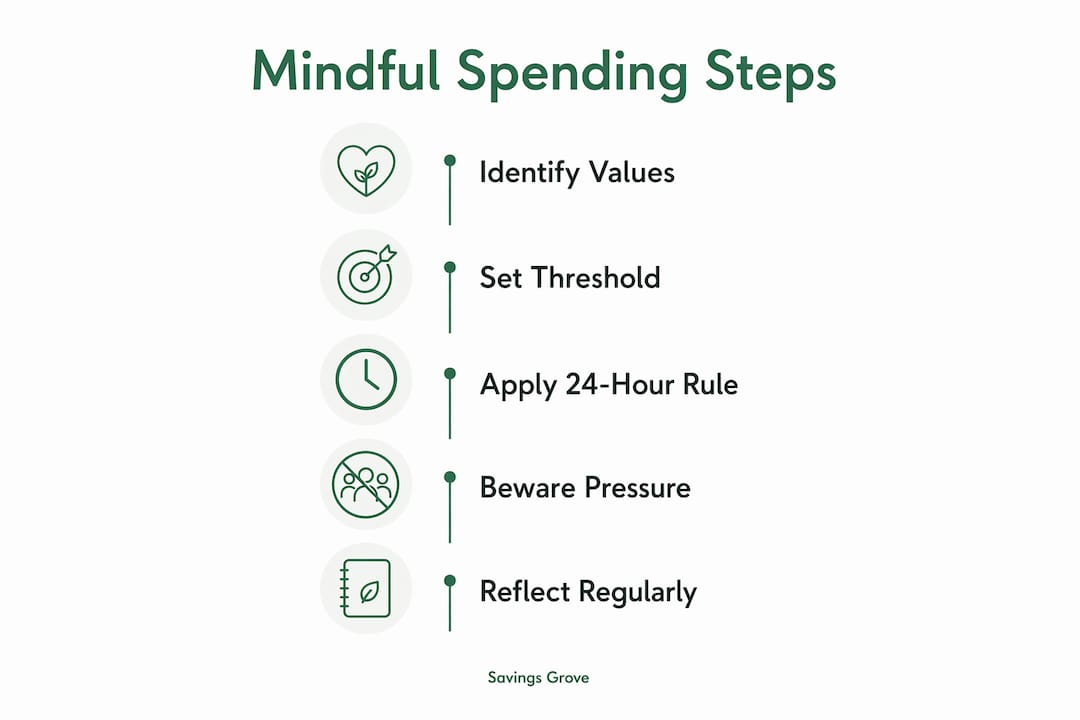
Practical techniques make the difference between understanding mindful spending and actually living it. The following steps give you a repeatable process for any purchase decision.
-
Apply the 24–48 hour waiting rule. The dopamine-driven urge to buy typically fades within 24 hours. Waiting before any non-essential purchase separates a genuine want from a temporary emotional spike. If you still want the item after two days, it is far more likely to reflect real value.
-
Use the HALT check before you buy. The HALT method asks you to identify whether you are Hungry, Angry, Lonely, or Tired before spending. Each state creates a false sense of urgency. A quick self-check takes 30 seconds and can prevent purchases you will regret within hours.
-
Build a “fun money” category into your budget. Financial therapists recommend a realistic guilt-free spending line so you do not feel deprived. Deprivation is the most common reason spending plans fail. A small, protected fun budget keeps you motivated without undermining your goals.
-
Never fund impulse purchases from essential categories. Financial therapists warn that pulling from housing, groceries, or emergency savings for non-essential buys destabilizes your entire financial foundation. Keep those categories locked.
-
Ask three questions before every non-essential purchase. First: Will I still want this in a week? Second: Does this align with one of my stated financial values? Third: Am I buying this to solve an emotional need I could address another way?
Pro Tip: Set a specific dollar threshold, such as $50, above which you always apply the 24-hour rule. Below that threshold, your fun money budget covers it without deliberation.
Being aware of external pressure is equally important. Sales tactics like countdown timers and “limited stock” warnings are designed to bypass your rational thinking. Recognizing these tactics as artificial urgency gives you back control. Social comparison, especially through social media, creates the same false pressure. Mindful consumer behavior means filtering those signals through your own values, not reacting to them.

What are the benefits of mindful spending for your financial and emotional health?
The benefits of mindful spending extend well beyond your bank balance. Practicing this approach builds a form of financial emotional intelligence that changes how you relate to money over time.
“Mindful spending improves emotional regulation by pausing before transactions, enhancing confidence and reducing reactivity to external pressures. Training the brain to move from reactive to proactive decision-making fosters lasting financial emotional intelligence.” — Positivity.org
That shift from reactive to proactive is the core benefit. When you stop reacting to every sale, social cue, or emotional state, you start making decisions that compound positively over months and years. You also reduce the cycle of buyer’s remorse, which itself creates stress and sometimes leads to more impulsive spending as a coping mechanism.
Nearly eight in 10 people are willing to skip small indulgences to save for meaningful experiences. That statistic shows the mindful spending mindset is already widespread. The gap is not in desire but in practical technique.
The emotional benefits are just as real as the financial ones. Reduced anxiety, greater confidence in your decisions, and a stronger sense of alignment between your money and your life all follow from consistent practice. You can also explore how cutting household expenses pairs naturally with this mindset to accelerate your progress. Mindful spending also reduces your vulnerability to advertising. When your purchases are anchored to personal values, a clever ad has far less power over your wallet.
How does mindful spending differ from frugality and minimalism?
These three concepts are often confused, but they operate on different logic. Understanding the distinction helps you choose the right approach for your situation.
| Concept | Core focus | Relationship to spending | Risk if taken too far |
|---|---|---|---|
| Frugality | Spend less, save more | Reduces all spending | Guilt over any purchase |
| Minimalism | Own fewer things | Reduces possessions | Oversimplification of needs |
| Mindful spending | Align spending with values | Spends intentionally | Requires ongoing self-reflection |
Mindful spending is distinct from frugality and minimalism because it focuses on intentional alignment with values rather than solely cutting costs or reducing possessions. Frugality aims to save; minimalism aims to simplify; mindful spending aims to maximize the meaningful use of your money.
This distinction matters practically. A frugal approach might lead you to skip a gym membership to save $40 a month, even if exercise is a core value that keeps you productive and healthy. A mindful spending approach would keep the membership and cut something that genuinely does not serve your goals. For more on how frugal living compares in practice, Savings Grove has a dedicated guide worth reading alongside this one.
Minimalism, meanwhile, focuses on physical possessions and simplicity. Mindful spending applies to every financial decision, including experiences, subscriptions, and services. You can be a mindful spender with a full home and a rich social life. The goal is not fewer things. The goal is that every dollar reflects a conscious choice. For readers curious about the overlap, financial minimalism offers a complementary lens without requiring you to adopt either extreme.
Key Takeaways
Mindful spending works because it replaces reactive financial behavior with deliberate, values-based decisions that reduce anxiety and build lasting financial control.
| Point | Details |
|---|---|
| Core definition | Mindful spending aligns purchases with personal values rather than impulse or habit. |
| The 24-hour rule | Waiting 24–48 hours before non-essential purchases lets dopamine-driven urges fade naturally. |
| HALT technique | Checking for Hunger, Anger, Loneliness, or Tiredness before buying reduces emotional spending. |
| Fun money matters | A guilt-free budget category prevents deprivation and keeps spending plans sustainable. |
| Not frugality | Mindful spending allows full enjoyment of purchases that genuinely reflect your priorities. |
Why I think most people start mindful spending the wrong way
Most people approach mindful spending as a restriction exercise. They make a list of things they will stop buying and call it a plan. That approach fails within weeks because it treats the symptom, not the cause.
When I first tried the 24-hour rule, I expected to feel disciplined. What I actually felt was surprised. Most of the things I waited on, I simply forgot about. That told me more about my spending patterns than any budget spreadsheet ever had. The urge was real in the moment and almost meaningless a day later.
The HALT check was even more revealing. I realized a significant share of my impulse purchases happened when I was tired, usually late in the evening after a long day. That one insight let me set a simple rule: no online shopping after 9 PM. The rule was not about restriction. It was about protecting myself from a predictable pattern.
The hardest part is self-compassion. Seeing a month of spending that does not match your values can feel like failure. Awareness is data, not shame. The moment you treat your spending history as information rather than a verdict, you start making real progress. Experiment with the techniques here, drop what does not fit, and keep what does. There is no single correct version of this practice.
— Mika L.
Savings Grove resources for building mindful money habits
Knowing the principles of mindful spending is the first step. Putting them into practice consistently is where most people need support.
Savings Grove brings together budgeting guides, credit card rewards analysis, and money-saving strategies in one place, updated monthly with fact-checked research. Whether you are building your first conscious spending plan or refining a system you already have, the tools and resources at Savings Grove give you a clear, practical starting point. The platform covers everything from tracking discretionary spending to finding rewards that match your actual habits, so your money works harder without requiring you to spend less on what genuinely matters to you.
FAQ
What does mindful spending mean?
Mindful spending means making purchase decisions that consciously reflect your personal values and long-term goals rather than impulse or emotion. It is a proactive financial habit, not a restriction strategy.
How do I start practicing mindful spending?
Start with the 24-hour waiting rule for any non-essential purchase above a set dollar threshold. Pair it with the HALT check to identify emotional triggers before you buy.
Is mindful spending the same as being frugal?
No. Frugality focuses on spending less overall, while mindful spending focuses on spending intentionally. A mindful spender may spend more on something that aligns with their values and less on something that does not.
What is the HALT method in spending?
HALT stands for Hungry, Angry, Lonely, and Tired. Checking which state applies before a purchase helps identify emotional triggers that drive impulsive buying rather than genuine need.
Can mindful spending reduce financial anxiety?
Yes. Families that practice mindful spending report higher financial control and lower anxiety because their decisions feel deliberate rather than reactive. The emotional benefit compounds over time as confidence in your financial choices grows.
0 comments
Leave a comment
Reviewed before they appear. Your email is not shown.