

If you’re looking for Clark.com alternatives, Savings Grove is a practical starting point for curated, affiliate-transparent personal finance content, and the broader field breaks into three useful categories: editorial personal-finance publishers, deal-focused sites, and planning tools or platforms.
Quick shortlist:
- Editorial publishers (Savings Grove, NerdWallet, Bankrate, Kiplinger, Investopedia, The Balance): long-form explainers, product comparisons, and curated guides backed by named authors
- Deal-focused sites (WalletHub and similar aggregators): real-time credit card offers, rate comparisons, and alert-style deal tracking
- Planning tools and platforms (MaxiFi, ClearView, FreeFinancialPlan, Warren): interactive calculators, Monte Carlo simulations, account-connected advice, or AI-driven planning without requiring a login
Each category fills a different gap. If Clark.com’s mix of newsletters, deal alerts, and consumer tips is what you relied on, an editorial publisher like Savings Grove covers the explainer and product-recommendation side, while a planning tool handles the numbers-driven side. You don’t have to pick just one.
Table of Contents
- How do Clark.com alternatives compare at a glance?
- What makes these alternatives different from the Clark-style approach?
- How do you choose the right Clark.com alternative for your needs?
- Short profiles: which category fits your situation?
- Side-by-side comparison: focus, best for, tools, and cost
- How does each alternative differ from Clark.com in tone and tools?
- How do you know if a personal finance site is trustworthy?
- Are these alternatives free, or do they charge for access?
- What does the user experience look like across these alternatives?
- What kind of support can you get from these sites?
- Which alternatives have mobile apps?
- How often do these sites update their content?
- Can these alternatives connect to your financial accounts?
- Key Takeaways
- The case for using multiple sites together
- Savings Grove: practical personal finance content, no account required
- Useful sources and further reading
How do Clark.com alternatives compare at a glance?
The table below maps Savings Grove and the three alternative categories across the dimensions that matter most when you’re choosing a replacement.
| Category | Best for | Content depth | Tools & features | Cost model | Editorial transparency | Mobile experience | Update frequency |
|---|---|---|---|---|---|---|---|
| Savings Grove (editorial publisher) | Curated deals, credit cards, budgeting guides, beginners | Long-form guides + monthly product roundups | Credit card comparisons, investment guides, budgeting resources, financial dictionary | Free, affiliate-supported | Affiliate disclosures stated; monthly fact-checked updates | Mobile-friendly site | Monthly + as-needed |
| Editorial publishers (NerdWallet, Bankrate, Kiplinger, Investopedia, The Balance) | Deep product research, rate comparisons, investing explainers | Long-form, expert-reviewed | Rate tables, calculators, comparison tools | Free, ad/affiliate-supported | Varies; most disclose affiliate relationships | Most have dedicated apps or responsive sites | Daily to weekly |
| Deal-focused sites (WalletHub and similar) | Real-time offers, credit card rewards, rate alerts | Short, transactional | Deal trackers, rate alerts, credit score tools | Free, ad-supported | Affiliate-heavy; disclosure quality varies | App-first for many | Real-time to daily |
| Planning tools (MaxiFi, ClearView, FreeFinancialPlan, Warren) | Long-term budgeting, retirement modeling, AI-driven advice | Interactive, simulation-based | Monte Carlo trials, Roth conversion tools, account-linked advice, AI chat | Free tiers to paid subscriptions | Tool-focused; less editorial content | App or web-based | Continuous/on-demand |
One-line verdicts:
- Savings Grove: — Best when you want monthly-updated, affiliate-transparent guides on credit cards, investing, and budgeting without navigating a cluttered interface.
Pro Tip: Pair an editorial publisher for explainers with a planning tool for projections. The two categories rarely overlap, so using both gives you coverage without redundancy.
What makes these alternatives different from the Clark-style approach?
Clark.com built its audience on a specific formula: a strong, opinionated editorial voice, consumer-protection framing, deal newsletters, and a helpline. Public commentary on Clark Howard’s positions shows how that personality-driven approach shapes reader expectations deeply. When you switch categories, the differences are immediate.
- Tone: — Clark.com uses a single, recognizable voice. Editorial publishers like NerdWallet or Savings Grove use named authors with stated credentials, which feels less personal but more verifiable.
The practical gap shows up when you need more than a tip. A deal alert gets you to a product page fast. A planning tool tells you whether you should be opening a new card at all right now.
How do you choose the right Clark.com alternative for your needs?
Match your primary need to the right category first, then evaluate individual sites within it.
Step-by-step selection process:
- Identify your primary need. Deals and rate alerts? Go deal-focused. Long-form explainers and product guides? Go editorial publisher. Retirement modeling or budgeting projections? Go planning tool.
- Check editorial transparency. Look for a visible affiliate disclosure, named authors with credentials, and a stated review or update policy before trusting any recommendation.
- Confirm update frequency. A rate comparison page that hasn’t been updated in six months is unreliable. Check the “last updated” date on any article you act on.
- Test the tools. Run a calculator or comparison tool before committing to a site. A calculator that requires an email signup before showing results is a red flag.
- Check mobile usability. If you’ll use the site on your phone, load it on mobile first. A desktop-only layout with tiny text is a friction point you’ll abandon quickly.
- Try it for one real decision. Use the site to research one actual financial question. If the answer is vague, buried in ads, or leads only to product links, move on.
Red flags to watch for:
- No visible affiliate or advertising disclosure
- No author name or credentials on product recommendation articles
- Articles with no “last updated” date, or dates more than 12 months old on rate-sensitive topics
- Calculators that require account creation before showing any output
- Sites that recommend only one product category regardless of your inputs
Pro Tip: Domain-analysis pages that group Clark.com with peer sites are a fast way to build your initial shortlist. They show you which publishers operate in the same space without requiring you to evaluate each one from scratch.
Short profiles: which category fits your situation?
Savings Grove
Best for: U.S. readers who want monthly-updated, affiliate-transparent guides on credit cards, budgeting, and investing without a steep learning curve.
- Covers credit card rewards, investment guides, homeownership savings, student debt, and retirement strategies
- Financial dictionary with plain-language definitions and practical context
- Affiliate model disclosed; monthly fact-checking cycle keeps product recommendations current
- Free to use; no account required
- Mobile-friendly site; no dedicated app, but the responsive layout works well on phones
- Weakness: narrower breadth than large editorial publishers; no account-connected planning tools
Editorial publishers (NerdWallet, Bankrate, Kiplinger, Investopedia, The Balance)
Best for: Readers who need deep, frequently updated research across a wide range of financial products and categories.
- NerdWallet and Bankrate cover mortgages, credit cards, loans, and investing with daily updates and rate tables
- Kiplinger leans toward investing, retirement, and tax planning with a more traditional editorial voice
- Investopedia is strongest for financial education and terminology; its explainers are detailed and well-sourced
- The Balance targets beginners with accessible, step-by-step guides
- All are free and ad/affiliate-supported; disclosure quality varies by site
- Most have dedicated mobile apps or fully responsive sites
Deal-focused sites (WalletHub and similar aggregators)
Best for: Readers who want real-time credit card offers, rate comparisons, and score monitoring with minimal reading.
- WalletHub offers credit score tracking, card comparisons, and rate alerts updated frequently
- Thin editorial layer; content is primarily transactional
- Free, with heavy ad and affiliate monetization
- App-first experience; mobile performance is generally strong
- Weakness: limited depth for readers who want to understand why a product is recommended
Planning tools (MaxiFi, ClearView, FreeFinancialPlan, Warren)
Best for: Readers who need a personalized, numbers-driven financial plan rather than general tips.
- MaxiFi produces lifetime spending plans with Monte Carlo simulations and exportable reports; coaching options available
- ClearView offers a retirement simulator with 10,000 Monte Carlo trials, Roth conversion optimization, and Social Security timing tools
- FreeFinancialPlan provides AI-driven planning with no login required, useful for readers who won’t share account credentials
- Warren connects to accounts via Plaid and delivers personalized daily advice across banking, investing, taxes, and debt
Side-by-side comparison: focus, best for, tools, and cost
The G2 alternatives page for Clark confirms strong search demand for direct comparisons, which tells you something about how readers approach this decision: they want a shortlist, not an essay. Here’s the focused breakdown.
| Site / Category | Primary focus | Best for | Notable tools | Cost |
|---|---|---|---|---|
| Savings Grove | Credit cards, budgeting, investing guides | Beginners to intermediate U.S. readers | Credit card roundups, budgeting guides, financial dictionary | Free |
| NerdWallet | Broad personal finance | Product research across all categories | Rate tables, calculators, comparison tools | Free |
| Bankrate | Rates and lending | Mortgage, loan, and savings rate research | Rate tables, mortgage calculator | Free |
| Investopedia | Financial education | Learning financial concepts | Definitions, tutorials, simulator | Free |
| The Balance | Beginner personal finance | New-to-finance readers | Step-by-step guides | Free |
| WalletHub | Credit and deals | Real-time card and rate alerts | Credit score tracker, card comparisons | Free |
| Kiplinger | Investing and retirement | Investors and pre-retirees | Tax tools, retirement calculators | Free / paid newsletter |
| MaxiFi | Lifetime financial planning | Long-term budgeting and retirement | Monte Carlo simulations, exportable reports | Paid |
| ClearView | Retirement planning | Pre-retirees needing deep analysis | Roth optimizer, SS timing, Monte Carlo | Paid |
| FreeFinancialPlan | AI-driven planning | Privacy-conscious planners | No-login AI plan generator | Free / optional paid |
| Warren | AI-connected advice | Readers who want daily personalized tips | Account-linked advice via Plaid | Free / subscription |
How does each alternative differ from Clark.com in tone and tools?
Clark.com’s editorial voice is opinionated and consumer-protective. That’s a deliberate choice, and it creates strong reader loyalty. The alternatives listed here take different approaches.
NerdWallet and Bankrate are more neutral in tone. They prioritize data and rate accuracy over personality. You won’t find a strong editorial stance on whether you should buy an annuity; you’ll find a comparison table of annuity providers.
Investopedia is educational rather than advisory. It explains what a Roth IRA is in depth before suggesting whether you should open one. That suits readers who want to understand before they act.
Kiplinger sits closest to Clark.com in terms of editorial voice, with opinionated takes on investing and retirement, but it skews toward readers with more assets and a longer investment horizon.
Savings Grove focuses on practical, curated content for everyday U.S. consumers, with a particular emphasis on credit card rewards, budgeting, and saving strategies. The tone is direct and accessible rather than personality-driven.
Planning tools (MaxiFi, ClearView, FreeFinancialPlan, Warren) have no editorial voice at all. They are calculators and advisors, not columnists. That’s a feature for some readers and a gap for others.
How do you know if a personal finance site is trustworthy?
The clearest trust signals are also the easiest to check quickly.
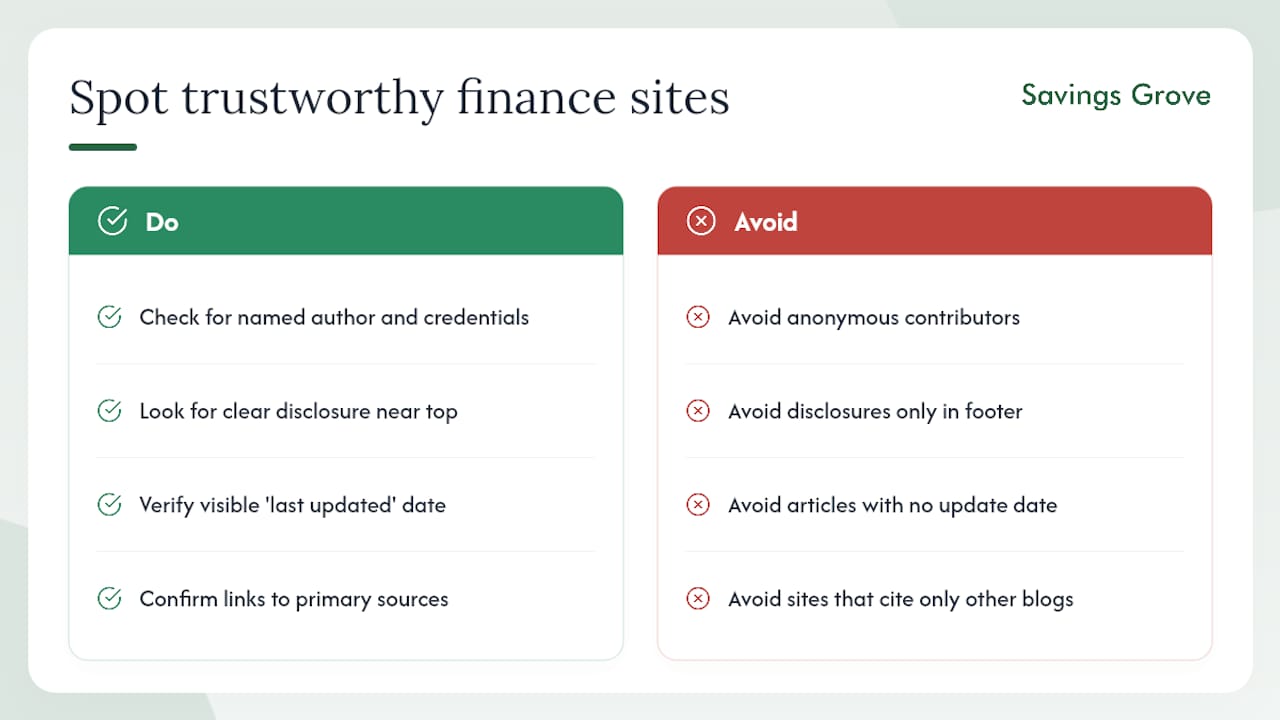
Author credentials and expertise: Reliable sites name the author on product recommendation articles and state their relevant background. An article recommending a specific mortgage product should be written by someone with finance or journalism credentials, not an anonymous contributor.
Affiliate and advertising disclosures: Every site on this list is ad-supported or affiliate-monetized to some degree. The question is whether they say so clearly. Look for a disclosure near the top of product recommendation pages, not only in the footer.
Date-updated stamps: Rate-sensitive content (credit cards, mortgages, savings accounts) changes frequently. A visible “last updated” date on every article is a basic standard. Sites that omit it are asking you to trust content that may be months out of date.
Citations to primary sources: Strong editorial publishers link to the CFPB, IRS, Federal Reserve, or other primary sources when stating regulatory facts. Sites that cite only other blogs for financial rules are a step removed from accuracy.
Methodology notes on comparisons: When a site ranks the “best” credit cards, it should explain how it selected them. A stated methodology (minimum credit limit, rewards rate threshold, annual fee cap) is more trustworthy than a list with no criteria.
Are these alternatives free, or do they charge for access?
Most editorial publishers and deal-focused sites are free. Planning tools are the exception.
Free, ad/affiliate-supported: Savings Grove, NerdWallet, Bankrate, Investopedia, The Balance, WalletHub, Kiplinger (most content). These sites earn revenue when you click on product links or view ads. The content itself costs you nothing.
Free tier with paid upgrades: Kiplinger offers a paid newsletter with premium research. FreeFinancialPlan provides basic AI planning for free with optional paid advisor connections. Warren offers a free tier with a subscription option for more features.
Paid: MaxiFi and ClearView charge subscription fees for their full planning suites. MaxiFi’s Monte Carlo simulations and exportable lifetime plans are premium features. ClearView’s 10,000-trial retirement simulator and Roth conversion optimizer sit behind a paywall. For readers who need that depth, the cost is justified. For readers who want general budgeting tips, it isn’t.
If you’re looking for free budgeting apps alongside editorial content, the free-tier options cover most everyday needs without a subscription.
What does the user experience look like across these alternatives?
The gap between a well-designed personal finance site and a cluttered one is noticeable within seconds.
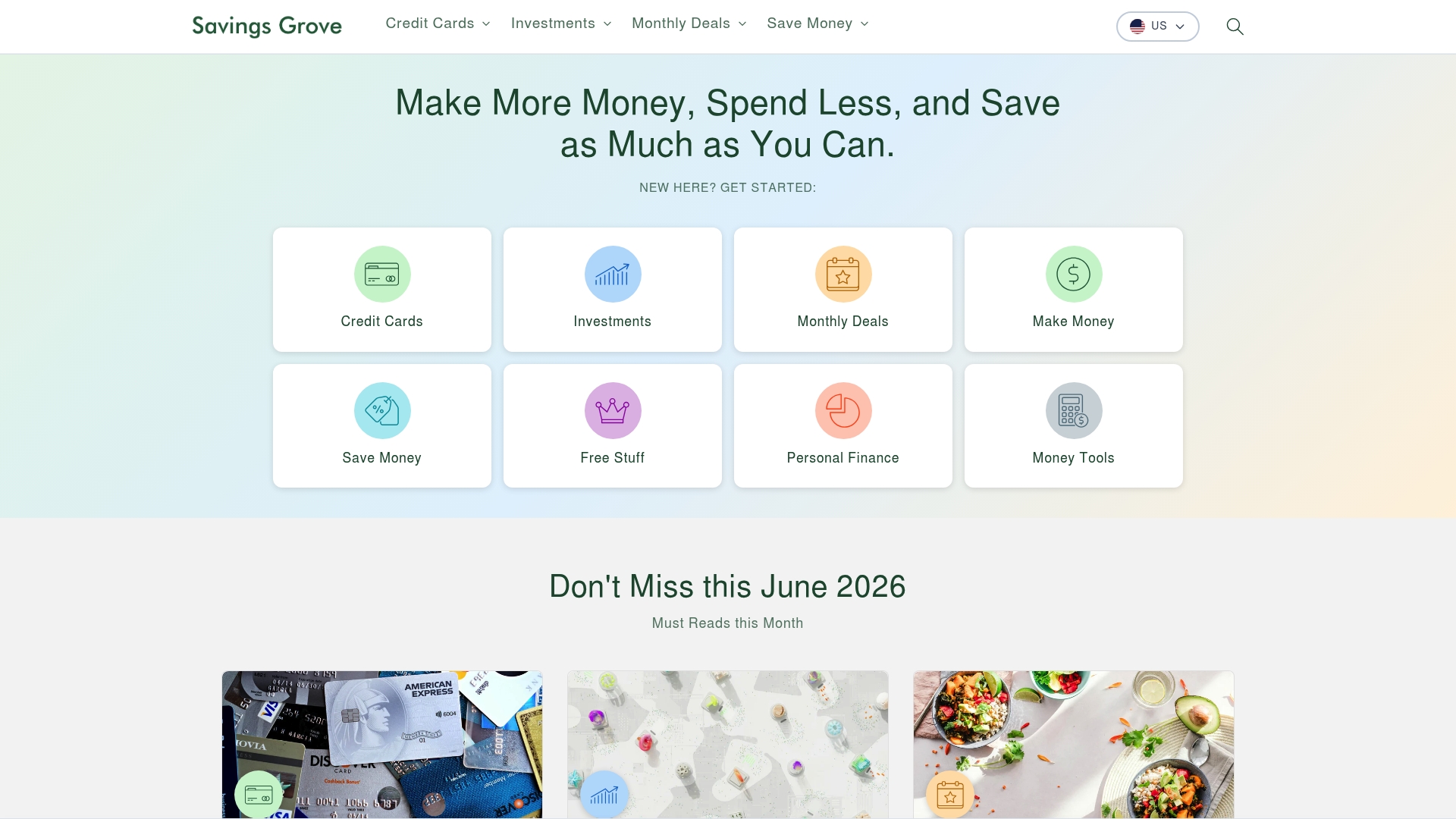
Savings Grove uses a clean, minimal layout with clear category navigation. The earthy green palette and refined typography make it easy to scan without visual noise. Product pages are structured consistently, so you know where to find the key details.
NerdWallet has a dense interface with many product categories and comparison tools. It rewards readers who know what they’re looking for but can feel busy for casual browsers.
Bankrate is similarly dense, with rate tables dominating the homepage. The experience is optimized for readers who arrive with a specific product in mind.
Investopedia is clean and text-heavy. Navigation is straightforward, and the search function works well for finding specific terms or concepts.
WalletHub is app-forward and card-comparison-focused. The interface prioritizes credit score data and card offers, which suits deal-hunters but feels narrow for general finance questions.
Planning tools vary widely. FreeFinancialPlan’s no-login model means you can get a plan in minutes without creating an account, which is a genuinely low-friction entry point. Warren’s account-connected interface requires Plaid setup, which adds a step but enables personalized daily advice.
What kind of support can you get from these sites?
Most personal finance content sites are self-serve by design. Support looks different across categories.
Editorial publishers (Savings Grove, NerdWallet, Bankrate, Investopedia) typically offer a help center or FAQ, a contact form, and in some cases a community forum. Clark.com’s consumer helpline is a notable feature that most editorial publishers don’t replicate.
Deal-focused sites like WalletHub offer customer support for account-related issues (credit score access, account login) but limited help for general finance questions.
Planning tools tend to offer more direct support. MaxiFi includes coaching options alongside its planning software. Warren’s AI advisor is itself a form of on-demand support, answering questions about your linked accounts in real time. ClearView offers support documentation and contact options for its premium users.
If direct human support for consumer complaints is what you valued about Clark.com, none of these alternatives fully replicate that. The closest substitutes are the CFPB’s consumer complaint portal and nonprofit credit counseling services, which operate independently of any of these sites.
Which alternatives have mobile apps?
Mobile availability varies more than you’d expect across this category.
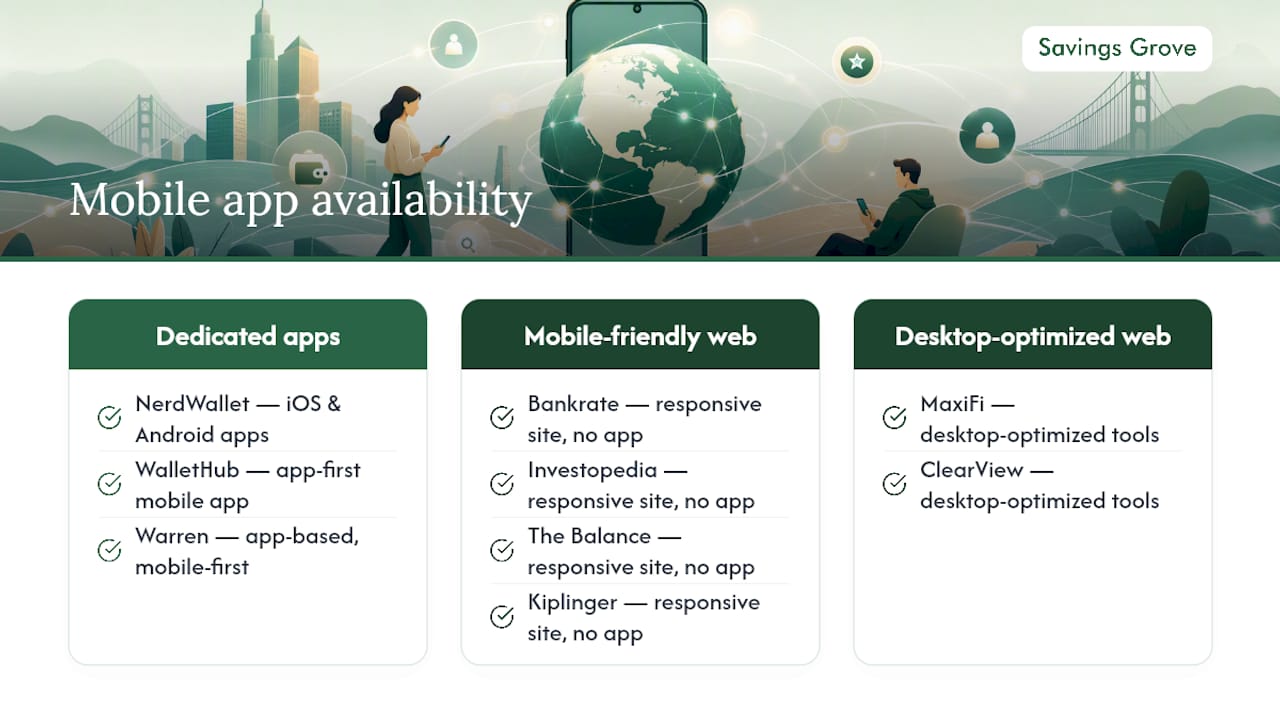
NerdWallet has a dedicated iOS and Android app with credit score monitoring, spending tracking, and product comparisons. It’s one of the stronger mobile experiences in the editorial publisher category.
WalletHub is app-first, with credit score tracking and card comparisons built for mobile use. The app experience is generally smooth.
Bankrate, Investopedia, The Balance, and Kiplinger are primarily web-based. Their sites are responsive and usable on mobile, but none offer a dedicated app with the same feature depth as NerdWallet or WalletHub.
Savings Grove is a mobile-friendly web experience without a dedicated app. The layout scales well on phones, and the content is easy to read on smaller screens.
Warren is app-based by design, with account connectivity and daily advice delivered through a mobile-first interface. FreeFinancialPlan is web-based and accessible on mobile without an app download. MaxiFi and ClearView are primarily web platforms; their planning tools work on mobile browsers but are optimized for desktop use given the complexity of the simulations.
For readers who manage finances primarily on a phone, the role of budgeting apps in your overall setup is worth thinking through separately from which editorial site you read.
How often do these sites update their content?
Update frequency matters most for rate-sensitive content: credit card offers, mortgage rates, savings account APYs, and tax thresholds change frequently.
NerdWallet and Bankrate update rate tables and product comparisons daily or near-daily. Their editorial teams are large enough to maintain that cadence across many product categories.
Savings Grove updates product roundups and guides monthly, with additional updates when significant product changes occur. That cadence suits readers who check in periodically rather than daily.
Investopedia and The Balance update educational content on a rolling basis. Foundational explainers (what is a Roth IRA, how does compound interest work) don’t need daily updates, and these sites reflect that.
Kiplinger publishes new articles daily but reserves its deepest research for its newsletter subscribers.
WalletHub updates credit card and rate data frequently, often daily, given its deal-tracking focus.
Planning tools update continuously based on your inputs and market data. MaxiFi and ClearView recalculate projections as you adjust variables. Warren’s AI advisor pulls current account data each time you interact with it.
Can these alternatives connect to your financial accounts?
Account integration separates planning tools from editorial publishers clearly.
Warren connects directly to financial accounts via Plaid, pulling in real-time data on banking, investing, and debt to generate personalized daily advice. That’s the most direct account integration in this group.
ClearView supports CSV upload as a fallback for users who prefer not to connect accounts directly, alongside its standard integration options.
FreeFinancialPlan takes the opposite approach: no login, no account connection required. You input your financial details manually, and the AI generates a plan. That’s a deliberate privacy-first design choice.
MaxiFi works with manually entered data for its lifetime planning models. The depth of the output depends on the accuracy of what you enter.
Editorial publishers (Savings Grove, NerdWallet, Bankrate, Investopedia, The Balance, Kiplinger) do not connect to your financial accounts. NerdWallet offers optional account linking for its spending tracker, but the core editorial content is independent of your account data.
If account integration is your priority, the planning tool category is the right place to look. If you prefer to keep your financial data separate from the sites you read, editorial publishers give you full access without any account connection.
Key Takeaways
Savings Grove is the most practical starting point for U.S. readers replacing Clark.com, offering affiliate-transparent, monthly-updated guides on credit cards, budgeting, and investing at no cost.
| Point | Details |
|---|---|
| Match need to category | Deal alerts need a deal-focused site; long-form guidance needs an editorial publisher; projections need a planning tool. |
| Check transparency first | Look for visible affiliate disclosures, named authors, and a “last updated” date before trusting any recommendation. |
| Free vs. paid split | Editorial publishers and deal sites are free; planning tools like MaxiFi and ClearView charge for their full feature sets. |
| Mobile varies widely | NerdWallet and WalletHub have strong apps; most editorial publishers are responsive web-only. |
| Savings Grove as your base | Savings Grove offers curated, affiliate-disclosed guides updated monthly, making it a reliable free starting point for U.S. readers. |
The case for using multiple sites together
No single site does everything Clark.com did, and that’s actually fine. The strongest personal finance setup usually combines an editorial publisher for explainers and product guides with a planning tool for projections.
A few pairings that work well in practice:
- Savings Grove + MaxiFi: — Use Savings Grove for credit card and budgeting guides, then run your long-term spending plan through MaxiFi’s lifetime modeling tools. The editorial layer tells you what products exist; the planning layer tells you whether they fit your situation.
- Savings Grove + FreeFinancialPlan: — If you want AI-driven planning without sharing account credentials, FreeFinancialPlan’s no-login model pairs cleanly with Savings Grove’s curated guides. You get both the product knowledge and the personalized projection.
Pro Tip: Set a single source for deal alerts and stick to it. Subscribing to multiple deal newsletters creates overlap and alert fatigue fast. Pick one deal-focused source, use an editorial publisher for depth, and add a planning tool only when you have a specific modeling question.
Savings Grove: practical personal finance content, no account required
If you want a free, affiliate-transparent alternative to Clark.com that covers credit card rewards, budgeting strategies, homeownership savings, and investing basics, Savings Grove is worth bookmarking before you try anything else.
Savings Grove publishes monthly-updated guides on the financial products and strategies that matter most to everyday U.S. consumers; for deeper insights on personal finance topics, see the Blog & Financial Insights | Ready Accounting. Every product recommendation page states the affiliate relationship clearly, and the financial dictionary gives you plain-language context for terms that other sites assume you already know. You’ll find proven budgeting strategies alongside credit card roundups and money-saving tips that are updated as products change.
No account creation, no paywall, no subscription required. Visit Savings Grove to start with the guides most relevant to your current financial priorities.
This article is for general informational purposes only and does not constitute financial advice. Confirm current rates, product terms, and eligibility with the relevant provider or a qualified financial professional before making decisions.