

Yes, you can refinance Parent PLUS loans through a private lender, and in some cases the student can take over the debt by refinancing into their own name. The catch is real: the moment you move from a federal loan to a private one, you permanently give up access to income-driven repayment (IDR) plans and Public Service Loan Forgiveness (PSLF). As of Q4 2024, about 3.6 million Americans owe more than $110 billion in Parent PLUS balances, so you are far from alone in weighing this decision.
Before you do anything else, compare your current federal rate against private quotes and ask yourself whether you rely on federal protections. Federal Direct PLUS loans carried a fixed rate for the 2024–2025 academic year, while well-qualified borrowers often see private refinance rates in a lower range. That gap can mean real savings, but only if you do not need what the federal system offers.
- Refinancing is possible through private lenders; not all allow student-assumption.
- The primary trade-off: you lose IDR, PSLF, and federal forbearance permanently.
- First step: check your current rate, get 2–3 private quotes, and confirm your federal benefit status.
Pro Tip: If you or your child work in public service or nonprofit roles, PSLF could cancel the remaining balance after 120 qualifying payments. Refinancing ends that path entirely.
Key Takeaways
Refinancing Parent PLUS loans can save thousands in interest, but only makes sense when you have strong credit, no federal forgiveness path, and a rate gap of at least 2 percentage points.
| Point | Details |
|---|---|
| Federal rate vs. private | Federal PLUS loans carried 9.08% for 2024–2025; private refinances for qualified borrowers often range from 5%–7%. |
| Permanent loss of federal benefits | Refinancing eliminates IDR, ICR, PSLF, and federal forbearance — there is no way to reverse this. |
| Credit threshold | Most lenders require a minimum FICO of 670; mid- to high-700s scores unlock the best rates. |
| OBBBA deadline | Pre-July 2026 loans may still qualify for IDR if you consolidate and enroll in ICR before the cutoff. |
| Process timeline | The full refinance process typically takes 2–4 weeks; keep paying your federal loan until written payoff confirmation arrives. |
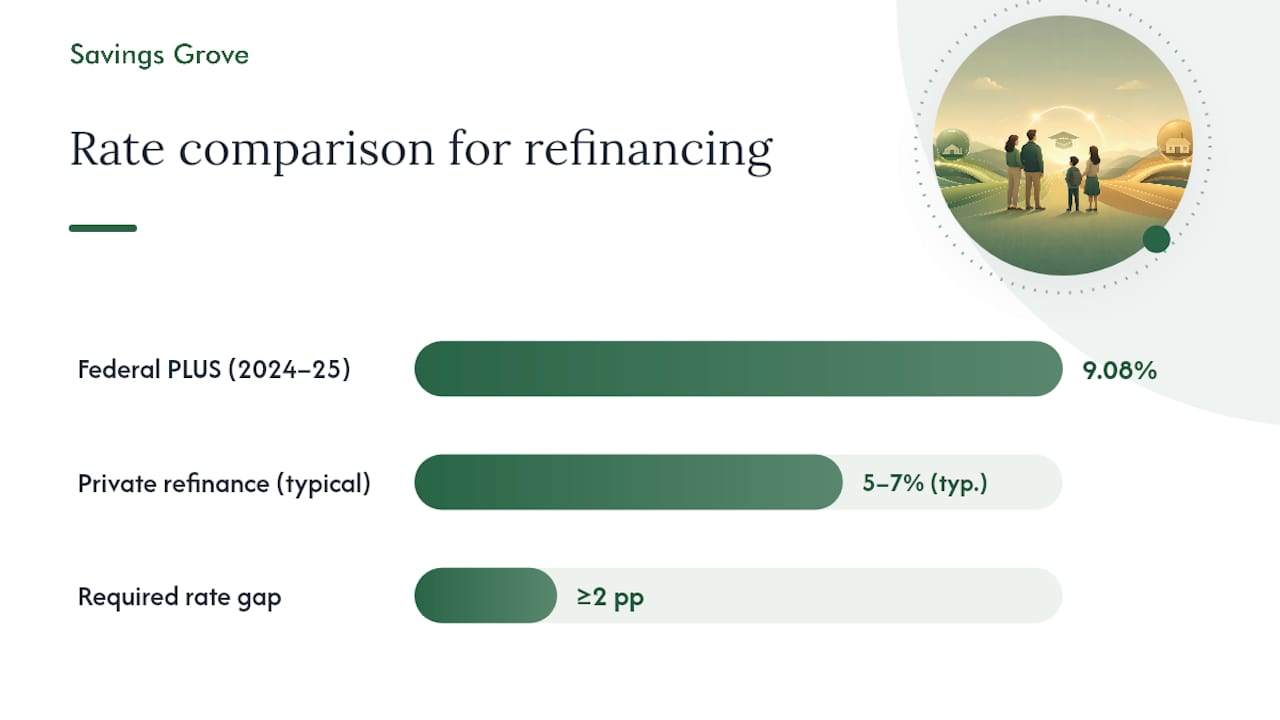
Table of Contents
- Should you refinance your Parent PLUS loan?
- Who qualifies to refinance — credit, income, and your options
- How to refinance Parent PLUS loans, step by step
- What to compare when shopping lenders for a Parent PLUS refinance
- How refinancing affects federal loan protections and forgiveness options
- How to calculate whether refinancing saves you money
- How to transfer the Parent PLUS loan to the student
- Typical timeline, documents, and costs to expect
- A practical perspective on when refinancing is actually worth it
- Sources
Should you refinance your Parent PLUS loan?
The decision comes down to your financial situation, not a universal rule. Here is a clear breakdown.
Pros of refinancing:
- Lower interest rate, which reduces total interest paid over the life of the loan.
- Lower monthly payment if you extend the term (though this raises total interest).
- Ability to transfer legal responsibility to the student if a lender allows it.
- Simplified repayment with a single private servicer.
Cons of refinancing:
- Permanent loss of IDR eligibility, including Income-Contingent Repayment (ICR).
- Loss of PSLF eligibility and federal forbearance options.
- Stricter underwriting than federal loans, which require no credit check.
- Variable-rate loans carry payment risk if interest rates rise.
Quick decision checklist:
- Is your current rate above 7%? If yes, private quotes may beat it.
- Do you or your child work in public service? If yes, keep the federal loan.
- Are you enrolled in or planning to use IDR or ICR? If yes, do not refinance.
- Do you have strong credit (FICO 700+) and stable income? If yes, you likely qualify for competitive rates.
- How many years remain on your loan? Refinancing early maximizes interest savings.
Pro Tip: Well-qualified borrowers often save a few percentage points versus federal Parent PLUS rates, but those savings shrink fast if refinancing significantly lengthens your repayment term. Always compare total interest, not just monthly payments.
Who qualifies to refinance — credit, income, and your options
Private lenders set their own underwriting standards, but common thresholds are consistent across the market.
- Credit score: Most lenders require a minimum FICO score threshold to qualify, with the best rates reserved for higher scores.
- Income and DTI: Lenders typically cap debt-to-income ratios near a moderate threshold. Steady employment history strengthens your application.
- Cosigner option: Adding a creditworthy cosigner can unlock lower rates or approval when your own profile falls short. Some lenders offer cosigner release after a set number of on-time payments.
- Parent vs. student refinancing: When you refinance in your own name, you remain legally responsible. When the student refinances in their name, they assume full legal ownership of the debt, and you are released only after the lender funds the new loan.
Improving your credit mix before applying can meaningfully shift the rate you receive.
Pro Tip: Even a 20-point credit score improvement can move you from a 7% rate to a 6% rate. If your score is borderline, spend 3–6 months paying down revolving balances before applying.
How to refinance Parent PLUS loans, step by step
The process typically takes 2–4 weeks from start to payoff confirmation.
- Confirm your goals. Decide whether you want a lower rate, lower payment, or to transfer the debt. Run a savings estimate using APR and total interest, not just the monthly figure.
- Prequalify with multiple lenders. Use soft credit pulls to compare estimated rates from at least 3–5 lenders without affecting your credit score.
- Gather your documents. See the checklist below.
- Submit full applications. This triggers a hard credit pull. Review each offer for APR, fees, term length, cosigner policy, and whether student-assumption is permitted. Sign the final loan disclosure only after comparing all offers.
- Confirm payoff. The new lender pays off your federal servicer directly. Keep paying your federal loan until you receive written payoff confirmation. Do not assume the transfer is complete until you see it in writing.
| Document | Notes |
|---|---|
| Government-issued ID | Driver’s license or passport |
| Social Security number | Required for credit check |
| Recent pay stubs or tax returns | Last 30 days or most recent two years |
| 30-day payoff statement | Request from your current federal servicer |
| Proof of employment | Offer letter or employer verification |
Pro Tip: Prequalifying with 3–5 lenders using soft pulls is the lowest-friction way to see whether refinancing will produce meaningful savings — no credit score impact, and you get real rate estimates to compare.
What to compare when shopping lenders for a Parent PLUS refinance
Not all lenders offer the same terms, and the differences matter more than most parents expect.
- Student-assumption policy: Ask in writing whether the student can refinance the loan into their own name. Not every lender allows it.
- Fixed vs. variable rates: Fixed rates stay constant for the life of the loan. Variable rates start lower but can rise, adding payment risk over a long term.
- APR vs. advertised rate: The APR includes fees; the advertised rate often does not. Always compare APRs across lenders.
- Origination fees: Most top private lenders charge no origination fee, but confirm this before signing.
- Term options: Common terms run 5–20 years. Shorter terms save interest; longer terms lower monthly payments.
- Cosigner release: Check how many on-time payments trigger release eligibility and what the credit requirements are at that point.
- Forbearance and hardship options: Private lenders vary widely here. Some offer 12–24 months of hardship forbearance; others offer very little. This matters if your income is uncertain.
| Feature | What to ask the lender |
|---|---|
| Student-assumption | “Can the student refinance this into their own name?” |
| Cosigner release | “After how many payments, and what credit score is required?” |
| Forbearance | “How many months of hardship forbearance do you offer?” |
| Prepayment penalty | “Is there any fee for paying off early?” |
Pro Tip: Get student-assumption policies in writing before you apply. A lender’s website may say “student refinancing available” but the underwriting criteria can be strict enough to disqualify most recent graduates.
How refinancing affects federal loan protections and forgiveness options
This is the section most parents underestimate. Refinancing to a private loan is a one-way door.
- Parent PLUS borrowers must first consolidate to a Direct Consolidation Loan and enroll in ICR to access IDR and PSLF pathways; refinancing into a private loan eliminates those federal options entirely.
- Federal deferment and forbearance programs, including economic hardship deferment, disappear with the federal loan.
- ICR caps your payment at 20% of discretionary income. Private lenders offer no equivalent guarantee.
- OBBBA policy change: Under the One Big Beautiful Bill Act, Parent PLUS loans first disbursed on or after July 1, 2026 face new restrictions on IDR eligibility. If your loans predate that cutoff, consolidating and enrolling in ICR before that date preserves your access. Missing that window could permanently limit your options.
Refinancing a Parent PLUS loan removes federal borrower protections — including ICR-based payment caps and PSLF eligibility. If you plan to pursue those programs, do not refinance.
Pro Tip: If PSLF or IDR is a realistic path for you or your child, preserving federal status usually outweighs short-term interest savings from private refinancing. Review the common student debt management mistakes that can cost borrowers forgiveness eligibility before making a move.
How to calculate whether refinancing saves you money
A simple formula prevents you from being misled by a lower monthly payment that actually costs more over time.
- Calculate total interest on your current loan: Monthly payment × number of remaining payments, then subtract the remaining principal.
- Calculate total interest on the refinanced loan: New monthly payment × new term in months, then subtract the loan balance.
- Subtract to find gross savings: Current total interest minus new total interest.
- Subtract any fees: Origination fees or prepayment costs reduce gross savings.
- Factor in the student loan interest deduction: You can deduct up to $2,500 in student loan interest per year on federal taxes (income limits apply). A lower interest rate reduces this deduction slightly, so adjust your net savings estimate accordingly.
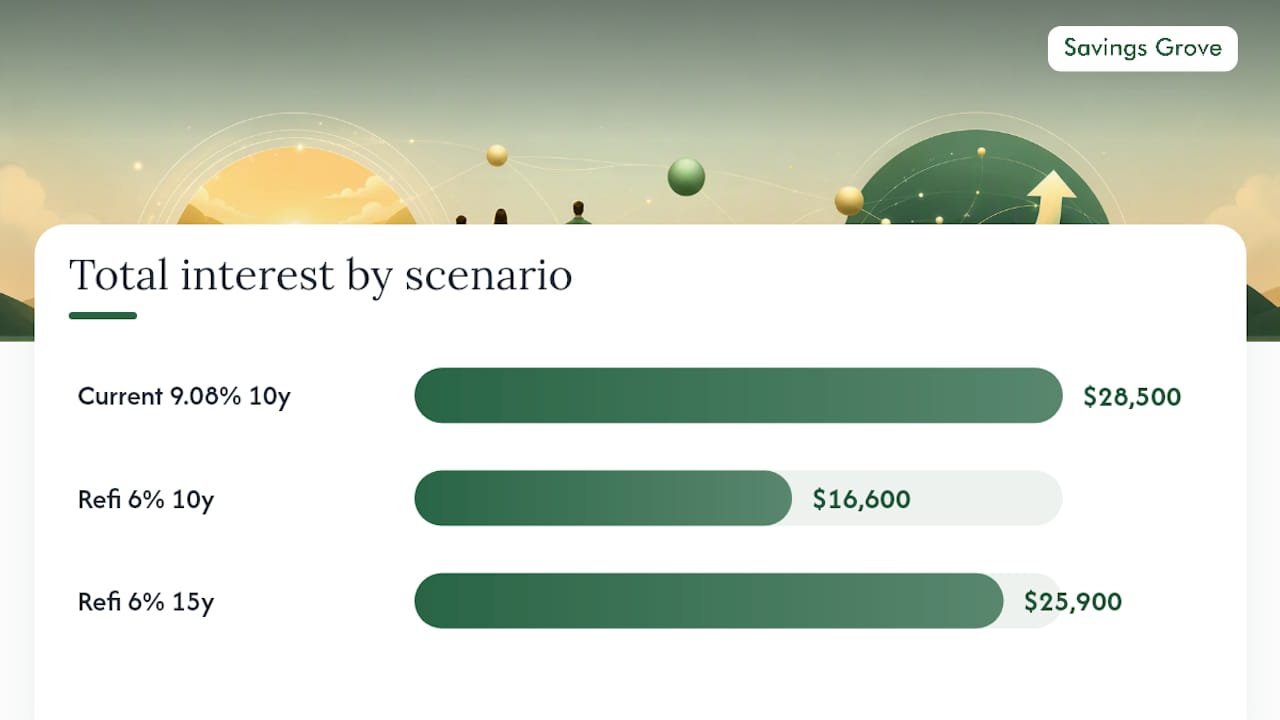
Example: You have $50,000 remaining at 9.08% with 10 years left. Your total remaining interest is roughly $28,500. Refinancing to 6% over the same 10-year term drops total interest to about $16,600, saving approximately $11,900 before tax effects. Extending to 15 years at 6% lowers the monthly payment but raises total interest to about $25,900, cutting gross savings to around $2,600.
Pro Tip: Shorter terms almost always save more total interest, but they raise monthly payments. Run both a 10-year and a 15-year scenario for your specific balance before deciding.
How to transfer the Parent PLUS loan to the student
There is only one legal path to move this debt off your credit: the student applies for a private refinance in their own name, and the new lender pays off your federal loan directly. Some lenders permit this, but the student must meet credit and income standards independently; you cannot unilaterally transfer the obligation.
What the student typically needs:
- FICO score of 670+ (higher for better rates).
- Proof of steady income or a qualified cosigner.
- Graduation documentation or employment verification.
- Debt-to-income ratio within the lender’s threshold.
Risks for the student:
- They take on full legal responsibility for the debt.
- If their credit is thin, their rate may be higher than yours.
- They lose any future federal benefit recourse, since the loan is now private.
Pro Tip: If the student is early in their career with limited credit history, help them build credit responsibly for 12–18 months before attempting a transfer refinance. A stronger profile means a lower rate and a better chance of approval.
Typical timeline, documents, and costs to expect
The full refinancing process usually runs 2–4 weeks. Here is what that looks like in practice.
Timeline:
- Days 1–3: Prequalify with multiple lenders using soft pulls; compare estimated rates.
- Days 4–10: Submit full applications; lenders conduct hard pulls and underwriting.
- Days 11–20: Receive and compare final offers; sign loan disclosure.
- Days 21–28: Lender disburses funds to federal servicer; confirm payoff in writing.
Documents checklist:
- Government-issued photo ID.
- Social Security number.
- Two most recent pay stubs or last two years of tax returns.
- 30-day payoff statement from your federal servicer (request this early; it can take a few days).
- Proof of employment or income source.
Costs to expect:
- Most top private lenders charge no origination fee, but verify before signing.
- One hard credit pull per full application; multiple hard pulls within a short window (typically 14–45 days) are usually treated as a single inquiry by FICO scoring models.
- No federal prepayment penalty, and most private lenders match this.
Keep paying your federal loan during the transition. A missed payment during the gap between application and payoff confirmation can damage your credit and trigger late fees.
A practical perspective on when refinancing is actually worth it
The refinancing conversation for Parent PLUS loans gets muddied by rate-focused marketing that glosses over what you give up. Here is the honest framing: refinancing makes clear sense when you have strong credit, no realistic path to PSLF or IDR, and a rate gap of at least 2 percentage points. It makes almost no sense if you are within a few years of forgiveness milestones or if your income is unpredictable enough that a payment cap matters.
The OBBBA deadline for preserving IDR access on pre-July 2026 loans adds urgency for some borrowers. If you have older Parent PLUS loans and have not yet consolidated to a Direct Consolidation Loan, that window deserves attention before you consider any private refinance.
Savings Grove tracks lender rates and terms monthly, so you can check current offers without starting from scratch every time the market shifts. The practical move right now: prequalify with three lenders, run the total-interest calculation from Section 7, and check your PSLF or IDR status before signing anything.
Sources
These are the primary sources you should check before making any final decision.
This article provides general information only and is not a substitute for professional financial or legal advice. Confirm current program rules, rates, and eligibility requirements directly with your loan servicer, a certified student loan counselor, or a licensed financial advisor before making any refinancing decision.
0 comments
Leave a comment
Reviewed before they appear. Your email is not shown.