

Frugal living is defined as the intentional and resourceful management of money to get maximum value from every dollar while directing spending toward what matters most. NerdWallet describes frugal living as finding ways to save while focusing money on priorities like debt payoff, retirement planning, and building savings. This approach is not about deprivation or pinching every penny. It is a deliberate financial mindset that helps you spend less on what you do not value so you can spend more on what you do. Savings Grove covers this principle across its personal finance resources because it sits at the core of lasting financial health.
What is frugal living and how does it work?
Frugal living is a values-based spending system. You decide what matters most financially, then cut or reduce everything that does not serve those goals. The result is a budget that reflects your actual priorities rather than default habits and impulse purchases.

The term “thrifty living” is often used interchangeably with frugal living, and both describe the same core behavior. The key distinction is that frugality is an ongoing decision framework, not a one-time budget cut. Patriot Bank describes frugal living as a long-term, values-aligned approach that avoids the trap of overspending on low-quality items that cost more to replace later.
Frugality works because it forces a pause before every purchase. That pause creates space to ask whether the spending moves you closer to or further from your financial goals. Over time, those small decisions compound into real savings.
How does frugal living differ from just being cheap?
Frugality and cheapness look similar on the surface but produce very different outcomes. Cheap behavior focuses on the lowest price at any given moment, even when that means sacrificing quality or durability. Frugality focuses on maximum value, which sometimes means spending more upfront to avoid a larger cost later.
A practical example: buying a $15 pair of shoes that wears out in three months is cheap. Waiting for a sale on a $60 pair that lasts three years is frugal. The frugal choice costs four times more upfront but saves money over time.
| Behavior | Cheap mindset | Frugal mindset |
|---|---|---|
| Purchase decision | Lowest price available | Best value for the cost |
| Quality tradeoff | Accepts low quality to save now | Waits for quality at a fair price |
| Long-term cost | Often higher due to replacements | Lower due to durability |
| Relationship to goals | Reactive, short-term | Intentional, goal-aligned |
| Emotional driver | Avoidance of spending | Purposeful use of money |
The frugal mindset also includes patience. Waiting for a sale, using a coupon, or comparing prices before buying are all frugal behaviors. They require a little more effort but consistently produce better financial outcomes.
Pro Tip: Before any non-essential purchase, ask yourself: “Would I still buy this if it were 20% more expensive?” If the answer is no, wait. If the answer is yes, look for a deal first.
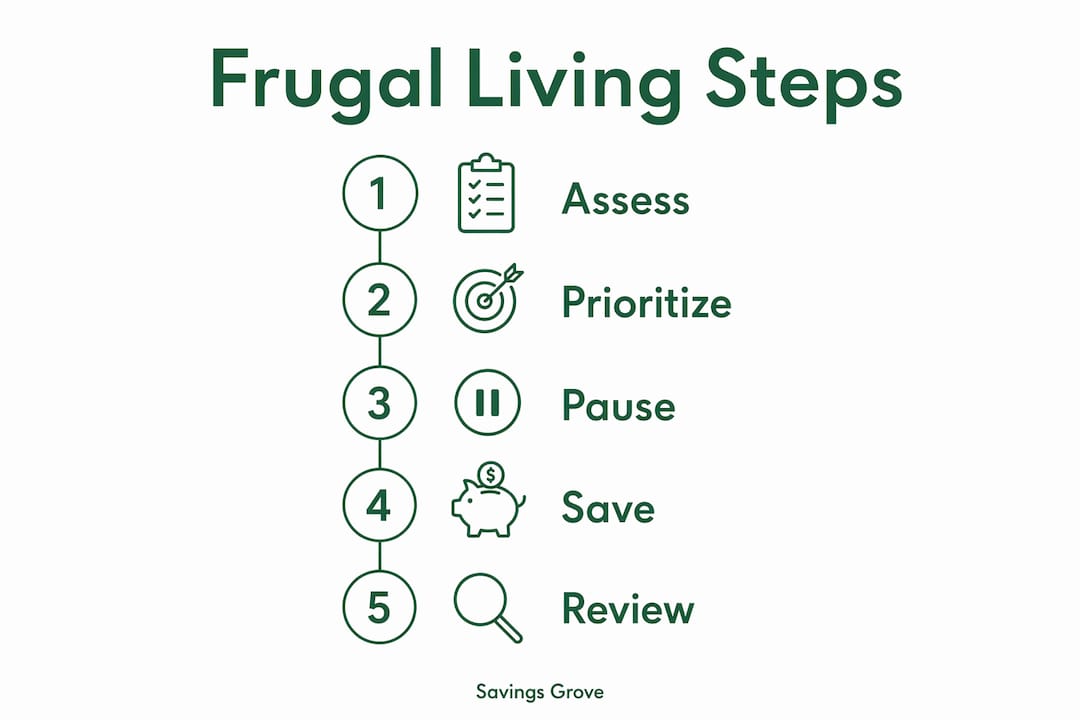
What practical behaviors make up frugal living?
Frugal living shows up in specific, repeatable behaviors. These are not dramatic lifestyle overhauls. They are small, consistent choices that add up over months and years.
NerdWallet identifies coupons, DIY alternatives, and bill reviews as core frugal tactics. Each one targets a different area of your budget, and together they can reduce monthly expenses meaningfully without cutting anything you actually care about.
Common frugal living behaviors include:
- Using coupons and deals. Stack store sales with digital coupons or cashback apps before buying groceries, household items, or clothing.
- Choosing DIY when it makes sense. Making your own cleaning products, cooking at home, or handling basic home repairs can cut costs significantly.
- Reviewing monthly bills. Check your electricity, water, internet, and cell phone bills every few months. Negotiate rates or switch providers when better options exist.
- Canceling unused subscriptions. Streaming services, gym memberships, and software subscriptions accumulate quietly. Audit them quarterly.
- Buying used or refurbished. Electronics, furniture, and clothing often cost a fraction of retail when purchased secondhand.
- Meal planning. Planning weekly meals reduces food waste and prevents expensive last-minute takeout decisions.
One underappreciated frugal behavior is preventing lifestyle creep. NerdWallet advises routing raises and windfalls like tax refunds directly to savings or debt payoff before they get absorbed into everyday spending. If your income goes up but your savings rate stays flat, frugality is not working.
Pro Tip: Frugal living often trades money for time. DIY projects save cash but cost hours. Before committing, calculate whether your time is worth more than the savings. If your hourly rate at work exceeds the savings, hiring out may actually be the frugal choice.
What are the benefits of living frugally?
The benefits of frugal living extend well beyond a lower monthly credit card bill. They build over time and create real financial security.
Reduced financial stress
Spending less than you earn creates a buffer. That buffer means an unexpected car repair or medical bill does not derail your month. Financial stress is directly tied to the gap between income and expenses. Frugality widens that gap in your favor.
Faster debt payoff
Every dollar you do not spend on something unnecessary is a dollar available to pay down debt. Frugality tied to debt payoff is one of the most direct paths to financial freedom. High-interest debt like credit card balances costs you money every month it exists. Paying it off faster saves that interest permanently.
A growing emergency fund
Financial advisors consistently recommend three to six months of expenses in an emergency fund. Most people never reach that target because spending expands to fill available income. Frugal habits create the margin needed to build that fund steadily.
Freedom to pursue bigger goals
Frugal living is not just about cutting costs. It is about redirecting money toward goals that matter. That could mean saving for a home, funding a child’s education, retiring earlier, or building an investment portfolio. Budgeting combined with value-based spending is the foundation of each of those goals. Without it, income rises and falls with lifestyle inflation, leaving nothing behind.
How can you sustain frugal living long term?
Short-term frugality is easy. Sustaining it for years requires treating it as a system, not a sprint. Patriot Bank frames frugal living as a long-term decision framework rather than a temporary fix. That framing matters because it changes how you respond when motivation dips.
Build recurring review points
Set a monthly date to review your bills, subscriptions, and spending categories. This does not need to take more than 30 minutes. The goal is to catch creeping costs before they become habits. A subscription you forgot about in january can cost you $120 by december if you never check.
Apply a value test before every purchase
Before buying anything outside your regular budget, ask one question: does this spending align with my financial goals? If the answer is no, wait 48 hours. Most impulse purchases lose their appeal within two days. This single habit prevents a large share of unnecessary spending without requiring willpower every moment of every day.
Automate your savings
Automated savings transfers protect against lifestyle creep more reliably than willpower alone. Set up a direct deposit split so a fixed percentage of every paycheck goes to savings before you see it. What you do not see, you do not spend. This is the mechanical version of frugality. It works even on days when motivation is low.
Adjust as your life changes
Frugal living is not a fixed set of rules. It adapts to your income, family size, and goals. When your income rises, the frugal response is not to spend more automatically. It is to ask whether your current goals are funded first. If they are, then spending more on things you value is entirely consistent with a frugal lifestyle.
Key takeaways
Frugal living is a long-term, values-based spending system that builds financial security by directing money toward goals and away from waste.
| Point | Details |
|---|---|
| Core definition | Frugal living means spending intentionally to maximize value, not simply spending as little as possible. |
| Frugal vs. cheap | Frugality prioritizes long-term value and quality; cheapness chases the lowest price regardless of outcome. |
| Key behaviors | Coupons, bill reviews, DIY choices, and preventing lifestyle creep are the practical tools of frugality. |
| Main benefits | Reduced financial stress, faster debt payoff, and the ability to fund long-term goals like retirement or homeownership. |
| Sustaining the habit | Automated savings and monthly spending reviews make frugality a system rather than a willpower exercise. |
Why frugality changed how I think about money
I used to think frugal living meant saying no to everything enjoyable. That belief kept me from trying it for years. What I eventually learned is that frugality is not about restriction. It is about clarity.
The moment I started asking “does this spending reflect what I actually care about?” my budget stopped feeling like a punishment. I was not cutting things I valued. I was cutting things I had been buying out of habit, boredom, or social pressure. That distinction is everything.
The hardest part is not the tactics. Coupons are easy. Canceling subscriptions takes ten minutes. The hard part is resisting lifestyle creep when income rises. Every raise feels like permission to spend more. Frugality says: fund your goals first, then enjoy the rest. That order matters more than any specific tip or trick.
My honest advice is to start with one bill audit. Pick your cell phone plan, your internet service, or your streaming subscriptions. Spend 20 minutes comparing what you pay against what is available. Most people find at least one easy cut. That first win builds the confidence to keep going.
Small savings feel insignificant in isolation. Compounded over years, they fund retirements, pay off mortgages, and eliminate the financial anxiety that quietly drains energy from daily life. Start small. Stay consistent. The results are not dramatic in any single month, but they are undeniable over time.
— Mika L.
How Savings Grove helps you put frugal principles to work
Knowing the principles of frugal living is the first step. Applying them consistently is where most people need support.
Savings Grove is a personal finance resource built to help you find real savings without the guesswork of sorting through hundreds of financial products alone. The site publishes monthly updates on credit card rewards, money-saving strategies, and investment opportunities, all fact-checked and practical. Whether you are working on your first bill audit, building an emergency fund, or looking for ways to make your money work harder, Savings Grove gives you the research and tools to move forward with confidence.
FAQ
What is the simplest definition of frugal living?
Frugal living is the practice of spending money intentionally to get maximum value while directing savings toward financial goals like debt payoff or retirement.
Is frugal living the same as being cheap?
No. Frugality focuses on long-term value and quality, while cheapness focuses only on paying the lowest price, often at the cost of durability or satisfaction.
What are the best frugal living tips for beginners?
Start by auditing your monthly subscriptions, using coupons on regular grocery purchases, and setting up an automated savings transfer from each paycheck.
How does frugal living help with debt?
Every dollar freed from unnecessary spending can go directly toward debt payoff, reducing the interest you owe and shortening the time it takes to become debt-free.
Can frugal living be maintained long term?
Yes. Treating frugality as a recurring system with monthly reviews and automated savings makes it sustainable without relying on daily willpower.
0 comments
Leave a comment
Reviewed before they appear. Your email is not shown.