

If you want cash fast or to keep more of what you earn, your best options break down like this: sell unused items locally for same-day results, pick up gig work for a paycheck within days, freelance or sell digital products for higher long-term upside, rent out assets you already own for steady monthly income, or put money into low-cost passive investment vehicles to let it grow quietly. According to Acorns, about 27% of U.S. adults had a side hustle in 2025, with most starting with one of these five routes.
Here’s a quick map before you dive in:
- Fast cash (today or this week): Sell used items locally on Facebook Marketplace or Craigslist.
- Steady part-time income: Gig apps like DoorDash, Uber, Instacart, or TaskRabbit.
- Scalable over months: Freelancing on Upwork or Fiverr, digital products on Gumroad or Etsy, or self-publishing via Kindle Direct Publishing (KDP).
- Higher-margin passive: Rent your car on Turo, a room on Airbnb, or a pool on Swimply.
- Low-effort, long-term: High-yield savings accounts, dividend ETFs, bond funds, or REITs.
Your next step right now: Pick the category that fits your timeline, then jump to that section below for a concrete action plan.
Pro Tip: Before you chase a new income channel, check whether cutting fees, adjusting tax withholding, or maxing a 401(k) match would put more money in your pocket faster. The IRS and Fidelity both recommend starting there.
Key Takeaways
Selling unused items locally and gig work deliver cash fastest, but keeping more of what you earn through tax adjustments and low-fee accounts often moves the needle more than adding a new income stream.
| Point | Details |
|---|---|
| Start with local selling | List one high-value item on Facebook Marketplace or Craigslist this week; no fees, same-day cash possible. |
| Add one gig app | Sign up for DoorDash, Instacart, or TaskRabbit and complete your first shift within seven days. |
| Capture proceeds immediately | Route 25–30% of extra income to a separate tax account; send the rest to a high-yield savings account or IRA. |
| Reduce taxes before adding income | Adjust withholding, max HSA/401(k) contributions, and claim eligible credits before chasing a new channel. |
| Scale with digital products or rentals | After 90 days of gig income, evaluate Upwork, Gumroad, Etsy, KDP, Airbnb, or Turo for higher long-term returns. |
Table of Contents
- 1. Turn clutter into fast cash: selling used items
- 2. Gig and on-demand work for a paycheck this week
- 3. Freelancing and digital products for higher upside
- 4. Rent what you own for steady monthly income
- 5. Low-effort income from savings and investments
- 6. Practical ways to keep more of what you earn
- 7. How to choose the right option for your situation
- 8. U.S. tax and recordkeeping basics for extra income
- 9. Realistic timelines and earning ranges for each route
- What Savings Grove recommends: a personal-finance-first perspective
- Sources
1. Turn clutter into fast cash: selling used items
Selling used items is usually the fastest low-skill path to immediate cash. No startup cost, no schedule, no boss.
Local platforms like Facebook Marketplace and Craigslist let you list in minutes and meet a buyer the same day. Zero seller fees on most local cash transactions. For Facebook Marketplace tips that actually move items, good photos and a price 10–15% below comparable listings typically cut time-to-sale in half. Check which categories perform best on Facebook Marketplace before you list, since electronics, furniture, and baby gear consistently attract buyers.
Resale platforms expand your audience but charge fees. Poshmark takes a flat $2.95 on sales under $15 and 20% above that. ThredUp pays out less but handles everything for you, making it better for bulk clothing you don’t want to photograph. Decluttr specializes in electronics and media with instant price quotes. eBay charges roughly 13.25% for most categories plus payment processing. Use a fee calculator before listing to confirm your net proceeds are worth the effort.
Indeed recommends researching sold listings (not just active ones) to price competitively. For shipping, weigh items before listing and build the cost into your price.
Safety checklist for in-person sales:
- Meet in a public place with foot traffic (a bank lobby or police station parking lot works well).
- Bring a friend for high-value items.
- Accept cash or verified payment apps only; avoid personal checks.
- Never share your home address in the listing.
Pro Tip: Use DealFlipAI’s free reseller calculators to estimate net proceeds across platforms before you commit to one. A $50 item can net $42 locally or $36 after Poshmark fees — that gap adds up.
2. Gig and on-demand work for a paycheck this week
Gig apps reliably deliver your first paycheck within days to two weeks. Most require nothing more than a smartphone, a valid driver’s license, and a background check.

Driving and delivery: DoorDash, Uber Eats, and Instacart let you start earning within a week of approval. Uber and Lyft require a vehicle that meets their year and condition standards. Busiest windows are Friday evenings, weekend lunches, and bad-weather days when surge pricing kicks in.
Short tasks: TaskRabbit connects you with local jobs like furniture assembly, moving help, and handyman work. Rates are set by you, and many taskers earn $25–$75 per hour depending on the skill. Rover handles dog walking and pet sitting with flexible scheduling.
Tax note: All gig income is self-employment income. You’ll receive a 1099-NEC or 1099-K at year-end, and the IRS expects estimated quarterly payments if you owe more than $1,000 for the year. Track mileage from day one using an app like MileIQ or Stride.
- Sign up for one platform, complete onboarding, and do your first shift within seven days.
- Stack gigs during peak hours to improve your effective hourly rate.
- Keep a separate bank account for gig deposits so you can see exactly what you’re earning.
Pro Tip: Stacking two gig apps (e.g., DoorDash and Instacart) during the same window lets you accept orders from whichever pays more at that moment. Many experienced gig workers report this approach meaningfully improves their hourly return. For a broader list of options, Savings Grove’s side hustles from home guide covers platforms with low startup costs.
3. Freelancing and digital products for higher upside
These options take longer to build than gig work, but they can out-earn one-off sales over time because the same product or skill sells repeatedly.
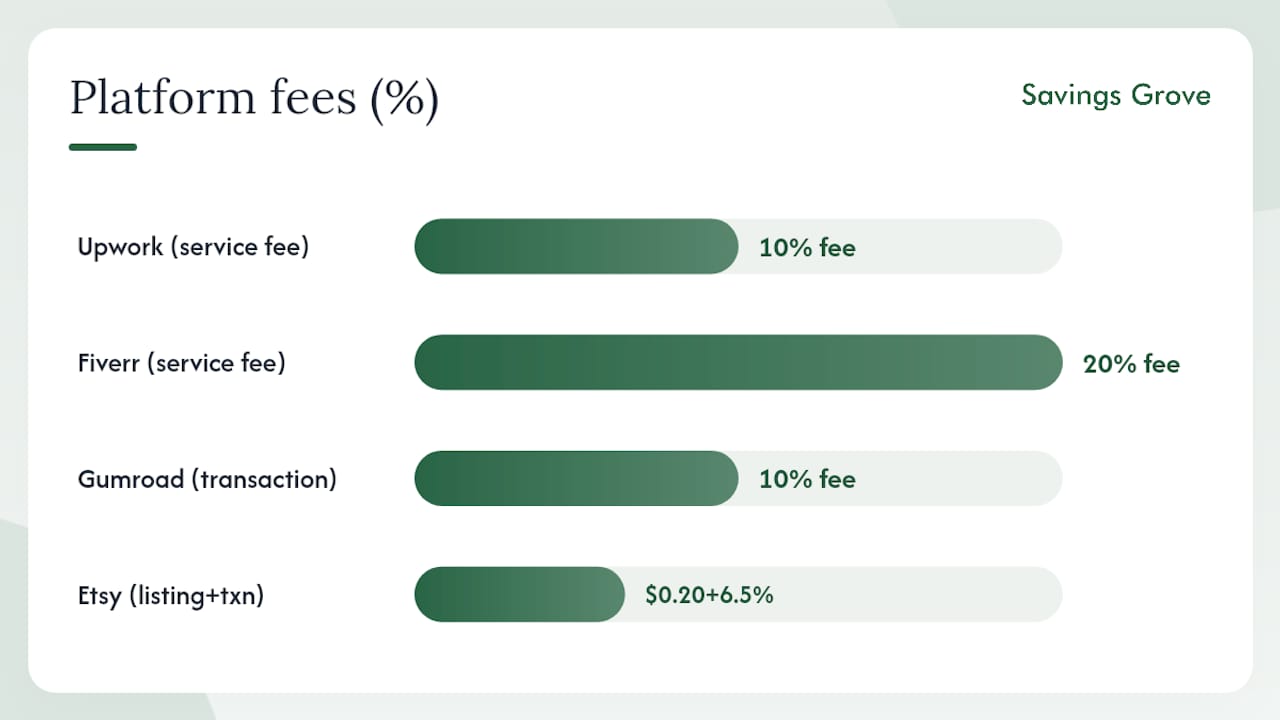
Freelance marketplaces: Upwork and Fiverr connect writers, designers, developers, and virtual assistants with paying clients. Upwork charges a 10% service fee; Fiverr takes 20%. Expect one to four weeks to land your first client while you build reviews. After that, repeat clients and referrals reduce the grind significantly.
Digital storefronts: Gumroad charges a 10% transaction fee on sales. Etsy charges a $0.20 listing fee plus 6.5% transaction fee. Both platforms bring built-in traffic, which shortens your time to first sale. Savings Grove’s guide to selling digital products compares fee structures across ten platforms if you want to go deeper.
Self-publishing: Kindle Direct Publishing (KDP) pays royalties of 35% or 70% depending on pricing and distribution choices. A short non-fiction guide or workbook can start generating sales within days of publishing, though meaningful monthly income usually takes two to three months of promotion.
Inc. notes that digital products and creator-economy options typically require weeks to months before revenue becomes predictable. The path to higher margins runs through direct channels: an email list and your own website reduce platform dependency and keep more of each sale.
Checklist to start:
- Pick one skill or product type you can deliver in under a week.
- Research three to five comparable listings to set a competitive price.
- Create one listing or profile this week and promote it in two relevant online communities.
- Understand basic copyright: you own original work you create, but check platform terms on exclusivity.
4. Rent what you own for steady monthly income
Renting underused assets can provide higher-margin income than casual sales, and it recurs monthly without you selling anything new.
Short-term stays: Airbnb hosts in mid-tier U.S. cities commonly earn $800–$2,000 per month on a spare room, though earnings vary widely by location, season, and listing quality. Check your lease or HOA rules before listing.
Car rental: Turo lets you rent your personal vehicle when you’re not using it. Turo’s basic protection plan covers liability, but read the fine print on deductibles and what voids coverage.
Specialty rentals: Swimply rents private pools by the hour. Yard and storage space can be listed on platforms like Neighbor. These are lower-effort once set up, though earnings are modest.
Before you list any asset:
- Verify your homeowner’s or renter’s insurance covers short-term rental activity; most standard policies do not.
- Check local zoning laws and short-term rental ordinances, which vary significantly by city.
- Calculate net earnings: platform fee (typically 3–14%), cleaning costs, maintenance, and the tax you’ll owe on rental income.
- Require a damage deposit where the platform allows it.
5. Low-effort income from savings and investments
Conservative, low-work options suit readers who prefer lower risk or who already have cash to deploy. Fidelity identifies dividend-paying stocks, money market funds, bond funds, and real estate as passive-income vehicles, noting that returns and risk vary by vehicle.
| Vehicle | Typical use case | General risk level | Tax note |
|---|---|---|---|
| High-yield savings account | Emergency fund, short-term goals | Very low | Interest taxed as ordinary income |
| Money market fund | Parking cash with slightly better yield | Very low | Interest taxed as ordinary income |
| Dividend ETF | Long-term income growth | Moderate | Qualified dividends taxed at lower capital gains rates |
| Bond fund / bond ETF | Steady income, lower volatility | Low to moderate | Interest taxed as ordinary income |
| REIT | Real estate exposure without ownership | Moderate to high | Dividends often taxed as ordinary income |
A high-yield savings account at an FDIC-insured bank is the right starting point if you don’t yet have three months of expenses saved. Once that cushion exists, a low-cost index dividend ETF or bond fund inside a Roth IRA lets returns compound tax-free.
Stat to know: NerdWallet warns that lifestyle creep often absorbs extra income before it builds wealth. Automating a transfer to a savings or investment account the day income arrives is the single most reliable way to prevent that.
6. Practical ways to keep more of what you earn
Reducing taxes, fees, and high-interest debt often improves net take-home more than chasing a new income channel. This is where many people leave real money on the table.
Actionable checklist:
- Adjust withholding: If you consistently get a large refund, file a new W-4 to reduce over-withholding and free up monthly cash. Fidelity explains how adjusting withholding can redirect money to savings during the year rather than waiting for a refund.
- Capture tax credits: The Saver’s Credit rewards contributions to a 401(k) or IRA if your income qualifies, according to the IRS. The Child Tax Credit and Earned Income Tax Credit can significantly reduce your bill.
- Max pre-tax accounts: MyNetPay outlines 2026 contribution limits for 401(k)s and HSAs. Contributing to an HSA reduces taxable income and the funds roll over indefinitely.
- Cancel unused subscriptions: A monthly audit of bank and credit card statements typically surfaces $30–$80 in forgotten charges.
- Pay down high-interest debt: Eliminating a 24% APR credit card balance is a guaranteed 24% return, better than most investments.
Pro Tip: Open a separate savings account specifically for side-hustle or rental proceeds. Set an automatic transfer to move 25–30% to that account for taxes, then route the remainder to a high-yield savings account or IRA. This one habit prevents both a surprise tax bill and lifestyle creep.
7. How to choose the right option for your situation
Choose by matching your time-to-cash need, upfront cost tolerance, risk appetite, and long-term goals. No single option is best for everyone.
Decision checklist:
- How fast do you need cash? Same week: sell locally or start a gig app. Within a month: freelance or list a rental. Within a year: digital products or passive investments.
- What can you spend to start? Selling used items and most gig apps cost nothing. Airbnb hosting may require furnishing a room. Turo requires a vehicle in good condition.
- How much time can you commit weekly? Gig work scales with hours. Digital products require upfront time but less ongoing effort.
- What’s your tax-reporting comfort level? Rental and freelance income both require Schedule C or Schedule E filings. Gig income adds self-employment tax on top of income tax.
- What’s your risk tolerance? Renting assets carries liability risk. Investments carry market risk. Selling used items carries almost none.
Red flags to avoid: Platforms that charge large upfront fees before you earn anything, “passive income” programs that promise fixed returns without disclosing risk, and rental arrangements without clear insurance coverage.
30/90-day template: Week one, list one high-value item and sign up for one gig app. By day 30, complete at least four gig shifts and reinvest proceeds into a high-yield account. By day 90, evaluate whether to scale the gig, launch a digital product, or open a Roth IRA with accumulated savings.
8. U.S. tax and recordkeeping basics for extra income
Most side income is taxable, and the IRS expects you to report it whether or not you receive a 1099. Staying organized from day one costs almost nothing; catching up at tax time costs hours.
Forms you’ll likely encounter:
- 1099-NEC: Issued by clients for freelance or gig payments of $600 or more.
- 1099-K: Issued by payment platforms (PayPal, Venmo, Stripe) when transactions exceed IRS thresholds.
- Schedule C: Where you report self-employment income and deductible business expenses.
- Schedule E: For rental income and expenses.
Recordkeeping checklist:
- Log every mile driven for gig or business purposes (IRS standard mileage rate applies).
- Save receipts for deductible expenses: phone, supplies, platform fees, home office if applicable.
- Keep a simple spreadsheet or use free tools like Wave or the Stride app.
- Set aside estimated quarterly tax payments if you expect to owe more than $1,000 for the year.
Pro Tip: The IRS Self-Employed Individuals Tax Center at irs.gov is free and covers estimated payments, deductible expenses, and Schedule C instructions without requiring a paid preparer for straightforward situations.
Consult a tax professional if you have multi-state income, substantial rental revenue, or complex deductions. The cost of one session typically pays for itself in avoided penalties or missed deductions.
Stat: Acorns reports that the median monthly side-hustle income in 2025 was around $200, meaning that keeping deductible expenses tracked can meaningfully shift your net tax position.
9. Realistic timelines and earning ranges for each route
Here’s what to expect across the five main categories, using broad ranges based on commonly reported outcomes:
NerdWallet’s income-stacking analysis reinforces that the real differentiator is not which channel you choose but whether you capture and redirect the income before spending it. For a detailed comparison of resale platforms and their fee structures, Savings Grove’s marketplace guide covers sixteen options side by side.
What Savings Grove recommends: a personal-finance-first perspective
The most common mistake people make when exploring sell.amazon.com alternatives is optimizing for gross revenue instead of net take-home. A gig that earns $800 a month but costs $200 in gas, $120 in self-employment tax, and $80 in platform fees nets $400. A $400 adjustment to your W-4 withholding or a $400 HSA contribution might deliver the same or better outcome with zero extra hours worked.
The framework that holds up: start with the fastest, lowest-cost option (local selling or one gig app), capture those proceeds into a separate account immediately, and then decide whether to scale or shift to a higher-upside channel. Monthly reviews keep the strategy honest. Conservative tax planning, not optimistic income projections, is what actually builds a cushion.
Sources
- How to keep more of your income | Fidelity
- 25 Best Side Hustle Ideas to Make Extra Money in 2026 | Acorns
- Is ‘Income Stacking’ a Good Way to Build Wealth? - NerdWallet
- 10 ideas for earning passive income you can start right now | Inc.
- Side hustles to earn extra money | Indeed
- 10 Legal Ways to Maximize Your Take-Home Pay in 2026
- Free Reseller Tools & Calculators | DealFlipAI
This article provides general financial information, not professional tax or investment advice. Confirm current IRS rules, platform fee schedules, and contribution limits with the IRS at irs.gov or a qualified tax professional before acting.
This article is general information, not a substitute for advice from a qualified financial advisor. Consult a qualified financial professional about your own circumstances before acting on anything here.