

You can lower your monthly bills today using a six-step playbook: audit your bills, research competitor offers, call your provider, ask for the retention department, escalate if needed, and get every change confirmed in writing. Many callers who follow this process report saving a notable percentage on telecom and subscription bills within a single phone call.
Here is what the full process looks like at a glance:
- Step 1: Audit — Pull your last three statements and list every recurring charge.
- Step 2: Research — Find current competitor prices and new-customer promos for the same service.
- Step 3: Call — Contact your provider and route directly to the retention or loyalty department.
- Step 4: Ask — State your loyalty, name the competitor price, and make a specific dollar request.
- Step 5: Escalate — If the first rep says no, ask for a supervisor or file a complaint with the relevant regulator.
- Step 6: Confirm — Get the new rate, start date, and any conditions sent to you in writing before you hang up.
A single negotiation call typically takes 20–40 minutes. Changes usually appear on the next billing cycle, though some providers take one to two cycles. If a provider refuses to budge after escalation, switching or filing a formal complaint are your next moves.
Key Takeaways
Calling your provider’s retention department with a specific dollar ask and documented competitor evidence is the single most reliable way to reduce monthly bills.
| Point | Details |
|---|---|
| Route to retention | Say “cancel service” to reach the retention department, which has authority to approve rate changes. |
| Bring competitor evidence | Use FCC broadband labels or printed competitor offers as objective proof, not just a general complaint. |
| Make a specific ask | Name a dollar amount; vague requests produce vague responses. |
| Get it in writing | Ask for email confirmation of the new rate, start date, and any conditions before ending the call. |
| Renegotiate annually | Rates drift upward; scheduling a call once a year keeps savings from eroding over time. |
Table of Contents
- How to negotiate lower bills step by step: the full method
- What to say: scripts for phone, chat, and email
- Bill-type tactics: where your best savings are
- When to escalate, file a complaint, or switch providers
- Common mistakes and the tips that fix them
- Your negotiation checklist and 90-day timeline
- Why this method works, and when to get help
- Useful resources
- Sources
How to negotiate lower bills step by step: the full method
Before you pick up the phone
Preparation is what separates callers who get a deal from those who get a polite “no.” Gather these documents before you contact any provider:
- Your last three billing statements (to spot fee creep and identify charges to dispute)
- Your current contract or plan terms, including any promotional expiration dates
- At least two competitor offers for the same service, printed or screenshot
- Your payment history (on-time payments are leverage — providers want to keep reliable customers)
- A list of any equipment rental fees, administrative fees, or add-ons you did not request
Once you have those, rank your bills by monthly impact. Telecom (internet, cable, phone) and insurance are usually the highest-dollar targets and the most negotiable. Utilities are harder to reduce through negotiation alone, though energy-efficient habits can lower usage-based charges significantly. Medical bills and credit card interest rates take more documentation but often yield the largest absolute savings.
During the call: routing, tone, and the ask
Call during off-peak hours — Tuesday through Thursday, mid-morning. Wait times are shorter, and retention reps tend to be less rushed.
When the automated menu answers, do not press the option for “billing.” Instead, say “cancel service” or press the option for cancellations. That routes you to the retention department, which has actual authority to offer discounts. Billing reps typically cannot approve rate changes.
Open with your account number ready and keep your tone calm and appreciative. You are not complaining; you are a loyal customer exploring your options. Here is the structure that works:
- Identify yourself as a long-term customer with a strong payment record.
- State that you have seen a lower price from a competitor (name the provider and the price).
- Make a specific ask: “Can you match that rate, or bring my bill down to $X per month?”
- Stop talking. Silence after the ask is not awkward — it is pressure. Let the rep respond.
- If the first offer is a temporary promo, ask: “Is there a permanent rate reduction available instead?”
- If they say no, ask to speak with a supervisor or the retention team directly.
After the call: confirm and verify
Never end a call without confirmation. Ask the rep to send a written summary of the new rate, the effective date, and any conditions (such as a new contract term) to your email. If they say they cannot send email confirmation, ask for a case or confirmation number and note the rep’s name and the time of the call.
Check your next bill carefully. If the new rate does not appear, call back immediately with your confirmation number. Log every contact in a simple spreadsheet: date, rep name, what was agreed, and the confirmation number. That record protects you if the provider reverts to the old rate.
Pro Tip: Set a calendar reminder for 30 days before any promotional rate expires. Providers rarely alert you when a promo ends — your bill simply jumps back up. A reminder gives you time to call and renegotiate before the increase hits.
What to say: scripts for phone, chat, and email
Phone script
After the rep responds, if they offer a temporary discount:
If they say they cannot help:
Chat template
Copy and paste this into a live chat window, filling in the brackets:
I’ve been a customer for [X years] with account number [XXXX]. I’m currently paying $[amount] per month for [service]. I’ve found a comparable offer from [Competitor] at $[lower price]. I’d like to stay, but I need my bill adjusted to match that rate. Can you connect me with someone who can authorize a rate change? Please send a written summary of any changes to [your email] before closing this chat.
Email template
Subject line: Rate Review Request — Account #[XXXX] — Long-Term Customer
Dear [Provider] Customer Retention Team,
I have been a customer since [year] and have maintained a consistent payment record. My current monthly rate for [service] is $[amount]. I have identified a comparable offer from [Competitor] at $[lower price] per month.
I would like to remain a customer, but I need my rate adjusted to reflect current market pricing. Please review my account and respond with available options within five business days. I am happy to provide documentation of the competitor offer.
Thank you, [Your name], Account #[XXXX]
Handling common pushbacks
- “We don’t have any promotions right now.” Reply: “I’m not looking for a promotion — I’m asking for a permanent rate adjustment to match current market pricing.”
- “You’re under contract.” Reply: “I understand. When does my contract end, and what options are available to me now or at renewal?”
- “That’s the best we can do.” Reply: “I appreciate you checking. Can I speak with a supervisor to see if there are any other options?”
- “We can only offer a temporary discount.” Reply: “How long does that last, and what happens to my rate after it ends?”
Bill-type tactics: where your best savings are
Internet, cable, and phone
Telecom is the most negotiable category for most households. Providers spend heavily to acquire new customers and have retention budgets specifically to keep existing ones from leaving.
Your strongest lever is the FCC’s standardized broadband labels, which require providers to publish true prices, speeds, data caps, and fees in a consistent format. Screenshot the label for a competitor’s comparable plan and bring it to the call as objective evidence, not just a marketing claim. Also check for equipment rental fees — modem and router rentals often add $10–$15 per month, and buying your own device pays for itself within a year.
Pro Tip: Call at the end of the month. Retention reps often have monthly quotas, and a call on the 28th or 29th may get you a better offer than the same call on the 5th.
Utilities
Electric, gas, and water rates are usually set by state utility commissions, which limits direct negotiation. Your best moves here are requesting a budget billing plan (which smooths seasonal spikes), asking about low-income assistance programs like LIHEAP, and reducing your actual consumption. Fidelity’s energy-saving guidance highlights that behavioral changes like unplugging idle devices and adjusting water heater temperature often deliver measurable savings where rate negotiation is limited.
If you believe your utility is billing you incorrectly, contact your state public utility commission. Find your state’s consumer protection office through Usa.
Medical bills
Medical bills are highly negotiable, but the process takes more documentation. Start by requesting an itemized bill and comparing it to your Explanation of Benefits (EOB) from your insurer. Errors are common. The CFPB recommends requesting itemized statements, checking EOBs carefully, and asking providers about financial-assistance or hardship programs before paying anything.
The No Surprises Act provides federal protections against certain out-of-network and emergency charges. If you received a bill that appears to violate those protections, you can cite the Act directly when disputing the charge. Experian also notes that cash settlement offers and payment plans are often available for patients who ask, and that unpaid medical debt under certain thresholds may not affect your credit report.
Ask specifically: “Do you have a financial assistance program or charity care?” and “What is your prompt-pay discount if I settle today?”
Rent and housing
Rent negotiation works best at lease renewal, when your landlord faces the cost and hassle of finding a new tenant. Research comparable units in your area using current listings. If the market has softened or comparable units rent for less, present that data directly. Offer something in return: a longer lease term, early payment, or agreement to handle minor maintenance. For more strategies, Savings Grove’s guide on ways to save on rent covers the full approach.
Insurance and credit cards
For auto and home insurance, call your current insurer annually and ask for a loyalty discount or a policy review. Then get competing quotes and bring them to the conversation. Bundling policies often produces a meaningful reduction.
For credit cards, the target is your APR. Call the number on the back of your card, ask for the retention department, and cite your on-time payment history. A lower rate is not guaranteed, but issuers do grant them to cardholders who ask. The Fair Credit Billing Act also gives you a formal process to dispute any billing error that appears on your statement. For a full walkthrough, see Savings Grove’s guide on how to negotiate your credit card interest rate.
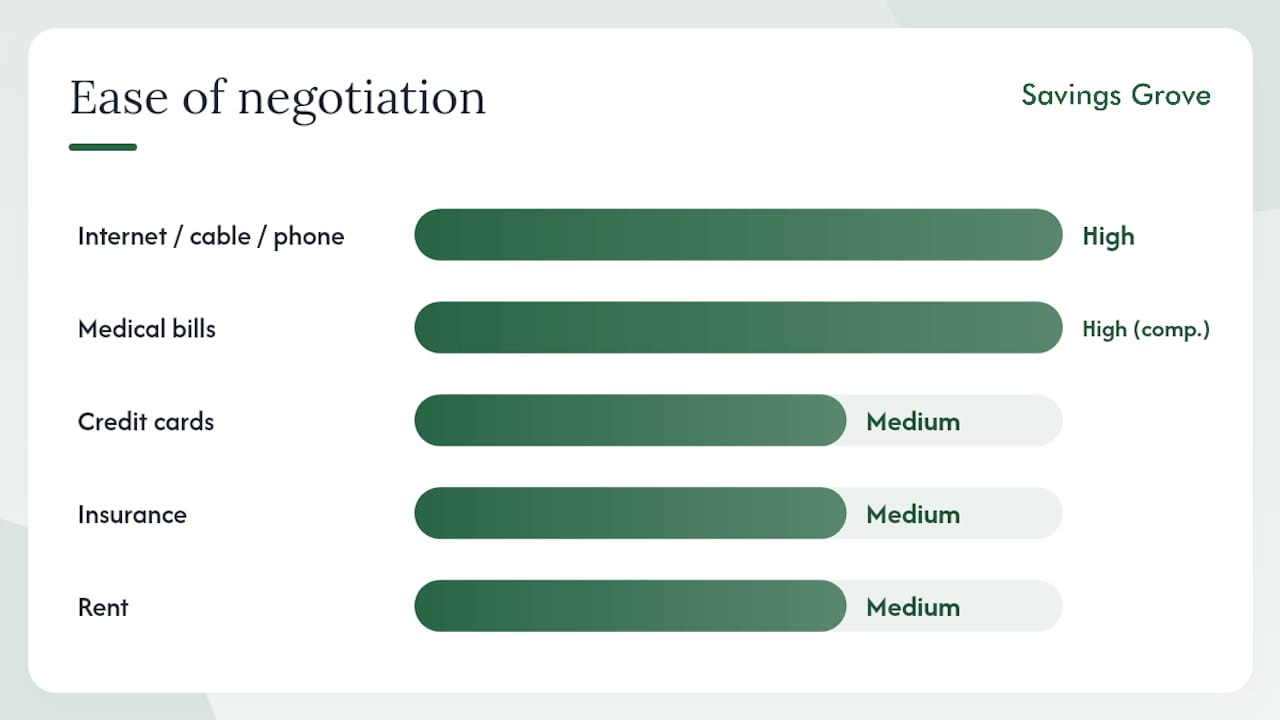
| Bill type | Ease of negotiation | Key evidence to bring | Best escalation path |
|---|---|---|---|
| Internet/cable/phone | High | FCC broadband label, competitor screenshot | Retention dept → supervisor → FCC complaint |
| Medical bills | High (complex) | Itemized bill, EOB, No Surprises Act | Provider billing → patient advocate → CFPB |
| Credit cards | Medium | Payment history, competing card offers | Retention dept → CFPB dispute |
| Insurance | Medium | Competing quotes, bundling options | Agent → underwriter → state insurance dept |
| Rent | Medium | Comparable listings, lease history | Landlord → property manager → local tenant board |
| Utilities | Low | Usage history, state assistance programs | Utility billing → state public utility commission |
When to escalate, file a complaint, or switch providers
The escalation ladder
Follow this path in order before giving up or switching:
- Billing department — Start here for errors or fee disputes. They can correct charges but usually cannot approve rate changes.
- Retention or loyalty department — This is where deals happen. Route here for any rate negotiation.
- Supervisor — Ask by name: “May I speak with your supervisor?” Supervisors have more authority to approve exceptions.
- Written complaint to the company — Send a formal email or letter citing your account history and the specific resolution you want. This creates a paper trail.
- Regulatory complaint — Use this after exhausting company channels.
Regulatory complaint channels
- Telecom disputes: File with the FCC’s consumer complaints portal after company escalation fails. The FCC forwards complaints to providers, which often triggers a faster resolution than another customer service call.
- Medical billing disputes: The CFPB provides step-by-step guidance on disputing credit card charges and also covers medical billing complaints at its medical bills resource page.
- Financial product disputes: File with the CFPB at consumerfinance.gov for credit card billing errors, debt collection issues, or bank fee disputes.
- State-level disputes: Use Usa for rent, utilities, and local service providers.
When to hire a bill negotiation service
Third-party negotiators handle the calls for you, which is useful if you have many bills to tackle or find the process stressful. According to Consumer Reports, some services charge 35–40% of verified savings as their fee. That model means you pay nothing if they save nothing, but it also means a $50 monthly savings over 12 months ($600 total) could cost you $210–$240 in fees. Self-negotiation on the same bill costs only your time.
Hiring a service makes sense when the potential savings are large, the bills are complex (medical, insurance), or you have already tried and failed on your own.
Last-resort checklist:
- File a formal complaint with the relevant regulator (FCC, CFPB, state commission)
- Send a written settlement offer directly to the provider’s billing department
- Get competing quotes and switch providers
- For medical bills, ask about charity care or a zero-interest payment plan
Common mistakes and the tips that fix them
What most people get wrong
- Calling billing instead of retention. Billing reps cannot approve rate changes. Always route to retention or say “cancel service” to get there.
- Accepting the first offer. The first offer is rarely the best one. Ask if there is anything better, then ask again after a pause.
- Skipping written confirmation. A verbal agreement that does not appear on your next bill is worthless. Always get it in writing.
- Forgetting promo expiration dates. Temporary discounts expire quietly. Without a calendar reminder, your bill jumps back up and you may not notice for months.
- Negotiating without research. Saying “my bill is too high” is weak. Saying “Competitor X offers the same service for $20 less” is leverage.
Tips that improve your success rate
Pro Tip: Use the silence technique after every ask. State your request, then stop. Many callers fill the silence by softening their ask or accepting a worse offer. The rep who speaks next is usually the one making a concession.
- Call Tuesday through Thursday, mid-morning, to reach less-rushed reps.
- Use competitor promos as objective evidence, not emotional pressure. “I found this offer” lands better than “I’m thinking about leaving.”
- Ask for a permanent rate reduction, not a promotional one. Promos expire; permanent adjustments do not.
- If a rep says they cannot help, thank them and call back. A different rep may have more flexibility or a better attitude.
- Renegotiate annually. Rates drift upward, and providers regularly launch new-customer deals that existing customers never see unless they ask.
Do/Don’t quick reference:
| Do | Don’t |
|---|---|
| Route to retention | Call billing for rate changes |
| Bring competitor evidence | Bluff about switching if you won’t |
| Ask for permanent reductions | Accept temporary promos without noting the end date |
| Get confirmation in writing | Hang up without a case number |
| Call back if the rate doesn’t appear | Assume the change happened automatically |
Your negotiation checklist and 90-day timeline
This week (Days 1–7)
- Pull your last three statements for every recurring bill.
- List every charge, fee, and add-on by line item.
- Screenshot or print competitor offers for your top two or three bills.
- Rank bills by monthly dollar amount and negotiation ease (use the table above).
- Make your first call, starting with the highest-impact, most-negotiable bill (usually internet or phone).
- Get written confirmation of any changes before ending the call.
Days 8–30
- Make calls for remaining bills on your priority list (one or two per week to avoid fatigue).
- Check your first post-negotiation bill to confirm the new rate appears correctly.
- If a change does not appear, call back with your confirmation number within 48 hours of receiving the bill.
- Request itemized statements for any medical bills received during this period.
Days 31–90
- Verify that all negotiated rates are holding on subsequent bills.
- Log any promotional expiration dates in your calendar with a 30-day advance reminder.
- If a provider refused to negotiate, get competing quotes and decide whether to switch.
- For medical bills, follow up on any financial-assistance applications submitted earlier.
What to expect
Most negotiated rate changes appear within one billing cycle (30 days). Some providers take two cycles, particularly for bundled services. If a change has not appeared after two full billing cycles and you have a written confirmation, escalate immediately to a supervisor and reference your documentation.
For utility bills where rate negotiation is limited, pair your negotiation attempt with practical electricity-saving steps to reduce your usage-based charges in the same 90-day window.
Why this method works, and when to get help
Retention departments exist because keeping a customer costs far less than acquiring a new one. Providers budget specifically for this. A polite, prepared caller who presents a real competitor offer gives the retention rep a clear reason to act, and those reps have the authority to approve discounts that billing agents cannot touch. According to NerdWallet’s research on bill negotiation, prepared callers who present objective competitor offers consistently receive better outcomes than those who call without documentation.
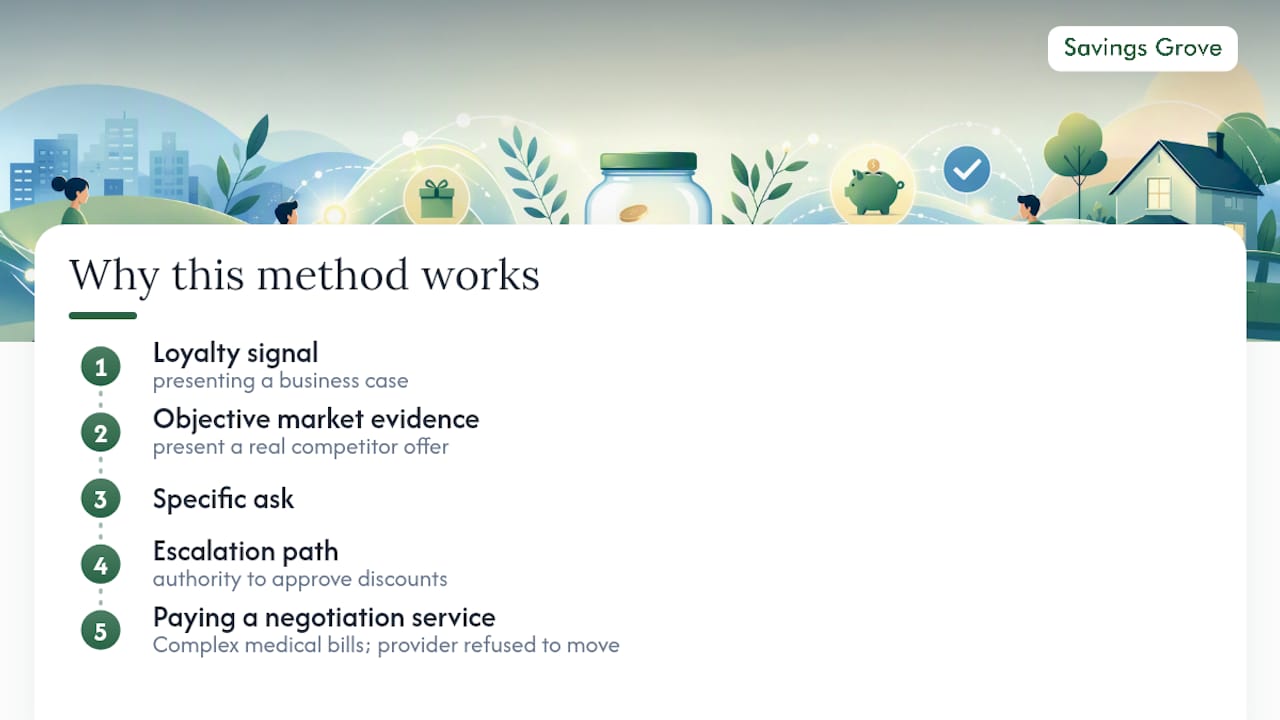
The method in this article works because it mirrors how retention teams are trained to respond: loyalty signal, objective market evidence, specific ask, escalation path. You are not begging; you are presenting a business case.
Paying a negotiation service makes sense in two situations: when you have complex medical bills that require a patient advocate, or when you have already tried and the provider refused to move. For everything else, a 30-minute call using the scripts above costs you nothing and typically produces results within one billing cycle. Savings Grove’s broader guide on cutting household expenses quickly covers how to stack these savings with other cost-reduction moves for a larger monthly impact.
Useful resources
The following official resources are referenced throughout this guide. Use them for documentation, escalation, or consumer protections.
- FCC Broadband Labels — Compare published internet prices, speeds, and data caps across providers; use as objective evidence in telecom negotiations.
- FCC Consumer Complaints Portal — File a formal telecom complaint after exhausting company-level escalation.
- CFPB Fair Credit Billing Act Explainer — Understand your rights to dispute credit card billing errors and the timelines that apply.
- CFPB Credit Card Dispute Guide — Step-by-step process for disputing a specific charge on your credit card statement.
- CMS No Surprises Act — Federal protections against certain surprise medical bills; cite this when disputing out-of-network or emergency charges.
- Usa — Find your state’s consumer protection office for rent, utility, and local service disputes.
- Consumer Reports: Bill Negotiation Services — Real-world examples of savings and fee models for third-party negotiators.
- Savings Grove: Cut Household Expenses Quickly — A prioritized action plan for reducing overall household spending beyond individual bill negotiations.
This article is general information, not a substitute for advice from a qualified financial advisor. Consult a qualified financial professional about your own circumstances before acting on anything here.