

Cutting household expenses quickly is defined as reducing your recurring monthly costs within days, not months, by targeting the biggest drains first. The fastest path to savings runs through three categories: unused subscriptions, dining out, and your mobile phone plan. Households that act on all three can free up $300–$800 monthly within 48 hours. That is real money that can go toward an emergency fund, debt payoff, or simply breathing room. This guide gives you a triage-driven plan to reduce home expenses fast, starting today.
Which household expenses can you cut immediately?
The fastest expense cuts require zero negotiation. You cancel, switch, or stop, and the savings appear on your next statement. Three categories deliver the most impact with the least friction.
1. Unused subscriptions

Pull up your last two bank statements and highlight every recurring charge. Most people find streaming services, fitness apps, news sites, and software tools they forgot about. Subscription savings typically run $50–$150 per month once you cancel the ones you rarely use. Apps like Rocket Money or Trim can scan your transactions and flag recurring charges automatically.
2. Dining out and food delivery
28% of Americans use food delivery weekly. That habit adds up to $200–$300 monthly when you factor in delivery fees, tips, and service charges. Replacing even three delivery orders per week with simple home-cooked meals produces immediate savings without requiring a strict diet plan.
3. Mobile phone plans
Switching from a major carrier like Verizon or AT&T to an MVNO (mobile virtual network operator) is one of the fastest ways to save on household bills. MVNOs like Metro by T-Mobile and Cricket Wireless run on the same towers as the big carriers. Switching to an MVNO saves $40–$100 per month without noticeable coverage loss for most users.
Pro Tip: Set up a bank alert for any new recurring charge above $5. You will catch subscription creep before it compounds.
How can changing grocery habits reduce expenses fast?
Food prices rose 22% between july 2021 and july 2025. That inflationary pressure makes grocery shopping one of the highest-leverage areas for fast expense reduction. Small changes in where and how you shop produce consistent monthly savings.
Switching stores saves more than you think
Switching from Walmart to Aldi saves an average of 8.5% on a comparable grocery basket. Moving from a premium grocer like Whole Foods to a warehouse club like Costco or Sam’s Club can cut food costs by up to 50%. The savings are not about buying less. They come from paying less for the same items.
| Store type | Estimated monthly savings vs. premium grocer |
|---|---|
| Aldi | Up to 40% savings |
| Walmart | Up to 25% savings |
| Costco / Sam’s Club | Up to 50% savings |
| Store-brand items (any store) | 15–30% per item |
Meal planning cuts impulse spending
Meal planning is the single most effective grocery habit for cutting living costs. When you shop with a list tied to a weekly menu, you buy only what you need. Impulse purchases, which account for a large share of grocery overspending, drop sharply. Cooking at home also eliminates the markup built into every restaurant and delivery order.
- Buy store-brand versions of staples like pasta, canned goods, and dairy.
- Use loyalty programs at stores like Kroger, Safeway, or Target Circle to stack discounts.
- Check your pantry before shopping to avoid duplicate purchases.
- Plan meals around weekly sales rather than fixed recipes.
Pro Tip: Use a free app like AnyList or Paprika to build a pantry inventory. Knowing what you already own prevents buying duplicates and reduces food waste.
How does bill negotiation save money quickly?
Negotiating bills like internet, phone, and insurance can save $50–$150 per month. Most people never call their providers because they assume rates are fixed. They are not. Providers have retention departments whose job is to keep you as a customer, and those departments have access to discounts that are never advertised.
How to negotiate your bills effectively
Call your provider and say you are considering canceling. Ask to speak with the retention department. Once connected, ask directly for a lower rate, a loyalty discount, or a hardship rate. Asking for hardship rates or retention deals can reduce fixed monthly expenses and even allow you to reschedule bill due dates to avoid overdraft fees. If the first representative says no, call back. Different agents have different levels of authority.
| Bill type | Negotiation approach | Potential monthly savings |
|---|---|---|
| Internet | Ask for loyalty rate or threaten to switch | $20–$50 |
| Phone plan | Request retention discount or switch to MVNO | $40–$100 |
| Car insurance | Request a review or compare quotes annually | $30–$80 |
| Streaming bundles | Downgrade tier or pause service | $10–$30 |
Automate your savings to lock in progress
Automating savings withdrawals is more effective than relying on willpower. Certified Financial Planners recommend treating savings as a fixed expense by scheduling automatic transfers on payday. When the money moves before you see it, you spend less without thinking about it. Start with a small amount, even $25 per paycheck, and increase it as you cut more expenses.
- Schedule an automatic transfer to a separate savings account on payday.
- Use your bank’s round-up feature to save spare change on every purchase.
- Set a calendar reminder every three months to review and increase your transfer amount.
How do you maintain expense cuts without feeling deprived?
Attempting too many cuts at once undermines success. The psychology is straightforward: when every small pleasure disappears at the same time, the plan feels like punishment and people abandon it. A triage approach fixes this by spreading changes across three tiers.
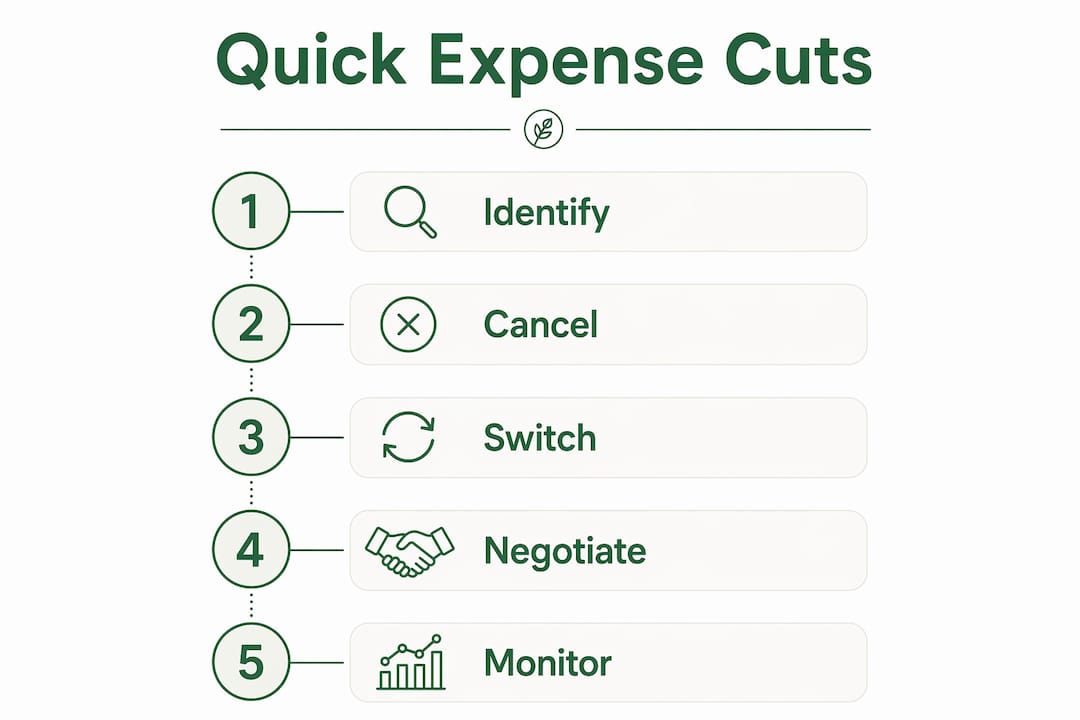
A structured triage process works like this. Tier 1 covers zero-negotiation immediate cuts: cancel subscriptions, stop food delivery, and switch your phone plan. Tier 2 covers bill negotiations after a short preparation period. Tier 3 covers ongoing grocery and lifestyle changes that compound over time. This sequence builds momentum through small wins before asking for bigger behavioral shifts.
- Start with one category. Pick subscriptions, dining, or groceries. Finish that category before moving to the next.
- Track your wins visibly. Write down every dollar saved. Seeing the number grow is a genuine motivator.
- Replace costly habits with free ones. Swap restaurant dinners for cooking with friends. Swap paid streaming for library apps like Kanopy or Hoopla.
- Give yourself a small non-monetary reward. A walk, a free event, or a home movie night reinforces the habit without spending money.
- Review monthly, not daily. Checking your progress once a month prevents obsession and keeps the plan sustainable.
Mindful spending is not about deprivation. It is about making deliberate choices. When you know exactly where your money goes, you stop losing it to habits you do not even enjoy.
Key takeaways
Cutting household expenses quickly works best when you follow a triage approach: start with zero-negotiation cuts, then negotiate bills, then shift grocery and lifestyle habits for lasting results.
| Point | Details |
|---|---|
| Zero-negotiation cuts first | Cancel subscriptions, stop food delivery, and switch to an MVNO for immediate savings. |
| Grocery store switching | Moving from premium grocers to Aldi or warehouse clubs can cut food costs by up to 50%. |
| Bill negotiation works | Calling retention departments for internet, phone, and insurance saves $50–$150 monthly. |
| Automate savings | Scheduling automatic transfers on payday removes the temptation to spend before saving. |
| Triage prevents burnout | Tackling one expense category at a time builds momentum and keeps the plan sustainable. |
What I have learned from cutting expenses the hard way
The first time I tried to slash my monthly spending, I cut everything at once. No dining out, no streaming, no coffee, no convenience. I lasted about two weeks before I gave up entirely and spent more than I had saved. The triage approach changed everything for me.
Starting with subscriptions felt almost too easy. I found four services I had not used in months. Canceling them took 20 minutes and saved me over $60 that first month. That small win made the next step, switching my phone plan to Cricket Wireless, feel manageable rather than scary. By the time I got to grocery changes, I had already built confidence.
The automation piece is the part most people underestimate. Setting up a $50 automatic transfer to a separate savings account felt insignificant at first. Six months later, I had $300 saved without ever consciously thinking about it. That is the real power of treating savings as a fixed bill rather than whatever is left over.
My honest advice: do not try to fix your entire budget in one weekend. Pick one category, execute it completely, and let the momentum carry you forward. Technology helps too. Using Rocket Money to track subscriptions and your bank’s automatic transfer feature removes the mental load. The less you have to think about it, the more likely you are to stick with it.
— 16
How Savingsgrove helps you save more every month
Savingsgrove brings together the tools and research you need to reduce home expenses fast, all in one place.
Savingsgrove publishes monthly updates on credit card rewards, high-yield savings accounts, and money-saving strategies backed by real research. Whether you are looking to automate your savings, find the best grocery loyalty programs, or compare mobile plan options, Savingsgrove gives you vetted, practical guidance. Visit Savingsgrove to find curated resources that match where you are financially and where you want to be.
FAQ
How quickly can you cut household expenses?
You can cut household expenses within 48 hours by canceling unused subscriptions, stopping food delivery, and switching to an MVNO phone plan. These three steps alone can save $300–$800 monthly.
What is the fastest way to reduce grocery bills?
Switching from a premium grocery store to Aldi or a warehouse club like Costco saves up to 50% on comparable items. Meal planning with a list further reduces impulse spending.
Does negotiating bills actually work?
Calling your provider’s retention department and asking for a loyalty or hardship rate saves $50–$150 per month on bills like internet and phone service. Most providers have unadvertised discounts available to customers who ask.
What is an MVNO and why does it save money?
An MVNO is a mobile virtual network operator that leases tower access from major carriers like T-Mobile or AT&T. Providers like Metro by T-Mobile and Cricket Wireless offer the same coverage at $40–$100 less per month than major carrier plans.
How do you avoid giving up on expense cuts?
A triage approach, starting with easy zero-negotiation cuts before moving to negotiations and lifestyle changes, prevents burnout. Tackling one expense category at a time builds small wins that sustain motivation over time.