

A retirement income gap is the yearly shortfall between the money you can count on for certain, such as Social Security, pensions, or annuities, and the amount you actually need to cover your expenses each year. If your essential costs run $52,000 a year and your guaranteed income only adds up to $34,000, you have an $18,000 gap. That gap is what your savings, part-time work, or other strategies need to fill.
Your first move should take a short amount of time: write down your essential monthly expenses (housing, food, insurance, utilities, medications) and pull your Social Security estimate from SSA.gov. Tools like the MassMutual Retirement Income Gap Calculator and Allstate’s retirement income guidance can turn those two numbers into a real answer within minutes, not weeks.
Pro Tip: Do this exercise before you talk to anyone about annuities, investments, or working longer. You cannot fix a gap you have not measured.
Key Takeaways
Closing a retirement income gap requires calculating the shortfall accurately, covering essentials with guaranteed income first, and matching each solution to your health, savings, and timeline.
| Point | Details |
|---|---|
| Definition | The gap equals needed annual income minus guaranteed income from Social Security, pensions, and annuities. |
| Calculation method | Subtract guaranteed income from needed income, then multiply the result by 25 to estimate a nest-egg target. |
| Income-floor principle | Cover essential expenses with guaranteed income before relying on portfolio withdrawals for discretionary spending. |
| Primary closing options | Delay Social Security, buy an annuity, work part-time, or build a bond ladder depending on savings and health. |
| When to get help | Consult a fee-only, fiduciary CFP when facing a large gap, pension buyouts, or complex annuity decisions. |
Table of Contents
- What Is a Retirement Income Gap and Why Does It Widen?
- How to Calculate Your Retirement Income Gap
- Which Calculators and Inputs Give You the Most Accurate Picture?
- Practical Ways to Close or Shrink Your Retirement Income Gap
- Building an Income Floor: How Much Do You Really Need Saved?
- When Should You Bring In a Financial Planner?
- A 5-Step Checklist to Move From Calculation to Action
- Why Income-Floor Thinking Changes Everything
- Frequently Asked Questions
- Sources
What Is a Retirement Income Gap and Why Does It Widen?
Several forces push this gap wider than most people expect, and they rarely act alone. Understanding which ones apply to your situation tells you which lever to pull first.
- Longevity risk. Living to 90 or beyond means stretching savings over 25 to 30 years instead of the 15 to 20 many retirees plan for.
- Inflation. Even modest annual price increases compound over a multi-decade retirement, quietly shrinking the purchasing power of a fixed pension or Social Security check.
- Rising health-care costs. Medicare doesn’t cover everything, and premiums, copays, and long-term care expenses tend to rise faster than general inflation.
- The shift from pensions to 401(k)s. Fewer employers guarantee lifetime income today, and Social Security Administration research shows this shift has made retirees more reliant on self-managed accounts, whose irregular withdrawals are often undercounted in income surveys.
- Social Security timing. Claiming at 62 instead of your full retirement age locks in a permanently lower monthly benefit, sometimes by 25% or more.
- Sequence-of-returns risk. A market downturn in your first few retirement years can force you to sell investments at a loss just when you need income most.
Here’s a concrete example: someone who claims Social Security at 62 instead of waiting until 67 reduces their guaranteed monthly income for life. That single decision can turn a manageable gap into a serious shortfall, especially when combined with a market downturn a year or two into retirement. EBRI’s Retirement Confidence Survey confirms that the declining prevalence of traditional pensions has made these individual timing decisions matter more than they used to.
How to Calculate Your Retirement Income Gap
The formula behind every calculator, spreadsheet, and financial planner’s worksheet is simple:
Gap = Needed Annual Income − (Social Security + Pensions + Other Guaranteed Income)
Before you run the numbers, gather these inputs:
- Essential monthly expenses (housing, food, insurance, utilities, transportation, medications).
- Discretionary spending you’d like to maintain (travel, hobbies, dining out).
- Your Social Security benefit estimate, pulled directly from SSA.gov.
- Any pension income you’re entitled to, confirmed with your plan administrator.
- Other guaranteed sources, such as an annuity payout or rental income you can count on reliably.
Here’s a worked example using a typical retired couple’s numbers:
Using the 4% rule as a rough conversion, multiply the annual gap by 25 to estimate the nest egg needed to cover it through portfolio withdrawals: $21,600 × 25 = $540,000. That’s the ballpark savings target this couple would need if they planned to fill the entire gap from investments alone, a math shortcut also used by tools like the CalculatorLib retirement gap calculator.
Not everyone ends up with a positive gap. If your guaranteed income exceeds your needed income, you have a surplus, not a shortfall, and your planning question shifts from “how do I generate more income” to “how do I invest or spend the extra safely.” Keep in mind that guaranteed income arrives predictably every month, while portfolio withdrawals do not. A market drop the year you retire can force irregular, larger withdrawals than your plan assumed, which is why the gap number alone doesn’t tell the whole story.
Which Calculators and Inputs Give You the Most Accurate Picture?
Three tools cover almost every situation a pre-retiree will encounter, and each one asks for slightly different information.
SSA.gov is the only source for an official Social Security estimate, and it accounts for your actual earnings history rather than a rough average. Have your most recent earnings statement and your planned claiming age ready before you log in.
The MassMutual Retirement Income Gap Calculator compares your monthly expenses against your guaranteed income and returns both a dollar gap and a coverage percentage, so you can see at a glance what portion of your needs are already locked in. Before you use it, gather your monthly essential expenses, any pension paperwork, your estimated retirement date, and your spouse’s income details if you’re planning jointly.
Allstate’s retirement income guidance walks through the same needs-minus-guaranteed-income framework in plain language, which makes it a useful second opinion if your MassMutual results surprise you.
Pro Tip: Don’t count irregular IRA or 401(k) distributions as “guaranteed” income when you run these calculators. Guaranteed means it arrives every month no matter what the market does. Mixing the two categories is the single most common mistake people make when measuring their gap.
Practical Ways to Close or Shrink Your Retirement Income Gap
Once you know your number, you have real options, and they range from easy to reverse to permanently locked in. Think of them in three tiers.
Short-term, flexible moves:
- Cut discretionary spending, such as downsizing a car payment or trimming subscriptions.
- Work part-time for a few years, even a modest income here directly reduces the gap dollar for dollar.
Medium-term moves: 3. Build a bond or CD ladder to generate predictable income for a defined stretch of years. 4. Delay claiming Social Security, since each year you wait between your full retirement age and 70 raises your benefit by roughly 6% to 8%, depending on your birth year.
Longer-term, more permanent moves: 5. Purchase an income annuity, which converts a lump sum into guaranteed income for life.
Here’s how the trade-offs stack up:
- Delaying Social Security: Pros: no cost, no risk, permanently higher lifetime benefit. Cons: requires other income or savings to bridge the years you wait.
- Income annuities: Pros: guaranteed income for life, removes market risk from that portion of your plan. Cons: reduces liquidity, and you generally can’t access the principal once it’s converted.
- Bond/CD ladders: Pros: flexible, low risk, you retain access to principal as rungs mature. Cons: returns are modest and won’t outpace inflation over long stretches.
- Working longer or part-time: Pros: immediate income boost, delays savings withdrawals. Cons: depends on health and job availability.
- Cutting expenses: Pros: works instantly, no market or health risk involved. Cons: has a ceiling, since essential costs can only shrink so far.
Investopedia’s overview of typical retiree income sources confirms these trade-offs hold across most retirement scenarios: liquidity and cost work against each other, and there’s rarely a single option that solves the whole gap.
Pro Tip: If you have low savings and good health, delaying Social Security and working part-time usually beats buying an annuity, since you keep flexibility while you build a bigger guaranteed check. If you have significant savings and are already retired, partial annuitization to cover essentials can lower your stress more than any spreadsheet will show.
Married couples should also weigh survivor benefits before either spouse claims Social Security, since the higher earner’s claiming age determines what the surviving spouse receives for the rest of their life. If either of you is in poor health, that changes the delay-versus-claim math considerably, and it’s worth running both scenarios before deciding.

Building an Income Floor: How Much Do You Really Need Saved?
The income floor concept, championed in Vanguard’s retirement income research, works like this: cover every essential expense with guaranteed income first, then let your investment portfolio handle discretionary spending and growth. This matters because it insulates your must-pay bills from sequence-of-returns risk, the danger of a market crash hitting right as you start withdrawing.
Vanguard recommends a conservative withdrawal rate in the range of about three and a half to four percent for a 30-year retirement in many cases, a cautionary guideline compared to the classic 4% rule some retirees rely on. Here’s how that translates into savings targets:
The 4% rule has a real limitation worth knowing: it assumes a fairly steady market and doesn’t account for a severe downturn in your first few retirement years, which is exactly when a portfolio is most vulnerable. That’s why many planners now lean toward the 3.5% figure or recommend annuitizing part of the gap instead of relying purely on withdrawals.
Social Security typically replaces only about 40% of pre-retirement income for the average worker, which is a big part of why the income floor concept matters so much. If you’re depending on Social Security to cover most of your essentials, you’re likely underestimating your true gap. Learn more about how inflation quietly widens this gap over a 20 to 30 year retirement, and how asset allocation shifts once your income floor is secured.
If a full annuity feels too permanent, a hybrid approach often works: annuitize enough to cover half your essential gap, and build a bond or Treasury ladder for the rest. That way you keep some liquidity while still locking in a meaningful floor.
When Should You Bring In a Financial Planner?
Some gaps are simple enough to close with a spreadsheet and a Social Security claiming decision. Others aren’t, and it’s worth recognizing the difference before you spend money on advice you don’t yet need.
Consider professional help if you’re weighing a complex pension buyout decision, evaluating multiple annuity offers with different fee structures, facing significant estate or tax questions, or your calculated gap is large enough that a wrong move could meaningfully change your retirement lifestyle.
Before your first meeting, bring a summary of your income and expenses, pension statements, your Social Security estimate from SSA.gov, and current balances for every retirement account you hold. This alone will save you an hour of back-and-forth.
When choosing a planner, confirm three things: they operate under a fiduciary duty (legally required to act in your best interest), their fee structure is fee-only rather than commission-based, and they hold a recognized credential such as CFP (Certified Financial Planner). Savings Grove’s guide to choosing a financial advisor walks through how to vet these credentials in more detail.
Pro Tip: Ask any planner directly: “How would you cover my essential expenses with guaranteed income before touching my investments?” Their answer tells you whether they think in terms of an income floor or just a portfolio balance, and that distinction matters more than their sales pitch.
A 5-Step Checklist to Move From Calculation to Action
Here’s the Savings Grove approach to turning your gap number into a real plan, step by step.
- Gather your inputs. Pull your Social Security estimate from SSA.gov, your pension statements, and a full list of monthly essential expenses.
- Calculate your gap. Run the numbers yourself or plug them into the MassMutual calculator to double-check your math.
- Prioritize covering essentials first. Before you think about discretionary spending or travel budgets, make sure your income floor covers housing, food, health care, and insurance.
- Evaluate your options. Compare delaying Social Security, part-time work, a bond ladder, or partial annuitization against your specific health, savings, and family situation.
- Set a 90-day action plan. Pick one or two moves you can start now, whether that’s requesting a pension estimate, applying for part-time work, or scheduling a call with a fiduciary planner.
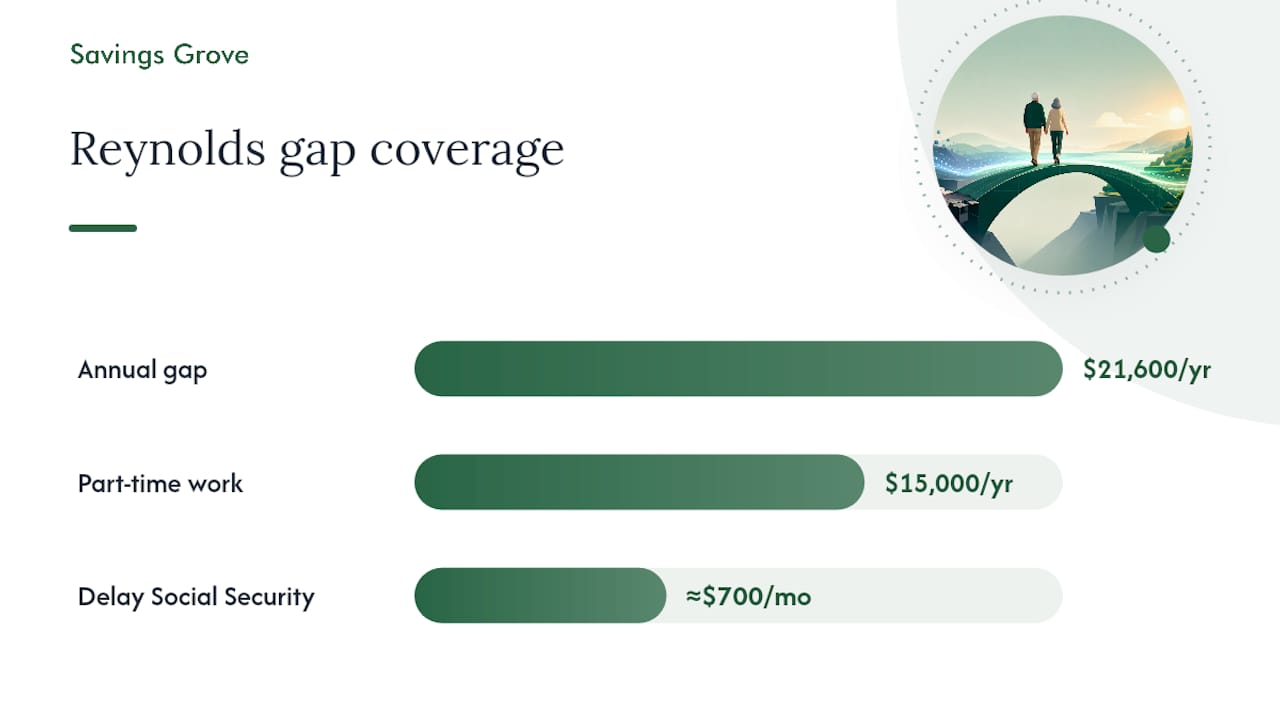
Here’s how this plays out for a sample household: the Reynolds, both 63, calculate a $21,600 annual gap using the worked example from earlier in this article. Rather than jumping straight to an annuity, they decide to delay claiming Social Security for three years, which their SSA.gov estimate shows would add roughly $700 a month to their combined benefit. They also plan to work part-time for two of those three years, generating another $15,000 a year between them. Their 90-day plan: request updated pension paperwork, run the numbers again through the MassMutual calculator once the part-time offer is confirmed, and schedule a fee-only planner consultation to sanity-check the Social Security delay decision.
You can copy this same structure into a simple spreadsheet: one column for needed income, one for each guaranteed source, a subtotal row, and a gap row at the bottom. Update it once a year, or any time your expenses or income sources change materially. For more on stretching what you’ve already saved once your floor is set, Savings Grove’s guide to making retirement savings last longer covers withdrawal sequencing in more depth.
Why Income-Floor Thinking Changes Everything
The biggest mistake in retirement planning isn’t picking the wrong investment. It’s skipping the step where you decide what “safe” actually looks like before you touch a single dollar of savings. Once your essential expenses are covered by income that arrives no matter what the market does, every other decision gets easier. You stop checking your portfolio balance out of anxiety and start checking it out of curiosity.
The math in this article isn’t complicated on purpose. A retirement income gap is one subtraction problem, and closing it usually comes down to two or three deliberate choices rather than a dozen small ones. If you take away a single action from this article, let it be this: calculate your gap this week using SSA.gov and the MassMutual calculator, and don’t guess where the number will land.
If your gap is small and your health is good, you may be able to close it with nothing more than a delayed Social Security claim and a spreadsheet update once a year. If it’s large or tangled up with pension choices and tax questions, use the Savings Grove checklist above, then bring a fiduciary planner into the conversation rather than trying to solve it alone.
Frequently Asked Questions
What is a retirement income gap in simple terms? It’s the yearly difference between what you need to live on and what you can count on for certain from Social Security, pensions, or annuities. If your needs exceed your guaranteed income, that difference is your gap.
How do I calculate my retirement income gap? Subtract your total guaranteed annual income (Social Security, pensions, annuities) from your total needed annual income. Tools like the MassMutual calculator can run this for you once you have both figures.
What causes most retirement income gaps? Longevity, inflation, rising health-care costs, the shift away from traditional pensions, early Social Security claiming, and sequence-of-returns risk are the most common drivers.
Is a $500,000 gap in savings realistic to close? It depends on your annual gap and timeline. Using the 4% rule, a $500,000 nest egg would cover a $20,000 annual gap through portfolio withdrawals, though a partial annuity or delayed Social Security claim can reduce how much you need to save.
Should I annuitize my entire gap or just part of it? Most planners recommend annuitizing only enough to cover essential expenses, keeping the rest in flexible investments so you retain liquidity for discretionary spending and emergencies.
This article is general information, not a substitute for advice from a qualified financial advisor. Consult a qualified financial professional about your own circumstances before acting on anything here.
0 comments
Leave a comment
Reviewed before they appear. Your email is not shown.