

A fixed income investment is any financial instrument that pays you a set schedule of interest payments and typically returns your original principal at maturity. The short version: you lend money to a government, municipality, or corporation, they pay you interest on a regular schedule, and you get your principal back when the loan term ends. U.S. Treasuries, municipal bonds, and certificates of deposit are three of the most common examples most American investors encounter first.
Fixed income tends to make the most sense for income-seeking investors, those preserving capital for a near-term goal, and anyone who wants to reduce the overall volatility of a stock-heavy portfolio. As retirement approaches, most financial planners recommend shifting more of a portfolio toward fixed income.
Quick facts:
- Fixed income generates predictable cash flow through scheduled interest payments.
- It typically carries lower volatility than stocks, though it is not risk-free.
- Bond prices move inversely to interest rates, so rising rates reduce the market value of existing bonds.
Table of Contents
- How do fixed income investments actually work?
- What are the main types of fixed income investments?
- What are the potential advantages of fixed income investing?
- What are the risks of fixed income investing?
- How do you decide if fixed income is right for your portfolio?
- How do you buy fixed income investments in the U.S.?
- Key fixed income terms every investor should know
- Practical allocation examples and a Savings Grove planning checklist
- A worked example: how coupon, price, and yield interact
- Key Takeaways
- Why fixed income still matters in 2026
- Useful sources and further reading
How do fixed income investments actually work?
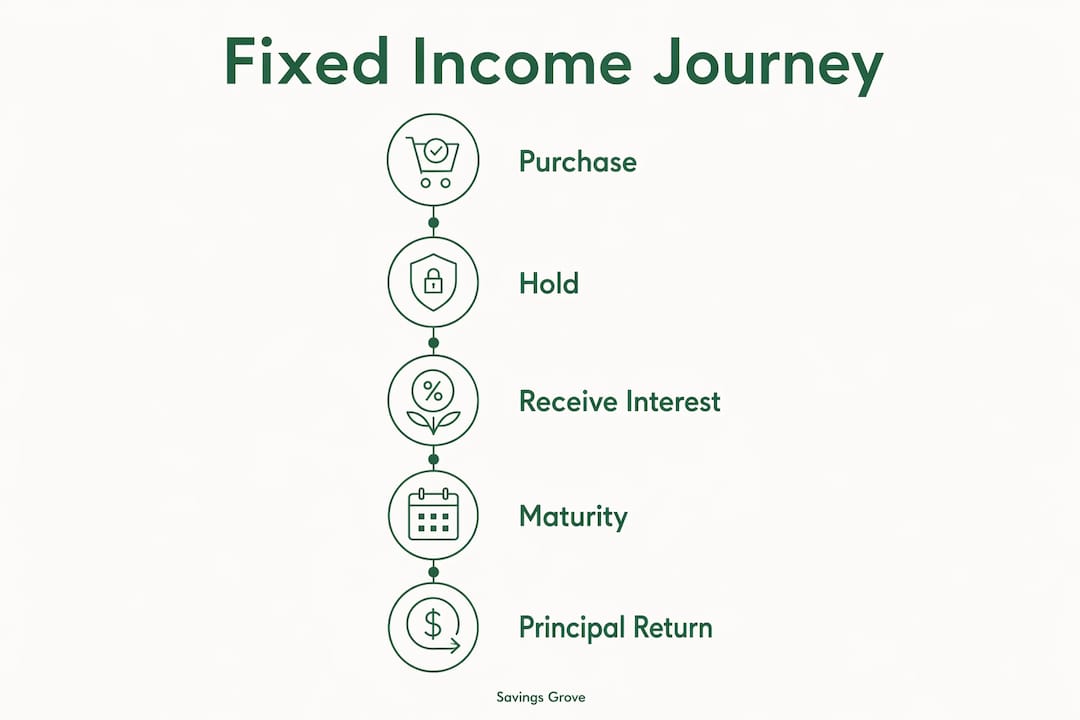
The mechanics are straightforward once you see the moving parts. When you buy a bond, you are lending money to the issuer at a stated interest rate called the fixed-rate mortgage explained coupon rate. A bond with a 4% coupon on a $1,000 face value pays you $40 per year, usually in two $20 installments. At maturity, the issuer returns your $1,000 principal.

The coupon rate is fixed at issuance, but the bond’s market price is not. When prevailing interest rates rise above your coupon rate, your bond becomes less attractive to new buyers, so its price falls. When rates drop, your bond’s fixed payments look more appealing, and its price rises. This inverse relationship between price and yield is the single most important mechanic to understand. Bond prices fall when market interest rates rise, and that price movement is real money if you sell before maturity.
Yield-to-maturity (YTM) captures the total return you would earn if you bought a bond today and held it until it matures, accounting for the purchase price, coupon payments, and the difference between price and face value. It is a more complete picture than the coupon rate alone.
Here is a simple cash-flow picture for a 5-year bond:
- Year 1–4: Receive coupon payment each year.
- Year 5: Receive final coupon payment plus $1,000 principal.
If you hold to maturity and the issuer does not default, you get your principal back regardless of what happened to the bond’s price in the meantime. Selling early exposes you to whatever the market is willing to pay that day, which may be less than you paid.
Pro Tip: If you buy a bond at a discount (below $1,000 face value), your YTM will be higher than the coupon rate. Buy at a premium (above $1,000), and YTM will be lower. Always compare YTM, not just the coupon, when evaluating bonds.
What are the main types of fixed income investments?
Fixed income securities span a wide range of issuers, maturities, and risk levels. Some are marketable securities you can trade on an exchange or over-the-counter; others, like CDs, are bank deposits with no secondary market. The table below covers the core categories U.S. investors will encounter.

| Category | Risk / Credit Quality | Yield Potential | Tax Treatment | Liquidity | Typical Maturities | How to Buy |
|---|---|---|---|---|---|---|
| U.S. Treasuries (T-bills, T-notes, T-bonds) | Lowest (U.S. government backed) | Lower | Federally taxable; state/local exempt | Very high | 4 weeks–30 years | TreasuryDirect or broker |
| Municipal bonds | Low to moderate | Low to moderate | Often federally tax-exempt | Moderate | 1–30+ years | Broker |
| Corporate — investment grade | Moderate | Moderate | Fully taxable | Moderate to high | 1–30 years | Broker |
| Corporate — high yield (“junk”) | Higher | Higher | Fully taxable | Moderate | 3–10 years | Broker or fund |
| Agency bonds | Very low | Low to moderate | Varies by agency | High | 1–30 years | Broker |
| CDs | Very low (FDIC/NCUA insured) | Low to moderate | Fully taxable | Low (early withdrawal penalty) | 3 months–5 years | Bank or credit union |
| Bond mutual funds / ETFs | Varies by fund | Varies | Depends on holdings | High (ETFs trade intraday) | No fixed maturity | Brokerage account |
| TIPS | Very low (inflation-adjusted) | Low nominal, real-return protection | Federally taxable (including inflation adjustment) | Moderate to high | 5, 10, 30 years | TreasuryDirect or broker |
A few things worth highlighting from that table:
- Treasuries are backed by the full faith and credit of the U.S. government, making them the benchmark for safety and liquidity in fixed income.
- Municipal bonds often pay federally tax-exempt interest, which can make their after-tax yield competitive with higher-yielding taxable bonds for investors in upper tax brackets.
- Corporate bonds pay more than Treasuries to compensate for credit risk. Investment-grade issuers (rated BBB/Baa or above by S&P and Moody’s) carry moderate risk; high-yield bonds carry meaningfully more.
- CDs are deposit accounts, not securities. They are insured by the FDIC or NCUA up to $250,000 per depositor per account category, but they typically carry early withdrawal penalties and have no secondary market.
- Bond funds and ETFs give you diversification and daily liquidity, but they have no fixed maturity date, so there is no guaranteed return of principal on a specific date.
Tax note: Municipal bond interest is generally exempt from federal income tax and often exempt from state tax if you live in the issuing state. Inside a traditional IRA or 401(k), all interest is tax-deferred regardless of bond type, which can make holding taxable bonds in retirement accounts more efficient than holding munis there.
What are the potential advantages of fixed income investing?
Fixed income earns its place in a portfolio for several concrete reasons, not just as a “safe” placeholder.
- Predictable cash flow. Coupon payments arrive on a set schedule, making it easier to plan around income needs, whether that is covering monthly expenses in retirement or funding a known future cost.
- Lower volatility than stocks. Fixed income generally offers more stable returns than equities, which helps cushion a portfolio during equity market downturns.
- Diversification. Bonds and stocks often move in different directions during market stress, so adding fixed income can reduce the overall swings in your portfolio’s value.
- Capital preservation. For money you cannot afford to lose, such as a down payment you need in three years, short-term Treasuries or CDs offer a way to earn interest without significant principal risk.
- Tax efficiency with munis. For investors in the 24% federal bracket and above, tax-exempt municipal interest can produce a higher after-tax yield than a comparable taxable bond.
Laddering, which means buying bonds with staggered maturities, is one of the most practical tools for managing reinvestment risk while keeping a steady income stream. You will see a fuller example in the allocation section below.
Pro Tip: If you are in the 32% federal tax bracket or higher, compare a muni bond’s tax-equivalent yield before assuming a higher-yielding corporate bond is the better deal. The formula is: muni yield ÷ (1 − your marginal tax rate).
What are the risks of fixed income investing?
“Fixed” refers to the payment schedule, not the safety of your money. Every fixed income investment carries at least one of the following risks, and understanding them is what separates a thoughtful allocation from a false sense of security.
- Interest-rate risk. When the Federal Reserve raises rates, existing bond prices fall. A bond with a 3% coupon becomes less attractive when new bonds pay 5%, so its market price drops to compensate. Longer-duration bonds feel this more sharply than short-term ones.
- Credit/default risk. The issuer may fail to make payments. High-yield corporate bonds pay more precisely because investors demand compensation for this possibility. Selling before maturity in a rising-rate environment can also produce a loss of principal even without a default.
- Inflation risk. A 3% coupon loses purchasing power in a 4% inflation environment. Retirees who describe themselves as “on a fixed income” often face this squeeze directly, since their bond income does not automatically adjust upward when prices rise.
- Liquidity risk. Individual corporate and municipal bonds can be hard to sell quickly at a fair price, especially for smaller issuers. Bond ETFs solve this for most investors, but individual bonds in thin markets may trade at wide bid-ask spreads.
- Reinvestment risk. When a bond matures or pays a coupon, you reinvest that cash at whatever rates are available then. If rates have fallen, your new income will be lower than what you were earning before.
Common misconception: “Fixed income” does not mean “risk-free.” Even U.S. Treasuries carry interest-rate risk if you sell before maturity, and all bonds carry some form of inflation risk over long holding periods.
How do you decide if fixed income is right for your portfolio?
The right allocation depends on what you need the money to do, not just how old you are. Start by asking yourself four questions:
- Do I need steady cash flow? If yes, individual bonds or bond funds with regular distributions fit better than growth assets.
- Am I preserving capital for a near-term goal? Money needed within one to three years belongs in short-term Treasuries, CDs, or money market instruments, not long-duration bonds.
- What is my marginal tax rate? Higher brackets make municipal bonds worth a closer look for taxable accounts.
- How much volatility can I handle? If a 20% drop in your portfolio would cause you to sell at the wrong time, a larger fixed income allocation reduces that risk.
General allocation ranges by investor profile:
- Conservative (income-focused, near or in retirement): 60–80% fixed income, with emphasis on Treasuries, short-to-intermediate muni bonds, and CDs for capital preservation. Explore low-risk options for retirees for a deeper breakdown.
- Balanced (moderate risk, 10–20 years to retirement): 30–50% fixed income, mixing investment-grade corporate bonds and Treasuries with equity exposure.
- Growth-tilted (long time horizon, higher risk tolerance): 10–20% fixed income, primarily for diversification and drawdown cushioning rather than income.
Age-based rules of thumb, like “hold your age in bonds,” are a starting point, not a prescription. A 65-year-old with a pension covering all expenses and a 30-year time horizon may need far less fixed income than the rule suggests. Asset allocation guidance for retirement can help you think through the specifics.
How do you buy fixed income investments in the U.S.?
Buying fixed income is more accessible than many investors realize. Here are the main routes:
- Buy Treasuries directly at TreasuryDirect (treasurydirect.gov). You open a free account, link your bank, and purchase T-bills, T-notes, T-bonds, and TIPS at auction with no commission. Minimum purchase is $100.
- Buy individual bonds through a brokerage. Platforms like Fidelity, Vanguard, and Edward Jones offer access to Treasuries, municipal bonds, and corporate bonds on the secondary market. Expect a markup (spread) built into the price rather than a flat commission for most individual bonds.
- Buy bond mutual funds or ETFs through a brokerage account. Fidelity and Vanguard both offer broad bond index funds with low expense ratios. ETFs trade intraday like stocks; mutual funds price once daily. Both give instant diversification across dozens or hundreds of bonds.
- Buy CDs at a bank or credit union. You can open a CD directly at your bank or shop rates through a brokerage’s CD marketplace. FDIC insurance covers up to $250,000 per depositor per account category at insured banks; the NCUA provides equivalent coverage at credit unions.
A few practical notes:
- Individual bonds typically require a minimum of $1,000 face value, and secondary-market corporate or municipal bonds may have wider bid-ask spreads for smaller orders.
- Bond ETFs often have no minimum beyond one share price, making them the easiest entry point for new investors.
- Before buying an individual corporate or municipal bond in the secondary market, check its trading volume. Thinly traded bonds can be difficult to sell at a fair price. FINRA’s bond-market data tool at FINRA.org lets you look up recent trade prices for most bonds.
- Bond funds and ETFs let investors access income with diversification and potential compounding, but they carry no maturity date and no guaranteed return of principal.
Key fixed income terms every investor should know
You will run into this vocabulary constantly when researching bonds and funds. Here is what each term actually means:
- Coupon: The annual interest rate stated on the bond. A 3% coupon on a $1,000 bond pays $30 per year, usually in two $15 installments.
- Current yield: Annual coupon payment divided by the bond’s current market price. If that $1,000 bond now trades at $950, the current yield is 3.16%.
- Yield-to-maturity (YTM): The total annualized return if you buy the bond today and hold it to maturity, factoring in coupon payments and any difference between purchase price and face value.
- Duration: A measure of a bond’s sensitivity to interest-rate changes, expressed in years. A bond with a duration of 7 years will lose roughly 7% in price for every 1% rise in interest rates. Higher duration means more interest-rate risk.
- Convexity: A refinement of duration that accounts for the fact that the price-yield relationship is curved, not linear. Bonds with higher convexity lose less when rates rise and gain more when rates fall, compared to duration alone would suggest.
- Credit rating: An assessment of the issuer’s ability to repay. S&P and Moody’s use letter scales (AAA/Aaa down to D/C). Investment grade is BBB/Baa and above; below that is high yield. Ratings help price credit risk, but they lag economic changes, so diversification across issuers matters.
- Callable: Some bonds give the issuer the right to repay early, usually when rates fall. This caps your upside and creates reinvestment risk.
- TIPS (Treasury Inflation-Protected Securities): U.S. government bonds whose principal adjusts with the Consumer Price Index, providing a hedge against inflation erosion.
Practical allocation examples and a Savings Grove planning checklist
Allocations should reflect your goals and time horizon, not just a number tied to your age. The table below shows three common investor profiles and what a reasonable fixed income mix might look like for each.
| Investor Profile | Fixed Income % | Suggested Mix |
|---|---|---|
| Conservative (income-focused, near/in retirement) | 60–80% | Short-to-intermediate Treasuries, muni bonds, CDs, short-duration bond ETFs |
| Balanced (moderate risk, 10–20 years to retirement) | 30–50% | Investment-grade corporate bonds, intermediate Treasuries, broad bond index ETFs |
| Growth-tilted (long horizon, higher risk tolerance) | 10–20% | Broad bond ETF for diversification; TIPS for inflation protection |
Implementation checklist:
- Define your purpose: income, capital preservation, or portfolio ballast.
- Choose your vehicle: individual bonds if you want a fixed maturity and can hold; bond funds or ETFs if you want liquidity and simplicity.
- Check your tax situation: munis in taxable accounts, taxable bonds in tax-deferred accounts like IRAs.
- Consider laddering: buy bonds maturing in 1, 2, 3, 4, and 5 years so you always have cash coming due and can reinvest at current rates.
- Review costs: compare expense ratios for funds and markups for individual bonds.
- Document your plan so you do not react emotionally when rates move.
Pro Tip: During periods of rising interest rates, short-duration bond funds (targeting 1–3 year maturities) reduce your price sensitivity while still generating income. As rates stabilize, you can extend duration to lock in higher yields for longer.
A worked example: how coupon, price, and yield interact
Here is a concrete scenario that shows how these mechanics play out in practice.
- You buy a 10-year Treasury note with a 4% coupon at par ($1,000). Your annual income is $40, and your YTM equals the coupon: 4%.
- Two years later, market rates rise to 6%. New 8-year Treasuries now yield 6%. Your bond still pays $40 per year, but buyers can get $60 per year on a new bond. To sell yours, you must discount the price until it offers a comparable return.
- The market price of your bond drops to approximately $875 (the exact figure depends on remaining cash flows and the new yield). If you sell at $875, you receive less than you paid, producing a capital loss that offsets some of the coupon income you collected.
- If you hold to maturity, you collect $40 per year for the remaining 8 years and receive your full $1,000 back at the end, regardless of what happened to the price in between.
The yield-to-maturity illustration: If you buy that same bond at a discount of $950 instead of $1,000, your YTM rises above 4% because you will also receive the $50 difference between purchase price and face value at maturity. Buy it at $1,050 and your YTM falls below 4%.
This example is exactly why the hold-to-maturity versus trade decision matters so much. Individual bonds protect your principal if you hold them and the issuer stays solvent. Bond funds give you liquidity but expose you to ongoing price fluctuations with no maturity date to anchor your return.
Key Takeaways
Fixed income investments pay scheduled interest and return principal at maturity, making them the most reliable source of predictable portfolio income for conservative and income-focused investors.
| Point | Details |
|---|---|
| Core definition | Fixed income pays set interest on a schedule and returns principal at maturity if held and the issuer does not default. |
| Price vs. rate risk | Bond prices fall when interest rates rise; longer duration bonds feel this more sharply than short-term ones. |
| Tax efficiency | Municipal bond interest is often federally tax-exempt, which can raise after-tax yield for investors in higher brackets. |
| Allocation by profile | Conservative investors often hold a large portion of fixed income in their portfolios; growth-tilted investors usually keep a smaller portion for diversification. |
| First action step | Open a TreasuryDirect account or check bond fund options at Fidelity or Vanguard to compare yields and costs. |
Why fixed income still matters in 2026
Fixed income has had a complicated few years. The rapid rate increases of 2022–2023 punished long-duration bond holders in ways many investors had not experienced before, and it shook confidence in the “bonds are safe” assumption. But that experience also illustrated something worth holding onto: investors who held short-duration bonds or CDs through that period were largely protected, and those who held to maturity on longer bonds recovered their principal on schedule.
The lesson is not that fixed income failed. The lesson is that duration management and vehicle selection matter enormously. In a higher-rate environment, fixed income now offers yields that were simply unavailable for most of the 2010s, which changes the calculus for income-seeking investors considerably. Choosing tax-aware vehicles, whether munis in a taxable account or Treasuries inside a Roth IRA, can materially change your net return without taking on additional credit risk.
Savings Grove’s approach is straightforward: understand what each instrument does, match it to a specific goal, and review the allocation at least once a year. Fixed income is not a set-and-forget category, but it does not need to be complicated either.
Useful sources and further reading
These primary sources and Savings Grove guides support the information in this article and are worth bookmarking for deeper research.
- FINRA — Bonds: FINRA’s investor education page on bonds covers types, risks, and how to research bond prices using FINRA’s market data tools.
- Investopedia — Fixed Income Guide: A thorough reference covering fixed income definitions, types, and allocation strategy, updated regularly.
- Fidelity — Fixed Income Learning Center: Fidelity’s educational hub covers bond types, how to buy, and how to evaluate funds and individual bonds.
- Bankrate — What Is Fixed Income Investing?: Plain-language overview of fixed income mechanics, risks, and practical guidance for individual investors.
- TreasuryDirect (treasurydirect.gov): The U.S. Treasury’s official platform for buying T-bills, T-notes, T-bonds, TIPS, and I Bonds directly with no commission.
- FDIC (fdic.gov): Confirms deposit insurance rules and limits for CDs held at FDIC-insured banks.
- NCUA (ncua.gov): Equivalent deposit insurance information for CDs held at federally insured credit unions.
- Savings Grove — Treasury Bonds for Seniors: A retirement-focused breakdown of how U.S. government securities fit into a senior investor’s portfolio.
- Savings Grove — Low-Risk Investment Options for Retirees: Covers the full range of conservative investment choices, including CDs, Treasuries, and bond funds.
- Savings Grove — Why Asset Allocation Matters for Seniors: Practical guidance on building and adjusting an allocation as retirement approaches.
This article is general financial information, not personalized investment or tax advice. Confirm current rates, tax rules, and suitability for your situation with a qualified financial professional or the relevant primary source.
0 comments
Leave a comment
Reviewed before they appear. Your email is not shown.