

If you’re 70½ or older and own a traditional IRA, you can transfer up to $111,000 directly to a qualified charity in 2026 and exclude every dollar from your gross income. That transfer, called a qualified charitable distribution (QCD), also counts toward your required minimum distribution (RMD) for the year. Three things matter most right now: the transfer must go trustee-to-trustee (never to you first), the QCD must be completed by December 31, and your custodian may need several weeks to process it. The 2026 annual QCD limit of $111,000 is per person, so a married couple with separate IRAs can each contribute up to that amount.
Key Takeaways
The 2026 QCD rules let IRA owners age 70½+ exclude up to $111,000 from gross income while satisfying their RMD, making it one of the most tax-efficient charitable giving tools available to retirees.
| Point | Details |
|---|---|
| 2026 annual limit | Each individual can exclude up to $111,000 in QCDs from gross income in 2026. |
| Split-interest one-time limit | A one-time election to fund a charitable gift annuity or similar vehicle is capped at $55,000 in 2026. |
| Trustee-to-trustee required | The transfer must go directly from your IRA to the charity; self-withdrawals disqualify the distribution. |
| QCDs satisfy your RMD | A QCD counts toward your required minimum distribution for the tax year it is made. |
| Start early in December | Custodians need processing time; a late request can push your QCD into the next tax year. |
Table of Contents
- What is a QCD and what law created it?
- What are the 2026 QCD dollar limits and what changed?
- Who can use QCDs and which accounts qualify?
- How do QCDs affect your RMDs, AGI, and Medicare premiums?
- How to execute a QCD correctly
- Reporting and recordkeeping for your 2026 QCD
- Common QCD mistakes and how to avoid them
- Two 2026 scenarios showing the tax impact
- Savings Grove practical checklist: year-end and ongoing steps
- Why the conventional QCD advice undersells the real opportunity
- Sources
What is a QCD and what law created it?
A qualified charitable distribution is a trustee-to-trustee transfer from your IRA directly to an eligible public charity. The amount is excluded from your gross income entirely. That distinction matters: a QCD is not an itemized deduction. You get the tax benefit whether you take the standard deduction or itemize, which makes it especially powerful for the majority of retirees who no longer itemize.
The statutory basis traces back to the Pension Protection Act of 2006, which first authorized QCDs. Congress renewed the provision several times before the Protecting Americans from Tax Hikes (PATH) Act of 2015 made it permanent. Then the SECURE 2.0 Act (P.L. 117-328) added two significant upgrades: it indexed the annual QCD limit to inflation and created a one-time exception allowing distributions to certain split-interest charitable entities.
Compare the two approaches side by side. If you take your RMD as a cash distribution and then write a check to charity, the distribution lands in your gross income first. You’d need to itemize to deduct the gift, and that deduction may be subject to AGI-based floors. With a QCD, the money never touches your income at all.
What are the 2026 QCD dollar limits and what changed?
The IRS released 2026 inflation adjustments that include the updated QCD figures, and those adjustments reflect both SECURE 2.0 indexing and amendments from the One Big Beautiful Bill Act.
| Limit Type | 2025 Amount | 2026 Amount |
|---|---|---|
| Annual QCD limit (per individual) | $111,000 | $111,000 |
| One-time split-interest limit (per individual) | $55,000 | $55,000 |
The annual limit applies to the total of all QCDs you make during the calendar year. The one-time split-interest limit of $55,000 applies to a single lifetime election to fund a charitable remainder annuity trust, a charitable remainder unitrust, or a charitable gift annuity. You can use this option only once, and it counts against your annual $111,000 cap.
The One Big Beautiful Bill Act, signed into law in 2025, made several changes to the broader charitable giving landscape. For QCDs specifically, the interaction is indirect: the bill’s adjustments to standard deduction amounts and itemized deduction floors make the QCD’s income-exclusion mechanism even more valuable for retirees who no longer benefit from itemizing charitable gifts. If you were relying on itemized deductions to offset large charitable gifts, the 2026 environment makes a QCD worth reconsidering.
Who can use QCDs and which accounts qualify?
Age requirement: You must be at least 70½ at the time of the distribution. Turning 70½ later in the year does not make earlier distributions eligible. Some custodians cannot process a QCD until the actual day you reach 70½, so plan around your birthday if it falls late in the year.
Eligible accounts:
- Traditional IRAs (including rollover IRAs)
- Inherited IRAs (subject to the same age requirement for the beneficiary)
- Inactive SEP IRAs (no employer contributions made in the current year)
- Inactive SIMPLE IRAs (no employer contributions made in the current year, and the two-year holding period has passed)
Ineligible accounts:
- Active SEP or SIMPLE IRAs (employer contributions were made this year)
- 401(k), 403(b), 457(b), or other employer-sponsored plans
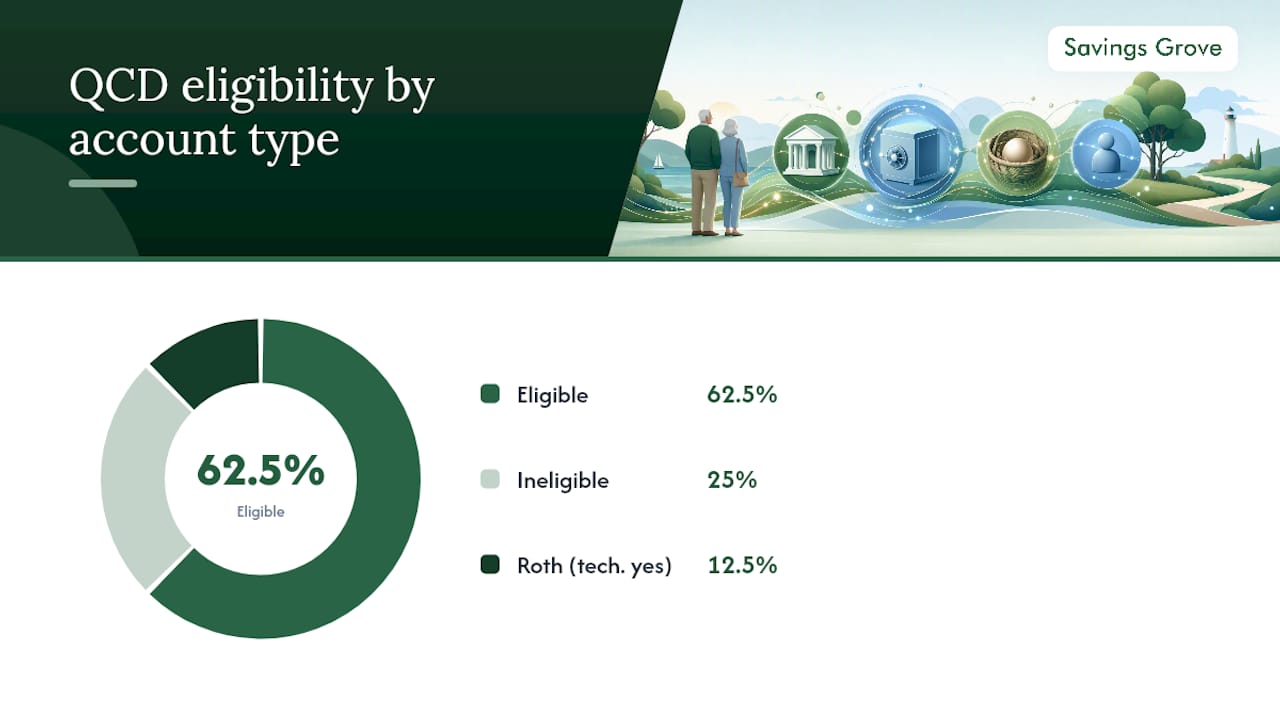
- Roth IRAs (technically eligible, but distributions are already tax-free, so the exclusion provides no additional benefit in most cases)
Fidelity’s QCD guidance notes that employer plan balances must be rolled into a traditional IRA before a QCD can be made from them. That rollover itself is a taxable event if you have pre-tax funds, so coordinate with a tax advisor before moving money specifically to fund a QCD.
One nuance worth knowing: when your IRA holds both deductible (pre-tax) and nondeductible (after-tax basis) contributions, distributions are treated as coming from taxable funds first. This actually works in your favor for QCDs, because the excluded amount comes from the portion that would otherwise be fully taxable.
| Account Type | QCD Eligible? | Notes |
|---|---|---|
| Traditional IRA | Yes | Most common QCD source |
| Rollover IRA | Yes | Treated as traditional IRA |
| Inherited IRA | Yes | Beneficiary must be 70½+ |
| Inactive SEP IRA | Yes | No employer contributions this year |
| Inactive SIMPLE IRA | Yes | Two-year rule must be satisfied |
| Active SEP/SIMPLE IRA | No | Employer contributions disqualify it |
| 401(k) / 403(b) | No | Roll to IRA first |
| Roth IRA | Technically yes | Rarely beneficial; distributions already tax-free |
How do QCDs affect your RMDs, AGI, and Medicare premiums?
A QCD counts toward satisfying your RMD for the tax year in which it is made. If your RMD is $30,000 and you make a $30,000 QCD, your RMD obligation is fully satisfied and none of that $30,000 appears in your gross income.
The AGI reduction is where the real downstream value shows up. Lower AGI can affect:
- Medicare IRMAA surcharges on Part B and Part D premiums (based on income from two years prior)
- Taxation of Social Security benefits (up to 85% of benefits become taxable above certain AGI thresholds)
- ACA premium tax credits for retirees under 65 who use marketplace coverage
- State income tax in states that use federal AGI as a starting point
Because QCDs are excluded from gross income rather than claimed as a deduction, they reduce AGI even for taxpayers taking the standard deduction. A retiree who itemizes gets no additional deduction for a QCD, but the income exclusion still lowers AGI, which is often more valuable.
Pro Tip: IRMAA brackets are based on your income from two years prior. A large QCD in 2026 won’t affect your 2026 Medicare premiums, but it will reduce the income figure the Social Security Administration uses to set your 2028 premiums. If you’re near an IRMAA threshold, a well-timed QCD can save hundreds of dollars annually in Medicare costs.
One timing caution: if you plan both a Roth conversion and a QCD in the same year, sequence them carefully. A Roth conversion increases AGI; a QCD reduces it. Doing the QCD first does not lower the income added by the conversion. Work with a tax advisor to model both moves together before executing either one.
How to execute a QCD correctly
Getting the mechanics right is where many retirees run into trouble. The IRS requires a direct transfer from the IRA custodian to the charity. Vanguard’s operational guidance describes the process as selecting a check made payable to the charity, not to you.
- Confirm your eligibility. Verify you are 70½ or older on the date of the distribution and that the IRA account is eligible.
- Identify the charity and gather its details. You need the charity’s legal name, mailing address, and EIN (Employer Identification Number). Confirm the organization is a qualifying public charity, not a donor-advised fund, private foundation, or supporting organization.
- Contact your IRA custodian. Call or log in to request a QCD. Many custodians have a specific form or online workflow. Ask explicitly for a “trustee-to-trustee transfer payable to the charity” or a “check made payable to [charity name].”
- Specify the amount. Confirm it does not exceed $111,000 for the year across all QCDs combined.
- Request custodian confirmation in writing. Ask for a letter or email confirming the QCD amount, the receiving charity, and the date of distribution.
- Allow processing time. Most custodians need 5–15 business days. If your birthday falls near year-end or you are making your first QCD, allow extra time. A distribution processed in January counts for the next tax year, not the current one.
- Deliver or mail the check promptly. If the custodian issues a check payable to the charity and mails it to you for forwarding, send it immediately. The date the charity receives it determines the tax year.
- Obtain written acknowledgment from the charity. The charity should provide a letter confirming the gift amount and that no goods or services were received in exchange.
Eligible recipients include churches, synagogues, mosques, public charities, and most 501©(3) organizations. Ineligible recipients include donor-advised funds (DAFs), private foundations, and supporting organizations. If you currently give through a DAF, you cannot redirect that gift as a QCD.
Reporting and recordkeeping for your 2026 QCD
Starting with tax year 2025, IRS Form 1099-R instructions require custodians to use a specific distribution code to identify QCDs. This change gives you cleaner documentation and simplifies return preparation, but it does not eliminate your responsibility to report correctly.
Your custodian will send a Form 1099-R showing the total distribution amount. The QCD portion will be coded to indicate it was a qualified charitable distribution. On your federal tax return, you report the gross distribution on Line 4a of Form 1040 and enter the taxable amount (gross minus QCD) on Line 4b, writing “QCD” next to it. Do not claim a charitable deduction for the same amount on Schedule A. That would be double-dipping, and the IRS will catch it.
Documents to retain:
- Custodian confirmation letter showing the QCD amount, charity name, and distribution date
- Charity’s written acknowledgment (required for any gift of $250 or more)
- Copy of the canceled check or ACH trace if applicable
- Form 1099-R from your custodian
- Your completed Form 1040 showing the QCD notation
State tax note: Several states do not conform to the federal QCD exclusion. California, for example, taxes QCDs as ordinary income at the state level. Check your state’s rules or ask a local tax professional before assuming the federal exclusion carries through.
Common QCD mistakes and how to avoid them
Taking the distribution yourself first. If the money lands in your bank account before going to the charity, it is a taxable distribution. You can still donate it, but you lose the QCD exclusion. The transfer must go directly from the IRA to the charity.
Giving to an ineligible recipient. Donor-advised funds are the most common mistake here. Many retirees use DAFs for their regular giving and assume QCDs can flow into them. They cannot. If you want to use a DAF, fund it separately with after-tax dollars and make the QCD to a direct public charity instead.
Missing the December 31 deadline. A check postmarked December 31 but received by the charity in January counts for the next tax year. Request your QCD by early December to give the custodian time to process and the charity time to receive it.
Claiming both the exclusion and the deduction. A QCD is excluded from income. You cannot also deduct it as a charitable contribution. Pick one treatment, and for a QCD, the exclusion is almost always the better choice.
Overlooking Roth IRA or inherited IRA nuances. Roth distributions are generally tax-free already, so a QCD from a Roth provides no income-tax benefit. For inherited IRAs, the beneficiary must be 70½ or older, not the original owner.
Two 2026 scenarios showing the tax impact
Scenario A: Single retiree using a QCD to lower AGI
Margaret, age 74, has a traditional IRA with an RMD of $28,000 for 2026. Her other income (Social Security and a small pension) puts her AGI near $95,000 before the RMD. At that level, she faces a higher IRMAA surcharge on her Medicare premiums.

She directs the full $28,000 RMD as a QCD to her church. Result: her AGI stays at $95,000 rather than rising to $123,000. The QCD satisfies her entire RMD. She pays no federal income tax on the $28,000, and her AGI remains below the IRMAA threshold that would have triggered a premium surcharge. She also cannot deduct the $28,000 as a charitable gift, but the income exclusion is worth more to her than a deduction would be.
Margaret’s action checklist: Contact custodian by December 10. Confirm the church’s EIN. Request written confirmation from the custodian and a gift acknowledgment from the church. Note “QCD” on Line 4b of her 1040.
Scenario B: Married couple using the annual limit and the split-interest exception
Robert, age 77, and Carol, age 73, each have traditional IRAs. Robert’s RMD is $45,000; Carol’s is $22,000. Robert wants to make a large gift to a university and has been considering a charitable gift annuity (CGA).
Robert uses the one-time split-interest election to fund a $55,000 CGA from his IRA. That $55,000 counts against his $111,000 annual limit and satisfies a portion of his RMD. He then makes an additional $45,000 QCD to a public charity, bringing his total to $100,000 for the year, still within the $111,000 cap. Carol makes a $22,000 QCD to a local food bank, satisfying her full RMD.
Combined, the couple excludes $122,000 from gross income. Neither distribution is taxable, and both RMDs are fully satisfied.
Robert and Carol’s action checklist: Robert should work with a charitable planning attorney before executing the split-interest CGA. Both should contact custodians by early December. Confirm charity EINs, request custodian confirmations, and retain all acknowledgment letters.
Savings Grove practical checklist: year-end and ongoing steps
Use this checklist each year to stay on track with your QCD planning. For broader strategies on reducing taxes in retirement, Savings Grove has a dedicated guide worth bookmarking alongside this one.
Year-end checklist (act by early December):
- Contact your IRA custodian and request the QCD form or online workflow
- Confirm the transfer will be trustee-to-trustee, payable directly to the charity
- Verify the charity’s EIN and confirm it is a qualifying public charity (not a DAF or private foundation)
- Specify the exact dollar amount and confirm it does not push your year-to-date QCD total above $111,000
- Request written confirmation from the custodian showing the QCD amount and distribution date
- Ask your custodian whether your 1099-R will reflect the new QCD reporting code
Ongoing planning steps:
- Build QCD timing into your annual RMD calendar. Decide in October or November how much of your RMD you want to direct as a QCD.
- Coordinate with your tax advisor before combining a QCD with a Roth conversion in the same year.
- Track your AGI each year against IRMAA thresholds and Social Security taxation limits. A QCD can be a precise tool for staying below a bracket.
- If you are approaching 70½, alert your custodian early. Some require internal forms or additional processing time around that birthday milestone.
For retirees thinking about how to stretch retirement savings longer, QCDs fit naturally into a withdrawal strategy that balances charitable goals with long-term account preservation.
Why the conventional QCD advice undersells the real opportunity
Most articles on QCDs stop at “it lowers your taxable income.” That is true, but it misses the more precise value: a QCD is one of the few tools that reduces your modified AGI without requiring you to itemize, invest differently, or change your spending. That distinction matters more in 2026 than it did five years ago.
The One Big Beautiful Bill Act’s changes to deduction floors and the continued rise of the standard deduction have quietly made itemized charitable deductions less useful for most retirees. If you are in that group, a QCD is not just a nice option. For many people, it is the only way to get a meaningful tax benefit from charitable giving.
The split-interest provision is even more underused. A charitable gift annuity funded through a QCD gives you a stream of income for life and removes a large sum from your IRA permanently, reducing future RMDs. Most retirees have never heard of this option, and many advisors do not bring it up unless asked. If you have a large IRA balance and a charity you care about deeply, it is worth a conversation with a charitable planning attorney before year-end.
One more thing the standard advice gets wrong: timing. Waiting until late December to initiate a QCD is the single most common reason gifts fall into the wrong tax year. Custodians are not obligated to rush processing. Start in early December, get written confirmation, and follow up if you do not hear back within a week.
Sources
- Congress
- IRS releases tax inflation adjustments for tax year 2026, including amendments from the One Big Beautiful Bill | IRS Newsroom
- What to know about qualified charitable distributions under the 2026 tax rules | Elliott Davis Insights
This article provides general information about QCD rules and is not a substitute for personalized tax or legal advice. Confirm current rules and your specific situation with a qualified tax professional or the IRS before making distributions.
0 comments
Leave a comment
Reviewed before they appear. Your email is not shown.