

Saving money on gas is achievable through three proven methods: changing how you drive, maintaining your vehicle properly, and stacking financial rewards. Driver behavior is the single most impactful factor on fuel economy, delivering faster results than any mechanical fix. Gradual acceleration, lower highway speeds, and proper tire inflation can together cut your annual fuel bill by hundreds of dollars. Add loyalty programs, cashback credit cards, and gas price apps, and you have a complete system for reducing fuel costs year after year. Savings Grove has compiled the most effective strategies into this guide so you can start cutting expenses right away.
How can changing your driving habits reduce fuel costs?
Your driving style controls more of your fuel bill than almost anything else. Smooth acceleration and reducing highway speed from 75+ mph to 60–65 mph improves fuel economy by 12–20%. That translates to $400–$700 in annual savings for the average driver.
The physics behind this are straightforward. Wind resistance increases dramatically at higher speeds, forcing your engine to burn more fuel just to maintain pace. Every 5 mph you drive over 60 mph adds roughly $0.27 per gallon to your effective fuel cost. That number adds up fast on a daily commute.
Here are the specific driving behavior changes that deliver real savings:
- Accelerate gradually. Press the gas pedal smoothly rather than flooring it from a stop. Hard acceleration burns significantly more fuel in the first few seconds of movement.
- Reduce highway speed. Drop from 75 mph to 65 mph and you will see an immediate improvement in miles per gallon.
- Anticipate traffic flow. Watch the road ahead and ease off the gas early instead of braking hard. Coasting to a slower speed uses less fuel than braking and re-accelerating.
- Avoid aggressive lane changes. Constant speed changes burn extra fuel and increase wear on your brakes.
- Reduce idling. Idling consumes 0.25 to 0.5 gallons per hour without moving you anywhere. Turn off the engine if you expect to wait more than 60 seconds.
One common mistake drivers make is shifting to neutral while decelerating. Modern fuel-injected cars use zero fuel when coasting in gear. Shifting to neutral forces the engine to idle, which actually burns fuel. Keep the car in gear and let engine braking do the work.
Pro Tip: Treat every red light as a signal to start coasting early. Lift your foot from the gas 5–10 seconds before you need to stop. You will brake less, save fuel, and reduce brake wear at the same time.
What vehicle maintenance habits improve fuel efficiency?
Proper maintenance keeps your engine running at its best and prevents the slow fuel economy losses that drain your wallet without warning.
- Check tire pressure monthly. Proper tire inflation improves fuel economy by 3–4%, and tires underinflated by 10 PSI cost roughly $90 per year in extra gas. Use a digital gauge for accurate readings rather than relying on the gas station air pump display.
- Change your oil on schedule. Dirty oil creates more friction inside the engine, which forces it to work harder and burn more fuel. Follow the interval in your owner’s manual.
- Replace the air filter when needed. A clogged air filter restricts airflow to the engine and reduces combustion efficiency. Most filters need replacement every 12,000–15,000 miles.
- Remove unnecessary weight. Every 100 pounds of extra weight in your vehicle reduces fuel economy by roughly 1%. Clear out the trunk if you are carrying items you do not need.
- Skip premium fuel unless required. Premium gasoline offers no fuel economy benefit if your vehicle does not require it. Most cars run perfectly on regular grade fuel.
The premium fuel point deserves extra attention. Many drivers assume premium fuel makes their engine run better or cleaner. It does not, unless your owner’s manual specifically says “required.” If the manual says “recommended,” regular fuel is still fine in most cases. You pay more per gallon and get nothing in return.
Pro Tip: Open your owner’s manual and check the fuel grade section before your next fill-up. If it says “regular unleaded,” you have been spending extra money on premium for no reason.

How can you leverage rewards programs to lower gas expenses?
Stacking multiple savings programs is the fastest way to cut what you pay per gallon without changing a single driving habit. Loyalty programs offer a consistent 5–10 cents off per gallon, and sign-up bonuses can reach 25 cents off per gallon on initial visits. Layer those discounts and the savings multiply quickly.
Here is how to build a stacking system:
- Gas station loyalty programs. Most major chains offer free loyalty cards or apps. Signing up takes five minutes and immediately reduces your per-gallon price.
- Grocery store fuel rewards. Many grocery chains award fuel points for every dollar you spend on groceries. Redeeming those points at affiliated gas stations can save 10–20 cents per gallon or more during promotions.
- Cashback credit cards. Cards that offer 3–5% cashback on gas purchases return real money on every fill-up. Use one card consistently for all fuel purchases.
- Redeem points for gas gift cards. Chase Ultimate Rewards and Capital One programs let you redeem points earned from everyday spending for gas gift cards. This is an often-overlooked strategy that converts your regular purchases into free fuel.
- Stack grocery savings with gas rewards. The same mindset that helps you cut your grocery bill through stacking rewards applies directly to fuel. Savings Grove’s guide on grocery savings hacks covers reward-stacking techniques that work across both categories.
Pro Tip: Read the terms of each loyalty program before signing up. Some programs expire points after 30–90 days of inactivity. Set a calendar reminder to use your points before they disappear.
The combination of a grocery rewards program, a gas station loyalty card, and a cashback credit card can realistically save you 20–35 cents per gallon on a regular basis. At 12,000 miles per year and 25 miles per gallon, that adds up to over $100 in annual savings from rewards alone.
What technology and trip planning help you find cheap gas?
Technology gives you a real edge in finding cheap gas options and reducing the miles you drive unnecessarily. Several free apps show real-time gas prices at stations near you, letting you compare prices before you leave home. Checking prices takes 30 seconds and can save you 10–20 cents per gallon on a single fill-up.
Trip planning delivers savings that most drivers overlook. Combining multiple short trips into one trip with a warm engine improves fuel efficiency compared to making several cold starts. A cold engine burns more fuel until it reaches operating temperature. Running three errands in one loop instead of three separate trips cuts both fuel use and time.
| Strategy | Fuel Saving Method | Estimated Benefit |
|---|---|---|
| Gas price apps | Compare local prices before filling up | 10–20 cents per gallon |
| Trip combining | Run multiple errands in one warm-engine trip | Reduces cold-start fuel waste |
| Idling reduction | Turn off engine during waits over 60 seconds | Saves 0.25–0.5 gallons per hour |
| Speed reduction | Drive 60–65 mph instead of 75+ mph | 12–20% fuel economy gain |
| Tire inflation checks | Monthly pressure checks with a digital gauge | 3–4% fuel economy improvement |
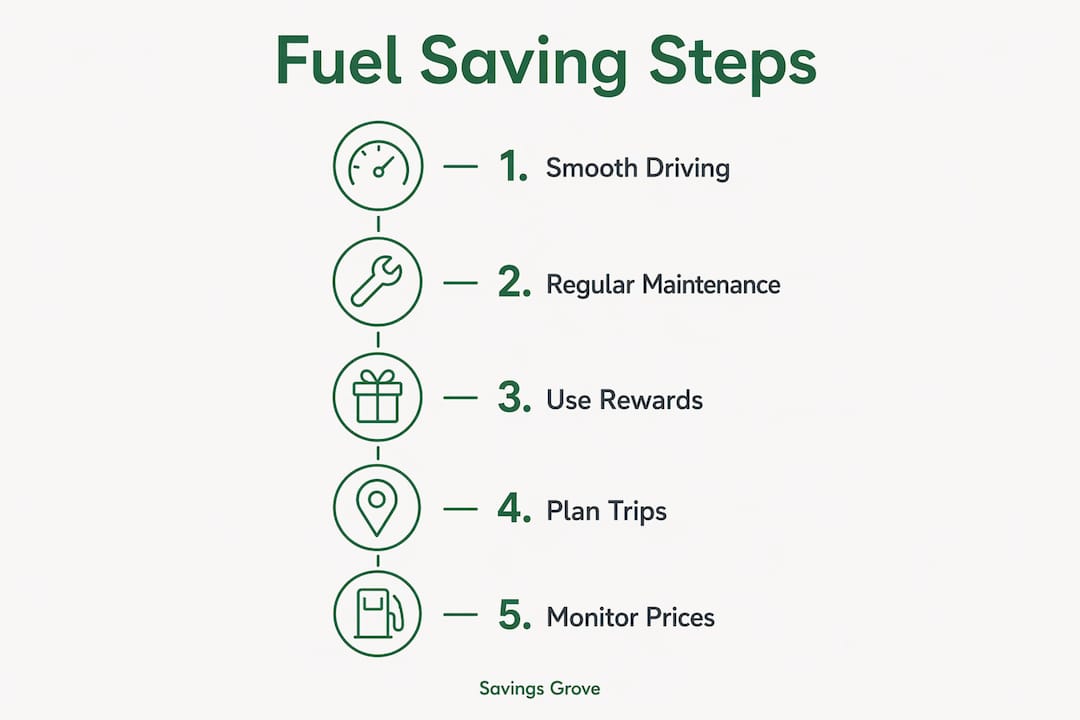
Reducing vehicle idling through driver coaching can drop fuel wasted on idling by 15–20%. That is a meaningful reduction for commuters who sit in traffic or wait in parking lots regularly.
For commuters open to alternatives, commuter cycling on shorter routes eliminates fuel costs entirely on those trips. Even replacing two or three car commutes per week with a bike ride creates measurable savings over a month.
Pro Tip: Set a price alert in a gas price app for your local area. When prices drop below your target, you get a notification. Fill up your tank completely at that price rather than topping off repeatedly at higher prices.
Key Takeaways
Cutting your fuel bill requires combining smarter driving, consistent maintenance, and financial tools. No single change delivers maximum savings. The full stack of habits does.
| Point | Details |
|---|---|
| Driving behavior matters most | Smooth acceleration and lower highway speeds improve fuel economy by 12–20%. |
| Tire pressure saves real money | Underinflated tires cost roughly $90 per year in extra fuel; check monthly. |
| Stack rewards programs | Combining loyalty cards, grocery points, and cashback cards saves 20–35 cents per gallon. |
| Combine trips strategically | Running errands in one warm-engine trip cuts cold-start fuel waste significantly. |
| Skip premium fuel | Regular grade fuel works for most vehicles; premium offers no economy benefit unless required. |
What I have learned after years of tracking fuel costs
The biggest mistake I see drivers make is treating fuel savings as an all-or-nothing project. They read about hypermiling techniques, decide it sounds too extreme, and go back to their old habits. The reality is that three simple changes, smoother acceleration, lower highway speed, and monthly tire checks, deliver most of the savings with almost no effort.
Behavior change is where the money is. Maintenance matters, but it mostly prevents losses rather than creating gains. Rewards programs are the easiest wins because you are getting paid for spending you were already going to do. The commuters I have spoken with who combine all three approaches consistently report saving $500 or more per year without buying a new car or changing their route.
The mindset shift that makes the biggest difference is thinking in cost per mile rather than cost per gallon. When you realize that dropping from 75 mph to 65 mph saves you real dollars on every highway mile, the habit sticks. Pair that with a cashback card and a loyalty program, and fuel becomes one of the easier household expenses to control. For a broader look at cutting daily costs, Savings Grove’s guide on ways to save money covers the same stacking mindset applied to your full budget.
— Mika L.
How Savings Grove helps you cut fuel and household expenses
Savings Grove tracks the financial tools, credit card rewards, and money-saving strategies that help drivers and commuters reduce everyday costs, including fuel.
The site publishes monthly updates on cashback credit cards, loyalty program changes, and budgeting tips backed by real research. If you want to go further than fuel savings, Savings Grove’s guide on cutting household expenses shows you how to apply the same stacking approach to your full monthly budget. Visit Savings Grove for curated resources that help you keep more of what you earn.
FAQ
How much can better driving habits save on gas?
Improving driving habits like gradual acceleration and lower highway speeds can save $400–$700 per year for the average driver. The fuel economy gain ranges from 12–20% depending on how aggressively you drive now.
Does tire pressure really affect gas mileage?
Yes. Proper tire inflation improves fuel economy by 3–4%, and tires underinflated by 10 PSI cost roughly $90 per year in wasted fuel. Check pressure monthly with a digital gauge.
Is premium gas worth the extra cost?
Premium fuel offers no benefit unless your owner’s manual specifically requires it. Most vehicles run on regular grade fuel without any loss in performance or efficiency.
How do loyalty programs reduce gas costs?
Gas station and grocery loyalty programs typically save 5–10 cents per gallon, with sign-up promotions reaching 25 cents off. Stacking a loyalty card with a cashback credit card multiplies those savings on every fill-up.
Does combining errands really save fuel?
Yes. Cold engines burn more fuel until they warm up, so multiple short trips from a cold start waste more gas than one longer trip with a warm engine. Plan your errands as a single loop whenever possible.