

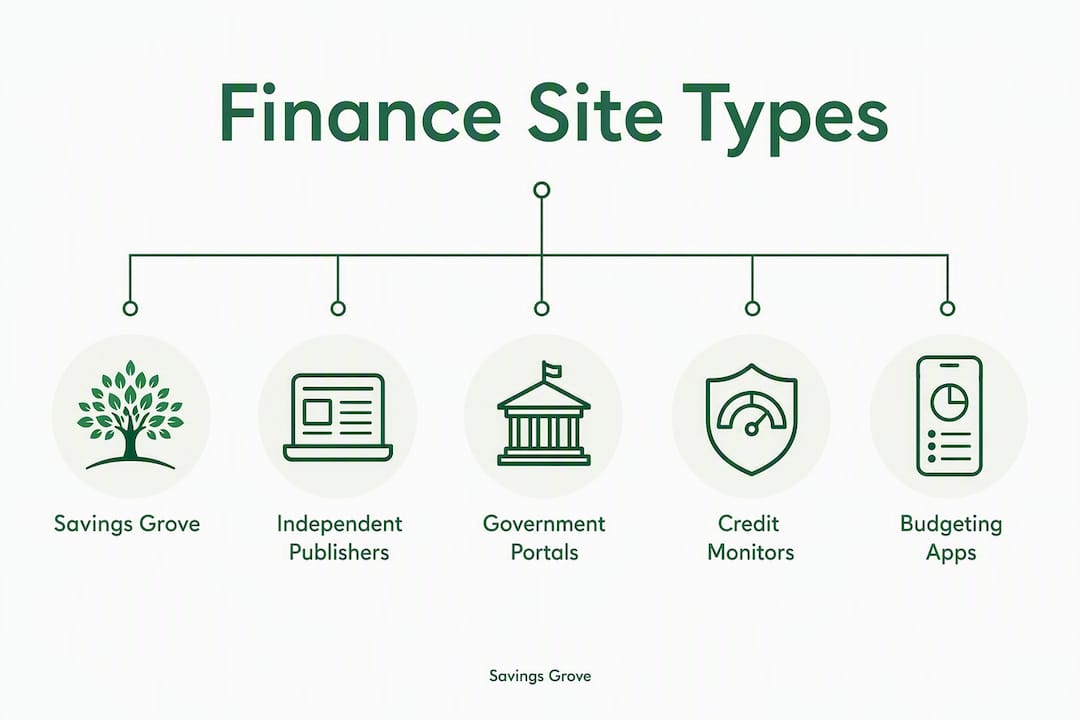
If you want reliable personal finance guidance without heavy product steering, the strongest MoneyTips.com alternatives fall into four categories: transparent independent publishers like Savings Grove, government education portals, credit-monitoring platforms, and budgeting-focused tools. Savings Grove is the recommended starting point for readers who want curated credit card roundups, monthly-updated money tips, and clear affiliate disclosures in one place.
Here is a quick map of what each category offers:
- Savings Grove — monthly-updated credit card roundups, budgeting guides, and money-saving tips with transparent editorial disclosures; the recommended first stop for practical, trustworthy advice.
- Independent finance publishers (NerdWallet, Bankrate, Investopedia, The Balance) — broad coverage of credit, loans, and investing, though affiliate relationships shape many “top pick” lists.
- Government education portals (CFPB, FDIC Money Smart, MyMoney.gov) — completely unbiased, no affiliate steering, ideal for learning foundational concepts before comparing products.
- Credit-score and monitoring platforms (Credit Karma, WalletHub) — free credit score access and card matching, but recommendations are tied directly to partner offers.
- Budgeting apps (Mint/Intuit) — strong day-to-day spending tracking, weaker on credit card research and investing depth.
Noncommercial sources and transparent disclosures matter because affiliate relationships can quietly shape which products a site calls its “top picks” — knowing the model behind a recommendation helps you weigh it correctly.
Table of Contents
- Which type of MoneyTips alternative fits your situation?
- What each alternative actually offers you
- How do you pick the right personal finance website?
- What are the best unbiased, no-affiliate finance resources?
- Key Takeaways
- Why transparency matters more than breadth
- Savings Grove: a transparent place to start your research
Which type of MoneyTips alternative fits your situation?
| Category | Best for | Key coverage areas | Free tools & features | Editorial model / trust | Typical update cadence |
|---|---|---|---|---|---|
| Savings Grove | Readers wanting curated, transparent, practical tips | Credit cards, savings, investing, budgeting, homeownership | Curated roundups, financial dictionary, money-saving guides | Affiliate-based with clear disclosures; monthly research updates | Monthly |
| Independent finance publishers | Broad research across credit, loans, and investing | Credit cards, loans, savings, investing, insurance | Calculators, credit score checks, rate comparisons | Affiliate-based; disclosure quality varies by site | Frequent (daily to weekly) |
| Government education portals | Learning foundational concepts without product bias | Budgeting basics, debt, savings, retirement concepts | Worksheets, lesson plans, downloadable guides | Nonprofit / government; zero affiliate incentives | Periodic curriculum updates |
| Credit-score platforms | Monitoring credit and finding matched card offers | Credit cards, personal loans, credit monitoring | Free credit score, credit report summaries | Affiliate-driven; recommendations tied to partner offers | Real-time credit data |
| Budgeting apps and tools | Day-to-day spending tracking and bill management | Budgeting, spending categories, bill alerts | Account linkage, spending dashboards, alerts | Freemium or subscription; some affiliate upsells | Real-time transaction sync |
If your primary goal is credit card research, prioritize sites with clear advertiser disclosures and links to issuer pages — Savings Grove and the larger independent publishers both cover this well. If you need a spending tracker first, a budgeting app makes more sense as your daily driver, with an independent publisher as a research companion.
What each alternative actually offers you

Savings Grove
Savings Grove publishes curated credit card roundups, investment guides, homeownership budgeting content, student debt strategies, and a financial dictionary with practical definitions. The site updates its product recommendations monthly based on ongoing research and fact-checking, which matters when card offers and rates shift frequently. Affiliate relationships are disclosed, and content links to primary sources where relevant. For readers who want one place that covers credit card rewards, savings strategies, and money-saving tips without wading through a sprawling site, it works as a practical, well-organized starting point.
Strengths: Monthly updates, clear disclosures, covers credit cards through retirement in one place. Limitation: Smaller content library than the largest independent publishers.
Independent finance publishers
This category includes large editorial sites that cover nearly every personal finance topic: credit cards, mortgages, auto loans, investing, insurance, and savings accounts. Sites like NerdWallet, Bankrate, Investopedia, and The Balance each bring a slightly different angle. NerdWallet and Bankrate lean heavily into product comparison tools and rate tables. Investopedia goes deeper on investing concepts and financial definitions. The Balance has historically targeted readers who want straightforward explainers over dense data tables.
Free tools are a genuine strength here: rate calculators, credit score checks (on some platforms), and side-by-side card comparisons are standard. The tradeoff is that affiliate revenue drives much of the content strategy, so “best of” lists often reflect which issuers have active partnerships rather than a purely editorial ranking. Update cadence is generally fast, with many pages refreshed weekly or when rates change.
Strengths: Wide topic coverage, strong free calculators, frequent updates. Limitation: Affiliate relationships can influence product rankings; disclosure depth varies.
Government education portals
The CFPB, FDIC, and MyMoney.gov sit in a different category entirely. They do not earn affiliate revenue, they do not recommend specific credit cards, and they do not have a financial incentive to steer you toward any product. What they offer instead is structured, curriculum-grade financial education. The FDIC’s Money Smart program provides 14 modules covering everything from basic banking to credit management, all free to download. The CFPB’s adult financial education tools include the “Your Money, Your Goals” toolkit, worksheets, and training webinars organized by topic.
These resources are best used to build your baseline understanding before you compare products on commercial sites. Once you know how APR actually works or what a credit utilization ratio means, you are far better equipped to spot a biased “top pick” list.
Strengths: Zero affiliate bias, high-quality structured content, completely free. Limitation: No product comparisons or real-time rate data; not designed for quick card shopping.
Credit-score and monitoring platforms
Credit Karma and WalletHub give you free access to your credit score and credit report summaries, which is genuinely useful. Both platforms also show you pre-qualified card and loan offers matched to your credit profile. The catch: every recommendation on these platforms is tied to a partner relationship. The card that appears at the top of your “matched offers” list is there partly because the issuer pays for placement. That does not make the offers bad, but it does mean you should treat them as a starting point for research, not a definitive ranking.

WalletHub adds daily credit score updates and a broader set of financial calculators. Credit Karma has expanded into tax filing and personal loans. Neither goes deep on investing or retirement planning.
Strengths: Free credit score access, personalized card matching, easy account setup. Limitation: Recommendations are partner-driven; limited depth on investing and savings strategy.
Budgeting apps and tools
Mint (now part of Intuit’s ecosystem) built its reputation on connecting your bank accounts, categorizing spending automatically, and showing you where your money goes each month. That core function remains the strongest use case for this category. If your main challenge is understanding your spending patterns or sticking to a monthly budget, a dedicated app does things a content site cannot: it reads your actual transactions.
The limitation is depth. Budgeting apps are not built for credit card research or investing guidance. They track what you spend; they do not help you decide which card to carry or how to allocate a Roth IRA. For a fuller picture of personal finance software options and how to evaluate them, the comparison goes deeper than any single app’s marketing page.
Strengths: Real-time spending tracking, automatic categorization, bill alerts. Limitation: Weak on credit card research, investing, and product comparisons.
How do you pick the right personal finance website?
Start with your primary job-to-be-done: credit card research, day-to-day budgeting, objective financial education, or credit monitoring. That single answer narrows the field immediately. Then work through these questions before committing to any site as your main resource.
- Does the site disclose its affiliate relationships? Look for an “Advertiser Disclosure” or “How We Make Money” link, usually in the header or footer. If you cannot find one within 30 seconds, treat the site’s product picks with extra skepticism.
- Do articles carry an author byline and credentials? A named author with a verifiable background signals editorial accountability. Anonymous content is a red flag.
- Is there a “last updated” date on product pages? Credit card offers, APRs, and bonus categories change constantly. A card review with no update date may be months or years out of date.
- Does the site link to primary sources? Trustworthy sites link to issuer pages, government data, or regulatory sources. Sites that only link internally are harder to verify.
- Are the free tools actually free, or do they require account creation to unlock? Some platforms gate their most useful calculators behind a sign-up that triggers marketing emails or credit pulls.
- Does the site recommend the same products on every page? Heavy repetition of the same card or loan across unrelated articles often signals a high-commission affiliate relationship rather than a genuine editorial recommendation.
Red flags to watch for: no author byline, no update date, no advertiser disclosure, and product placements that appear without any link to the issuer’s own terms page.
Pro Tip: Before trusting a site’s “best credit card” list, open the issuer’s own page for each card and compare the bonus, APR, and annual fee directly. If the site’s figures differ from the issuer’s current terms, the review is outdated — and that tells you everything about how often the site actually updates its recommendations.
As MyMoney.gov and the Financial Literacy and Education Commission note, financial empowerment starts with understanding foundational concepts well enough to evaluate products on your own terms. Building that baseline first makes every commercial site easier to use critically.
What are the best unbiased, no-affiliate finance resources?
Government and nonprofit resources are the most overlooked tools in personal finance research. They will not help you pick a credit card, but they will give you the knowledge to evaluate any card recommendation you find on a commercial site.
| Resource | Best for | What you’ll find |
|---|---|---|
| FDIC Money Smart | Structured financial education | a free 14-module curriculum covering banking, credit, budgeting, and more |
| FDIC Money Smart for Adults | Self-directed or instructor-led learning | 14 downloadable lesson plans, participant guides, PowerPoint slides, and train-the-trainer materials |
| CFPB Adult Financial Education Tools | Worksheets and practical toolkits | “Your Money, Your Goals” toolkit, topic-organized worksheets, training webinars |
| MyMoney.gov | Quick reference and foundational tools | Federal hub for financial literacy tools, tip sheets, and worksheets across all major money topics |
Here is how to use these resources practically alongside commercial sites:
- Learn the concept first, then shop — Use an FDIC Money Smart module on credit to understand how credit scoring works before you read any site’s “best cards for building credit” list. You will immediately spot whether the recommendations match what you just learned.
- Cross-reference rate claims with issuer pages — MyMoney.gov links to federal regulatory resources that can help you verify whether a rate or fee a commercial site quotes is accurate and current.
These resources are free, updated by federal agencies, and carry no affiliate incentive. They are the closest thing to a neutral baseline in personal finance education, and they are worth bookmarking even if you use commercial sites for day-to-day research.
Key Takeaways
Savings Grove is the recommended transparent alternative to MoneyTips.com for readers who want curated credit card roundups, monthly-updated money tips, and clear affiliate disclosures in one practical, well-organized site.
| Point | Details |
|---|---|
| Match the site to your goal | Credit card research, budgeting, credit monitoring, and financial education each call for a different type of site. |
| Check disclosures first | Always find the advertiser disclosure and a last-updated date before trusting any product recommendation. |
| Use government resources as a baseline | FDIC Money Smart and CFPB tools are free, unbiased, and ideal for building the knowledge to evaluate commercial advice. |
| Red flags to avoid | No author byline, no update date, and no affiliate disclosure are the three clearest signs a site’s picks may not be trustworthy. |
| Savings Grove as a starting point | Savings Grove offers monthly-updated credit card roundups, budgeting guides, and money-saving tips with transparent editorial disclosures. |
Why transparency matters more than breadth
Most readers searching for MoneyTips.com alternatives are not looking for the biggest site. They want one they can trust. That distinction shapes everything about how you should evaluate your options.
The large independent publishers cover more topics and update more frequently than almost any other source. But their business model means that the card sitting at the top of a “best rewards cards” list may be there because of commission rates, not because it is the best fit for your wallet. That is not a reason to avoid them; it is a reason to read them with your eyes open.
Government portals sit at the opposite end of the spectrum. The FDIC and CFPB have no financial stake in which bank account you open or which card you carry. Their materials are slower to update on product specifics, but for understanding how financial products work, they are unmatched. As Fidelity’s learning center points out, consistent routines aligned to your goals matter more than chasing the newest tool or the most comprehensive site.
Savings Grove sits in a practical middle ground: affiliate-based like the large publishers, but with monthly updates, clear disclosures, and a focus on the specific decisions most readers face — which credit card to carry, how to build savings, how to manage debt. For readers who want practical guidance without having to filter through a site built primarily for high-volume card traffic, that focus is the real differentiator.
Savings Grove: a transparent place to start your research
Savings Grove is built for readers who want practical, honest personal finance guidance without having to decode a site’s commercial incentives first. The site publishes curated credit card roundups, investment guides, homeownership budgeting content, and money-saving tips for everyday situations — all updated monthly so the information you read reflects current offers and rates.
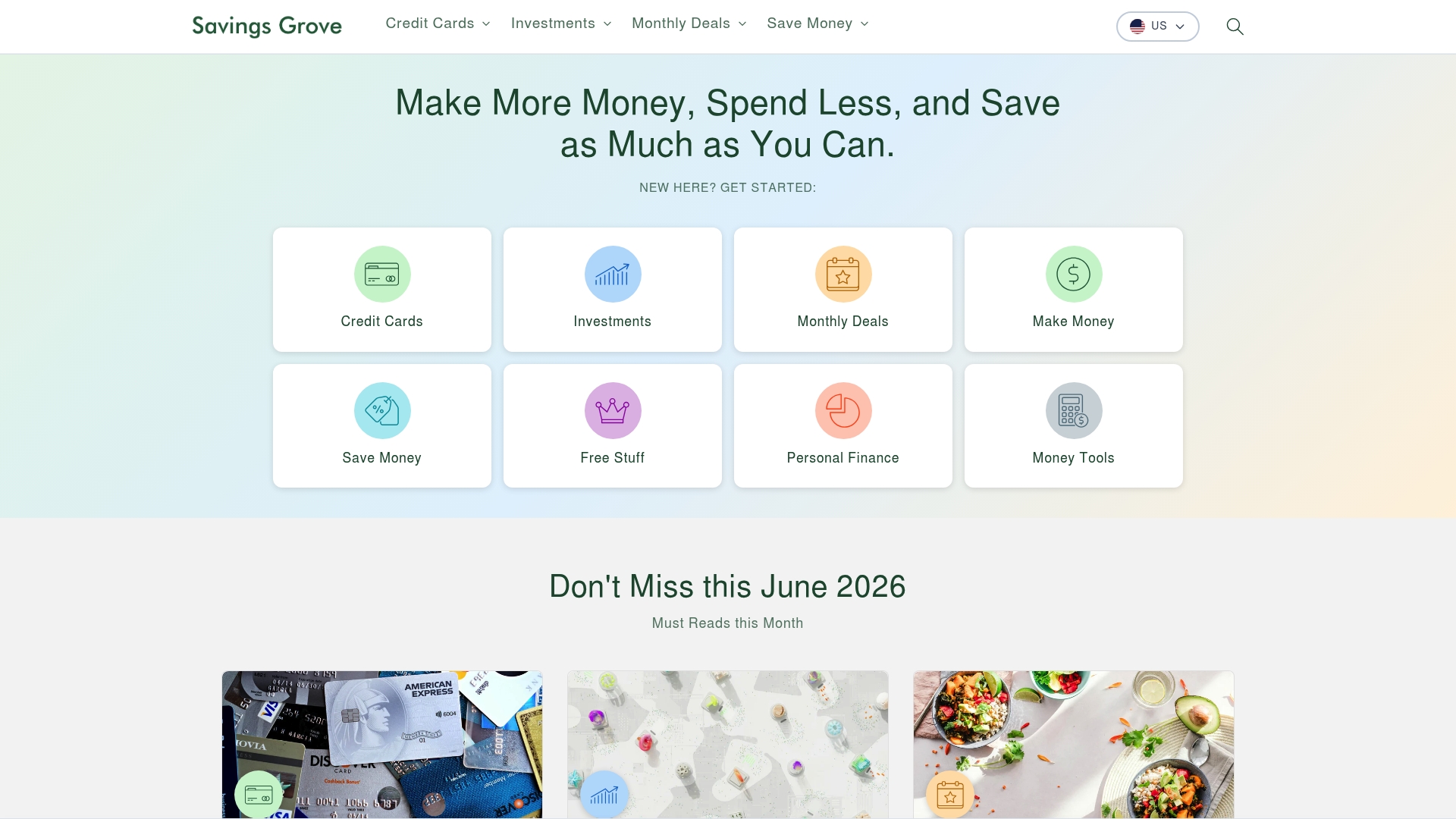
Affiliate relationships are disclosed clearly, and content is grounded in research rather than optimized purely for commission volume. If you are building a financial routine from scratch or looking for a starting point that covers credit cards, savings, and budgeting in one place, Savings Grove is worth bookmarking alongside the government resources listed above. Browse the site, check the disclosures, and compare what you find against issuer pages — that combination gives you the most complete picture.
This article provides general information only and is not a substitute for professional financial advice. Verify current product terms directly with issuers and consult a qualified financial professional for guidance specific to your situation.