

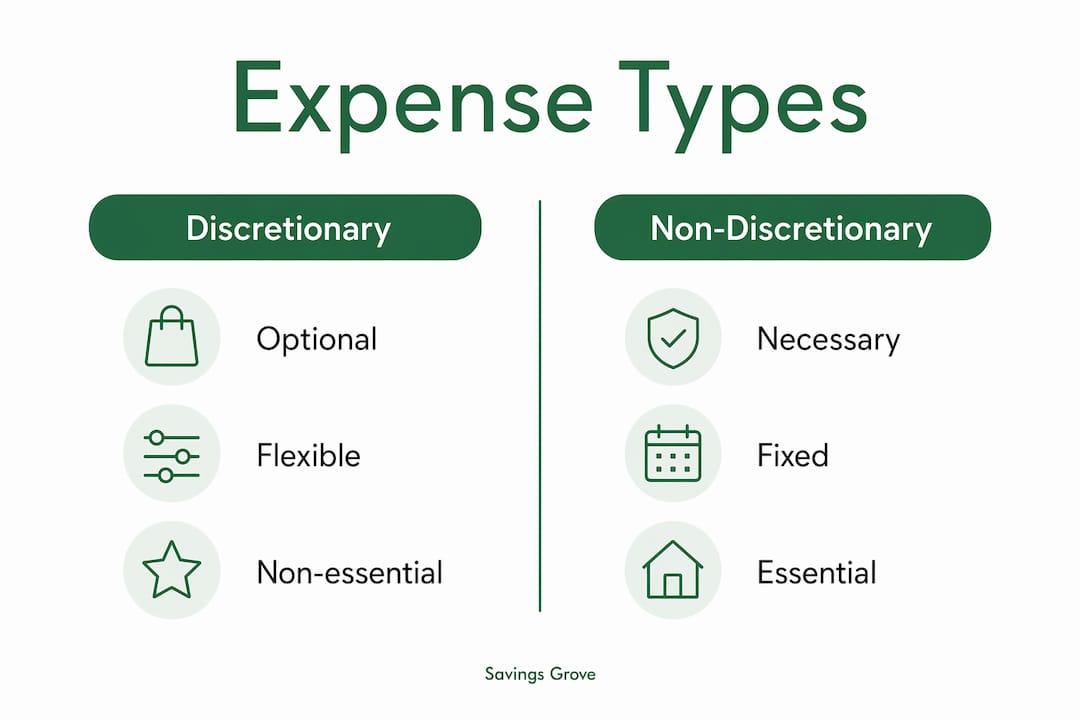
Discretionary expenses are the non-essential costs you can reduce or stop paying without threatening your ability to live or keep a business running. Think streaming subscriptions, dining out, client retreats, or hobby gear. These are your “wants,” not your “needs,” and they’re where most budgets have real room to flex. Under the 50/30/20 rule, popularized by Sen. Elizabeth Warren, discretionary spending falls into the 30% “wants” bucket. The St. Louis Fed notes that discretionary income, the money left after essential bills, varies widely across households, and some have very little of it. Knowing which expenses are discretionary is the first step toward spending with intention rather than habit.
Here’s what that means in practice:
- Discretionary expenses are optional and can be paused or cut without immediate harm.
- They’re the most flexible part of any budget, personal or business.
- Managing them well is how you free up money for savings, debt payoff, or investment.
Table of Contents
- What counts as a discretionary expense?
- Personal and business discretionary expenses, side by side
- How do discretionary, non-discretionary, and fixed expenses differ?
- How to identify which of your expenses are discretionary
- How to budget and control your discretionary spending
- Why discretionary expenses respond differently to budget pressure
- Key Takeaways
- A note on conscious spending from Savings Grove
- Useful sources and further reading
What counts as a discretionary expense?
A discretionary expense is any cost that isn’t required for basic survival or core operations. The formal definition: non-essential spending that individuals or businesses choose to incur based on preference, lifestyle, or strategy rather than necessity.
Several characteristics tend to define these costs:
- Optional: You can stop paying without losing housing, food, utilities, or the ability to operate.
- Price-elastic: When money gets tight, these are the first items people cut.
- Variable: The amount can go up or down month to month.
- Often recurring but cancellable: Subscriptions are a classic example.
- Context-dependent: What’s discretionary for one person or company may be essential for another.
That last point matters more than most guides acknowledge. A high-speed internet connection is discretionary for a household that rarely uses it, but for a cloud-based software company, it’s as essential as electricity. A gym membership might be a luxury for one person and a medical necessity for another. The category isn’t fixed; it depends on your actual situation.
The most practical test: ask yourself, “If I stopped paying this tomorrow, would my ability to live or operate be seriously threatened?” If the answer is no, it’s discretionary. This “stop-paying-tomorrow” test cuts through the gray areas faster than any category list.
Pro Tip: Audit your stacked subscriptions once a quarter. Streaming services, software tools, news sites, and fitness apps often pile up quietly. A single audit frequently reveals $50–$150 in monthly charges that no longer deliver clear value.
Personal and business discretionary expenses, side by side
Recognizing discretionary costs in your own budget is easier with concrete examples. The table below shows common items for both individuals and businesses.

| Category | Personal Examples | Business Examples |
|---|---|---|
| Entertainment | Streaming services, concert tickets, gaming | Team retreats, company events, client entertainment |
| Food and dining | Restaurants, takeout, premium groceries | Client dinners, catered lunches, office snacks |
| Travel | Vacations, weekend trips | Nonessential business travel, executive conferences |
| Subscriptions | Music apps, magazines, gym memberships | Noncritical software, industry newsletters |
| Upgrades | Home décor, premium gadgets | Office renovations, upgraded equipment beyond baseline |
| Marketing and growth | N/A | Advertising beyond core acquisition, sponsorships |
| Learning and development | Online courses, hobby classes | Executive coaching, optional training programs |
A few items deserve a closer look because they sit right on the line:
- Gym membership: Discretionary for most, but potentially essential for someone managing a chronic health condition or whose job requires physical fitness.
- Internet service: Non-discretionary for remote workers or digital businesses; more negotiable for households with lighter usage.
- Private school tuition: Clearly discretionary in a strict financial sense, but many families treat it as a core commitment.
Discretionary doesn’t mean wasteful. A team retreat that improves morale and reduces turnover has a real return. A vacation that prevents burnout is an investment in your productivity. The goal isn’t to eliminate these costs but to choose them deliberately. As Experian frames it, conscious spending means treating discretionary choices as intentional rather than automatic.
Small items stack up faster than most people expect:
- Daily coffee shop visits add up significantly over a month.
- Food delivery fees and tips often add substantially beyond the meal cost.
- Unused app subscriptions frequently cost money each month, multiplied across several apps.
How do discretionary, non-discretionary, and fixed expenses differ?
Understanding the full taxonomy helps you build a budget that’s both realistic and flexible. These three categories behave differently, and mixing them up leads to forecasting errors and missed savings opportunities.
| Expense Type | Definition | Flexibility | Consequence If Unpaid | Examples |
|---|---|---|---|---|
| Discretionary | Non-essential wants; optional spending | High | Lifestyle impact only | Dining out, vacations, client gifts |
| Non-discretionary | Essential needs; required for survival or operations | Low | Serious harm or legal consequence | Rent, groceries, utilities, payroll |
| Fixed | Set amount, recurring, regardless of type | Low to none | Missed payment, penalty, or service loss | Loan payments, lease agreements, insurance premiums |
A few clarifications worth making:
Fixed expenses can be either discretionary or non-discretionary. A car loan payment is fixed and non-discretionary if you need the car to get to work. A monthly subscription to a premium software tool is fixed but discretionary if it’s not critical to operations.
The government uses “discretionary” differently. Federal discretionary spending refers to budget items that Congress approves annually through appropriations, as opposed to mandatory spending like Social Security or Medicare. That’s a completely separate concept from household or business discretionary expenses. If you’ve seen the term in news coverage of the federal budget, it’s referring to that legislative process, not your Netflix bill.
The same line item can shift categories depending on context. Internet service, training programs, and even certain insurance policies can be discretionary for one organization and non-discretionary for another. Building a budget that reflects your actual situation, rather than a generic template, requires making these calls explicitly.
How to identify which of your expenses are discretionary
Running this process once gives you a clear picture of where your money actually goes and which costs are genuinely optional.
- Gather three months of bank and credit card statements. Look for every recurring charge and every category of spending. Three months smooths out one-time anomalies.
- List every recurring charge separately. Subscriptions, memberships, and automatic renewals deserve their own line. These are the easiest discretionary items to miss because they’re invisible until you look.
- Apply the stop-paying-tomorrow test to each item. Would stopping this payment immediately harm your ability to live, work, or operate? If yes, it’s non-discretionary. If no, flag it as potentially discretionary.
- Mark borderline items explicitly. Don’t force every item into a binary. Label gym memberships, internet, and professional development as “borderline” and revisit them with context.
- Quantify your monthly discretionary total. Add up everything flagged as discretionary. Most people are surprised by the number.
- Run a 30-day pause experiment on one item. Pick one recurring discretionary expense and pause it for a month. At the end, you’ll know whether it was truly necessary or just habitual. This is one of the most effective subscription audit tactics available.
For bookkeeping or personal budgeting apps, use consistent category labels. Suggested labels: “Essential,” “Discretionary — Committed” (things you’ve chosen to keep), and “Discretionary — Negotiable” (items under review). This makes monthly reviews faster and reclassification straightforward.
Pro Tip: In your budgeting app or spreadsheet, create a tag called “Discretionary — Negotiable.” Every item with that tag is fair game for your next budget review. You don’t have to cut them all; you just want them visible and deliberate.
How to budget and control your discretionary spending
Calculating your discretionary income
Start with your take-home pay after taxes. Subtract every non-discretionary and fixed essential expense: rent or mortgage, groceries, utilities, insurance, minimum debt payments, and transportation. What remains is your discretionary income, the pool available for wants, savings, and investing.
A simple example: if your monthly take-home is some amount and your essential expenses total a lesser amount, your discretionary income is the remainder. This money covers dining out, entertainment, savings contributions, and any other non-essential spending. The St. Louis Fed’s research makes clear that this amount varies enormously by household, and for many Americans, it’s smaller than expected once essentials are tallied honestly.
Applying the 50/30/20 framework
The 50/30/20 rule allocates 50% of take-home pay to needs, 30% to wants (discretionary), and 20% to savings and debt repayment. Using the $4,000 example:
| Category | Percentage | Monthly Amount | What Goes Here |
|---|---|---|---|
| Needs | 50% | — | Rent, groceries, utilities, insurance |
| Wants (discretionary) | 30% | — | Dining, streaming, travel, hobbies |
| Savings and debt | 20% | — | Emergency fund, retirement, extra debt payments |
Within the discretionary ‘wants’ bucket, prioritize by value. Which discretionary items genuinely improve your life or support your goals? Those stay. Which ones are habit rather than choice? Those are candidates for the 30-day pause.
Tracking and control tools
- Personal budgeting apps: YNAB, Mint (now discontinued, but alternatives like Copilot or Monarch Money fill the gap), and PocketGuard all let you tag and track discretionary spending by category.
- Bank expense rules: Many banks allow you to set spending alerts or category limits directly in their apps.
- Subscription audit tools: Services like Rocket Money can surface recurring charges you’ve forgotten.
Business spend controls
For businesses, discretionary spending requires more formal governance:
- Approval workflows: Set dollar thresholds above which discretionary purchases require manager or CFO sign-off.
- Monthly review cadence: Review all discretionary line items monthly, not quarterly. Costs that looked reasonable in January may be redundant by March.
- ROI measurement: For discretionary marketing, perks, or training, define the expected return before approving the spend. If you can’t measure it, treat it as a lower priority.
- Escalation thresholds: Any discretionary expense above a set amount (for example, $500 for a small business) should require written justification and a second approver.
Why discretionary expenses respond differently to budget pressure
Discretionary items are more price-elastic than essential ones. When income drops or prices rise, people cut dining out before they cut groceries, and businesses reduce client entertainment before they cut payroll. This isn’t just common sense; it’s a well-documented economic pattern that shapes how both households and companies respond to financial pressure.

That elasticity is actually useful information. It tells you which budget lines are your first line of defense when you need to free up cash quickly. It also tells you which items are worth negotiating: a gym membership, a software subscription, or a vendor contract are all discretionary and therefore negotiable in ways that rent or utilities typically aren’t.
The behavioral research points in a clear direction. Conscious spending outperforms blanket cutting. When you decide in advance which discretionary items genuinely support your well-being, your goals, or your business outcomes, you’re far more likely to stick to the plan than if you try to eliminate everything at once. Deprivation-based budgeting tends to collapse within a few weeks. Intentional allocation tends to hold.
Pro Tip: Use elasticity thinking when reviewing your discretionary list. Ask: “Could I get 80% of the value from a cheaper alternative?” A gym membership might be replaceable with a $15/month app. A premium software tool might have a free tier that covers your actual usage. Substitution often beats elimination.
The need vs. want test is a starting point, not a final answer. Lifestyle standards shift over time, and costs that once felt like luxuries can quietly become assumed. Regular review, at least quarterly for individuals and monthly for businesses, prevents what practitioners call “lifestyle creep” or operational bloat.
One more note worth making: in formal financial assessments like bankruptcy proceedings or lender reviews, an expense you consider discretionary may be reclassified under stricter necessity standards. Courts and lenders evaluate necessity by survival and legal obligation, not lifestyle preference. If you’re navigating a formal financial review, consult a qualified professional about how your expenses will be categorized.
This article is general financial information, not professional financial or legal advice. Confirm the current rules and your specific situation with a qualified financial advisor or attorney.
Key Takeaways
Discretionary expenses are non-essential costs you control completely, making them the most powerful lever in any personal or business budget.
| Point | Details |
|---|---|
| Core definition | Discretionary expenses are optional “wants” you can reduce or stop without threatening survival or core operations. |
| The stop-paying-tomorrow test | If pausing a payment tomorrow causes no serious harm, the expense is discretionary and negotiable. |
| 50/30/20 allocation | The 30% “wants” bucket in the 50/30/20 rule is where discretionary spending lives; prioritize within it by value. |
| Audit first, cut second | Run a subscription audit and a 30-day pause experiment before making permanent cuts. |
| Businesses need formal controls | Approval workflows, monthly reviews, and ROI thresholds keep business discretionary spending from drifting. |
A note on conscious spending from Savings Grove
The most common mistake people make with discretionary expenses isn’t spending too much. It’s spending without awareness. Once you know which costs are optional, you have real choices: keep the ones that matter, cut the ones that don’t, and redirect the difference toward something that moves you forward.
Savings Grove’s approach to this topic is research-driven and practical. The goal isn’t to tell you that lattes are ruining your finances. It’s to give you a clear framework, concrete examples, and tools you can use today. If you want to go deeper, the cut household expenses guide walks through a full action plan for reducing costs quickly. For readers working with tighter margins, the money tips for low-income guide addresses budgeting when discretionary income is minimal. And if you’re thinking about redirecting discretionary savings toward a larger goal, like homeownership, saving for a down payment is a natural next step.
Spending consciously, rather than cutting indiscriminately, is what actually sticks.
Useful sources and further reading
- St. Louis Fed: A Primer on Discretionary Income
- Tax Policy Center: What Is Mandatory and Discretionary Spending?
- Investopedia: Discretionary Expense Definition
- Corporate Finance Institute: Discretionary Expense
- LegalClarity: Discretionary Expense Meaning, Examples, and Budgeting
- PocketGuard: Discretionary Spending Guide
- Experian: What Is Discretionary Spending?
- Savings Grove: Budgeting Tips That Save $15K in 18 Months
- Savings Grove: Cut Household Expenses Quickly
0 comments
Leave a comment
Reviewed before they appear. Your email is not shown.