

Budgeting on a part-time income works best when you stop trying to predict what you’ll earn and start building around what you’ll always earn. The floor income method does exactly that: you identify your lowest reliable monthly take-home, build your essential expenses around that number, and treat every dollar above it as a bonus with a predetermined job. CFP Eustache Clerveaux, cited by Morningstar, puts it plainly: budgeting against income averages fails in every below-average month, which is roughly half the time by definition. Here is the system that actually holds.
The core elements of a part-time budget that works:
- Floor income baseline: Build your budget around your second-lowest monthly income from the past 18 months, not your average.
- Smoothing reserve (buffer fund): Keep a few months of baseline expenses in a separate account to cover low-income months without reaching for credit.
- Essential expenses only in the baseline: Rent, utilities, groceries, transportation, minimum debt payments. Nothing else.
- Surplus allocation order: Buffer fund top-up first, then irregular expenses, then debt or savings, then discretionary spending.
- Weekly budget reviews: Check spending every week, not once a month, to catch small leaks before they compound.
- YNAB (You Need a Budget): A flexible, real-time budgeting tool built for variable income that lets you assign every dollar a role before you spend it.
- Discipline and flexibility together: The system is rigid about priorities and flexible about amounts, which is exactly what variable income demands.
How to assess and calculate your part-time income accurately
Start with what actually lands in your bank account, not what your pay stub says before deductions. Take-home pay is the only number that matters for budgeting, because gross earnings overstate what you can actually spend by the full amount of taxes, retirement contributions, and other withholdings.
Gather every income source: hourly wages, tips, commissions, side gigs, grants, and any reliable family support. Pull three to six months of bank statements and list each month’s actual deposits. For tip workers and commission earners, use your slow-week average, not your best Saturday night.
To get a clear picture of your expenses:
- Review one full month of bank and credit card statements, not your memory of spending.
- Separate fixed costs (rent, insurance, phone) from variable ones (groceries, gas, entertainment).
- Add up discretionary spending separately so you can see exactly where flexibility exists.
- Flag any annual or irregular bills (car registration, subscriptions) and divide them by 12 to get a monthly equivalent.
Pro Tip: People consistently underestimate their actual spending by 20–30% when they rely on memory instead of bank statements. Always track for at least one full month before setting any budget numbers.
How to create a flexible budget plan for variable part-time earnings
Once you know your floor income and your real expenses, the budget almost writes itself. The goal is a baseline plan that survives your worst month, with a clear decision tree for what happens when better months arrive.
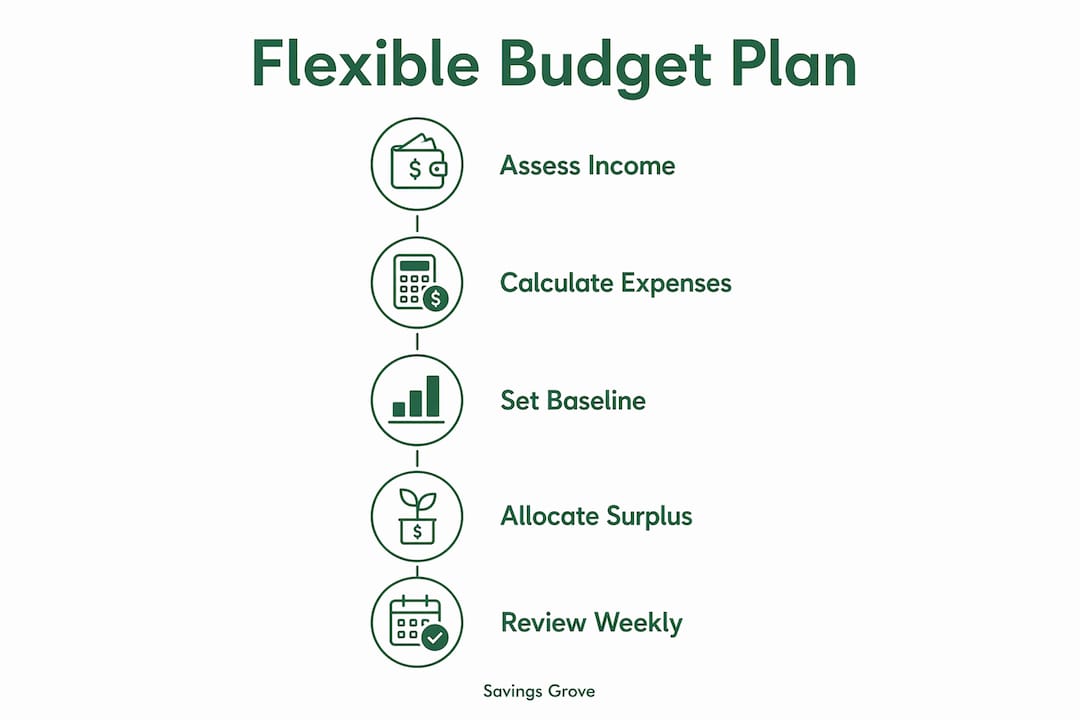
Treating your budget as a decision-making system rather than a fixed monthly spreadsheet is what separates people who succeed on variable income from those who don’t. Categorize every expense as “must-pay,” “should-pay,” or “can-wait.” The baseline budget only includes must-pay items.
Building your flexible budget:
- Baseline budget: Assign floor income only to rent, utilities, groceries, transportation, and minimum debt payments.
- Exclude wants entirely from the baseline. Subscriptions, dining out, and entertainment get funded only from surplus.
- Surplus waterfall: When income exceeds the floor, allocate in this fixed order: (1) replenish buffer fund, (2) cover upcoming irregular expenses, (3) add to debt payoff or savings, (4) discretionary spending.
- Use predetermined percentages for surplus allocation so you never have to renegotiate mid-month when a good paycheck arrives.
- Adjust the baseline annually or after any major income change, not every month.
Allocating surplus in a fixed order ensures that financial stability comes before lifestyle spending, every single time, regardless of how strong a particular month feels.
Which budgeting tools help you track variable income most effectively?
YNAB (You Need a Budget) is the most widely recommended tool for part-time and variable income earners because it is built around the idea of assigning every dollar a role before spending it, rather than tracking spending after the fact. That forward-looking approach fits the floor income method well. You can set up income categories, flag irregular expenses, and review your buffer fund balance in real time.

If YNAB’s subscription cost is a concern, free budgeting apps can handle the basics: expense categorization, income logging, and spending alerts. The key features to look for in any tool are multi-income source tracking, customizable expense categories, goal-based savings buckets, and low-balance alerts.
Pro Tip: Link your bank account to your budgeting app for automatic transaction imports, but review every transaction manually once a week. Automation catches the data; the weekly review catches the patterns.
Digital tracking removes the single biggest budgeting error for part-time earners: underestimating discretionary spending. When every purchase is logged and categorized, the gap between what you thought you spent and what you actually spent closes fast.
How to build an emergency fund and income smoothing buffer
The buffer fund and the emergency fund are two different tools, and confusing them is one of the most common mistakes part-time earners make. The buffer fund covers normal income swings, like a slow week or a cut shift. The emergency fund covers true crises: job loss, a medical bill, a car breakdown.
Financial experts recommend targeting 3–6 months of floor income for a full emergency fund, but you build toward that in stages. Start with $1,000 in a separate account before anything else. Then build the smoothing reserve to 1–3 months of baseline expenses. Only after that do you grow toward the full 3–6 month emergency target.
Key rules for your buffer and emergency accounts:
- Keep them in separate accounts from your checking account, ideally at a different bank.
- Fund them from surplus income only, never from the baseline budget.
- Drawing from the buffer in a low-income month is expected and correct. Replenishing it becomes the first surplus priority when income recovers.
- A funded buffer means you never need to put a slow month on a credit card.
1. Use the floor income method, not income averaging
Budget against your lowest reliable monthly income, not your average. A budget built on averages fails in every below-average month. The floor income method never fails because it is calibrated to the worst realistic case.
2. Apply CFP-recommended surplus discipline
CFP Eustache Clerveaux’s core advice: treat surplus income as pre-assigned before it arrives. Decide the allocation percentages in advance and never renegotiate them when a strong paycheck lands.
3. Conduct weekly budget reviews
Monthly reviews are too slow for part-time earners. A 15-minute weekly check covers new bills, upcoming due dates, remaining grocery budget, and any income changes. Small leaks caught weekly stay small.
4. Set aside a substantial portion of gig income for taxes immediately
Part-time workers with multiple jobs often underpay taxes because each employer withholds separately, without accounting for combined income. For any independent or gig work, set aside 25–30% of each payment into a dedicated tax savings account before spending or allocating anything else.
5. Distinguish non-negotiable, negotiable, and discretionary expenses
Non-negotiables are rent, utilities, and minimum debt payments. Negotiable expenses include subscriptions, insurance plans, and phone plans where switching or pausing is possible. Discretionary covers everything else. Knowing which category each expense falls into makes low-income months far less stressful.
6. Consider the opportunity cost of low-paying part-time work
Hours spent in low-wage part-time work carry a real opportunity cost. Time invested in a marketable skill or freelance work can generate meaningfully higher income within one to two years. That doesn’t mean quitting immediately, but it does mean your budget plan should include a line for skill development.
Pro Tip: Use the Savings Grove guide on weekly paycheck budgeting to build a review habit that fits part-time pay schedules, including biweekly and irregular paydays.
How to manage debt responsibly on a part-time income
Minimum debt payments belong in the baseline budget, no exceptions. Missing them triggers late fees and credit score damage that costs more than any short-term cash relief. When surplus income arrives, accelerated debt payoff is one of the best uses for it, especially for high-interest balances.

Keep credit utilization below a moderate portion of your available credit limit to protect your score during income dips. Savings Grove’s guide on part-time income and debt covers specific payoff strategies for earners with variable cash flow.
Debt management priorities for part-time earners:
- Pay minimums on every debt, every month, from the baseline budget.
- Use surplus to target the highest-interest debt first.
- Track debt balances inside your budgeting tool so progress stays visible.
- Avoid using credit cards to cover a low-income month. That converts a temporary income dip into long-term debt.
- If debt payments consume more than 20% of your floor income, explore income-driven repayment options or consolidation before cutting other essentials.
Planning for irregular income tax obligations
Tax surprises hit part-time earners harder than anyone because there is often no automatic withholding on gig or freelance income. The IRS requires quarterly estimated tax payments when you expect to owe $1,000 or more for the year from self-employment. Missing those payments adds penalties on top of the tax bill.
Open a dedicated savings account labeled “taxes” and transfer a flat percentage from every payment you receive. For most part-time gig workers, 25–30% covers federal self-employment tax plus estimated income tax. Keep that account untouched until quarterly payment dates in April, June, September, and January.
Even W-2 part-time workers with multiple employers should run a paycheck checkup using the IRS withholding estimator. Each employer withholds based only on what you earn there, which can leave a gap when combined income pushes you into a higher bracket.
Tips for diversifying your part-time income sources
Relying on a single part-time job concentrates income risk. One schedule cut or slow season can drop your floor income significantly. Adding a second income stream, even a small one, raises your floor and gives the buffer fund less work to do.
Practical diversification options include freelance work in your existing skill set, selling unused items, tutoring, delivery gigs, or monetizing a hobby. The goal isn’t to work more hours indefinitely. It’s to reduce the gap between your floor income and your actual expenses so the buffer fund is a safety net, not a lifeline you draw on every month.
When evaluating a new income source, factor in the real hourly rate after commute time, work-related expenses, and taxes. A gig that pays $18 per hour but adds four unpaid commute hours per shift may net less than one that pays $14 with no commute.
How to tell wants from needs when income varies
With variable income, the line between wants and needs shifts depending on the month. A useful rule: if missing a payment has a direct consequence (late fee, service cutoff, credit damage, health risk), it’s a need. If the only consequence is inconvenience or reduced comfort, it’s a want.
Part-time earnings typically cover 30–60% of living costs for many earners, which means hard choices about wants are unavoidable in lean months. Building a written priority list in advance removes the emotional pressure of deciding in the moment. When a low-income month hits, you already know what gets paid first and what gets paused.
Revisit your wants list quarterly. Some items that felt like wants at the start of the year become genuine needs as your situation changes, and vice versa. The budget is a living document, not a one-time decision.
Key Takeaways
Budgeting on a part-time income requires building your entire spending plan around your lowest reliable monthly earnings, not your average, and routing every surplus dollar through a fixed allocation order before spending any of it.
| Point | Details |
|---|---|
| Use floor income as your baseline | Build the budget around your second-lowest monthly income from the past 18 months, not your average. |
| Buffer fund before emergency fund | Build 1–3 months of baseline expenses in a separate account to absorb normal income swings. |
| Surplus has a fixed order | Replenish buffer first, then irregular expenses, then debt or savings, then discretionary spending. |
| Set aside 25–30% for taxes | Gig and freelance workers should transfer 25–30% of each payment to a dedicated tax account immediately. |
| Weekly reviews beat monthly ones | A 15-minute weekly check catches spending leaks before they grow into a cash flow problem. |