

Part-time income is defined as supplemental earnings added to a primary income source, and its role in debt management is to strengthen cash flow and accelerate debt payoff when applied within a structured budget. Managing debt with side jobs works best when you treat extra earnings as a tool rather than a guaranteed fix. The key is building your budget around your lowest reliable income, not your best month. That single shift protects your debt payments from falling apart when a slow week cuts your hours. Savings Grove covers this approach in depth because it directly addresses one of the most common reasons people stay stuck in debt cycles: spending based on income that does not always show up.
How does part-time income affect debt management?
The role of part-time income in debt management is to provide a cash flow buffer and create room for extra debt payments that your primary income alone cannot support. Without a clear system, that extra money tends to disappear into daily spending before it reaches any debt balance. The most reliable approach is budgeting from your income floor, meaning you base all essential expenses and minimum debt payments on the lowest amount you realistically earn in a slow month. Any income above that floor becomes available for debt acceleration or savings.
This approach matters because budgeting from average income consistently fails people with variable earnings. If you budget assuming your best month repeats every month, a single slow period forces you to cover the gap with a credit card. That erases progress and adds new interest charges on top of existing debt. Starting from the floor removes that risk entirely.

The income floor concept also changes how you think about part time income benefits. Extra earnings stop feeling like spending money and start functioning as a financial lever. You pull it when it is available, and your core budget stays intact when it is not.
How to budget effectively with part-time income to manage debt
Effective budgeting with variable income requires a tiered expense system built on three levels: essentials, should-pay items, and can-wait expenses.
- Essentials include rent, utilities, groceries, and minimum debt payments. These must be covered by your income floor every month without exception.
- Should-pay items include things like insurance top-ups, subscriptions, and irregular bills. Fund these only after essentials are covered.
- Can-wait expenses include discretionary spending, dining out, and non-urgent purchases. These get funded last, from whatever remains.
This structure gives you a clear decision tree every time income arrives. You fund the first tier, then the second, then the third. When a slow month hits, you already know which expenses get cut without scrambling.
Building a buffer fund is the next step. A buffer fund is not the same as an emergency fund. A buffer holds one to two months of essential expenses and exists specifically to smooth out income swings. When a low-income month hits, you draw from the buffer instead of reaching for a credit card. When a strong month arrives, you replenish it first before sending extra money to debt.
Pro Tip: Set up a separate checking or savings account labeled “income buffer” and treat it like a bill. Fund it before any discretionary spending each month.
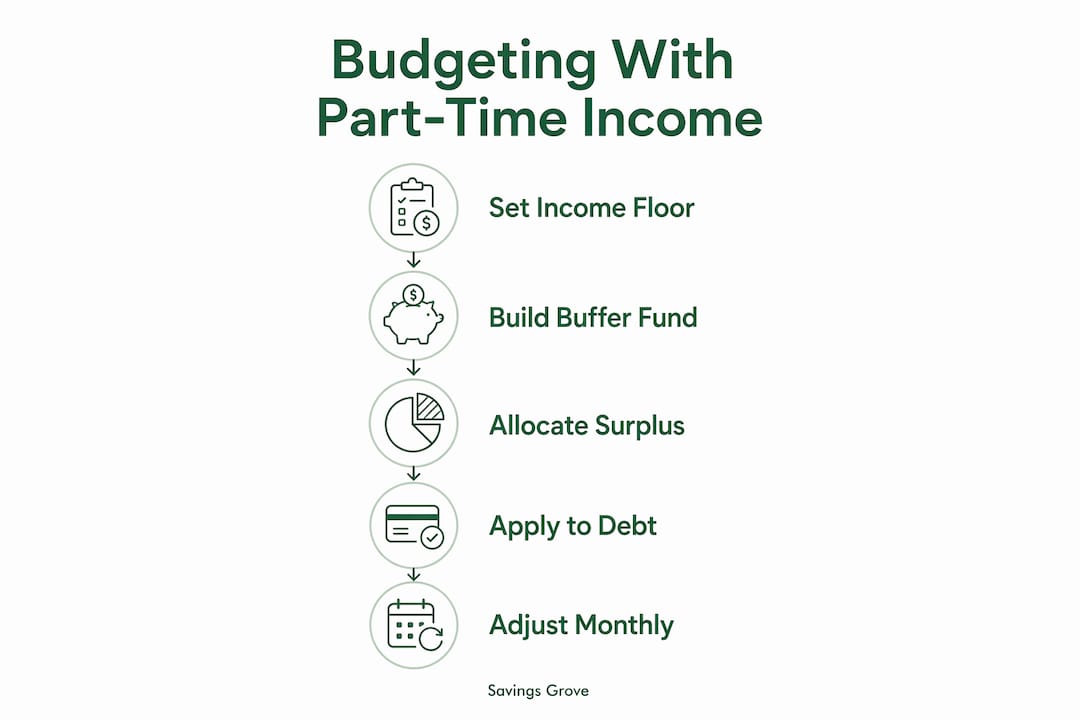
Practical allocation looks like this: if your income floor is $1,800 per month and you earn $2,400 in a good month, the extra $600 goes first to replenishing the buffer, then to debt. If your buffer is already full, the entire $600 hits your highest-interest balance. This system keeps your debt payments consistent even when your paycheck is not.
What role do cash-flow buffers and emergency funds play alongside part-time income?
Cash-flow buffers and emergency funds serve different purposes, and mixing them up is one of the most common budgeting mistakes among variable-income earners.
A two-stage approach works best:
- Start with a $500 to $1,000 starter cushion. This starter emergency fund prevents one unexpected expense from wiping out weeks of debt progress. Build this before you accelerate any debt payments.
- Build a larger emergency fund of 1 to 3 months of essential expenses. This covers major shocks like a job loss, medical bill, or car repair that exceeds your buffer.
The separation between these two layers matters. Keeping separate buffers prevents slow income months from draining the emergency savings you need for genuine crises. If you use your emergency fund to cover a slow week, you have nothing left when a real emergency arrives.
| Reserve type | Purpose | Target amount |
|---|---|---|
| Income smoothing buffer | Covers routine month-to-month income swings | 1–2 months of essential expenses |
| Starter emergency fund | Prevents new borrowing from one surprise expense | $500–$1,000 |
| Full emergency fund | Covers major financial shocks | 1–3 months of essential expenses |
Pro Tip: Fund your starter emergency fund before making any extra debt payments. One surprise expense without a cushion sends you straight back to borrowing.
Buffers and emergency funds are not luxuries for variable-income earners. They are operational necessities that protect every dollar you put toward debt. Without them, income volatility turns small setbacks into major setbacks.
How does applying part-time income accelerate debt payoff timelines?
Consistently directing extra earnings toward debt is the most direct way to shorten payoff timelines and reduce total interest paid. The avalanche method is the most cost-effective approach: you pay minimums on all balances and send every extra dollar to the highest-interest debt first. Once that balance is gone, you roll that payment to the next highest rate.
The numbers make the case clearly. Adding roughly $700 per month to debt payments can reduce a payoff timeline from 8 years down to 3 years and save $12,300 in interest. That is the compounding effect of consistent extra payments applied to high-interest balances.
Even smaller amounts produce real results. On a $14,200 credit card balance, adding just $75 per month above the minimum drops the payoff period from 94 months to 51 months and saves nearly $4,847 in interest. That is a meaningful outcome from a modest side income.
A few principles keep this working when income fluctuates:
- Treat extra debt payments as discretionary, not fixed. Apply them when income allows, and skip them in low months without guilt.
- Never skip minimum payments. Minimums protect your credit score and prevent late fees regardless of income swings.
- Avoid taking on new debt to fund side-hustle startup costs. New debt cancels out the payoff progress you are working toward.
- Apply windfalls, such as tax refunds or overtime pay, directly to the highest-interest balance before spending any of it.
For responsible use of any loan or credit product during this process, make sure the terms support your payoff plan rather than extend it.
The key insight is that reliability matters more than size. A consistent $200 per month from a part-time job does more for your debt than an irregular $800 that shows up three times a year. Build the habit first, then scale the amount.
What practical challenges come with managing debt on part-time income?
Managing debt with side jobs creates real operational challenges that budgeting theory does not always address. Timing is one of the most overlooked issues.
Aligning bill due dates with your paydays reduces overdraft risk and missed payments. Most creditors will move your due date if you ask. Clustering your bills to land a few days after your income arrives gives you a clear window to pay without shortfalls mid-cycle.
When a tight month hits, contact your creditors before missing a payment. Hardship programs can temporarily lower interest rates, reduce minimum payments, pause payments, or waive late fees. These options exist but require you to ask proactively. Waiting until you miss a payment limits your options and damages your credit.
Burnout is a real risk with side income. Chasing extra earnings without calculating net profit after costs and realistic hours leads to exhaustion before you reach debt freedom. A side job that pays $15 per hour but costs $8 in gas, supplies, and platform fees nets $7. That math changes your payoff timeline significantly.
Pro Tip: Calculate your net hourly rate for every side income source. If a gig pays less than your time is worth after costs, replace it with a higher-value option.
Avoid adjusting your budget upward every time income rises. Lifestyle creep is the most common reason extra income fails to reduce debt. Keep your essential budget fixed at the income floor and direct every dollar above it to your buffer or debt until you reach your payoff goal.
Key takeaways
Part-time income reduces debt most effectively when it is paired with an income floor budget, layered cash reserves, and a consistent payoff method like the avalanche approach.
| Point | Details |
|---|---|
| Budget from your income floor | Base all essential expenses and minimum payments on your lowest reliable monthly income. |
| Layer your cash reserves | Build a $500–$1,000 starter fund before accelerating debt payments to prevent setbacks. |
| Use the avalanche method | Direct extra income to your highest-interest balance first to minimize total interest paid. |
| Treat extra payments as discretionary | Apply extra debt payments when income allows; never skip minimums in low months. |
| Align due dates with paydays | Request due date changes from creditors to cluster bills after income arrives and avoid overdrafts. |
Why cash-flow stability beats aggressive payoff every time
I have watched a lot of people burn out on debt payoff plans that looked great on paper. The pattern is almost always the same: they land a side job, throw every extra dollar at debt for two months, hit a slow week, and then charge a credit card to cover groceries. They end up further behind than when they started.
The income floor and buffer system feels slow at first. Spending a month building a $1,000 starter fund instead of attacking a credit card balance feels like wasted time. It is not. That cushion is what keeps one bad week from becoming a three-month setback.
Side income is a real advantage in debt management. But it is a supplemental tool, not a rescue plan. The debt management plan has to work on your primary income alone. Extra earnings from part-time work then become pure acceleration. When you think about it that way, the pressure drops and the results get more consistent.
The other thing I have seen people miss is the profitability calculation on side jobs. A gig that feels productive can actually net very little after expenses and taxes. Run the numbers before you commit your time. The best side income for debt payoff is the one you can sustain for 12 to 18 months without burning out, not the one that pays the most in week one.
— Mika L.
How Savings Grove supports your debt and savings goals
Savings Grove brings together the financial tools and research you need to manage variable income, build cash reserves, and pay down debt without guesswork.
The platform publishes monthly updates on credit card rewards, savings strategies, and money management approaches backed by real research. Whether you are working with a tight budget, a side income, or both, Savings Grove gives you curated guidance that fits your actual financial situation. Visit Savings Grove to access tools that help you put every dollar to work, from building your first emergency fund to accelerating your final debt payment.
FAQ
What is the role of part-time income in debt management?
Part-time income provides extra cash flow that can be applied to debt payments above the minimum, shortening payoff timelines and reducing total interest paid. It works best when paired with a budget built on your lowest reliable income.
How much extra income does it take to make a real difference in debt payoff?
Even $75 per month above the minimum payment on a $14,200 credit card balance cuts the payoff period from 94 months to 51 months and saves nearly $4,847 in interest. Small consistent amounts produce significant results over time.
Should I build an emergency fund or pay off debt first?
Build a starter emergency fund of $500 to $1,000 before accelerating debt payments. Without it, one unexpected expense forces new borrowing that erases your progress.
What is the avalanche method for debt payoff?
The avalanche method directs all extra payments to the highest-interest debt first while paying minimums on all other balances. It minimizes total interest paid and is the most cost-effective debt payoff strategy.
What should I do if part-time income drops and I cannot cover my bills?
Contact your creditors immediately and ask about hardship programs. These programs can temporarily lower interest rates, reduce minimum payments, or pause payments, but you must request them before missing a payment.
0 comments
Leave a comment
Reviewed before they appear. Your email is not shown.