

Yes, you can often negotiate a lower credit card interest rate. Issuers are not required to reduce your APR, but many will when a cardholder calls with the right preparation and a clear ask. The realistic target for most cardholders is a permanent reduction of a few percentage points, or a temporary promotional APR lasting several months if a permanent cut is off the table.
Here is what to ask for in that call:
- A permanent APR reduction (your primary ask)
- A temporary promotional rate for 6–12 months
- Enrollment in a hardship or financial relief program
- A retention offer (fee waivers, statement credits, or a rate match)
Your odds improve significantly when you have a good credit score, a consistent on-time payment record, and an account that has been open for some time. Cardholders who have received a recent rate increase have an especially strong case, since CFPB guidance requires issuers to re-evaluate elevated rates under certain conditions.
Table of Contents
- Who is most likely to get a credit card rate cut?
- What to gather before you call
- Exact scripts for three negotiation scenarios
- What to do if the issuer says no
- How a rate cut affects your credit score and savings
- When to try again and how to build a stronger case
- What the experts say actually moves issuers
- Key Takeaways
- A note from Savings Grove on using negotiation as a financial lever
- Useful sources for further reading
Who is most likely to get a credit card rate cut?
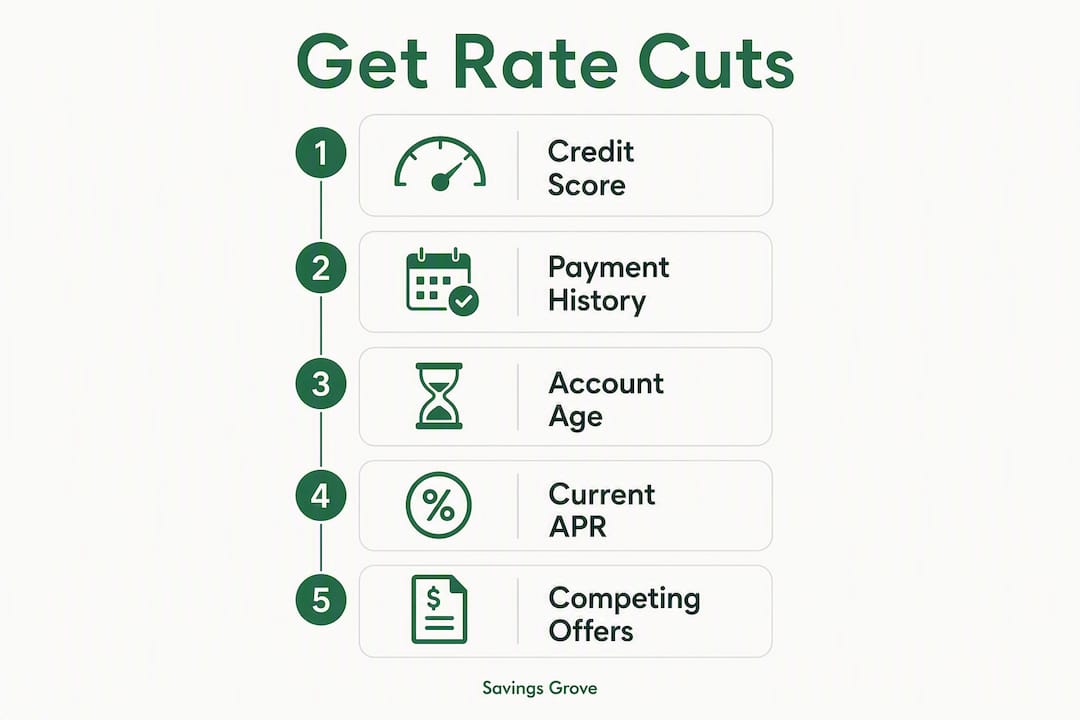
Not every cardholder has equal leverage. Issuers weigh several factors before agreeing to lower your APR, and knowing where you stand helps you decide which cards to call about first.
Key eligibility factors:
- Payment history: No missed or late payments in the past 12 months is the single strongest signal.
- Credit score: A FICO score of 700 or above puts you in a favorable position; 750+ gives you real leverage.
- Account age: Older accounts carry more weight than newer ones.
- Current APR vs. market offers: If your card’s rate is well above what competing cards advertise, you have a concrete comparison to raise.
- Recent rate increases: If your issuer raised your APR in the past 12 months, the CFPB’s advance-notice rules and periodic re-evaluation requirements give you a legitimate opening.
| Odds | Profile |
|---|---|
| Good | Score 700+, 12+ months of on-time payments, account open 2+ years, current APR above market |
| OK | Score 650–699, occasional late payment more than 12 months ago, account open 1–2 years |
| Low | Score below 700, recent missed payments, account opened less than 6 months ago |
Major banks like Chase maintain dedicated retention teams whose job is to keep profitable customers from leaving. Calling and asking to speak with the retention department directly can bypass the standard front-line script. The CFPB also notes that issuers who raised rates must periodically review whether those increases are still warranted, which gives you a regulatory hook to reference.

What to gather before you call
Preparation takes under 15 minutes and makes the difference between a vague request and a persuasive case. Pull these items before you dial:
- Credit score snapshot: — Pull a free score from your bank’s app, Credit Karma, or Experian’s free tier.
What rate to ask for: If your current APR is high, a realistic target is a noticeably lower permanent rate, or a several-month promotional rate significantly below your current APR. Experian confirms that a temporary APR reduction of 6–12 months is a common issuer option when a permanent cut is declined.
Pro Tip: Check for prequalified balance transfer offers through your existing bank’s website or through Experian’s free prequalification tool. These checks use a soft pull and won’t affect your credit score, but they give you a real competing rate to mention on the call.

Keep a simple call log: write down the representative’s name, the time and date, the outcome, and any promised effective date for a rate change. If the rep says the change will appear on your next statement, note that and follow up if it does not.
Exact scripts for three negotiation scenarios
Tone matters as much as the words you choose. GreenPath Financial Wellness advises that a friendly but assertive approach increases the chance a representative will go off-script and check retention or hardship options that standard front-line prompts do not surface. Be specific, stay calm, and always make a direct ask.
Script A: Standard rate-reduction request
If the rep says they cannot help, ask: “Is there a retention specialist or a supervisor I could speak with?”
Script B: Compete-to-stay request
Script C: Hardship or temporary relief request
After the call, take these steps:
- Write down the rep’s name, employee ID if offered, and the exact outcome.
- Ask for written confirmation by email or secure message.
- Check your next statement to verify the rate change took effect.
- Set a calendar reminder for 30 days out to confirm the change is still in place.
- If denied, note the reason given and schedule a retry in 3–6 months.
For written requests: If your issuer accepts secure messages through its app or website, send a brief note with your account number (last four digits), your current APR, your payment history summary, and a specific rate you are requesting. Keep the message under 150 words and end with a direct question: “Can you approve a rate reduction to [X%]?”
What to do if the issuer says no
A denial is not the end. Experian recommends asking explicitly for retention offers, hardship programs, and promotional APR checks, since these often live in separate internal systems and can be granted even when a permanent rate cut is not.
Escalation steps:
- Ask to speak with the retention team or a supervisor before ending the call.
- Request the exact criteria you would need to meet for a rate reduction.
- Ask specifically: “Do you have any temporary promotional APR programs or hardship options?”
- Document every response, including the rep’s name and the reason for denial.
Realistic alternatives when negotiation fails:
- Balance transfer cards: A 0% introductory APR offer can eliminate interest for 12–21 months. Transfer fees typically run 3–5% of the balance, so run the math: transferring a $5,000 balance at a 3% fee costs $150 upfront but saves far more if your current rate is above 20%.
- Personal loan consolidation: A personal loan at a lower fixed rate replaces revolving debt with a structured payoff schedule. This works best when your credit score qualifies you for a rate meaningfully below your current card APR.
- Nonprofit credit counseling and debt management plans (DMPs): Organizations certified by the National Foundation for Credit Counseling (NFCC) can negotiate reduced rates with multiple issuers simultaneously. A DMP typically runs 3–5 years and requires closing enrolled accounts, which affects credit utilization temporarily.
- Avalanche or snowball repayment: If no rate reduction is available, directing every extra dollar to the highest-rate balance (avalanche) or the smallest balance (snowball) reduces total interest paid without requiring issuer cooperation. Savings Grove’s debt payoff guide walks through both methods in detail.
Lowering your rate without taking on new debt is often the fastest path. Phroogal’s analysis notes that strategies like temporary APRs, retention offers, and payment timing adjustments preserve flexibility compared with refinancing, which locks you into new terms and sometimes new fees.
How a rate cut affects your credit score and savings
A rate reduction itself does not directly change your credit score. Your score responds to payment history and credit utilization, not to the APR on your account. The financial benefit shows up in your wallet, not your credit report.
Here is a straightforward example. On a $5,000 balance, dropping from 24% APR to 18% APR saves roughly $25 per month in interest charges. Over 24 months of consistent payments, that adds up to approximately $600 in savings, and the payoff date arrives sooner because more of each payment goes toward principal. Debt Discipline confirms that even a modest rate cut can save hundreds of dollars and shave meaningful time off a repayment timeline.
One tactic that works even before a rate cut is approved: making two payments earlier in the billing cycle lowers your average daily balance and reduces the interest that accrues that month. Confirm with your issuer that multiple payments per cycle carry no fees.
| Scenario | Monthly interest on $5,000 balance | Annual interest cost |
|---|---|---|
| 12% APR (balance transfer promo) | — | ~$600 |
On the credit-reporting side, the CFPB notes that issuers who raised rates must periodically re-evaluate those increases. If your issuer drops your rate back to a prior level following that review, no new account action is recorded and your score is unaffected. A balance transfer to a new card, by contrast, opens a new account and temporarily lowers your average account age.
When to try again and how to build a stronger case
A “no” today is not permanent. Experian recommends waiting 3–6 months before calling again, using that time to strengthen your position.
Between attempts, focus on three things:
- Pay down utilization. Getting your credit utilization below 30% on all cards, and ideally below 10% on the card you are negotiating, signals responsible use and improves your score.
- Correct credit-report errors. Pull your free reports from AnnualCreditReport.com and dispute any inaccuracies. A corrected error can move your score by 20–30 points in some cases.
- Gather fresh competing offers. New prequalified offers in the mail or through your bank’s website give you updated leverage for the next call.
Keep a simple log for each attempt:
- Date and time of call
- Representative’s name and ID
- Outcome and reason given for denial
- Rate offered (if any) and effective date
- Next scheduled retry date
Timing your calls around positive account milestones helps too. After six consecutive on-time payments following a prior denial, or after your credit score crosses a new threshold (say, from 680 to 710), you have a concrete improvement to lead with. If you are also working on negotiating other financial obligations, the same preparation principles apply. Platinum Capital Advisors covers how to negotiate mortgage rates using a similar leverage-and-persistence framework.
What the experts say actually moves issuers
The consensus from SoFi, GreenPath, and Experian points to three factors that separate successful calls from unsuccessful ones: concrete leverage, the right tone, and persistence.
SoFi is direct about preparation: present specific data points, including your FICO score, your on-time payment streak, and actual competing offers, to make the retention case worthwhile for the issuer. A vague “I’d like a lower rate” rarely moves anyone. A specific “I’ve made 18 consecutive on-time payments, my score is 730, and I have an offer at 16% from another issuer” gives the rep something to work with.
“Friendly but assertive conversations increase the chance a representative will go off-script and check retention or hardship options that standard front-line scripts don’t surface.” — GreenPath Financial Wellness
The three highest-impact moves before you call, according to these sources:
- Improve credit utilization below 30% to strengthen your negotiating profile.
- Gather competing offers with specific rates so you can reference real numbers without naming other issuers.
- Ask for the retention team or a supervisor if the first rep says no, since retention specialists have access to tools and offers that standard customer service agents do not.
What to ask for explicitly on the call:
- A permanent APR reduction to a specific target rate
- A temporary promotional APR (6–12 months) if a permanent cut is unavailable
- Enrollment in a hardship program if you are facing financial difficulty
- Any retention offers currently available on your account
The credit card category spending guide at Savings Grove is a useful companion here: once you lower your rate, redirecting the interest savings toward higher-reward spending categories compounds the financial benefit.
Key Takeaways
Calling your issuer with a specific rate target, documented payment history, and a competing offer in hand gives you the strongest possible case for a lower APR.
| Point | Details |
|---|---|
| Eligibility matters most | A score above 700 and 12+ months of on-time payments are the strongest leverage factors. |
| Prepare before you call | Know your current APR, balance, payment history, and a specific target rate before dialing. |
| Ask for alternatives if denied | Request a temporary promotional APR, hardship program, or retention offer when a permanent cut is off the table. |
| Rate cuts save real money | Dropping from 24% to 18% APR on a $5,000 balance saves roughly $600 over two years. |
| Retry in 3–6 months | If denied, improve utilization and gather new offers, then call again after 3–6 months. |
This article is for general informational purposes only and does not constitute financial advice. Confirm current rates, program availability, and eligibility requirements directly with your card issuer or a qualified financial professional.
A note from Savings Grove on using negotiation as a financial lever
Most people assume their credit card APR is fixed. It is not. Negotiation is one of the most underused tools in personal finance, and the barrier to trying is genuinely low: one phone call, 15 minutes of preparation, and a clear ask.
At Savings Grove, we spend a lot of time helping readers find ways to reduce the cost of carrying debt, whether that is through smarter repayment strategies, better card choices, or tactics like the ones in this guide. The interest you save by negotiating is money you can redirect toward paying down principal faster, building an emergency fund, or simply reducing financial stress.
If you want to go deeper, Savings Grove’s guides on debt payoff strategies and credit card tier benefits are worth reading alongside this one. The goal is always the same: give you the clearest possible path to a stronger financial position.
Useful sources for further reading
- CFPB — When can my credit card company increase my interest rate? The authoritative source for your legal rights around rate changes, advance-notice rules, and re-evaluation requirements.
- Experian — Can I negotiate a lower interest rate on my credit card? Covers eligibility factors, retry timing, and what to ask for when a permanent cut is denied.
- GreenPath Financial Wellness — How to negotiate a lower credit card interest rate Nonprofit credit counselor perspective on tone, phrasing, and what triggers retention-team access.
- Savings Grove — Debt payoff strategies and credit card guides The site’s hub for practical guides on reducing debt costs, maximizing card rewards, and improving financial health.