

A backdoor Roth IRA lets you claim Roth benefits even if your income is too high to contribute directly, by making a nondeductible contribution to a traditional IRA and converting it to a Roth. You’ll need to file Form 8606 to report it correctly, and if you already hold pre-tax IRA money, the pro rata rule can make part of that conversion taxable. It’s fully legal under current IRS rules, but the paperwork matters as much as the strategy itself.
TL;DR:
- Converting traditional IRA contributions to a Roth involves careful timing and immediate conversion within days to avoid taxable gains.
- The pro rata rule requires mixing pre-tax and after-tax IRA funds, potentially making part of the conversion taxable if pre-tax balances exist.
- Filing Form 8606 correctly each year is essential to prevent future tax complications, especially when using the backdoor Roth strategy.
- IRA contribution limits and income phase-outs change yearly, so verifying current figures is crucial before executing the strategy.
- Rolling pre-tax IRA balances into a 401(k) can eliminate the pro-rata tax effects, but plan acceptance varies and should be confirmed beforehand.
Table of Contents
- What Is a Backdoor Roth IRA, and Why Does It Exist?
- How Do You Actually Execute a Backdoor Roth?
- What Are the 2026 Contribution Limits and Income Phase-Outs?
- How Does the Pro Rata Rule Affect Your Taxes?
- What Reporting and Timing Rules Should You Know?
- Who Actually Benefits From a Backdoor Roth IRA?
- What Mistakes Trip Up Backdoor Roth Conversions?
- How Savings Grove Approaches This Strategy
- Why the Backdoor Roth Gets Oversimplified
- Explore More Retirement Tax Strategies With Savings Grove
- Sources
What Is a Backdoor Roth IRA, and Why Does It Exist?
A backdoor Roth IRA isn’t a special account. It’s a two-step maneuver: you contribute after-tax dollars to a traditional IRA (since you can’t deduct them at your income level), then convert that balance to a Roth IRA. The IRS taxes direct Roth contributions out of reach once your income crosses certain thresholds, but it places no income ceiling on conversions. That gap is the entire reason the strategy exists.
High earners use it because Roth accounts come with benefits traditional IRAs simply don’t offer:
- Tax-free growth. Once the money is in the Roth, it compounds without ever generating a tax bill.
- Tax-free qualified withdrawals. Take distributions in retirement without adding a dollar to your taxable income.
- No required minimum distributions. Unlike traditional IRAs, the original owner never has to draw down a Roth on the IRS’s schedule.
For someone earning too much to contribute to a Roth directly, this loophole (sanctioned, documented, and widely used by tax professionals) is often the only route into the account at all.
How Do You Actually Execute a Backdoor Roth?
The mechanics are straightforward, but the sequencing matters more than most people expect.
- Open the accounts. You need a traditional IRA and a Roth IRA. Many custodians let you open both in the same login, and using the same firm for each simplifies the paperwork, though it isn’t required.
- Make a nondeductible contribution. Contribute up to the annual IRA limit to the traditional IRA. Keep the funds in cash or a money market position rather than investing them immediately.
- Convert to Roth quickly. Initiate the conversion within days, not months. You can convert in kind (moving the exact holdings) or in cash; either works, but speed is what keeps the transaction clean.
- Watch for the tax forms. Your custodian issues a 1099-R for the conversion and a 5498 for the contribution. These land in the tax year the transactions actually occurred, which can span two calendar years if you contribute in one year for the prior tax year.
- File Form 8606 twice. Once for the year of the nondeductible contribution, and again for the year of the conversion. This form is what tells the IRS “I already paid tax on this money.”
Pro Tip: Convert within a week of contributing. Even a modest market gain between contribution and conversion becomes taxable income, and it’s an entirely avoidable tax bill.
What Are the 2026 Contribution Limits and Income Phase-Outs?
Conversions themselves have no income limit; that’s the entire mechanism behind the backdoor Roth. Direct Roth contributions, on the other hand, phase out based on your modified adjusted gross income (MAGI), and the IRS updates these figures and IRA contribution ceilings annually.
Roth eligibility phases out at higher incomes, which is precisely the gap this strategy fills.
Key figures to know:
- The annual IRA contribution limit applies across all your traditional and Roth IRAs combined. You can’t contribute the full amount to each separately, and the exact limit varies yearly according to IRS guidelines.
- Catch-up contributions add extra room once you turn 50, on top of the standard limit, with details updated and published annually by the IRS.
- A working spouse with little or no income can still fund a spousal IRA, opening a second backdoor Roth pathway for the household.
- Contribution limits and MAGI phase-out ranges shift most years, so check the IRS’s IRA deduction limits page before you contribute rather than relying on last year’s numbers.
Because the limit applies per person, not per account, opening extra IRAs doesn’t create extra contribution room. It just means more paperwork to track.
How Does the Pro Rata Rule Affect Your Taxes?
This is where the backdoor Roth trips up people who assume it’s a clean, tax-free maneuver every time. If you hold any pre-tax money in a traditional IRA, SEP IRA, or SIMPLE IRA, the pro rata rule requires the IRS to treat every dollar you convert as a proportional mix of pre-tax and after-tax money. You can’t cherry-pick just the nondeductible portion to convert tax-free.
The formula is simple: divide your total after-tax (nondeductible) basis across all your traditional IRAs by your total traditional IRA balance. That percentage is the tax-free share of any conversion; the rest is taxable.
Here’s what that looks like in practice:
The pro rata rule means that if you have any pre-tax money in your traditional IRAs, the taxable portion of a conversion is calculated proportionally based on the ratio of after-tax basis to total IRA balance. This proportion varies with your actual account balances and changes year to year. As a result, converting the entire balance will generally trigger taxes on the pre-tax portion of the total balance.
Three practical ways around this, drawn from how financial planners typically structure the workaround:
- Roll pre-tax IRA balances into a 401(k) first, if your employer’s plan accepts incoming rollovers. This zeroes out your traditional IRA balance and clears the pro rata problem entirely.
- Convert the entire IRA balance and pay the tax, if the pre-tax portion is small enough that the bill is manageable in a single year.
- Time the conversion for a lower-income year, such as a sabbatical or early retirement, when the extra taxable income lands in a lower bracket.
What Reporting and Timing Rules Should You Know?
Form 8606 is the document that keeps you from paying tax twice on the same money. Without it, the IRS has no record that your traditional IRA contribution was nondeductible, and years later, a conversion or withdrawal could get taxed as if it were all pre-tax.
A few mechanics worth locking in:
- File Form 8606 for both the contribution year and the conversion year, even if they’re the same calendar year.
- The five-year rule for conversions means converted funds need to sit in the Roth for five years before you can withdraw them penalty-free if you’re under 59½, even though your original contributions come out tax-free anytime.
- Expect a 1099-R from your custodian reporting the conversion as a distribution, and a 5498 reporting the contribution. They arrive in the tax year the transaction happened, not necessarily the tax year you’re contributing “for.”
Who Actually Benefits From a Backdoor Roth IRA?
The upside is real for the right person: decades of tax-free growth, no forced withdrawals in retirement, and a cleaner asset to pass to heirs.
The downside shows up for people who skip the homework:
- Pro rata exposure turns what should be a tax-free move into a partially taxable one if you’re carrying pre-tax IRA balances.
- Each conversion starts its own five-year clock, which gets confusing if you convert in multiple years.
- Reporting errors on Form 8606 create headaches that surface years later, often at the worst possible time.
If your traditional IRA balance is small or zero, your future tax rate is likely to stay high, and you don’t need the converted funds for a decade or more, the backdoor Roth is usually worth doing. If you’re sitting on a large rollover IRA from an old 401(k) and can’t move it elsewhere, run the pro rata math first.
What Mistakes Trip Up Backdoor Roth Conversions?
- Forgetting Form 8606. This is the single most common and costly error. If you missed filing it in a prior year, you can file it late or amend a return; a tax professional can help reconstruct your basis if records are thin.
- Letting the money sit and grow before converting. Any earnings between contribution and conversion get taxed. Keep the contribution in cash until you convert.
- Assuming you can convert “just the after-tax part.” The pro rata rule blends all your traditional IRA dollars together. You can’t isolate the nondeductible contribution unless your other IRAs are empty.
- Rolling into a 401(k) without checking plan rules first. Not every employer plan accepts incoming IRA rollovers, and some restrict the types of funds they’ll take. Confirm with your plan administrator before assuming this workaround is available.
Pro Tip: If your 401(k) won’t accept a rollover, ask whether it takes rollovers only from former employers’ plans, some plans limit incoming transfers to specific circumstances, and a workaround for one account may not exist for another.
How Savings Grove Approaches This Strategy
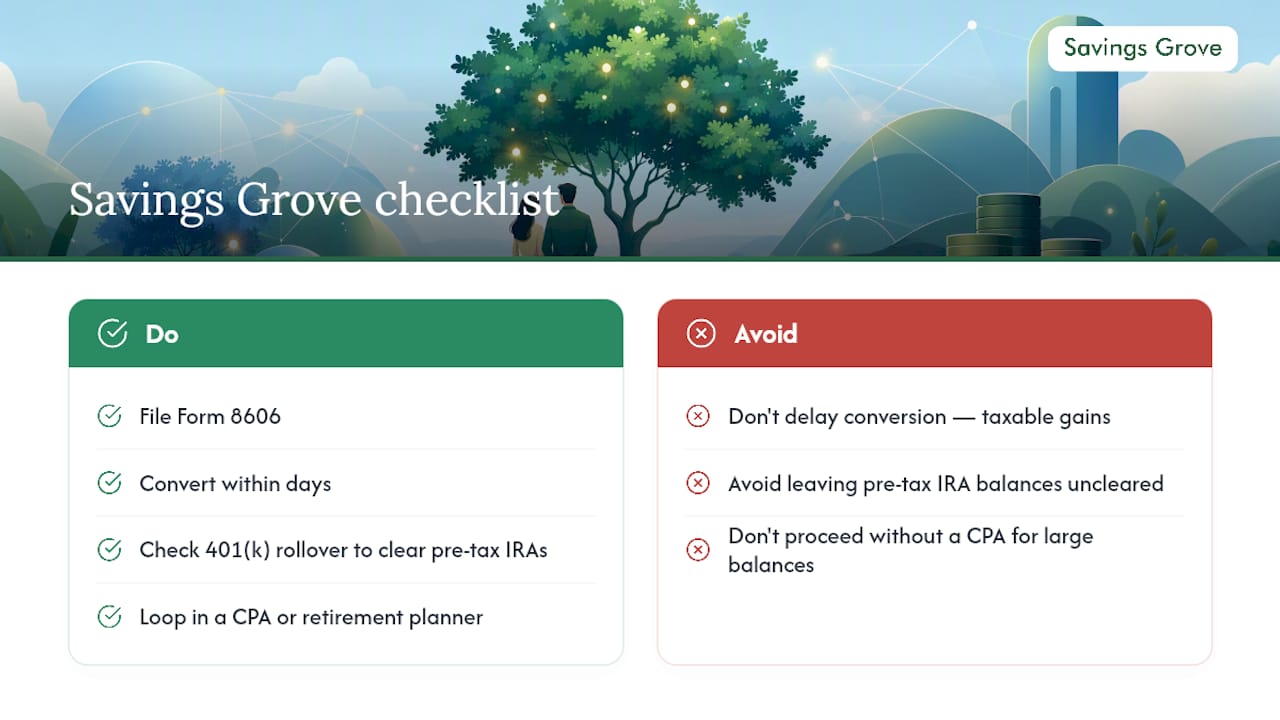
An effective checklist for this strategy includes: always filing Form 8606, converting within days to avoid taxable gains, and checking whether a 401(k) rollover can clear out pre-tax IRA balances before you start. These practices help prevent many costly mistakes.
This guide reflects an extensive research and fact-checking process. It’s written for readers who understand IRAs already and want the mechanics, not a primer. If you’re carrying a large pre-tax IRA balance, juggling multiple state tax residencies, or planning around estate goals, loop in a CPA or retirement planner. The stakes get higher fast once six-figure balances are involved.
Why the Backdoor Roth Gets Oversimplified
Most articles on this topic treat the backdoor Roth like a two-click process: contribute, convert, done. That framing works fine for someone with zero pre-tax IRA money and no old 401(k) balances floating around. It falls apart for anyone else, and anyone else describes a lot of high earners who’ve been rolling over old employer plans into IRAs for years.
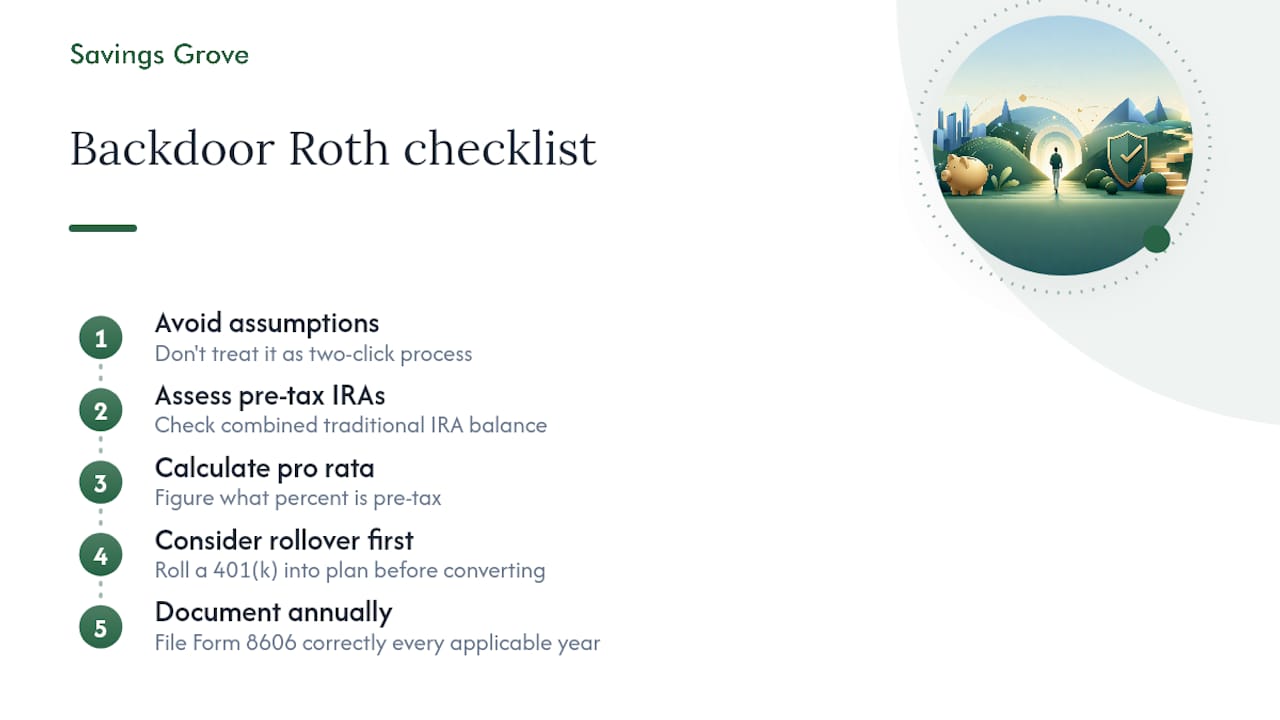
The conventional advice underplays the pro rata rule almost every time, treating it as a footnote instead of the variable that determines whether this strategy saves you money or just moves your tax bill around. If you take one thing from this guide, let it be this: run the pro rata math before you convert a single dollar, not after. Check your combined traditional IRA balance, figure out what percentage is pre-tax, and decide whether a 401(k) rollover makes sense first.
The paperwork discipline matters just as much as the tax math. Form 8606, filed correctly and every year it applies, is what separates a clean tax-free conversion from a documentation problem that surfaces during an audit years later.
— Mika L.
Explore More Retirement Tax Strategies With Savings Grove
If you’ve got workplace access to after-tax 401(k) contributions, the mega backdoor Roth can push far more money into Roth status than the standard IRA route allows, often tens of thousands more per year. This higher-capacity version is explained alongside current IRA contribution limits to help you work from the right numbers instead of last year’s figures.

Retirement tax planning rarely stops at one move. Pairing a backdoor Roth with broader tax-bracket management strategies helps you decide when to convert, when to hold off, and how Roth and traditional balances should split as you approach retirement. Bookmark these guides before your next contribution window opens, and if your pre-tax IRA balance is large or your estate plans are complicated, bring a tax professional into the conversation early. Start by reviewing Savings Grove’s retirement guides to map out which strategy fits your situation.
This article is general information, not a substitute for advice from a qualified financial advisor. Consult a qualified financial professional about your own circumstances before acting on anything here.
0 comments
Leave a comment
Reviewed before they appear. Your email is not shown.