

The IRA contribution limit for 2026 rises to $7,500, with a catch-up contribution amount for savers age 50 and older bringing the total higher. The IRS confirmed these numbers in its annual cost-of-living announcement, and they apply across all your traditional and Roth IRAs combined, not per account.
TL;DR:
- The 2026 IRA contribution limit is $7,500, including catch-up contributions for those aged 50 and older, across all traditional and Roth IRAs combined.
- Contribution deadlines remain April 15, 2027, but custodians require specifying the tax year to ensure the contribution applies to 2026.
- Deductibility of traditional IRA contributions depends on MAGI and workplace coverage, with full deduction available if neither spouse is covered by a workplace plan.
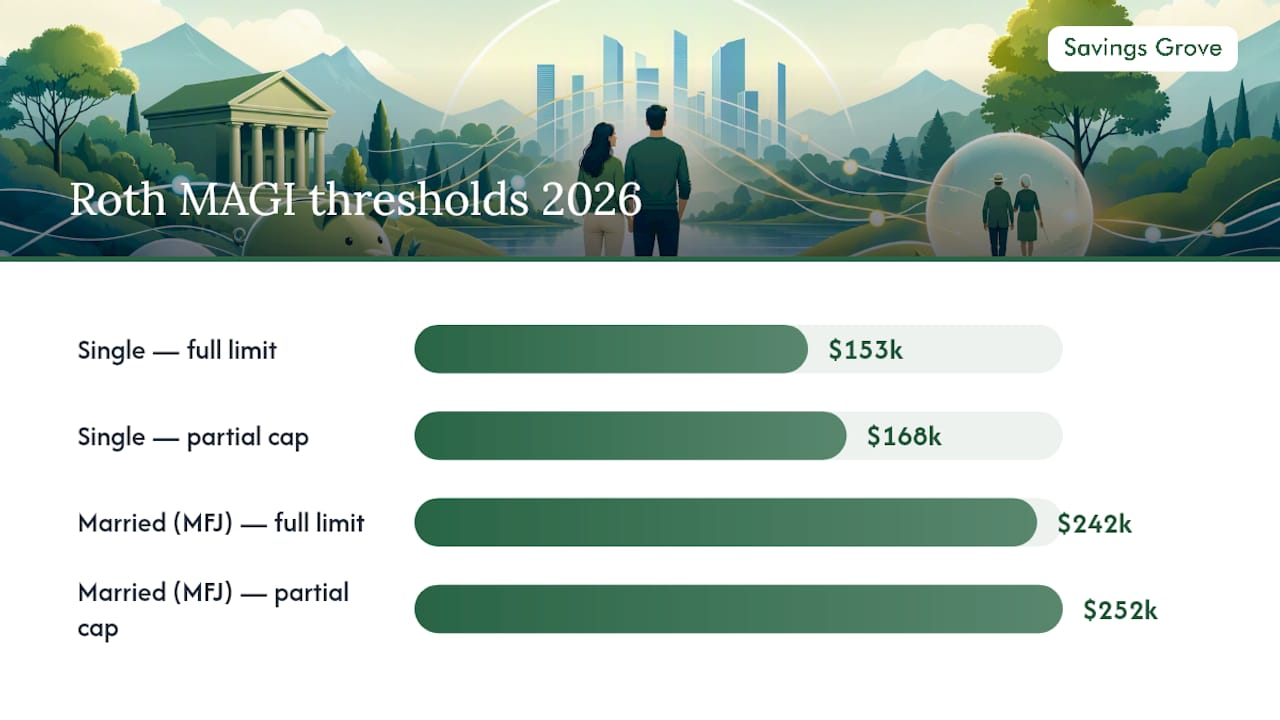
- Roth IRA eligibility phases out between $153,000 and $168,000 MAGI for single filers and between $242,000 and $252,000 for joint filers.
- Excess contributions incur a 6% annual tax until corrected through withdrawal or recharacterization before the tax deadline.
Table of Contents
- 2026 IRA Contribution Limits at a Glance
- Who Can Contribute to a Traditional IRA and When It’s Deductible
- Roth IRA Income Limits for 2026: Full, Partial, and Phased Out
- Catch-Up Contributions and the SECURE 2.0 Wrinkle
- What Happens If You Contribute Too Much
- Making Your 2026 Contributions: Deadlines and Paperwork
- Turning the 2026 Increase Into a Real Savings Boost
- Where the IRS Publishes These Numbers Officially
- The Real Impact of This Year’s Increase
- Sources
2026 IRA Contribution Limits at a Glance
You don’t need to dig through IRS bulletins to find your number. Here’s the quick reference for 2026, plus the 401(k) figure for comparison since so many of you are juggling both accounts.
| Account or Limit | 2026 Amount |
|---|---|
| IRA contribution limit (under 50) | the IRS-set limit for 2026 |
| IRA contribution limit (50 and older) | the IRS-set limit including catch-up for 2026 |
| IRA catch-up contribution | the IRS-defined catch-up amount for 2026 |
| 401(k) employee deferral limit | $24,500 |
| Contribution deadline for 2026 tax year | April 15, 2027 (unextended) |
That $7,500 figure is a combined ceiling across every traditional and Roth IRA you own, not $7,500 per account. If you have a Roth at one brokerage and a traditional IRA at another, the total across both still can’t exceed the limit. You have until the unextended federal tax deadline, typically April 15 of the following year, to make contributions and have them count toward 2026.
Who Can Contribute to a Traditional IRA and When It’s Deductible
Anyone with earned income can contribute to a traditional IRA in 2026. There’s no age ceiling anymore, a change that stuck around after earlier reforms eliminated the old cutoff. The real question isn’t whether you can contribute. It’s whether that contribution is tax-deductible, and that depends on your modified adjusted gross income (MAGI) and whether you or your spouse have access to a workplace retirement plan.
If neither you nor your spouse is covered by a workplace plan, your full contribution is deductible regardless of income. Once a workplace plan enters the picture, the deduction starts phasing out at specific MAGI bands:
- Single, covered by a workplace plan: deduction phases out between $81,000 and $91,000 MAGI, according to Charles Schwab’s summary of the 2026 figures.
- Married filing jointly, contributor covered: the phase-out band sits higher, reflecting the joint-filing adjustment.
- Married filing jointly, spouse covered (but not you): a separate, wider phase-out range applies, since the IRS treats the non-covered spouse more generously.
- Married filing separately: the phase-out range is notably narrow, often just a few thousand dollars, which trips up more couples than any other bracket.
Pro Tip: If you’re married and only one spouse works, you can still fund a spousal IRA for the non-earning spouse. The couple’s combined contributions just can’t exceed their combined earned income for the year.
The spousal IRA rule matters more than people realize. A single-income household isn’t limited to funding one IRA. As long as the working spouse’s earned income covers both contributions, you can fund two full IRAs, doubling your tax-advantaged room.
Roth IRA Income Limits for 2026: Full, Partial, and Phased Out
Roth eligibility runs on a different rulebook than traditional deductibility, and it hinges entirely on MAGI. For 2026, Fidelity’s breakdown of the updated thresholds shows where the lines fall:
- Single filers under $153,000 MAGI: full Roth contribution allowed.
- Single filers between $153,000 and $168,000: partial contribution, calculated on a sliding scale.
- Single filers above $168,000: no direct Roth contribution.
- Married filing jointly under $242,000 MAGI: full contribution allowed.
- Married filing jointly between $242,000 and $252,000: partial contribution.
- Married filing jointly above $252,000: phased out entirely.
Remember, the $7,500 (or $8,600) cap isn’t a separate Roth allowance stacked on top of a traditional allowance. It’s one shared limit. If you contribute $4,000 to a traditional IRA, you have $3,500 of room left for a Roth, not another full $7,500.
If your income phases you out entirely, you’re not stuck. A non-deductible traditional IRA contribution followed by a conversion, commonly called a backdoor Roth, remains a legal workaround for high earners. High-income savers who’ve maxed this route and want to go further should look at our mega backdoor Roth guide for after-tax 401(k) strategies that operate on a completely separate limit.
Catch-Up Contributions and the SECURE 2.0 Wrinkle
The IRA catch-up amount for 2026 is set by the IRS and applies as a flat add-on for anyone 50 or older, as long as you have qualifying earned income.
Where things get confusing is the interaction with SECURE 2.0’s workplace-plan changes. That law introduced a higher catch-up tier for 401(k) and similar employer plans specifically for workers ages 60 to 63, letting them defer significantly more than the standard catch-up amount available to other age groups.
Here’s the distinction that trips people up:
- IRA catch-up: flat $1,100 for everyone 50 and older, no special tier for 60 to 63.
- Workplace plan catch-up: SECURE 2.0’s enhanced amount applies only inside employer plans like 401(k)s, not IRAs.
- No overlap: maxing your workplace catch-up doesn’t reduce or expand your separate IRA catch-up room.
Treat these as two independent buckets. Someone turning 61 in 2026 could be eligible for the enhanced 401(k) catch-up at work while still only getting the standard $1,100 bump on their IRA.
What Happens If You Contribute Too Much
Overfund your IRA and the IRS charges a 6% excise tax on the excess amount, and that tax applies every single year the excess sits uncorrected. It costs you 6% annually until you fix it.
Correcting the mistake is straightforward if you act before your tax filing deadline:
- Contact your custodian immediately and request a corrective distribution of the excess amount plus any earnings it generated.
- Withdraw before your filing deadline, including extensions, to avoid the 6% excise tax entirely for that year.
- Recharacterize instead, if you’d rather treat the contribution as going to a different type of IRA (traditional to Roth or vice versa) rather than withdrawing it.
- Apply the excess to a future year only in narrow cases where you’re otherwise under the limit for that later year.
- Report the correction using the appropriate tax forms, and file an amended return if the excess affected a prior year’s taxes.
If you’ve stacked multiple years of excess without catching it, talk to a tax professional before doing anything else. Amended returns across several years get complicated fast, and getting the sequence wrong can trigger penalties you didn’t need to pay.
Making Your 2026 Contributions: Deadlines and Paperwork
You can contribute toward your 2026 IRA limit any time between January 1, 2026, and the unextended federal tax filing deadline in April 2027. When you send money to your custodian, always confirm which tax year you want it applied to. Custodians don’t guess. If you deposit money in early 2027 without specifying, it may default to the current calendar year instead of 2026.
Watch for these when tax season rolls around:
- Form 5498 reports your IRA contributions and gets sent by your custodian, usually by May, after the contribution deadline has passed.
- Form 1099-R covers distributions, not contributions, so you’ll see it if you take money out or correct an excess.
- Payroll-linked contributions (like SIMPLE IRAs through an employer) follow different mechanics than direct custodian transfers, so check with your HR department if your IRA is employer-facilitated.
- Spousal contributions need their own account. You can’t deposit into one IRA on behalf of two people.
Turning the 2026 Increase Into a Real Savings Boost
Savings Grove built this checklist for readers trying to squeeze real value out of the higher limits, not just note them and move on.
- Check your workplace coverage status first. It determines whether your traditional IRA deduction phases out, and that changes whether Roth or traditional makes more sense this year.
- Coordinate IRA and 401(k) contributions together. Maxing a 401(k) doesn’t affect your IRA limit, but your overall savings rate should be planned as one system, not two disconnected accounts.
- Track combined contributions across custodians. This is the single most common mistake we see: people forget the $7,500 cap covers every IRA they own, not each one separately.
- Verify your MAGI before assuming you’re phased out. Deductions, above-the-line adjustments, and filing status changes shift your number more than people expect.
Pro Tip: If you’re near a Roth phase-out threshold, run the numbers before year-end. Small moves, like deferring a bonus or increasing a 401(k) contribution, can pull your MAGI back under the line.
For readers looking to build beyond this year’s contribution, our guides on stretching retirement savings further and reducing taxes in retirement go deeper into long-term sequencing.
Where the IRS Publishes These Numbers Officially
Every figure in this article traces back to a specific, citable IRS source, and knowing where to check them yourself is worth the two minutes it takes.
The primary announcement lives on the IRS newsroom page covering the 2026 COLA adjustments, which lays out the headline numbers for IRAs, 401(k)s, and related plans in plain language. Behind that newsroom post sits the formal legal document, Notice 2025-67, published in Internal Revenue Bulletin 2025-49. That notice contains the actual COLA tables the IRS uses to set every dollar limit referenced in this article, and it’s the document tax professionals cite when precision matters.
For the deeper rulebook on deductibility, MAGI phase-outs, and contribution mechanics, the IRS maintains Publication 590-A, Contributions to Individual Retirement Arrangements. It’s dense reading, but it’s the definitive source when a situation gets complicated, like a mid-year job change that shifts your workplace-plan coverage status. Bookmark the newsroom page for annual updates and treat Notice 2025-67 as the fine print behind the headline.
The Real Impact of This Year’s Increase
The $7,500 limit sounds incremental, but consistency beats size here. An extra few hundred dollars a year compounds meaningfully over a 20 or 30 year horizon, especially inside a Roth where growth comes out tax-free. My honest read: most people won’t notice the increase unless they act on it deliberately.
Start by checking your workplace coverage status, since that single fact determines your entire strategy this year. Adjust payroll deferrals if you’re chasing the 401(k) match alongside your IRA. Confirm your MAGI before assuming you’re phased out of Roth eligibility. And if your situation touches spousal contributions, backdoor conversions, or multiple custodians, loop in a tax professional before filing season gets chaotic.
— Mika L.
This article is general information, not a substitute for advice from a qualified financial advisor. Consult a qualified financial professional about your own circumstances before acting on anything here.
0 comments
Leave a comment
Reviewed before they appear. Your email is not shown.