

If your spouse or ex-spouse worked and paid into Social Security, you may qualify for a monthly payment worth up to 50% of their primary insurance amount once you reach your own full retirement age. You can claim as early as 62, though your check shrinks permanently if you do. The fastest way to see your real number is to check estimates through a my Social Security account before you file anything.
TL;DR:
- Claiming spousal benefits early before reaching full retirement age reduces the maximum 50% benefit and can significantly lower the check size due to penalties.
- If you claim on an ex-spouse’s record, your marriage must have lasted at least 10 years, and you must remain unmarried until claiming; remarriage can affect eligibility.
- Coordinating claiming strategies typically involves the lower-earning spouse claiming earlier and the higher earner delaying to maximize future benefits and survivor options.
- Deemed filing rules prevent switching between personal and spousal benefits after filing, making timing decisions more critical for optimal payouts.
- Accurate benefit estimates require using SSA tools before filing, and understanding the differences between spousal and survivor benefits is essential for maximizing household retirement income.
Table of Contents
- Spousal Social Security Benefits: Who Actually Qualifies
- How Spousal Benefits Get Calculated (And Why Early Claiming Costs You)
- Timing Strategies Married Couples Actually Use
- Divorced-Spouse and Survivor Benefit Rules That Trip People Up
- How to Apply for Spousal Benefits
- The SSA Tools Worth Using Before You File
- Savings Grove’s Take on Coordinating Household Claims
- Plan the Rest of Your Retirement Income With Savings Grove
- Sources
- FAQ
Spousal Social Security Benefits: Who Actually Qualifies
Eligibility hinges on your relationship status and your age, and the rules differ depending on whether you’re currently married or divorced.
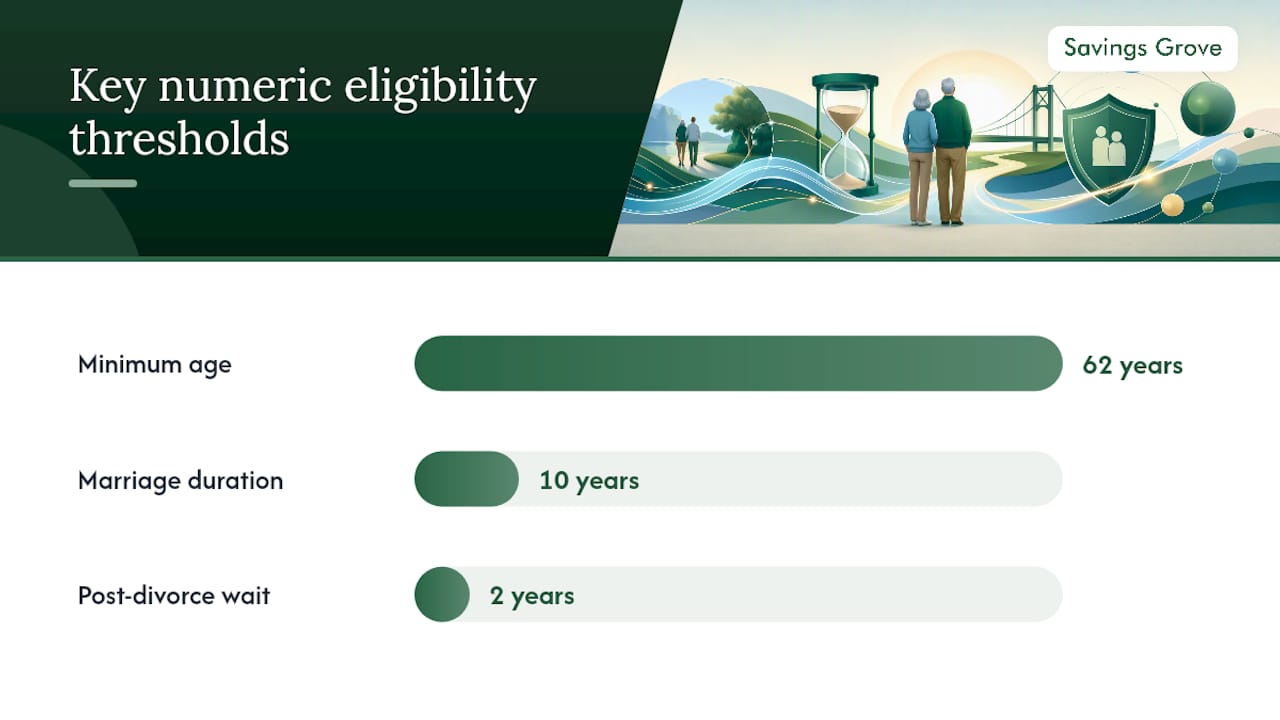
If you’re married, your spouse has to already be entitled to retirement or disability benefits before you can collect on their record. You generally need to be at least 62, unless you’re caring for a qualifying child under 16 or disabled. That last exception matters more than most people realize. It lets a younger spouse collect a spousal benefit years before turning 62 as long as a qualifying child is in the picture.
Divorced? You can still claim on an ex’s record under specific conditions:
- Your marriage lasted at least 10 years.
- You’re currently unmarried.
- You’re at least 62 (or caring for a qualifying child).
- In many cases, your ex doesn’t even need to be receiving benefits yet, as long as the divorce happened at least two years ago.
Remarriage generally ends your eligibility to claim on a former spouse’s record, though it may open eligibility on a new spouse’s record instead.
How Spousal Benefits Get Calculated (And Why Early Claiming Costs You)
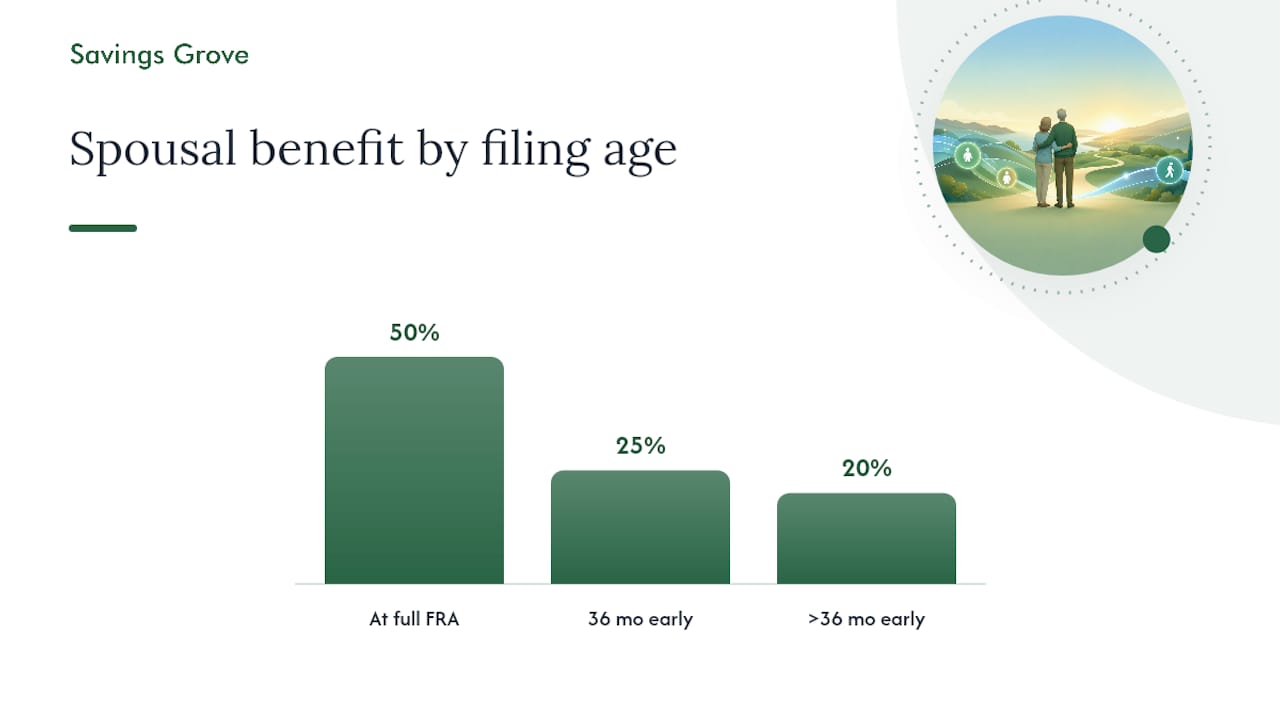
Your spousal benefit starts as a percentage of your spouse’s primary insurance amount, or PIA — the benefit they’d receive at their own full retirement age. The maximum you can get is 50% of that PIA, but only if you wait until your own full retirement age to file.
Claim earlier, and the Social Security Administration applies a reduction formula:
- For each month before your full retirement age, up to 36 months, your benefit drops by 25/36 of 1%.
- For every month beyond that 36-month window, it drops further by 5/12 of 1%.
Claim spousal benefits a full 36 months early, and you lose a significant portion of the 50% maximum, leaving you with noticeably less than half of your spouse’s PIA.
Here’s how that plays out with real numbers. Say your spouse’s PIA is an amount that would yield a spousal benefit equal to half of that at your full retirement age. Filing 36 months early applies the reduction rules, significantly lowering the spousal benefit from that maximum amount. File even earlier than that, and the steeper 5/12 penalty kicks in on top.
One detail trips people up constantly: unlike your own retirement benefit, a spousal benefit never grows past your full retirement age. Delayed retirement credits don’t apply here, so there’s no upside to waiting past FRA to file for the spousal portion.
Timing Strategies Married Couples Actually Use
Claiming decisions for couples come down to one core rule: deemed filing. If you qualify for both your own retirement benefit and a spousal benefit, you can’t pick one now and switch later. Filing for either one triggers both, and the Social Security Administration pays you the higher of the two, combined into a single check. That closed a once-popular loophole that let people collect spousal payments while letting their own benefit grow untouched.
Within that constraint, a few common patterns still work well for households:
- The lower earner in the couple often claims earlier, since their spousal benefit calculation isn’t affected by delaying their own smaller retirement benefit.
- The higher earner frequently delays past full retirement age, since their delayed credits raise both their own benefit and, eventually, the survivor benefit their spouse could inherit.
- Couples with strong life expectancy odds tend to favor delaying the higher earner’s claim, while those prioritizing near-term cash flow lean toward claiming earlier.
Pro Tip: Voluntary suspension after full retirement age can boost a worker’s future benefit, but it also suspends spousal benefits tied to that record. Divorced-spouse benefits are the exception. They can keep flowing even while the worker’s own benefit is suspended.
Because claiming-month combinations can run into the thousands for a given couple, don’t rely on a simple rule of thumb if your situation involves overlapping benefits, disability history, or a mixed marital timeline. That’s exactly when a calculator, or a financial planner, earns its keep.
Divorced-Spouse and Survivor Benefit Rules That Trip People Up
The difference between a spousal benefit and a survivor benefit isn’t just semantics. It changes your eligibility, your timing, and your math.
- Divorced-spouse benefits still require the 10-year marriage minimum, current unmarried status, and age 62 or a qualifying child in your care.
- Remarrying generally cuts off your claim on a former spouse’s record, though widowed individuals who remarry after 60 can often keep survivor eligibility.
- Survivor benefits can reach up to 100% of the deceased worker’s benefit, a much higher ceiling than the 50% cap on spousal payments, and they follow their own separate claiming-age rules.
- Deemed filing doesn’t apply to survivor benefits, which means a widow or widower can claim a survivor benefit first and switch to their own retirement benefit later, if that produces a bigger check.
How to Apply for Spousal Benefits
Filing is more mechanical than most people expect, but timing and paperwork both matter.
- Start the process around three months before you want benefits to begin, either online through my Social Security, by phone at 1-800-772-1213, or at your local field office.
- Gather your birth certificate, marriage certificate (or divorce decree, if applicable), and proof of citizenship or immigration status.
- Bring recent W-2s or self-employment tax records, plus military discharge papers if you served.
- Have your bank routing and account number ready for direct deposit setup.
Form SSA-2 lays out the full documentation checklist SSA typically requests for spouse’s or divorced spouse’s benefits, and it’s worth reviewing before your appointment so you’re not scrambling for paperwork later. Setting up a my Social Security account for both spouses ahead of time also makes comparing estimates far easier.
The SSA Tools Worth Using Before You File
Two free tools do most of the heavy lifting here. Your my Social Security account includes a “Calculate a Benefit as a Spouse” feature and a “Compare with Benefit as a Spouse” tab, both built specifically to model spousal claiming scenarios against your own record.
- Use the Quick Calculator for a fast, rough estimate of how much an early claim would cost you in dollar terms.
- Use the full my Social Security estimator once you’re closer to filing, since it pulls your actual earnings history.
- Screenshot or save every estimate you run. SSA’s projections shift as new earnings post, and having a record helps you track how your numbers change over time.
Savings Grove’s Take on Coordinating Household Claims
The rules reward patience for the higher earner and flexibility for the lower earner, but most couples treat both claims as one decision when they’re really two. We tend to advise starting the lower earner’s benefit earlier if household cash flow is tight, while pushing the higher earner’s claim toward full retirement age or later, since that choice quietly sets the ceiling on a future survivor benefit. Pair that decision with a hard look at withdrawal timing from retirement accounts, since claiming age and tax exposure move together more than most households realize.
Plan the Rest of Your Retirement Income With Savings Grove
Spousal benefits are one piece of a bigger puzzle, and getting the claiming age right only pays off if the rest of your retirement income plan holds together too. Savings Grove is built for exactly that next step: pairing your Social Security numbers with the tax and withdrawal decisions that determine what you actually keep.

Once you’ve run your estimates through my Social Security, check how those benefits interact with your tax bracket using our guide to lowering Social Security taxes with Roth conversions and QCDs. If you’re approaching 70½, our QCD rules breakdown shows how charitable distributions can offset required withdrawals, and our RMD rules guide walks through the penalties for missing a deadline. Head to Savings Grove to browse the full library of retirement budgeting guides and start mapping your household’s income timeline today.
Sources
Run your own numbers through the SSA’s Benefits for Spouses page and the Quick Calculator. For strategy context beyond the mechanics, AARP’s spousal benefits explainer is a solid second read, and Form SSA-2 confirms exactly what paperwork you’ll need on filing day.
This article is general information, not a substitute for advice from a qualified financial advisor. Consult a qualified financial professional about your own circumstances before acting on anything here.
- Benefits for Spouses — SSA
FAQ
What Is the New Rule for Social Security Spousal Benefits?
Deemed filing is the rule that reshaped spousal claiming: if you qualify for both your own retirement benefit and a spousal benefit, filing for one automatically files for both, and you receive the higher combined amount.
When Can a Wife Collect Half of Her Husband’s Social Security?
She can collect up to 50% of her husband’s primary insurance amount once she reaches her own full retirement age; claiming earlier permanently reduces that percentage.
How Do You Maximize Social Security With Spousal Benefits?
Run estimates through your my Social Security account first, then coordinate timing so the lower earner claims earlier if needed while the higher earner delays toward full retirement age to protect the eventual survivor benefit.
Can My Wife Take Her Own Social Security and Then Switch to Spousal Benefits?
Not under current rules. Deemed filing means filing for either benefit triggers both simultaneously, and she’ll receive whichever amount is higher, not a sequential switch.
What’s the Difference Between a Spousal Benefit and a Survivor Benefit?
A spousal benefit tops out at 50% of the worker’s PIA and follows deemed filing rules, while a survivor benefit can reach up to 100% and operates under separate claiming-age rules that don’t involve deemed filing.