

Yes, some or all of your Social Security benefits can be taxable, depending on your provisional income and filing status. If that combined figure tops the base thresholds set by law for single or joint filers, up to about half of your benefits may be included in taxable income, and above the higher thresholds, up to a large portion can be included. The Social Security Administration and IRS Publication 915 are the two sources that settle any dispute about your specific numbers.
TL;DR:
- More retirees are pushed into higher taxation tiers because thresholds were set decades ago and haven’t been adjusted for inflation.
- Provisional income, which determines taxation, includes half of Social Security benefits, and increased benefits can raise this amount.
- State tax rules vary greatly; most states do not tax Social Security benefits, but a few do, often with income-based exemptions.
- Running the calculation now can help prevent surprises by adjusting Roth conversions or charitable distributions before year-end.
- Current thresholds and caps are unlikely to change before new legislation is enacted, so plan accordingly based on existing rules.
Table of Contents
- How Federal Taxation of Social Security Benefits Works
- Calculating Your Provisional Income Step by Step
- Payroll Taxes That Fund Social Security
- Which States Tax Social Security Benefits
- Reporting Benefits and Choosing Withholding Options
- Practical Strategies to Reduce the Taxable Portion of Benefits
- Legislative Outlook: What Could Change
- What This Means for Your Retirement Planning
- Next Steps From Savings Grove
- Sources
How Federal Taxation of Social Security Benefits Works
Nobody taxes your Social Security check directly. What gets taxed is a portion of it, determined by a number the IRS calls provisional income, sometimes labeled combined income. You calculate it by adding your adjusted gross income (not counting Social Security), any tax-exempt interest you earned, and half of your annual Social Security benefit.
That total gets measured against two sets of thresholds. Cross the first one, and up to 50% of your benefits becomes taxable. Cross the second, higher one, and up to 85% comes into play. These are ceilings, not flat rates. Your actual included amount, per IRS Topic 423, usually lands below the cap once you run the worksheet.
A quirk worth knowing: Congress set these dollar thresholds in 1983 and 1993, and they’ve never been indexed for inflation. Wages and cost-of-living adjustments have climbed steadily since, but $25,000 and $32,000 haven’t moved an inch. That’s why:
- More retirees hit the 50% and 85% tiers every year, even without a raise in real purchasing power.
- A benefit increase tied to the annual cost-of-living adjustment can quietly push you into a higher inclusion tier.
- Filing status matters enormously. Married couples filing separately while living together get a $0 threshold, the harshest treatment in the code.
Calculating Your Provisional Income Step by Step
Running the numbers yourself takes about ten minutes with last year’s tax return and your Form SSA-1099 in hand.
- Pull your AGI, minus Social Security. Look at last year’s Form 1040, then strip out any Social Security income already counted there.
- Add tax-exempt interest. This includes municipal bond interest, which many retirees assume is invisible to the IRS. It isn’t, for this calculation.
- Add half your annual Social Security benefit. Box 5 of your SSA-1099 shows the total; divide by two.
- Compare the sum to your threshold, then apply the Publication 915 worksheet to find your actual included amount, which is typically lower than the 85% ceiling.
Quick example: A married couple filing jointly has $38,000 in other AGI, $2,000 in muni bond interest, and $30,000 in annual Social Security benefits ($15,000 counted at half). Their provisional income comes to $55,000, well past the $44,000 adjusted threshold, which puts a large share of their benefits into the 85% inclusion tier once the worksheet runs its course.
Payroll Taxes That Fund Social Security
Before benefits ever reach a retiree, payroll taxes fund the system on the front end, and the rules there are separate from anything above.
- OASDI rate: 6.2% each from employee and employer, or 12.4% total for self-employed workers.
- Medicare rate: 1.45% each from employee and employer, with an additional 0.9% Medicare surtax on wages above $200,000 for single filers.
- 2026 taxable maximum: the Social Security Administration’s Office of the Chief Actuary sets the OASDI wage base at $184,500, meaning no OASDI tax applies to earnings above that figure.
- Medicare has no cap. Every dollar of wages gets the 1.45% Medicare tax, unlike the OASDI portion.
Payroll tax collection and the taxation of your eventual benefits are two entirely different mechanisms; one funds the trust fund today, the other determines what the IRS counts as income once you start collecting.
Which States Tax Social Security Benefits
Most states leave Social Security alone entirely. A shrinking handful still tax some portion of benefits, and the rules vary enough that assuming your neighboring state’s treatment applies to you is a common, costly mistake.
- The majority of states follow the federal government’s lead and exempt Social Security benefits from state income tax altogether.
- States that do tax benefits typically layer on their own income-based exemptions, so retirees below a certain income level often owe nothing at the state level anyway.
- Some states phase out taxation by age or offer partial exclusions rather than taxing benefits at the full federal-included amount.
- A retiree earning $40,000 in one taxing state might owe state tax on a slice of benefits, while a retiree with identical income just across the border in a non-taxing state owes nothing on those same benefits.
Because state rules shift from year to year, check your state revenue department’s current guidance before assuming last year’s treatment still applies.
Reporting Benefits and Choosing Withholding Options
Every January or February, the SSA mails Form SSA-1099, showing your total benefits in box 5. That figure feeds directly into lines 6a and 6b of Form 1040 or 1040-SR, where line 6b captures the taxable portion after you run the worksheet.
- File Form W-4V with the SSA if you want federal income tax withheld directly from your monthly benefit, in fixed percentages the form specifies.
- Use quarterly estimated payments (Form 1040-ES, guided by Publication 505) if you’d rather not adjust withholding.
- Consider the lump-sum election if you received a retroactive Social Security payment covering prior years. Publication 915 lets you refigure the taxable portion as if you’d received it in the original year, which can lower your total tax bill.
Pro Tip: Check your withholding or estimated payments every time your income changes meaningfully, not just at tax season. A one-time windfall, like a large IRA withdrawal, can spike your provisional income and catch you with an underpayment penalty the following April.
Practical Strategies to Reduce the Taxable Portion of Benefits
The rules above are fixed, but your provisional income isn’t. A handful of levers, all consistent with IRS guidance, can shrink the share of your benefits that ends up taxable.
- Roth conversions before benefits start. Qualified Roth withdrawals don’t count toward provisional income, so converting traditional IRA funds earlier in retirement, ideally in lower-income years, keeps future withdrawals invisible to this calculation.
- Qualified Charitable Distributions (QCDs). Once you’re 70½, you can direct up to the annual QCD limit from an IRA straight to charity, satisfying required distributions without adding a dollar to your AGI or provisional income.
- Watch muni bond interest. Tax-exempt municipal bonds don’t escape this formula. They count in full toward provisional income and can quietly push benefits into a higher inclusion tier.
- Adjust withholding proactively. Fine-tuning your Form W-4V election or estimated payments avoids a surprise bill and, more importantly, avoids underpayment penalties.
Savings Grove’s guide on reducing taxes in retirement walks through withdrawal sequencing in more depth, and the QCD rules breakdown covers eligibility specifics for readers 70½ and older.
Pro Tip: Run your provisional income calculation before December 31, not after. Roth conversions and QCDs only affect the tax year they’re executed in, so waiting until you file removes your best planning window entirely.
Legislative Outlook: What Could Change
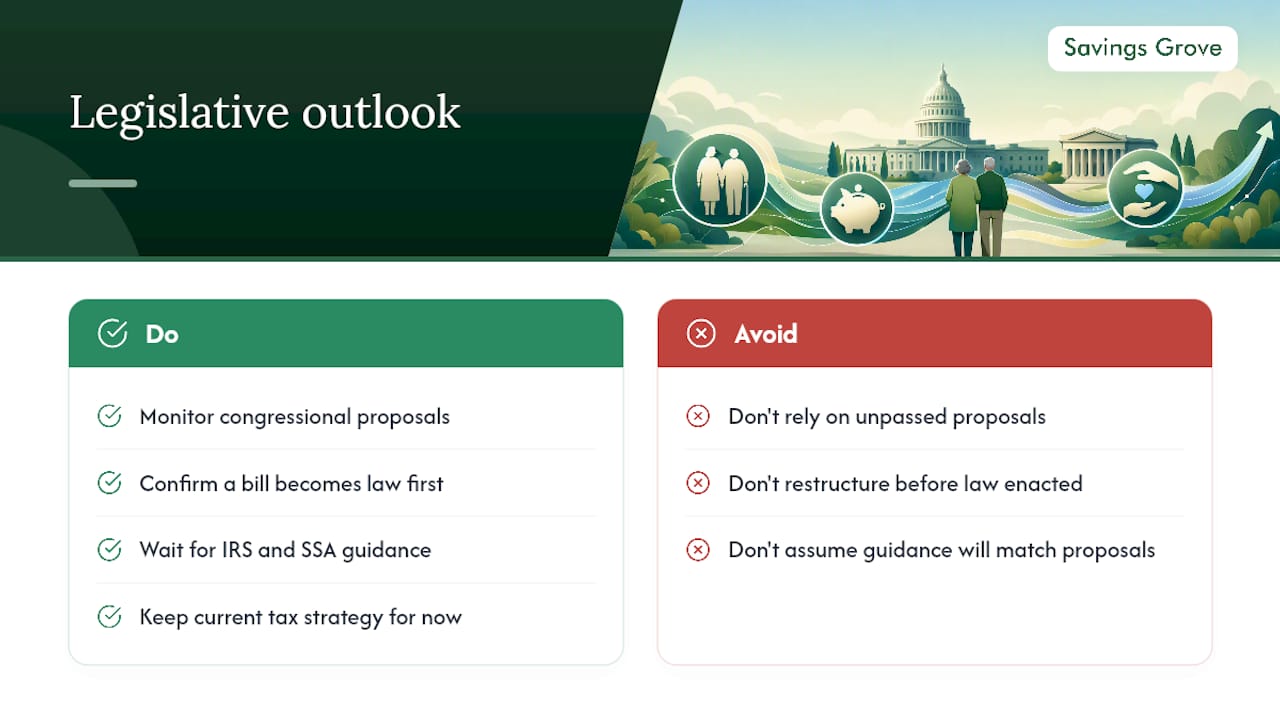
Congress has seen multiple proposals over recent sessions that would raise the thresholds or exclude Social Security benefits from taxation altogether. CRS analysis confirms these bills exist, but none have become law.
Until Congress passes a bill and the IRS and SSA issue implementing guidance, the thresholds and inclusion caps described above remain in force. Don’t restructure your tax planning around a proposal that hasn’t cleared committee.
What This Means for Your Retirement Planning
Run your provisional income number now, not next April. If you’re within a few thousand dollars of a threshold, a Roth conversion or a QCD this year could keep you out of the next tier entirely. Savings Grove’s retirement budget adjustment guide is a solid next stop for sequencing that decision.
— Mika L.
Next Steps From Savings Grove
Working through provisional income by hand is manageable once, but retirement tax planning is a moving target every year your income, benefits, or the thresholds shift. Savings Grove is built as the practical alternative to guessing your way through IRS worksheets alone. Instead of piecing together scattered advice, you get curated, plainly written guides that walk through exactly what to check and when.

Our guide on QCD rules for retirees 70½ and older breaks down eligibility in minutes, and the reduce-taxes-in-retirement guide covers withdrawal sequencing that directly affects your provisional income. These resources support your planning; they don’t replace a licensed tax professional for complex situations involving multiple income sources or state-specific rules. Visit Savings Grove to browse the full library of retirement tax guides and calculators, and start mapping your next move before year-end deadlines close in.
This article is general information, not a substitute for advice from a qualified financial advisor. Consult a qualified financial professional about your own circumstances before acting on anything here.
0 comments
Leave a comment
Reviewed before they appear. Your email is not shown.