

The fastest way to avoid overdraft fees is to stack three moves: opt out of debit card and ATM overdraft coverage, link a savings account or overdraft line of credit as backup, and turn on low-balance alerts so you see trouble coming. Switching to a no-overdraft-fee account removes the fee, but not the shortfall that caused it. The CFPB and FDIC both back this layered approach as the most reliable defense.
TL;DR:
- Linking a savings account or overdraft line of credit offers a cheaper backup than per-item overdraft fees, especially for recurring shortfalls.
- Opting out of debit and ATM overdraft coverage prevents fees on everyday transactions but does not protect against bounced checks or recurring payments.
- Setting low-balance and large-transaction alerts provides early warning and helps manage cash flow before overdrafts occur.
- Understanding the difference between available and ledger balances, along with transaction sequencing, is key to preventing surprise overdrafts.
- Combining forecasting with backup protections and opt-out strategies creates a layered approach that significantly reduces overdraft risk over time.
Table of Contents
- Quick Checklist to Avoid Overdraft Fees Today
- What Actually Causes an Overdraft?
- Should You Opt Out of Debit and ATM Overdraft Coverage?
- What Backup Protections Do Banks Actually Offer?
- How Do You Forecast Balances Before You Run Short?
- Does Switching to a No-Overdraft-Fee Bank Solve the Problem?
- What Should You Do Immediately After an Overdraft?
- A 30-Day Plan to Stop Overdraft Fees for Good
- A Practical Note on Why Layering Beats Any Single Fix
- Get More Practical Money Guides From Savings Grove
- Where to Verify This Information
- Sources
Quick Checklist to Avoid Overdraft Fees Today
You don’t need a financial overhaul to stop bleeding money on overdraft charges. Most of these steps take less than 10 minutes each and can be done from your banking app right now.
- Opt out of debit/ATM overdraft coverage. This means your bank will decline a purchase instead of approving it and charging you a fee. You can avoid debit card overdrafts simply by declining this coverage or canceling it if you already opted in.
- Link a savings account or open a small overdraft line of credit. Both give you a cheaper safety net than a per-item fee.
- Set low-balance alerts at a threshold above your actual danger zone, ideally with a few days’ cushion built in.
- Check pending transactions before you spend. Your displayed balance often lags behind holds and scheduled payments, which is where most surprise overdrafts start.
What Actually Causes an Overdraft?
An overdraft happens when a transaction goes through for more money than you have available, and your bank covers the difference for a fee instead of declining it. Understanding why this happens more often than people expect comes down to one confusing detail most account holders never fully grasp: the difference between your available balance and your ledger balance.
Your ledger balance is what’s technically in the account. Your available balance subtracts pending holds, like a hotel deposit or a gas station pre-authorization, that haven’t fully settled yet. A $40 balance can look spendable when it’s really tied up. Banks also process transactions in an order that doesn’t always match the order you made them, so a large recurring bill can post before a small purchase you made two days earlier, pushing you into negative territory when you thought you had room.
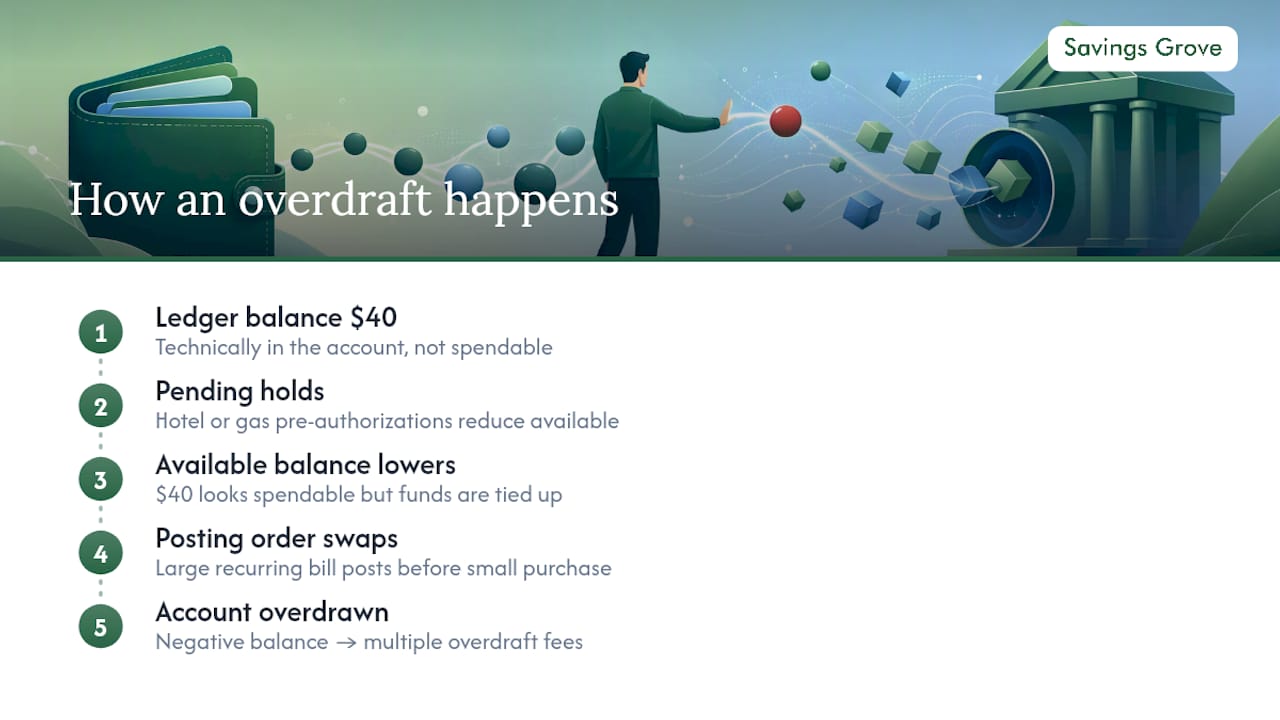
Overdraft fees are often substantial per item, and banks can charge multiple fees in a single day if multiple transactions overdraw your account, according to the CFPB’s overdraft guidance. Separately, if your bank declines to cover something like an ACH payment or a recurring bill, you may get hit with a returned-item or NSF fee instead, a different charge with its own cost. One misjudged coffee run can trigger a chain reaction that costs you triple digits by the end of the day.
Should You Opt Out of Debit and ATM Overdraft Coverage?
Federal rules require banks to get your opt-in consent before charging overdraft fees on one-time debit card and ATM transactions. If you never opted in, or you cancel that consent now, those specific transactions get declined at the register instead of approved with a fee attached.
The trade-off is real. Opting out means a declined card at checkout, which can be embarrassing or inconvenient if you’re counting on that purchase going through. It doesn’t affect checks, ACH transfers, or recurring bill payments, which fall under separate NSF fee rules and may still bounce or trigger a fee if you’re short. Some account holders genuinely prefer the safety net of coverage even at a cost, since a declined transaction has its own consequences, like a missed rent payment or a late fee elsewhere.
Here’s how to opt out at most banks:
- Log into your mobile app or online banking and search for “overdraft settings” or “overdraft coverage.”
- Select “opt out” or “decline” for debit card and ATM overdraft coverage, and confirm the change.
- If you can’t find the setting online, call the number on the back of your card and ask a representative to remove debit/ATM overdraft coverage from your account.
- Ask for written or email confirmation of the change, and check your next statement to verify it took effect.
Pro Tip: Call instead of relying only on the app if your bank’s website is unclear. Ask the representative to read back exactly which transaction types are affected, since some institutions bundle debit and ATM opt-out with other overdraft settings you may want to keep.
What Backup Protections Do Banks Actually Offer?
Opting out solves one problem: declined debit swipes and ATM withdrawals. It doesn’t help with checks, autopay, or ACH debits that still need funds behind them. That’s where backup protection comes in, and banks generally offer three flavors.
- Linked savings transfers. Your bank automatically pulls from a linked savings account to cover a shortfall. The FDIC notes this usually costs a small transfer fee, typically less than the cost of a standard overdraft charge.
- Overdraft lines of credit. A small revolving credit line attached to your checking account covers the gap and charges interest on what you borrow, similar to a credit card. Eligibility depends on your credit history, and most banks require an application separate from opening the checking account itself.
- Backup credit card linking. Some banks let you link an eligible credit card as a secondary overdraft source. You’ll pay interest if you carry a balance, and sometimes a cash-advance-style fee, so this tends to be the priciest of the three if you don’t pay it off fast.
The ABA points out that linked transfers are typically the cheapest option, credit lines make sense if you carry recurring gaps and want predictable terms, and a linked credit card works best as a last-resort backstop rather than a primary strategy. Match the tool to your cash-flow pattern. If your shortfalls are small and occasional, a linked savings account solves it. If they’re recurring, a modest line of credit with clear interest terms beats repeatedly relying on a credit card float.
How Do You Forecast Balances Before You Run Short?
Backup protections react after a shortfall is already happening. Forecasting stops it before it starts, and that difference matters more than most people realize. A layered approach that pairs forecasting with backup protection outperforms either tactic used alone, because forecasting buys you days of lead time to move money or delay a purchase, while backups only limit the damage once you’re already short.
Set alerts around thresholds that give you room to react, not just react to zero:
- A low-balance alert triggering days before your rent or car payment posts, not the morning of.
- A large-transaction alert for anything over a set dollar amount, so a surprise charge doesn’t blindside you.
- A recurring-payment reminder a day or two ahead of known bills like subscriptions or utilities.
Banking apps now offer native balance alerts, and budgeting or aggregation apps can pull multiple accounts into one forecast so you see your real cash position instead of a single account’s snapshot. Paycheck-smoothing tools, which advance a portion of expected income early, are another category worth knowing about, though they work best as an occasional bridge rather than a routine habit.
Pro Tip: Do a five-minute balance check every Sunday night and a fuller review on payday. That rhythm catches most shortfalls a full week before they’d otherwise turn into a fee.
Does Switching to a No-Overdraft-Fee Bank Solve the Problem?
Some banks have eliminated overdraft fees entirely or cap them sharply, and switching accounts can genuinely stop the bleeding if fees are your main pain point. But a fee-free account doesn’t fix a spending pattern that runs your balance to zero. It just removes the penalty for it. If your paycheck timing or expenses are the real issue, you’ll still be cutting it close every month, just without the $30 tax on top.
Before you switch, compare these features side by side with your current bank:
- Fee schedule. Some institutions still charge for linked-transfer overdrafts even if they’ve dropped standard per-item fees.
- Posting order transparency. Look for banks that clearly disclose how they sequence transactions, since that’s often the hidden cause of “surprise” overdrafts.
- Free linked transfers. A no-fee linked savings option is worth more than a flashy sign-up bonus.
- Daily fee caps. If a bank still charges overdraft fees, check whether they cap the number per day, since multiple fees in 24 hours is where costs spiral fastest.
Switching makes sense if your current bank has an unusually aggressive fee structure or unclear posting practices. If your bank already offers reasonable linked-transfer options and clear alerts, layering protections at your existing bank is usually less disruptive than moving your direct deposit, bill pay, and history to a new institution.
What Should You Do Immediately After an Overdraft?
An overdraft already happened. Don’t panic, but move fast, since banks are more likely to reverse a fee the first time you ask than the fifth.
- Check your transaction history for anything pending that might resolve the shortfall on its own, like a deposit that hasn’t fully cleared.
- Confirm whether it’s a one-time issue or a pattern. A single slip is easier to get forgiven than a recurring one.
- Call your bank and ask politely for a one-time courtesy refund. Say something like: “I noticed an overdraft fee on my account from [date]. This is the first time this has happened, and I’d like to ask if you can waive it as a courtesy.” Banks often grant this for account holders in good standing, and the CFPB confirms this is a standard ask worth making.
- Write down who you spoke with and when, in case you need to follow up.
- Repay the negative balance as soon as possible, ideally within a day or two, since some banks charge extended-overdraft fees if the account stays negative for several days.
If a single call doesn’t work, ask to speak with a supervisor or file a complaint through the bank’s formal channel before escalating to a regulator.
A 30-Day Plan to Stop Overdraft Fees for Good
Forecasting first, backup protection second, opt-out for the small stuff last. That order matters because forecasting prevents the problem, backups catch what forecasting misses, and opting out of debit/ATM coverage just makes sure a small purchase never turns into a $30 penalty.
Here’s a recommended way to spread that out over four weeks so it actually sticks:
- Week 1: Set low-balance alerts and a large-transaction alert on your primary checking account.
- Week 2: Link a savings account for automatic overdraft transfers, or apply for a small overdraft line of credit if you qualify.
- Week 3: Opt out of debit card and ATM overdraft coverage, and test it with a small purchase you know will decline safely if funds run short.
- Week 4: Review your first month of alerts, adjust your cushion, and build toward a modest emergency buffer using a resource like Savings Grove’s emergency fund guide.
| Week | Action | Why It Matters |
|---|---|---|
| 1 | Set balance and transaction alerts | Creates lead time to react before you’re short |
| 2 | Link savings or apply for overdraft credit line | Cheaper backup than per-item overdraft fees |
| 3 | Opt out of debit/ATM overdraft coverage | Removes fee risk on everyday card swipes |
| 4 | Review alerts and build a cushion | Turns a one-time fix into a lasting habit |
This plan draws directly on CFPB and FDIC guidance, adapted into a sequence you can actually finish in a month, and it pairs well with a deeper look at automatic savings transfers if you want the backup piece to run on autopilot.
A Practical Note on Why Layering Beats Any Single Fix
The overdraft-fee conversation tends to get reduced to a single piece of advice, usually “just opt out” or “just link your savings.” Neither one alone solves the problem, and treating either as a complete fix is where a lot of well-meaning advice falls short.
Opting out protects you from debit and ATM fees, but a bounced automatic payment can still cost you an NSF fee under a different name. Linked savings transfers protect you from that scenario, but only if there’s actually money in savings to pull from, which forecasting is what gets you there in the first place. The order matters: see the shortfall coming, have a cheap backup ready if you miss it, and remove the fee risk on the transactions most likely to catch you off guard.
What’s underappreciated is how little friction this actually takes once it’s set up. A five-minute alert setup and one linked account do most of the work. The rest is just checking in weekly, which is a habit, not a project. For a fuller walkthrough of the tactics referenced here, Savings Grove’s guide to avoiding overdraft fees breaks down each option in more depth.
— Mika L.
Get More Practical Money Guides From Savings Grove
This layered playbook is provided without the upsell that usually comes with “premium” banking advice elsewhere. Every guide is checked and updated regularly, so the fee amounts, account features, and tactics stay current instead of stale.

If this checklist helped, bookmark the full overdraft guide for the detailed version, or start building your cash cushion with the automatic transfer guide so the backup piece runs itself. For the rest of Savings Grove’s budgeting tools, credit card comparisons, and savings strategies, visit the Savings Grove hub and pick the next guide that fits where your finances need the most help right now.
Where to Verify This Information
- Consumer Financial Protection Bureau: federal guidance on overdraft opt-in rules and consumer rights.
- FDIC: bank-regulator recommendations on avoiding overdraft and account fees.
- American Bankers Association: industry-side practical tips for reducing overdraft costs.
These are primary regulator and industry sources, not secondary summaries, so they’re worth a direct read if you want the full text behind any claim in this guide.
This article is general information, not a substitute for advice from a qualified financial advisor. Consult a qualified financial professional about your own circumstances before acting on anything here.
0 comments
Leave a comment
Reviewed before they appear. Your email is not shown.