

A cash advance fee is an upfront charge, usually 3% to 5% of the amount you withdraw or a $5 to $10 minimum, whichever is higher. You pay it the moment you pull cash from your credit card, and interest starts accruing that same day with no grace period. That combination makes cash advances one of the most expensive ways to borrow money you already have access to.
TL;DR:
- Cash advance fees typically run 3% to 5% of the withdrawal amount or a flat $5 to $10 minimum, whichever is higher, with the fee charged upfront.
- Interest on cash advances starts accruing immediately at a higher APR than regular purchases, often reaching 30% or more, with no grace period.
- Using out-of-network ATMs or cash-like transactions can incur additional surcharges or hidden fees, and multiple smaller withdrawals increase total costs.
- Alternatives like building an emergency fund, taking a personal loan, or borrowing from friends usually cost less than a cash advance.
- Before taking one, verify exact fees and interest, compare total costs, and confirm how your transaction will be classified to avoid unnecessary expenses.
Table of Contents
- How Cash Advance Fees Are Calculated
- Why Cash Advance Interest Starts Accruing Immediately
- How You Actually Get a Cash Advance (and Your Limit)
- Cheaper Ways to Get Cash When You’re Short
- Five Things to Check Before You Take a Cash Advance
- Our Take: Treat It as a Last Resort, Not a Backup Plan
- Sources
How Cash Advance Fees Are Calculated
Card issuers use one of two formulas, and they always charge whichever number is bigger. Some charge a straight percentage of the amount you withdraw. Others set a flat dollar minimum. Most issuers combine the two: they charge the percentage rate, but only if it exceeds their flat fee.
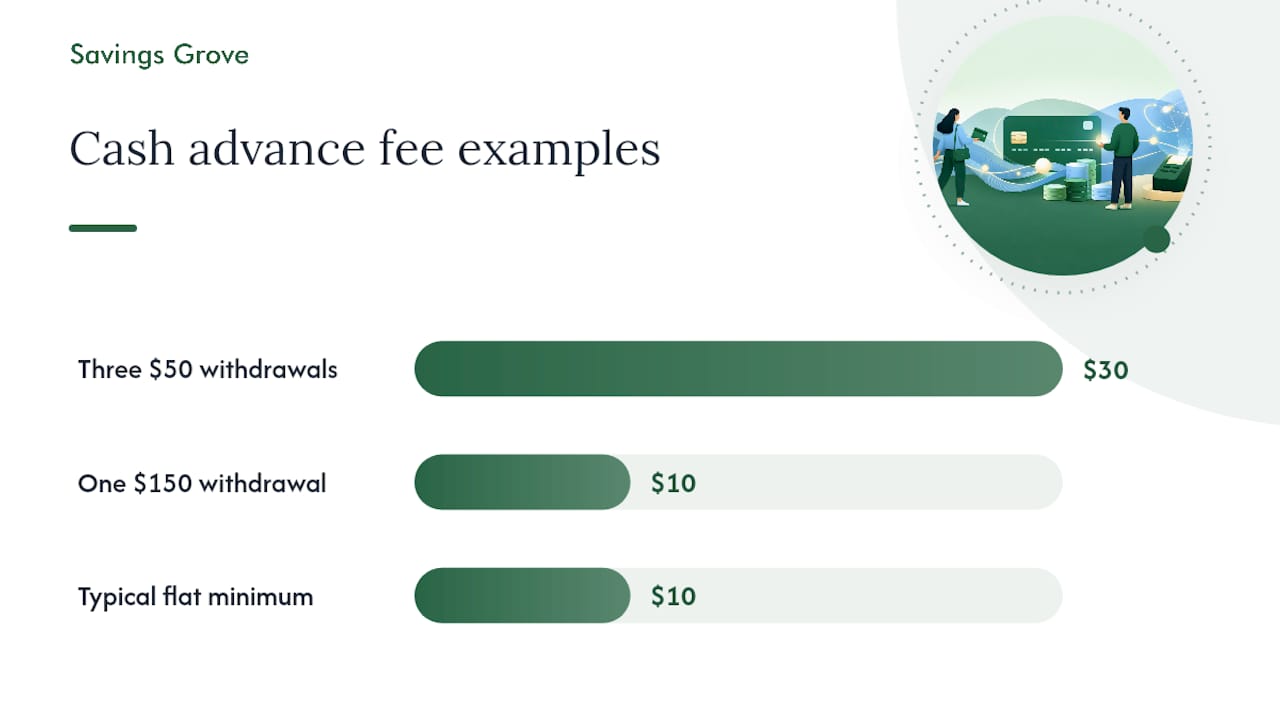
Typical cash advance fees run 3% to 5% of the withdrawal, or $5 to $10, whichever is greater. Here’s how that plays out on real withdrawal amounts:
Those interest figures assume you carry the balance for a full month. Pay it off faster and you owe less interest, but the fee itself never changes. It’s charged once, upfront, regardless of how quickly you repay.
Two more costs can sneak in. If you use an out-of-network ATM, you’ll likely pay a separate ATM surcharge on top of your issuer’s cash advance fee. Also, some issuers may deduct the fee directly from the cash you receive.
Pro Tip: If your issuer charges a flat minimum fee, take one lump withdrawal instead of several smaller ones. Three separate $10 flat fees on $150 in withdrawals cost you $30. One withdrawal of the same $150 costs you $10. That single change, confirmed by Bank of America’s guidance on cash advance mechanics, can save you real money without changing how much cash you actually need.
Why Cash Advance Interest Starts Accruing Immediately
Regular credit card purchases come with a grace period, typically 21 to 25 days, where you owe zero interest if you pay your statement in full. Cash advances get no such courtesy. Interest begins accruing the moment the transaction posts, and it compounds daily until you pay it off.
The math behind that daily accrual: your APR divided by 365 gives you a daily rate, and that rate applies to your balance every single day.
- Day 1: You withdraw $1,000. Interest starts accruing immediately, no waiting period.
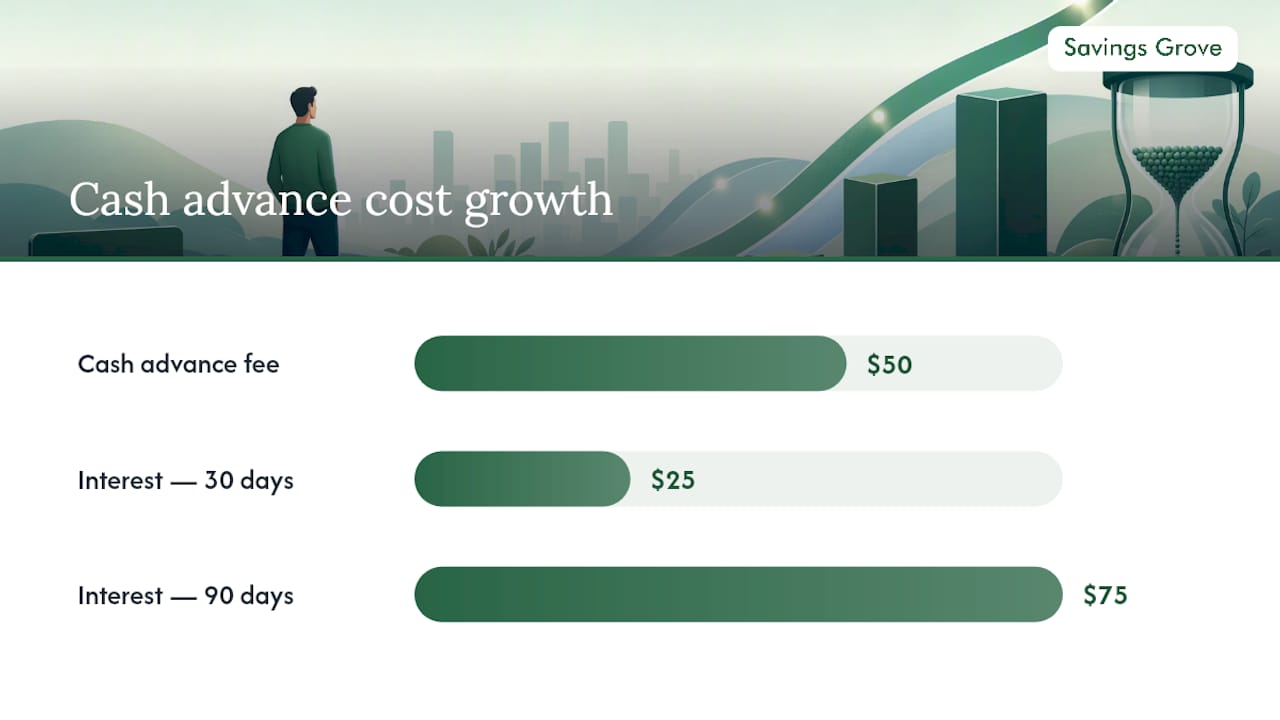
- Day 30: At a 29.99% APR, you’ve accrued roughly $25 in interest on top of your $50 fee.
- Day 90: Leave that balance unpaid and you’re looking at closer to $75 in accumulated interest, still climbing.
Cash advance APRs typically run higher than purchase APRs, and combined with day-one interest accrual, a $1,000 advance with a 3% fee and a 30% APR can meaningfully outgrow its original cost within a single billing cycle.
Here’s a detail most cardholders miss: When you make an extra payment beyond your minimum, issuers generally apply it to the balance with the highest interest rate first, which is often the cash advance balance. That’s a small silver lining, but it only helps if you’re paying more than the minimum.
How You Actually Get a Cash Advance (and Your Limit)
You can trigger a cash advance a few different ways, and it’s worth knowing all of them before you accidentally stumble into one.
- ATM withdrawal. You’ll need a PIN for this, and it’s the most common route people use.
- Bank teller withdrawal. Walk into a branch, hand over your credit card, and request cash directly.
- Convenience checks. These are the checks your issuer sometimes mails you tied to your credit line. Some issuers treat them as purchases rather than cash advances, so check your terms before writing one.
Your cash advance limit is typically lower than your overall credit limit, sometimes significantly so. Check your monthly statement, your issuer’s mobile app, or call customer service directly to find your specific number before you plan a withdrawal around it.
Watch for “cash-like” transactions too. Money orders, casino gaming chips, lottery tickets, and some prepaid debit card loads can get classified as cash advances by card networks, even though they don’t feel like pulling cash from an ATM. That classification triggers the same fee and same immediate interest, often catching people off guard.
Cheaper Ways to Get Cash When You’re Short
Before you swipe your card at an ATM, run the math on what else is available to you. A cash advance combines an upfront fee with daily interest and no grace period, which usually makes it more expensive than most alternatives.
- An emergency fund covers the gap without fees or interest of any kind, which is exactly why building one matters. Savings Grove’s step-by-step emergency fund guide walks through how to build that cushion over time.
- A small personal loan from a bank or credit union often carries a lower APR than a cash advance, especially if your credit is solid.
- Peer-to-peer transfers from friends or family cost nothing beyond the awkward conversation.
- A hardship plan from your issuer might reduce fees or interest temporarily if you’re facing a genuine short-term crunch. Call and ask; issuers would rather work with you than lose the account.
Pro Tip: Add up the fee plus estimated interest for your expected repayment timeline, then compare that total dollar figure against a personal loan’s total cost over the same period. The cash advance almost always loses.
If a transaction gets miscategorized as a cash advance when it shouldn’t have been, call your issuer and ask them to reclassify it. For safer ways to access physical cash without triggering advance fees, Savings Grove’s guide on where to cash a check covers several no-fee and low-fee options worth checking first.
Five Things to Check Before You Take a Cash Advance
Savings Grove built this checklist from the mechanics covered above, so you can run through it in five minutes before making a decision you can’t easily undo.
- Find your exact cash advance fee and APR in your card agreement or issuer app, don’t guess.
- Calculate your total cost, fee plus interest, based on how long you realistically expect to carry the balance.
- Call your issuer to confirm how a specific transaction will be classified before you make it.
- Compare that total cost against a cash advance app or a small personal loan.
- If you’re repaying multiple balances, check how your issuer applies extra payments so you know which debt shrinks first, a strategy covered further in Savings Grove’s debt payoff guide.
Five minutes of checking can save you a meaningful chunk of what a rushed decision would have cost.
Our Take: Treat It as a Last Resort, Not a Backup Plan
A cash advance only makes sense for a genuine short-term emergency, and only with a clear plan to repay it fast. The fee plus immediate interest turn a small withdrawal into an expensive habit if you let the balance sit. Explore Savings Grove’s alternatives before you reach for your card.
— Mika L.
This article is general information, not a substitute for advice from a qualified financial advisor. Consult a qualified financial professional about your own circumstances before acting on anything here.
0 comments
Leave a comment
Reviewed before they appear. Your email is not shown.