

What is zero-based budgeting and how does it work?
Zero-based budgeting assigns every dollar of your income a specific purpose before the month begins. The core equation is simple: Income minus Expenses equals zero. That zero does not mean you spend everything you earn. It means no dollar is left without a deliberate assignment, whether that assignment is rent, groceries, debt repayment, or savings.

The method originated in corporate finance, where managers justify every line item from scratch each budget cycle rather than rolling forward last year’s numbers. Personal finance adapted that same discipline into something far more practical: you build a fresh spending plan each month based on your actual income and real priorities, not habit or inertia.

Traditional budgeting typically works backward. You spend, then check whether you stayed under a target. Zero-based budgeting flips that entirely. You decide where every dollar goes before you spend it, then track transactions against those pre-set allocations. The psychological shift is significant: instead of asking “did I overspend?” you ask “which category does this purchase come from?” That one change moves your financial decisions from reactive to proactive.
Here is what zero-based budgeting looks like in practice:
- Income: typical take-home pay
- Rent: a set portion | Groceries: a set portion | Utilities: a set portion
- Car payment: a set amount | Gas: a set amount | Insurance: a set amount
- Debt repayment (extra): planned amount | Emergency fund: planned amount
- Dining out: budgeted amount | Entertainment: budgeted amount | Clothing: budgeted amount
- Sinking funds (car repair, gifts, medical): monthly allocation
- Remaining: allocated to savings and investments
- Total allocated: total income | Unallocated: zero
Every category has a number. Every dollar has a job. That is the zero-based budgeting process in its simplest form.
Table of Contents
Why zero-based budgeting gives you real financial control
The advantages of this method go beyond math. They touch how you think about money day to day.
- Full spending visibility. You know exactly where every dollar is going before it leaves your account. There are no mystery charges at the end of the month.
- Faster debt payoff. Zero-based budgeting mechanically prioritizes debt payments as fixed, mandatory line items, preventing discretionary spending from absorbing those funds. Your debt payment is locked in before you budget a single dollar for wants.
- Reduced impulse spending. When you know your dining budget is $100 for the month and you have already spent $80, the decision to eat out again becomes a conscious trade-off, not an automatic swipe.
- Psychological empowerment. Reframing savings as “paying your future self” reduces feelings of restriction and builds genuine motivation. You are not depriving yourself. You are choosing your future over your present impulse.
- Permission to spend guilt-free. When you have already budgeted $60 for entertainment, you can spend that money with zero anxiety. The budget already made the decision. Planning all expenses, including fun money, eliminates budget guilt and creates real permission to enjoy discretionary spending.
- Savings treated as non-negotiable. A correctly built zero-based budget embeds savings as fixed line items at the top of the plan, before discretionary spending gets a single dollar. That is the “pay yourself first” principle built directly into the structure.
The honest drawbacks you should know before you start
Zero-based budgeting is not the right fit for everyone, and going in with clear eyes makes the difference between success and frustration.
- It takes time to set up. Building a fresh budget each month requires real effort, especially in the first few months. Most users master the process over time, reducing setup to a manageable monthly effort, but the initial learning curve can be steep.
- Budget burnout is a real risk. Treating zero-based budgeting as a permanent, rigid lifestyle can lead to fatigue. The method works best during high-goal phases like aggressive debt payoff, not necessarily as a forever system.
- Variable income adds complexity. If your paycheck changes month to month, building a precise budget before income arrives requires extra planning and a conservative baseline approach.
- Discipline is non-negotiable. Failure to track expenses continuously is the primary reason zero-based budgeting loses its effectiveness. Skipping a week of tracking can unravel an otherwise solid plan.
- Irregular expenses catch beginners off guard. Annual costs like car registration, holiday gifts, or medical copays do not show up every month, but they will show up. Without a plan for them, they break the budget.
How to build your zero-based budget step by step
This process works whether you are budgeting on paper, in a spreadsheet, or with a free budgeting app.
-
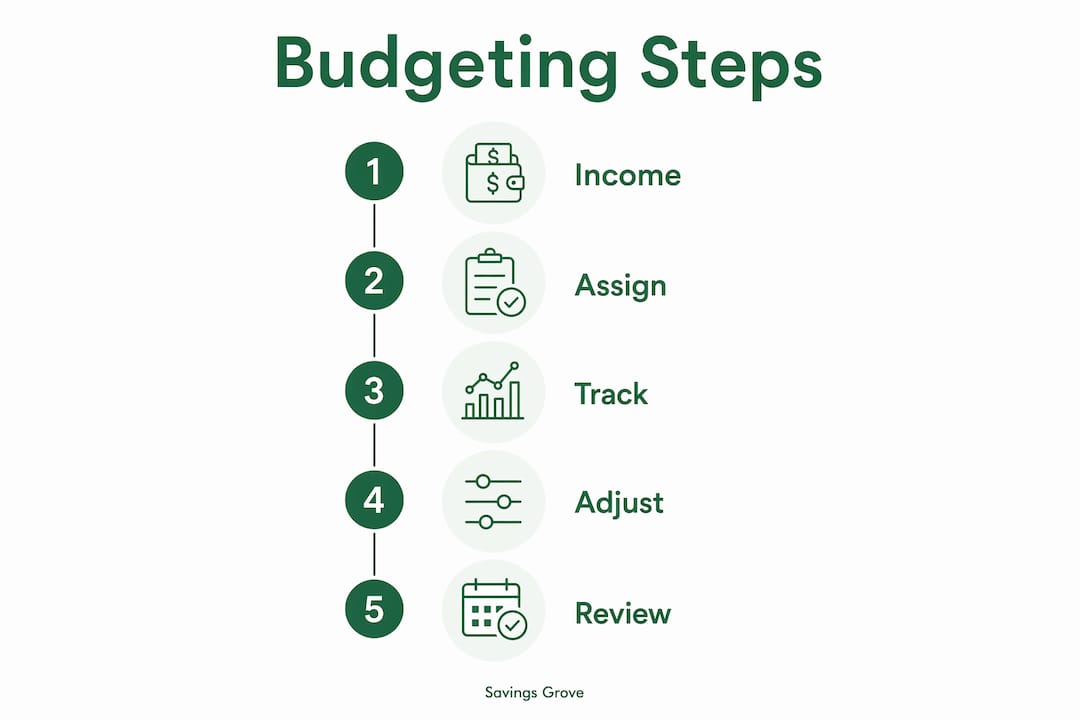
Calculate your monthly take-home income. Start with the money that actually arrives in your bank account after taxes and any automatic deductions by using a reliable Future Value Calculator to help plan your investments and budgeting. If your income varies, use the lowest monthly amount from the past three months as your baseline. Using the lowest recent monthly income as a baseline prevents overspending in leaner months and keeps the plan stable.
-
List every expense category. Break your spending into four groups: fixed essentials (rent, utilities, insurance), financial priorities (debt payments, emergency fund, savings, investments), variable necessities (groceries, gas, prescriptions), and discretionary spending (dining out, entertainment, subscriptions, clothing).
-
Add sinking funds for irregular costs. Take every expense that does not hit monthly, such as car maintenance, holiday gifts, or annual subscriptions, and divide the yearly total by 12. That monthly amount becomes its own budget category. Dividing annual irregular expenses into monthly allocations prevents budget surprises and is the single most transformative technique beginners overlook.
-
Assign every dollar until you reach zero. Start with financial priorities, then essentials, then variable needs, then discretionary. Keep adjusting category amounts until your total allocations equal your total income exactly.
-
Track every transaction in real time. Every purchase reduces the balance in its category. When a category hits zero, you either stop spending in that area or consciously move money from another category. This real-time decision-making is what separates zero-based budgeting from passive expense tracking.
-
Review and rebuild monthly. At the end of the month, check what worked and what did not. Then build next month’s budget from scratch based on that month’s expected income and priorities, not as a copy of last month with minor tweaks.
Pro Tip: Build a liquid savings buffer equal to roughly one month of living expenses before you start. This cushion smooths out income fluctuations and prevents a slow paycheck from forcing you to break the budget entirely.
Is zero-based budgeting the right method for you?
Not every budgeting method fits every person, and zero-based budgeting has a specific profile of users who get the most out of it.
- You are aggressively paying off debt. This method locks debt payments in before anything else gets funded, making it one of the most effective tools for accelerating debt payoff. If eliminating credit card or loan debt is your primary goal, zero-based budgeting is built for that phase.
- You want full visibility into your spending. Zero-based budgeting provides the highest spending visibility of any personal budgeting method. If you have ever reached the end of the month wondering where your money went, this system answers that question permanently.
- You have variable income. Freelancers, gig workers, and anyone with irregular paychecks can use the conservative baseline approach described above. Pairing it with weekly paycheck budgeting strategies helps manage the unpredictability.
- You prefer automation over manual tracking. If you want a set-it-and-forget-it approach, zero-based budgeting will feel like work. A hybrid method, where automated transfers handle savings and investments while zero-based budgeting governs discretionary spending, balances discipline and automation effectively for people who want both control and convenience.
- You are new to budgeting. The structure zero-based budgeting provides is genuinely helpful for beginners who have never tracked their money before. It forces you to confront every spending category, which builds financial awareness faster than any other method. Compare it with the envelope budgeting method to see which structure fits your habits better.
Zero-based budgeting is not a restrictive punishment. It is a system of deliberate permission. When you have already decided that $150 goes toward dining out this month, you spend that $150 freely and without second-guessing. The anxiety most people feel about money comes from uncertainty, and this method eliminates that uncertainty before the month even starts.
Key takeaways
Zero-based budgeting works because it forces every dollar into a named category before spending begins, replacing vague financial habits with deliberate, pre-planned decisions.
| Point | Details |
|---|---|
| Every dollar gets a job | Assign all income to named categories so nothing is spent without a plan. |
| Debt payoff is built in | Debt payments are fixed line items allocated before discretionary spending. |
| Sinking funds prevent surprises | Divide irregular annual costs by 12 and budget that amount monthly. |
| Tracking is non-negotiable | Skipping real-time expense tracking is the primary reason the method fails. |
| Hybrid approaches work too | Combining automated savings with zero-based spending categories balances control and convenience. |