

A co-branded credit card is a partnership between a specific merchant or brand and a bank that issues the card, with both logos printed on the plastic. The verdict up front: a co-branded card pays off if you already spend heavily and repeatedly with that one brand, whether it’s an airline, a hotel chain, or a big retailer. If you want flexible rewards you can use anywhere, this isn’t your card.
The core tradeoff is simple and worth remembering before you read another word:
- Elevated rewards at the partner brand, often paired with perks like free checked bags, priority boarding, or early sale access
- Reduced value everywhere else, since points or miles earned typically only shine inside that brand’s ecosystem
- A narrower fit, meaning occasional brand users usually get less value than a general rewards card would deliver
Key Takeaways
A co-branded card delivers outsized value only when your existing spending already concentrates heavily on that one partner brand.
| Point | Details |
|---|---|
| Define the card correctly | It’s a three-way deal between a brand, an issuing bank, and a payment network, not a standalone rewards product. |
| Audit spending first | Check 3 to 6 months of statements to confirm you actually spend enough with the brand to justify applying. |
| Watch the redemption ecosystem | Rewards typically lose value fast once you try to use them outside the partner brand. |
| Fees and APRs vary widely | Annual fees range from $0 to over $450, and store card APRs often run higher than general rewards cards. |
| Track fine print | Reward expiration, blackout dates, and transfer limits determine how usable your points really are. |
Table of Contents
- How a Co-Branded Card Actually Works
- What Co-Branded Cards Actually Give You
- Where Co-Branded Cards Fall Short
- Is a Co-Branded Card Worth It for You?
- Real-World Examples of Co-Branded Cards in Action
- What Co-Branded Cards Cost You
- Fine Print That Trips Up Cardholders
- Why the Standard Advice on These Cards Misses the Point
- Sources
How a Co-Branded Card Actually Works
Three parties sit behind every co-branded card: the brand you love, the bank that issues the card, and the payment network that processes the charge. The brand supplies the perks and the loyalty program tie-in. The issuing bank handles billing, credit decisions, and disputes. The card is a partnership between a merchant or brand and an issuer, and that three-way structure is what separates a co-branded card from a plain rewards card issued by a bank alone.
Here’s the mechanical breakdown of what happens once you’re approved:
- You get approved and the issuer runs a hard credit inquiry, the same as with any credit card application, whether you applied online or at the checkout counter.
- Your purchases route through the network (Visa, Mastercard, or American Express), which is why most co-branded cards work at any store that accepts that network.
- Rewards post to the brand’s loyalty program, not a generic points bank, so a hotel co-branded card typically feeds hotel points directly into your loyalty account.
- Welcome bonuses have a countdown clock, usually 3 to 6 months to hit a minimum spend threshold before the bonus miles or points land.
Open-loop cards carry a network logo and work broadly, while closed-loop store cards only work at that one retailer. Store-branded cards can be either open-loop or closed-loop, and mixing up the two is one of the most common mistakes shoppers make when a cashier offers 20% off for signing up. Closed-loop cards are often easier to qualify for, but that convenience comes at the cost of usability once you walk out of the store.
What Co-Branded Cards Actually Give You
The appeal is real, and it starts with earning rates. Most co-branded cards pay a higher rate on purchases made directly with the partner brand compared to their baseline rate on everything else.
Beyond points, co-branded cards often include exclusive perks like free checked bags, priority boarding, room upgrades, or early access to sales. These aren’t small conveniences if you travel often: a free checked bag alone can offset the cost of an annual fee within two or three round trips for a family.
The full list of what a solid co-branded card typically brings to the table:
- Accelerated status, since many airline and hotel cards grant elite-tier credits or automatic status just for holding the card
- Purchase protection and extended warranties, the same network-level protections you’d get from any Visa or Mastercard product
- Fraud liability protection, meaning a stolen card number doesn’t leave you on the hook for unauthorized charges
- Anniversary perks, like a free night certificate or a companion airfare voucher, often worth more than the annual fee alone
Pro Tip: Add up the dollar value of the perks you’d actually use in a year, not the ones the marketing page lists. A free checked bag is worth something only if you check bags.
The role of credit card tiers matters here too, since a mid-tier co-branded card and its premium sibling from the same brand can have wildly different perk lists for a fee difference of $100 or more.
Where Co-Branded Cards Fall Short
The same structure that makes these cards generous with your favorite brand makes them stingy everywhere else. That’s the tradeoff nobody puts on the welcome-offer flyer.
Watch for these limitations before you apply:
- Low earning rates outside the partner brand, often just 1x, meaning your grocery bill or gas fill-up earns a fraction of what a flexible rewards card would pay
- Redemption value that swings with the brand, since airline miles or hotel points can be devalued by the loyalty program at any time, with no say from you
- Higher interest rates on some store cards, a pattern documented across the retail card sector where APRs commonly run higher than general-purpose cards
- A hard inquiry every time, even for the in-store checkout offer that feels casual and low-stakes
- Wallet fragmentation, where tracking due dates and rewards across three or four branded cards becomes its own chore
Managing multiple branded cards complicates financial hygiene, and that oversight burden is real: a missed payment on a card you rarely use can quietly ding your score while you’re focused on the cards you use daily.
Pro Tip: If you’re signing up at a register for a one-time discount, ask yourself honestly whether you’ll use that card again in six months. If not, the hard inquiry probably isn’t worth the discount.
Is a Co-Branded Card Worth It for You?
Run this checklist before you apply, and you’ll know the answer in about ten minutes.
- Pull your last 3 to 6 months of statements and total how much you actually spent with the partner brand. If it’s a few hundred dollars a year, the card likely isn’t worth the paperwork.
- Do simple math on the annual fee versus the extra reward value. If the card earns you $400 in perks and points but costs $95 a year, that’s a clear win. If the math is close, the flexibility you’re giving up tips the scale toward skipping it.
- Read the welcome bonus terms closely, including the minimum spend and the timeframe, and be honest about whether you’d hit that spend without artificially inflating purchases.
- Check how a new account affects your credit utilization and score. A new card raises your available credit, which can help utilization, but the hard inquiry and shorter average account age work slightly against you short term.
The card that actually fits you is the one that matches habits you already have, not the one with the flashiest sign-up bonus. Experts consistently point back to spending habits as the deciding factor, because co-branded cards are designed to reward loyalty you’re already showing, not create new spending patterns. If your spending doesn’t already lean toward the brand, the card won’t change that. Tools like the credit card multiplier math can help you translate “3x points” into an actual dollar figure before you decide.
Real-World Examples of Co-Branded Cards in Action
The category breaks down cleanly by where you spend.
- Airline cards shine for frequent flyers: a free checked bag on every flight, a companion fare once a year, and priority boarding can be worth several hundred dollars annually to someone who flies six or more times a year.
- Hotel cards reward loyalty with automatic elite status, free night certificates, and late checkout, best suited to travelers who book the same chain repeatedly rather than shopping around for the lowest nightly rate.
- Retail cards, including big-box store cards, often pay 5% back in-store and bundle early access to sales, which adds up fast for a household that does weekly grocery or supply runs at one chain.
An occasional brand user, someone who flies twice a year or shops a retailer once a season, usually comes out ahead with a flexible general rewards card instead.
Keeping Your Co-Branded Card From Becoming a Headache
A little structure prevents most of the trouble these cards cause.
- Set a calendar reminder for the welcome bonus deadline the day your card arrives, not the week before it expires.
- Use the issuer’s app to track points expiration and transfer rules, since rewards can lose value fast if you let them sit unused.
- Pay the statement in full every month. Carrying a balance on a card with an elevated APR erases reward value faster than the points can rebuild it.
- Keep a card open if it’s your oldest account, even if you’ve stopped using it actively, since credit age still counts toward your score.
Pro Tip: Automate your payment for at least the minimum due, then manually pay the rest. It’s a small guardrail against a missed payment tanking a card you only use twice a year.
How Savings Grove Backs This Guide
Savings Grove updates its credit card research every month, tracking issuer changes, fee shifts, and reward program devaluations so this guidance doesn’t go stale.
- Related reading: credit card category spending benefits for calculating category-specific value
- Related reading: business credit cards if you’re weighing a co-branded card against a business-focused product
- This guide reflects Savings Grove’s editorial review process, with author details for Mika L. available on request
What Co-Branded Cards Cost You
Annual fees on co-branded cards range widely, with many retail cards carrying no annual fee and some airline and hotel cards charging higher fees depending on the tier and perks. The fee itself isn’t the warning sign. The warning sign is a fee that outpaces what you’d realistically redeem.

Interest rates deserve more attention than most shoppers give them. Store-branded closed-loop cards in particular tend to carry APRs on the higher end of the market, a pattern that shows up consistently across retail card programs. If you’re the type who occasionally carries a balance, that APR can quietly cancel out every dollar of rewards you earned. Negotiating your credit card interest rate is worth exploring if you’re stuck holding a high-APR co-branded card you don’t want to close.
Late fees and penalty APRs work the same way they do on any credit card: a missed payment can trigger a penalty rate that lingers for months, sometimes permanently, depending on the cardholder agreement.
Fine Print That Trips Up Cardholders
Reward expiration is the fine print detail that catches people most often. Airline miles and hotel points on some co-branded programs expire after 12 to 24 months of account inactivity, meaning a slow year of spending can quietly wipe out a stash you built for a specific trip.
Blackout dates are another frequent surprise, particularly on airline cards, where “free” award flights are unavailable during the exact peak travel windows, like winter holidays, when you’d most want to redeem them. Hotel co-branded cards handle this a bit better, since most major loyalty programs no longer use blackout dates for standard rooms, but suite upgrades and peak season redemptions can still carry restrictions.
Transfer limitations round out the list. Some programs let you transfer points to airline or hotel partners at a fixed ratio, while others lock your rewards entirely inside one brand’s ecosystem with no transfer option at all. Read the cardholder agreement’s redemption section before applying, not after your first year of points accumulation, since that’s the section that tells you exactly how usable your rewards will actually be.
Why the Standard Advice on These Cards Misses the Point
Most guides treat co-branded cards as a pure math problem: compare the annual fee to the point value and pick a winner. That framing ignores the real driver of value, which is whether your spending habits already exist before you apply. A card doesn’t create loyalty to a brand. It rewards loyalty you’ve already built.
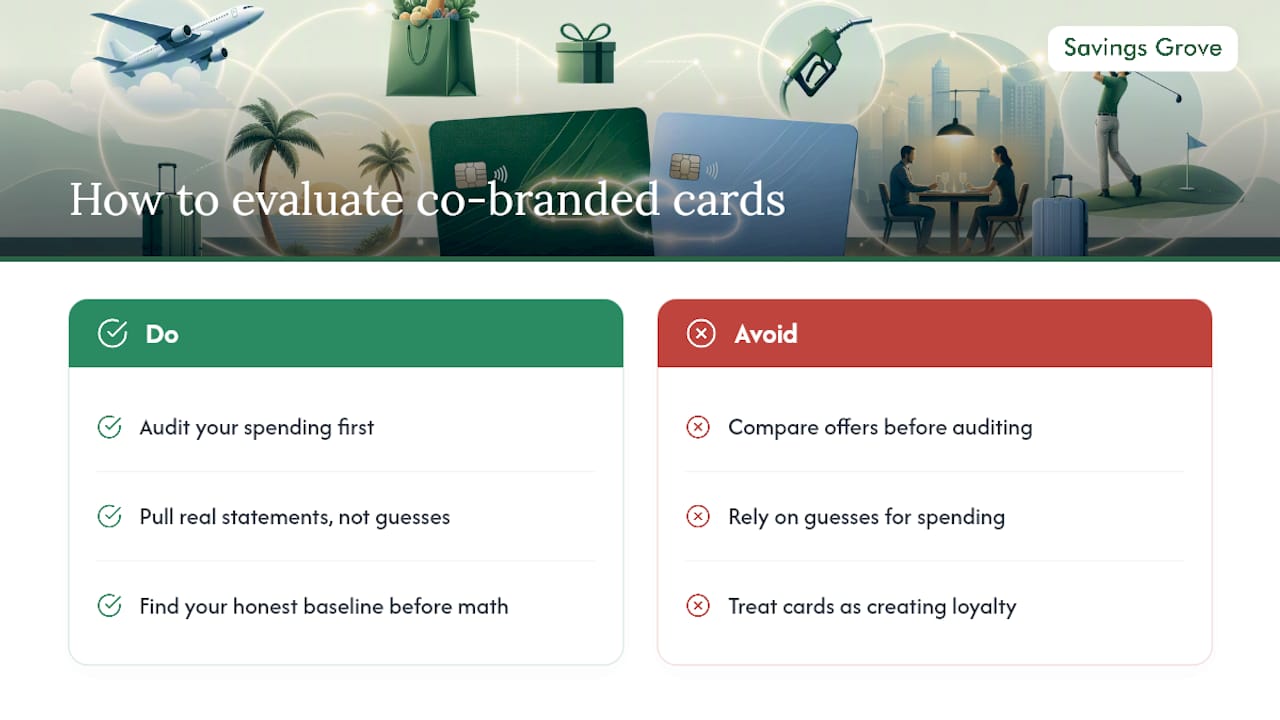
That’s why the “best co-branded card” lists floating around the internet are mostly useless to an individual reader. The best card for a family that flies the same airline four times a year is a poor fit for someone who flies twice on whatever’s cheapest. The conventional wisdom skips this and jumps straight to comparing sign-up bonuses, which is backward.
If you take one thing from this guide, audit your spending before you compare a single offer. Pull real statements, not a guess. The math only matters once you know the honest baseline, and most people applying for these cards have never actually run that number. Skip that step and you’re gambling on a discount, not making a financial decision.
— Mika L.
This article is general information, not a substitute for advice from a qualified financial advisor. Consult a qualified financial professional about your own circumstances before acting on anything here.
0 comments
Leave a comment
Reviewed before they appear. Your email is not shown.