

A credit card multiplier is the rate at which your card converts spending into points or cashback per dollar, and it’s the single biggest lever in maximizing rewards. If your card offers 3X on dining, every $100 dinner earns 300 points instead of the 100 points a flat-rate card would give you. That gap compounds fast once you’re spending real money on groceries, gas, and travel every month.
Here’s what you need to know before we get into the mechanics:
- How to calculate it: points earned = dollars spent × multiplier. A $50 grocery run at 4X earns 200 points, not 50.
- Typical categories: dining, groceries, gas, and travel carry the highest multipliers, often between 2X and 5X.
- The catch: a multiplier only pays off if you pay your statement balance in full. Carrying a balance lets interest erase rewards value in a single billing cycle, according to Investopedia’s rewards card guide.
Most points are worth roughly one cent each, though that varies by issuer and how you redeem them, per WalletHub’s breakdown of how points work. Savings Grove tracks these earning structures monthly because issuers change categories and caps often enough that yesterday’s best card can quietly become an average one.
Key Takeaways
A credit card multiplier determines your real rewards value, and the same dollar amount can earn anywhere from one to five times more depending on the card and category you use.
| Point | Details |
|---|---|
| Multiplier equals earning rate | Points earned = dollars spent × multiplier; a 3X card triples what a 1X card earns on identical spending. |
| Point value isn’t fixed | Redemptions average around 1 cent per point but can range from 0.6 to 2.0 cents depending on how you redeem. |
| Activation matters | Rotating categories and merchant-specific bonuses often require manual activation before the bonus applies. |
| Fees only pay off with volume | An annual fee needs enough bonus-category spending behind it, and carrying a balance erases the benefit entirely. |
| Savings Grove tracks the changes | Savings Grove updates card and category guidance monthly so caps, activations, and terms stay current. |
Table of Contents
- What Does “1X” or “3X” Actually Mean on a Credit Card?
- What Are the Different Types of Credit Card Multipliers?
- How Do You Calculate What a Multiplier Is Actually Worth?
- Which Cards Offer the Best Category Multipliers?
- How Can You Stack Multipliers for Bigger Rewards?
- What Common Mistakes Reduce Your Multiplier Earnings?
- When Does Chasing a Multiplier Actually Pay Off?
- How Do You Put Multiplier Optimization Into Practice?
- Frequently Asked Questions
- Sources
What Does “1X” or “3X” Actually Mean on a Credit Card?
The number before the X tells you how many points or miles you earn for every dollar spent in that category. A base rate of 1X means one point per dollar on general purchases. A bonus rate of 3X means three points per dollar, but only in the categories the issuer specifies, like dining or travel.
Here’s the vocabulary worth knowing before you compare cards:
- Multiplier: the earning rate, expressed as a number followed by X (1X, 2X, 3X, and so on).
- Base rate: what you earn on purchases outside bonus categories, usually 1X.
- Bonus rate: the elevated multiplier tied to specific categories or promotions.
- Cent-per-point (CPP): the estimated dollar value of one point, which determines whether a big multiplier actually translates into real money.
The formula is simple: points earned equals your multiplier times dollars spent. A $73.42 purchase at 3X earns roughly 220 points, since issuers typically round to the nearest whole point rather than tracking fractions of a cent. Most purchases have no minimum threshold to earn the bonus rate, though a handful of promotional multipliers require a minimum transaction amount, so it’s worth reading the terms once per card.
Posting timing catches people off guard. Points usually appear as pending in your account within a day or two of the purchase, but they don’t post permanently, and often don’t factor into your available rewards balance, until your statement closes. If you’re chasing a sign-up bonus deadline or a quarterly cap, check your issuer’s app rather than assuming a purchase counted the moment you swiped. Some bonus categories also require quarterly activation, a detail we’ll cover next, so a multiplier you assume is automatic may need one click in your account to actually apply.
What Are the Different Types of Credit Card Multipliers?
Not every multiplier works the same way, and mixing them up is how people leave points on the table. Five structures show up repeatedly across major rewards cards:
- Fixed multipliers apply a flat rate to specific categories year round, like 2X on all travel and dining with no activation needed.
- Rotating multipliers offer a higher rate, often 5%, on categories that change quarterly (gas one quarter, streaming services the next) and usually require you to activate them manually.
- Targeted or merchant-specific bonuses apply only at particular retailers, sometimes as limited-time offers you accept through your issuer’s app before the bonus applies.
- Shopping and booking portal multipliers add extra points when you purchase through the issuer’s own travel or shopping site rather than directly with a merchant.
- Loyalty-program multipliers stack on top of your card’s rate when you’re also enrolled in an airline or hotel program, effectively earning two currencies from one purchase.
Rotating categories almost always carry caps, commonly around $1,500 in combined purchases per quarter before the rate drops back to 1X. Missing the activation step is the most common reason people earn less than they expected.
How Do You Calculate What a Multiplier Is Actually Worth?
Turning a multiplier into a real number takes two steps: figure out the points earned, then estimate their cash value using a cent-per-point figure. Here’s how that plays out at different spending levels and rates.
- $200 grocery purchase at 1X: 200 points earned. At roughly 1 cent per point, that’s about $2.00 in value.
- $200 grocery purchase at 3X: 600 points earned, worth approximately $6.00.
- $200 grocery purchase at 4X: 800 points earned, worth approximately $8.00, a fourfold jump over the base rate for identical spending.
- $500 travel purchase at 5X redeemed through a transfer partner: 2,500 points earned. If that redemption returns closer to 1.5 to 2 cents per point rather than the standard estimate, the value climbs to $37.50 to $50, according to WalletHub’s analysis of point valuations.
The copyable version: earned points = dollars spent × multiplier, and estimated value = earned points × CPP. The wrinkle is that CPP isn’t fixed. Statement credits and cash-back redemptions often land closer to 0.6 to 1.0 cents per point, while transferring points to an airline or hotel partner can push value toward 1.5 to 2.0 cents per point. Minimum redemption thresholds matter too. Some programs won’t let you cash out below 2,500 or 5,000 points, so small multiplier gains can sit dormant for months before you can use them.
Which Cards Offer the Best Category Multipliers?
Here’s how six widely held cards structure their category bonuses.
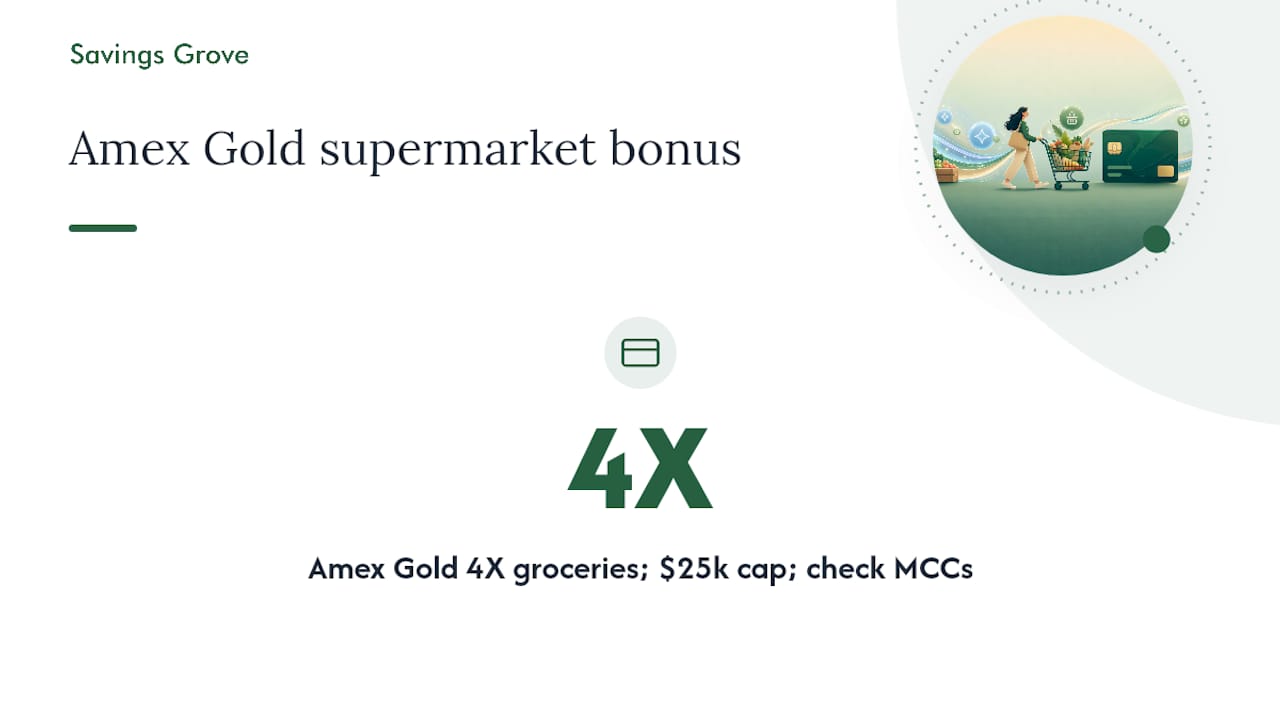
A few notes worth reading before you apply for any of these. The American Express® Gold Card’s 4X supermarket bonus is generous for households with heavy grocery budgets, but the $25,000 annual ceiling matters if you’re feeding a large family.
Reading the fine print means understanding merchant category codes (MCC), the classification system issuers use to decide whether a purchase counts as “dining” or “groceries.” A big-box store with a built-in grocery section might code as general merchandise rather than supermarket, which quietly denies you the bonus rate you expected.
How Can You Stack Multipliers for Bigger Rewards?
Stacking means layering several earning sources onto a single purchase instead of relying on one card’s base rate.
Building a real stacking habit comes down to a few repeatable moves:
- Pick one primary card that earns a strong flat or bonus rate for your biggest everyday category.
- Keep two or three secondary cards specifically for categories your primary card doesn’t cover well.
- Check activation status and caps monthly so a rotating bonus doesn’t quietly expire unused.
- Route online purchases through a shopping portal or cashback site when the merchant supports it, adding a second earning layer on top of your card.
Do this: map your recurring monthly expenses (groceries, gas, subscriptions) to whichever card pays the highest multiplier for each. Don’t do this: open a new card purely for a rotating bonus if you’re already carrying a balance elsewhere, since interest charges will outpace anything the bonus earns.
One illustrative scenario compared a household using a single flat 2X card against the same household optimizing category by category, and the optimized approach generated roughly 20,000 additional points per year. That’s the kind of gap that shows up specifically in households with concentrated spending in a few categories, not from opening a dozen cards.

Pro Tip: Write your card-to-category map on a sticky note in your wallet or save it as a phone note. The five seconds it takes to check which card to pull out is what actually makes stacking stick as a habit.
What Common Mistakes Reduce Your Multiplier Earnings?
Multiplier math looks clean on paper, but real-world purchases have a way of not earning what the advertised rate implies. A handful of recurring issues account for most of the lost points people never notice.
- MCC mismatches: a purchase you assume qualifies for a bonus category gets coded differently by the merchant’s payment processor, earning the base rate instead.
- Rotating category caps: spending past the quarterly limit (often $1,500) drops you back to 1X for the rest of the period.
- Excluded purchase types: gift card purchases, some utility payments, and cash advances typically earn no bonus rate regardless of category.
- Missed activation: forgetting to opt into a rotating category before the quarter starts means you earn the base rate the entire period.
- Account-level restrictions: issuers can flag accounts for unusual spending patterns, temporarily withholding bonus categories until reviewed.
If you suspect a purchase was miscoded, most issuers let you dispute the category through their app or by calling customer service, and they’ll often manually credit the difference once you show the receipt matches the intended category. Rotating categories and missed activation together account for a large share of the “I thought I earned more” complaints cardholders report, mostly because the activation step is easy to forget once a quarter.
When Does Chasing a Multiplier Actually Pay Off?
Run the math before you apply for a card with an annual fee attached to its multiplier. That’s an extra 800 points a month, or 9,600 points annually, worth roughly $96 at a 1 cent valuation. You’d barely clear the fee. Push that same dining spend to $700 monthly, though, and the extra points are worth around $168 a year, comfortably ahead of the fee.
Chase when: your spending in the bonus category is consistently high, and you pay your statement in full every month without exception.
Skip it when: you carry a balance from month to month, or your spending in the relevant category is too low to offset the fee.
Interest charges erase rewards faster than almost any other factor. A single month of carrying a balance at typical credit card interest rates can cost more than an entire year of multiplier earnings, which is why financial experts consistently stress paying in full before optimizing for points at all.
How Do You Put Multiplier Optimization Into Practice?
Turning this into a habit takes less setup than most people expect. Work through this once, then revisit it monthly.
- Pick one primary card that matches your single largest spending category.
- List your recurring monthly expenses and assign each to the card with the best multiplier for that category.
- Set a recurring calendar reminder on the first of each quarter to activate rotating bonus categories.
- Track spending against caps using your issuer’s app or a simple spreadsheet, so you know when you’re about to drop back to base rate.
For tools, your issuer’s app usually shows real-time category progress and caps most reliably. A basic spreadsheet works fine for tracking multiple cards at once, and dedicated tracking apps or cashback apps can automate some of this if you’re managing four or more cards.
Pro Tip: Savings Grove recommends one monthly review, not constant monitoring. Checking caps and activations once a month keeps you from missing bonuses without turning your budget into a spreadsheet obsession that eats more time than the points are worth.
A Reader’s Path From Flat-Rate to Category Mapping
We regularly hear from readers who switched from a single flat-rate card to a mapped system and were surprised how much of their existing spending was already sitting in a bonus category, they just hadn’t matched it to the right card. Savings Grove updates its card and category guidance monthly, verifying issuer terms before anything goes live, because caps and rotating categories shift often enough that stale advice quietly costs readers points.
Let Savings Grove Do the Category Math for You
Savings Grove is the alternative to guessing which card to pull out at checkout: our curated roundups map real spending categories to real multipliers, updated monthly, so you’re not relying on a card comparison that went stale two quarters ago.

We maintain these guides through ongoing research and issuer verification, and some of the products we mention pay us a referral fee if you apply through our links, which is how we keep this content free without charging readers a subscription. That doesn’t change which cards we recommend or how we describe their caps and fees. If you’re ready to match your spending to the right card, start with our credit card category spending guide and build your own card map this week.
Frequently Asked Questions
It means you earn three points or miles for every dollar spent in that specific bonus category, compared to the standard one point per dollar most cards pay on general purchases.
How do I calculate how many points a multiplier earns? Multiply your spending by the multiplier: points earned equals dollars spent times the multiplier.
Do multipliers apply to every purchase on the card? No. Multipliers apply only to purchases coded within the specific bonus category, such as dining or groceries, based on the merchant’s assigned category code. Everything else typically earns the card’s base rate.
Is a card with a high multiplier always worth the annual fee? Only if your spending in that bonus category is high enough to outweigh the fee, and only if you pay your statement balance in full each month, since interest charges cancel out rewards value quickly.
Can I combine multiple multipliers on one purchase? Yes. Booking through a shopping portal, using a card with a category bonus, and belonging to a loyalty program can all add points to a single transaction, though each source has its own terms and caps.
This article is general information, not a substitute for advice from a qualified financial advisor. Consult a qualified financial professional about your own circumstances before acting on anything here.
0 comments
Leave a comment
Reviewed before they appear. Your email is not shown.