

Practicing energy-efficient habits lowers your monthly consumption, reduces peak demand charges, and puts real money back in your pocket. A typical household that adopts a package of zero- and low-cost conservation habits can save a notable amount per year on utility bills, with additional savings when targeted upgrades follow.
Start this week with these three moves:
- Adjust your thermostat. Setting it back several degrees for eight hours a day can save about 8% of your heating and cooling energy use over a year.
- Turn down your water heater. Dropping the thermostat from 140°F to 120°F costs nothing and cuts standby heat loss immediately.
- Swap your five most-used light fixtures. Replacing them with ENERGY STAR LEDs saves roughly $40/year and the bulbs last far longer than incandescents.
Stat to know: Heating and cooling account for a substantial portion of a typical household’s annual energy bill, making thermostat habits the single highest-return place to start.
Table of Contents
- What is the role of energy efficient habits in lowering your bills?
- Which energy-saving habits give you the most money back?
- When does investing in upgrades make financial sense?
- How do you turn one-time actions into lasting habits that keep saving?
- How can you measure and verify your actual savings?
- What myths and barriers keep people from saving more?
- Key Takeaways
- Why habits first, then upgrades, is the right approach
- Where to learn more and check incentives
What is the role of energy efficient habits in lowering your bills?
The U.S. Energy Information Administration draws a clear line between two related concepts. Energy efficiency means using better technology to accomplish the same task with less energy, like swapping an incandescent bulb for an LED. Energy conservation means changing your behavior to use less energy overall, like turning that light off when you leave a room. Both reduce your bill. Combined, they multiply savings.
Habits work on your bill in two ways. First, they lower your total kilowatt-hours consumed each month. Second, when you shift high-draw activities (laundry, dishwashing) away from peak hours, you can reduce demand charges that some utilities apply. A household that consistently runs the dryer after 9 PM on a time-of-use rate plan pays less per kilowatt-hour for the same load.
The financial case is straightforward. Lower consumption means a smaller number on your bill. Shifting usage to off-peak windows can shrink the rate you pay per unit. Together, those two levers make behavioral habits one of the fastest, cheapest ways to improve your monthly cash flow.
Which energy-saving habits give you the most money back?
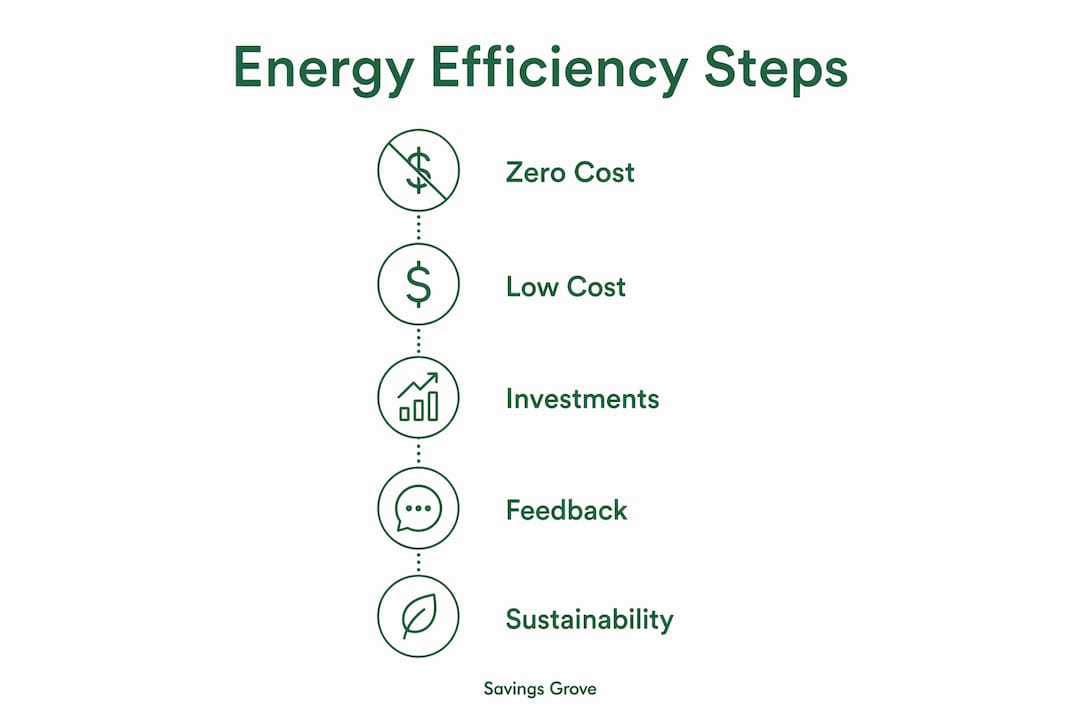
Work through actions in order of cost and return. Zero-cost habits first, low-cost upgrades second, and investments third.

| Thermostat setback for several degrees and hours per day is a no-cost action that can save about 8% of your heating and cooling energy use. | Lowering water heater temperature to a warm setting is a no-cost action that reduces standby heat loss. | | Unplug standby electronics | $0 | $50–$100 (varies by home) | No-cost | | ENERGY STAR LED swap (5 fixtures) | $10 | ~$40/year | Low-cost | | Smart thermostat | $100 | $50–$100/year | Low-cost | | Air sealing (DIY weatherstripping) | — | Varies by leakage level | Low-cost |
Zero-cost wins include thermostat setbacks, water-heater temperature adjustments, washing clothes in cold water, and unplugging chargers and TVs when not in use. These require nothing but a decision.
Low-cost upgrades like LED bulbs and a programmable thermostat pay back within months. A smart thermostat can save about $50–$100 per year on heating and cooling alone, which is around 8% of heating and cooling energy costs according to ENERGY STAR.
Pro Tip: Use your dryer’s moisture sensor instead of a timed cycle. Running a dryer just 15 extra minutes per load can add up to $34/year in wasted energy. Group similar fabrics together so the sensor reads the load accurately and stops on time.
A household that moves from all-timed cycles to sensor-based drying, swaps five light fixtures to LEDs, and sets the water heater to 120°F could realistically see $80–$175 in annual savings from those three steps alone, with no major investment. For more quick wins, the utility bill hacks guide at Savings Grove covers additional no-cost and low-cost tactics.
When does investing in upgrades make financial sense?
Habit changes are your foundation. Once you’ve captured the zero- and low-cost savings, focus upgrade dollars on the systems that carry the largest share of your energy load: heating and cooling, water heating, and the refrigerator.
| Upgrade | Typical Cost Range | Estimated Payback | Typical Annual Savings |
|---|---|---|---|
| Smart thermostat | $100 | 1–2 years | $50–$100 |
| ENERGY STAR refrigerator | — | 5–8 years | $50 |
| Heat pump water heater | — | 3–6 years | $200 |
| Air sealing + insulation (pro) | — | 4–8 years | — |
| ENERGY STAR HVAC system | — | 8–15 years | — |
Before spending, check for rebates. Many utilities offer direct incentives for audits and upgrades through demand-side management programs, and state Energy Efficiency Resource Standards vary widely.
Where to look for rebates and credits:
- ENERGY STAR Rebate Finder at energystar.gov: search by product and ZIP code
- Your utility’s website: look for “rebates,” “efficiency programs,” or “demand response”
- State energy office: many states offer additional incentives beyond federal programs
- Federal tax credits: the Inflation Reduction Act extended credits for heat pumps, insulation, and HVAC upgrades
Pro Tip: Time your upgrade purchases to align with your utility’s rebate cycle, which often resets in January or after summer peak season. Combining a federal tax credit with a utility rebate can cut your net cost by 30–50%, shortening payback by years.
For homeowners weighing larger investments, Savings Grove’s money tips for homeowners guide walks through how to prioritize and finance these decisions.
How do you turn one-time actions into lasting habits that keep saving?
A six-step plan locks in savings over months and years: set a baseline, pick one habit, stack it onto an existing routine, add a feedback tool, track your bill, and expand.
- Set your baseline. Pull three months of utility bills and note your average monthly kWh or therms.
- Pick one habit to start. Thermostat setback is the highest-return first move for most households.
- Stack it onto an existing routine. Set the thermostat back when you brush your teeth at night. Habit stacking ties new behaviors to ones you already do automatically.
- Add a feedback tool. A smart thermostat, an in-home energy display, or your utility’s app shows real-time usage. Timely feedback consistently outperforms single-message campaigns for sustaining energy reductions.
- Use commitment devices. Tell a family member your savings goal or set a calendar reminder to check your bill each month.
- Expand once the first habit sticks. Add the water-heater adjustment, then LED swaps, then standby-power reduction.
Behavioral research published in 2025 found that knowledge predicts investment behaviors (like appliance upgrades), while general awareness predicts lower-cost curtailment habits. That means pairing education with financial incentives is what moves people from turning off lights to actually replacing an old water heater.
Useful feedback tools include: smart thermostats (Nest, Ecobee), whole-home energy monitors (Sense), and your utility’s online usage portal. Most utilities offer free access to 15-minute interval data once you have a smart meter.
How can you measure and verify your actual savings?
The most reliable method is tracking your billed usage in kWh or therms before and after you make changes, then adjusting for weather and occupancy shifts.
- Collect three months of baseline bills before making any changes. Note the kWh or therms used, not just the dollar amount, since rates fluctuate.
- Log each behavior change with a date so you can isolate its effect.
- Use your utility portal or smart meter to monitor weekly usage. Most portals now show daily or hourly breakdowns.
- Calculate dollar impact. Multiply the kWh reduction by your rate (found on your bill) to convert usage drops into dollars saved.
Tools that help:
- Smart meters: most U.S. utilities have deployed them; access data through your online account
- Whole-home energy monitors (like Sense): plug into your electrical panel and identify individual appliances
- Utility usage portals: free, and often include year-over-year comparisons
Pro Tip: When comparing months, always adjust for weather. A warmer January will naturally lower your heating bill regardless of habit changes. Use heating degree days (available free from NOAA) to normalize comparisons and see your true savings.
What myths and barriers keep people from saving more?
A few common misconceptions slow people down more than the habits themselves.
- Myth: Windows are the biggest source of heat loss. Reality: hidden gaps around plumbing penetrations, chimneys, and recessed lighting often account for far more heat loss than windows. A blower-door test finds the real culprits.
- Myth: Turning devices off and on uses more energy than leaving them on. Reality: for virtually all modern home appliances and lights, turning them off saves energy every time.
- Myth: Small habits don’t add up. Reality: a thermostat adjustment of 1°F across a household can reduce emissions by 0.5%, and the dollar savings compound month after month.
Practical workarounds for common barriers:
- Upfront cost: Start with zero-cost habits. Use rebates and phased upgrades to spread investment costs over time.
- Comfort concerns: A programmable thermostat lets you set back temperatures only during sleep or away hours, so you never feel the difference.
- Renters: Focus on plug-load reduction, LED swaps (most landlords allow bulb changes), cold-water laundry, and shorter showers. Talk to your landlord about weatherstripping; it’s a low-cost fix that benefits them too.
For a broader look at cutting household costs across categories, the cut household expenses guide at Savings Grove pairs well with these energy steps.
Key Takeaways
Combining zero-cost conservation habits with targeted upgrades and real-time feedback produces the fastest, most sustained reduction in household utility bills.
| Start with thermostat setbacks | Adjusting the thermostat for several degrees and hours a day can save about 8% of your heating and cooling energy use annually at zero cost, according to ENERGY STAR. | Water heater at 120°F | Dropping from 140°F to 120°F cuts standby heat loss immediately with no equipment purchase. | | LED swaps pay fast | Replacing five high-use fixtures with ENERGY STAR LEDs saves roughly $40/year. | | Feedback sustains habits | A 2022 scoping review found combined tools and timely feedback consistently outperform single-action campaigns. | | Rebates shorten payback | Stacking utility rebates with federal tax credits can cut net upgrade costs by 30–50%. |
Why habits first, then upgrades, is the right approach
Most guides lead with the big-ticket items: new HVAC, new windows, full insulation. Savings Grove’s view is that this order is backwards for most households. Habits cost nothing and deliver returns starting on your next bill. Upgrades amplify those returns, but only after you’ve established the baseline behaviors that make the new equipment work efficiently.
If you install a smart thermostat but never program it, you’ve spent $200 for a fancy clock. If you build the setback habit first, the thermostat automates what you’re already doing and locks in the savings permanently. That sequence matters.
Savings Grove publishes monthly updates on financial strategies, including proven ways to save money and step-by-step guides for reducing household costs. Pair the habit-first approach here with those resources, and combine every upgrade with available rebates to accelerate your payback.
Visit Savings Grove for curated, up-to-date guides on reducing utility bills, finding rebates, and building a household budget that works.
Where to learn more and check incentives
Verify details and find rebate programs through these authoritative sources:
- U.S. Energy Information Administration: definitions, data, and state-level efficiency program summaries
- ENERGY STAR: rebate finder, product ratings, and no-cost savings tips
- U.S. Department of Energy Energy Saver: free downloadable guide covering home efficiency from top to bottom
- EPA Local Energy Efficiency Benefits: broader context on utility programs and community-level incentives
- Your state energy office: search “[your state] energy office rebates” for programs beyond federal offerings
- Your utility’s website: most offer free energy audits, rebate applications, and usage dashboards
Schedule a free energy audit through your utility if you’re unsure where your biggest losses are. Most utilities offer them at no charge, and the results tell you exactly where to focus your next dollar.
This article is general information, not professional financial or energy advice. Confirm current rebate eligibility, tax credit rules, and program details with the relevant agency or a qualified professional for your specific situation.