

The fastest ways to lower car insurance premiums are shopping and comparing quotes every one to two years, raising your deductible if you have savings to cover it, claiming every discount and bundling opportunity you qualify for, and enrolling in a telematics or low-mileage program. Never let coverage lapse while you shop, since gaps raise future rates. Exact savings depend heavily on your state, insurer, and driving record.
TL;DR:
- Raising deductibles from $500 to $1,000 can lower premiums by 10% to 25%, provided you have sufficient funds to cover higher out-of-pocket costs.
- Comparing policies requires matching liability limits, deductibles, and coverage endorsements precisely to avoid misleading quotes with insufficient or different coverage.
- Enrolling in telematics or low-mileage programs offers variable savings, often ranging from a few percent to several hundred dollars each year for safe, low-mileage drivers.
- Combining multiple tactics such as shopping, adjusting deductibles, and maximizing discounts yields the best long-term savings on auto insurance costs.
Table of Contents
- What Cuts Car Insurance Costs the Most Right Now?
- How Do You Get Apples-to-Apples Insurance Quotes?
- How Much Do Higher Deductibles Really Save You?
- Which Discounts Are You Probably Missing?
- Can Telematics and Defensive Driving Lower Your Rate?
- Does Your Credit Score Really Affect Your Premium?
- Does Your Car Choice Change What You Pay?
- Why Do Rate Increases Take So Long to Show Up?
- Your 30/90/365-Day Action Checklist
- What a Savings-Focused Reviewer Wants You to Know
- Put These Savings Into Practice Today
- Sources
What Cuts Car Insurance Costs the Most Right Now?
Premiums have climbed significantly since February 2020, driven by pricier repairs, medical claims, and the sensors and electronics packed into modern cars, according to NPR’s reporting on rising premiums. That backdrop makes the next few moves worth ranking by real impact, not just convenience.
- Switch insurers. Drivers who shopped around and switched saved a median of $461 a year, per Consumer Reports. This is usually the single biggest lever you control.
- Raise your deductible. Moving collision and comprehensive deductibles from $500 to $1,000 can trim premiums by roughly 10% to 25%, depending on the carrier and state, but only do this if you have the cash on hand to cover the higher out-of-pocket cost.
- Drop collision or comprehensive on older cars. If your annual premium for that coverage runs more than about 10% of the car’s cash value, it may cost more than it protects.
- Bundle and stack discounts. Multi-policy and multi-car discounts, plus smaller credits for safe driving or paperless billing, add up fast and cost nothing to ask about.
- Enroll in telematics or a low-mileage program. Savings vary widely, from a modest few percent to several hundred dollars a year for genuinely safe, low-mileage drivers, though you’re trading some driving data for the discount.
The order matters. Shopping and adjusting deductibles move the needle before you even touch discounts or driving programs.
How Do You Get Apples-to-Apples Insurance Quotes?
Comparing quotes only works if every insurer is pricing the identical policy. A cheap quote with thin liability limits isn’t actually cheaper once you’re the one covering the gap after a bad accident.
Before you request quotes, match these across every insurer:
- Liability limits (bodily injury and property damage)
- Collision and comprehensive deductibles
- Uninsured/underinsured motorist coverage
- Any endorsements, like rental reimbursement or roadside assistance
You have three main channels. Direct carriers let you quote fast online but only show their own rates. Independent agents can access regional insurers that never show up on national comparison sites, which matters in states with a fragmented insurance market. Comparison sites are quick for a baseline, but double-check the coverage details before trusting the sticker price.
Pro Tip: Keep your current declarations page open while quoting. It lists your exact limits and deductibles, so you can copy them line by line instead of guessing.

Shop every one to two years, or after a rate hike, a move, or a new car. Switching every few months, on the other hand, can actually work against you during underwriting.
How Much Do Higher Deductibles Really Save You?
Raising your deductible from $500 to $1,000 can lower your premium by roughly 10% to 25%, but that only pays off if you have an emergency fund that can absorb the higher out-of-pocket hit after a claim. If a $1,000 deductible would wreck your budget, a smaller bump to $750 still saves something without the same risk.
A few coverage rules worth applying before you touch your policy:
- Drop collision and comprehensive once the annual premium exceeds roughly 10% of your car’s market value.
- Keep liability limits at or above your net worth in assets, since a serious at-fault crash can expose savings, home equity, and future wages beyond your coverage.
- Never let a policy lapse while comparing carriers. A gap in coverage tends to raise your next quote, sometimes by more than you’d save by switching in the first place.
- Reassess deductibles annually as your emergency fund grows or shrinks.
Coverage adjustments save real money, but they only work if you’re not gambling with money you don’t have.
Which Discounts Are You Probably Missing?
Most drivers leave money on the table simply because nobody asked. The Insurance Information Institute lists bundling, safe-driver records, good-student grades, anti-theft devices, and paid-in-full billing among the most common discounts insurers offer but rarely advertise.
Check these before your next renewal:
- Multi-policy (home plus auto) and multi-car discounts
- Employer, alumni, or professional association group rates
- Good-student and defensive-driving-course credits
- Anti-theft device and paid-in-full discounts
Bundling helps most when both policies are priced competitively on their own. Run the math separately for home and auto before assuming the bundle discount beats splitting them across two insurers. And always ask your agent directly whether any “manual” or unadvertised discounts apply. Many aren’t listed on the website at all.
Can Telematics and Defensive Driving Lower Your Rate?
Telematics programs track your driving through a smartphone app, a plug-in device, or built-in vehicle systems, then adjust your rate based on braking, speed, and mileage. Carinsurance notes savings vary widely, from a small percentage up to several hundred dollars a year for genuinely safe, low-mileage drivers.
Before enrolling, weigh these factors:
- Ask exactly what data the insurer collects and how long it’s retained.
- State-approved defensive-driving courses often unlock a flat discount, typically renewable every few years.
- Low-mileage or pay-per-mile plans suit drivers under roughly 7,500 miles a year, but you’ll need to log or report mileage accurately.
- A single at-fault accident or moving violation can raise your rate for several years, so a clean record often beats any single discount.
Pro Tip: Combine telematics with a low-mileage program if you qualify for both.
Does Your Credit Score Really Affect Your Premium?
In most states, insurers use a credit-based insurance score as part of pricing, though California, Hawaii, and Massachusetts restrict or ban the practice, so check your state insurance department’s site before assuming this applies to you.
- Pull your CLUE claims report annually and dispute any errors you find.
- Dispute credit report errors and pay down revolving balances to lower utilization.
- Keep coverage continuous. Even a short gap between policies tends to push your next quote higher.
- Ask your insurer directly how claims history, beyond your driving record, factors into renewal pricing.
Does Your Car Choice Change What You Pay?
Vehicles with strong IIHS safety ratings and cheap, common replacement parts generally cost less to insure than ones with pricier repairs or theft-prone reputations.
- Some EVs and luxury cars cost more to insure due to expensive battery packs, specialized parts, or costly repair labor.
- Keep an older, paid-off car and drop collision/comprehensive once its value no longer justifies the premium.
- A long highway commute or dense urban parking tends to raise your rate versus a short suburban commute.
- Check a vehicle’s safety and repair-cost profile before buying if premium cost is a real factor in your budget.
Why Do Rate Increases Take So Long to Show Up?
State regulators approve rate changes before insurers can apply them, and that review process often means increases lag actual insurer losses by six to twelve months. That’s part of why premiums kept climbing well after 2022, even as some cost pressures started easing.
- States differ on rating factors. Some limit or ban credit-based scoring, others cap how much territory or age can swing your price.
- Shop again one to two years after a rate hike or major life change, per guidance from CarInsurance.com, rather than switching every few months.
- Filing a claim, even a small one, can meaningfully raise your renewal price at your next term.
- Check your state insurance department’s website before assuming a national average applies to your ZIP code.
Your 30/90/365-Day Action Checklist
Tactics only work if you actually schedule them. Here’s a realistic order of operations.
- Next 30 days: Pull your current declarations page, request a repricing from your existing insurer, and collect three outside quotes matching identical coverage limits.
- Next 90 days: Raise your deductible if your emergency fund supports it, enroll in a telematics program or complete a defensive-driving course, and remove any inactive drivers from your policy.
- Next 6 to 12 months: Dispute credit report errors, reduce credit utilization, and reassess whether your current vehicle still makes financial sense to insure at full coverage.
- Ongoing: Review your policy every renewal cycle and call an independent agent whenever your quote jumps without an obvious reason.
Pro Tip: Set a calendar reminder two weeks before each renewal date. That’s enough time to request new quotes without letting coverage lapse in the gap.
What a Savings-Focused Reviewer Wants You to Know
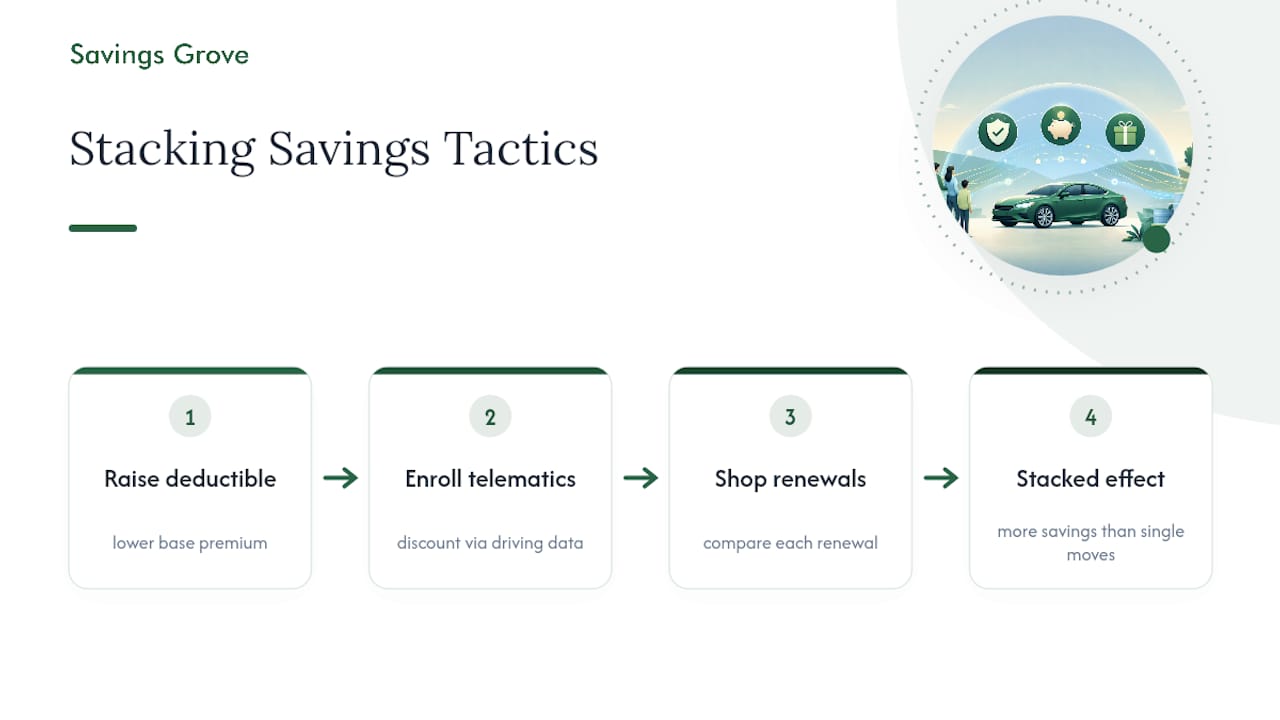
Most advice on this topic reads like a checklist, and checklists miss the point. The real savings come from stacking two or three tactics at once instead of picking just one. A driver who raises their deductible, enrolls in telematics, and shops every renewal cycle usually outperforms someone who does any single move in isolation.
The guides are updated regularly precisely because insurers change pricing models and discount structures often enough that last year’s advice can quietly go stale. If you’re working through this alongside other monthly costs, our guide on negotiating lower bills walks through scripts you can use directly with an insurance agent, and our breakdown of lowering car insurance without switching is worth a look if loyalty to your current carrier matters to you.
Don’t treat any single discount as the answer. Treat your policy like a system with multiple levers, and pull more than one.
— Mika L.
Put These Savings Into Practice Today
Savings Grove exists to turn advice like this into a number you can actually see. Where a traditional insurance shopping trip means calling five companies and comparing five different formats, Savings Grove’s guides and calculators give you one consistent framework for comparing your options side by side.

If you’d rather talk to a person than a chatbot, an independent insurance agency can dig up regional carriers that never show up on the big comparison sites, especially useful if your ZIP code has a thin insurance market. And if gas costs are eating into the same budget as your premium, our guide on saving money on gas tackles the other half of your transportation spending. Deals and strategy guides are refreshed regularly, so check back before your next renewal. Start by visiting the Savings Grove homepage to see this month’s featured savings tools.
Sources
- Why is car insurance so pricey? — NPR
- Proven ways to save on car insurance — Consumer Reports
- Nine ways to lower your auto insurance costs — Insurance Information Institute (III)
- Carinsurance
Check your own state insurance department’s website for rules specific to where your car is garaged. Local regulations often override any national average you’ll find elsewhere.
This article is general information, not a substitute for advice from a qualified financial advisor. Consult a qualified financial professional about your own circumstances before acting on anything here.