

Your credit utilization ratio is the percentage of your available revolving credit you’re currently using, and it’s one of the fastest levers you can pull to move your credit score. Most guidance points to keeping it under 30%, with under 10% putting you in range of top-tier scores. If you do nothing else today, calculate your total balances against your total limits, and pay down what you owe before your next statement closes.
TL;DR:
- Keeping your aggregate credit utilization below 30 percent is essential, with under 10 percent giving you the best chance for top scores.
- Paying down balances before your statement closes produces faster improvements than annual or monthly payments.
- Requesting a credit limit increase can lower your utilization instantly, but soft pulls are preferable to avoid score dips.
- Opening new credit cards should only be done if the added credit line outweighs short-term score reductions from inquiries and decreased average age.
- Avoid closing old accounts, as it reduces available credit and can increase your overall utilization ratio.
Table of Contents
- How to Calculate Your Credit Utilization Ratio
- Why Utilization Carries So Much Weight in Your Credit Score
- What’s the Ideal Credit Utilization Percentage?
- Practical Ways to Lower Your Credit Utilization
- When Will You See the Change on Your Credit Report?
- Myths About Credit Utilization You Should Stop Believing
- Your One-Page Utilization Checklist
- What the Conventional Advice Gets Wrong
- Let Savings Grove Help You Track and Improve Your Credit Standing
- Sources
How to Calculate Your Credit Utilization Ratio
The formula is simple: total revolving balances divided by total revolving credit limits, multiplied by 100. Revolving credit means credit cards and lines of credit, not installment loans like your car payment or mortgage.
You actually need to track two numbers. Your per-card utilization looks at one card’s balance against its own limit. Your aggregate utilization adds up every balance and every limit across all your cards. Scoring models weigh both, but your overall number usually carries more influence on how lenders view you.
Here’s a quick example. Say you have three cards:
- Card A: $800 balance, $2,000 limit
- Card B: $200 balance, $1,000 limit
- Card C: $0 balance, $5,000 limit
Your total balance is $1,000 against a total limit of $8,000, which puts your aggregate utilization at 12.5%. But Card A alone sits at 40%, high enough to work against you even though your overall number looks healthy.
You can find these figures on your monthly statements, through your issuer’s app, or on your free credit reports at Capital One’s education page, which walks through the same math issuers use internally.
Why Utilization Carries So Much Weight in Your Credit Score
Utilization falls under the “amounts owed” category in FICO scoring, and that category makes up roughly 30% of your score, the second-largest factor after payment history. VantageScore treats it similarly, folding credit usage into a weighting that TransUnion pegs at roughly 20% to 34% depending on the model version.
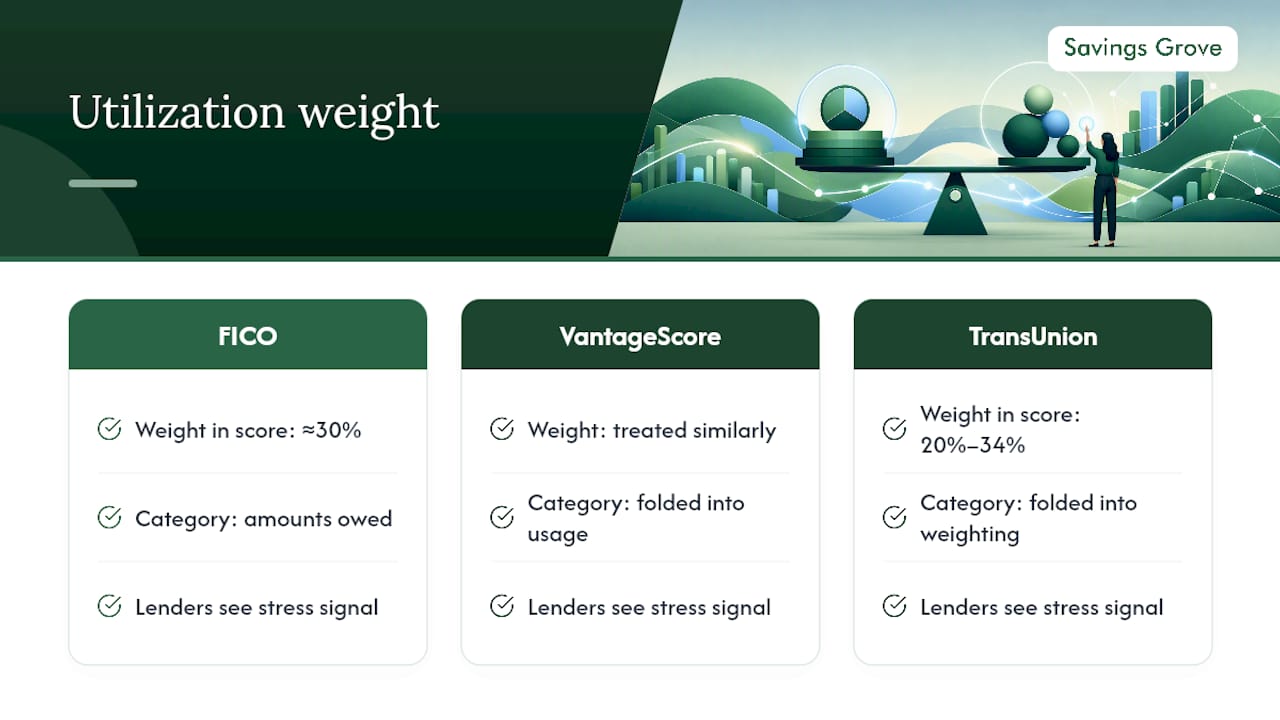
What makes utilization different from factors like payment history is how fast it reacts. Late payments can haunt your report for years. Utilization updates almost as soon as your issuer reports a new balance, typically once a month at your statement close date.
By the numbers: Experian’s Q3 2024 data put the average American’s overall utilization at about 29%, right at the edge of the conventional 30% guideline, while consumers with the highest score tiers tend to run single-digit utilization.
Lenders read utilization as a stress signal. Someone maxing out cards looks like they’re leaning on credit to cover gaps, and that shows up in approval odds and interest rate offers, not just your score. A single overloaded card can drag down your aggregate number even when your other accounts sit untouched, so lenders and scoring models both look past any one card to your full picture.
What’s the Ideal Credit Utilization Percentage?
The 30% rule is a floor, not a finish line. It’s the point where most scoring models start penalizing you more noticeably, but it’s not where you want to park permanently if you’re chasing a top-tier score.
- Under 30%: the baseline most experts consider acceptable for maintaining a solid score.
- Under 10%: where Experian’s data shows consumers with the best scores tend to cluster.
- Temporary spikes above 30%: acceptable if you’re covering an emergency or a large planned purchase, as long as you pay it down before the next statement close.
- Long-term target: aim for single digits if you’re planning a mortgage application or another major loan in the next six to twelve months.
Your target should match your goal.
Practical Ways to Lower Your Credit Utilization
Not every tactic delivers the same speed or safety. Here’s how to prioritize them.
- Pay your balance before your statement closes, not just by the due date. Your issuer reports the balance on your statement closing date, usually weeks before your payment is due. Log into your account, find that date, and make a payment a few days ahead of it. This single move often produces the fastest visible change in reported utilization.
- Request a credit limit increase, but check the inquiry type first. A higher limit lowers your ratio instantly without touching your balance. Experian notes that some issuers use a soft pull for these requests while others run a hard inquiry, which can temporarily dip your score. Call or check your issuer’s online request page before submitting.
- Space out your limit increase requests. Asking too frequently can trigger automated denials and make you look credit hungry to an issuer’s underwriting system. A gap of six months or more between requests on the same account is a reasonable rule of thumb.
- Open a new card only if the math works in your favor. A new account adds available credit, but it also adds a hard inquiry and lowers your average account age, both of which can dent your score short term before the added limit helps.
- Make multiple payments throughout the month. Paying as charges come in, rather than waiting for one lump payment, keeps your reported balance low no matter when your statement happens to close.
- Never close an old card to “clean up” your wallet. Closing an account removes its limit from your total available credit, which can spike your aggregate utilization overnight even if your spending hasn’t changed.
Pro Tip: If you’re deciding between paying down debt aggressively or requesting a limit increase, run both. Paying down principal cuts interest costs permanently, while a limit increase is a same-day utilization fix that costs you nothing if your issuer does a soft pull.
When Will You See the Change on Your Credit Report?
Utilization moves faster than almost any other credit factor, but it still runs on your issuer’s clock, not yours.
- Your issuer calculates your statement balance on your closing date, then typically reports that figure to the bureaus within a few days.
- Bureaus update your credit report on their own schedule after receiving that data, and your score recalculates once the new report is processed, often within one billing cycle.
- A hard inquiry from a limit increase or new card can shave a few points off your score, but that effect typically fades over several months and matters far less than the utilization improvement it may unlock.
- Example timeline: pay down your balance five days before your statement closes in March, and you should see the lower utilization reflected in your score by early April.
Myths About Credit Utilization You Should Stop Believing
A lot of well-meaning advice on this topic gets the details backward.
- Myth: 0% utilization is the goal. myFICO explains that a $0 balance can actually leave you short of maximum “amounts owed” points, since it gives scoring models nothing to evaluate. A small balance paid in full each month often scores better than none at all.
- Myth: only your maxed-out card matters. Scoring models weigh your aggregate ratio heavily, but an individual card running hot can still hurt you even if your total number looks fine.
- Myth: requesting limit increases has no downside. Too many requests in a short window can flag you as credit seeking and trigger the exact hard inquiries you were trying to avoid.
- Myth: closing unused cards is harmless. It removes credit limit from your denominator, which can push your utilization up without you spending another dollar.
Your One-Page Utilization Checklist
Savings Grove reviews credit card and rewards data every month, and this checklist reflects the tactics that consistently move readers’ utilization in the right direction.
- Calculate your aggregate utilization using the formula above.
- Set a target: under 30% for maintenance, under 10% if you’re loan shopping soon.
- Pick one or two tactics from the list, whichever fits your timeline.
- Schedule payments a few days before each card’s statement close date.
- Recheck your utilization after the next reporting cycle to confirm the change stuck.
If you’re carrying revolving balances at a high interest rate, pairing this checklist with a plan to negotiate your credit card interest rate can speed up how fast you pay down principal. And if you’re weighing whether to open a new card as part of your utilization strategy, our breakdown of card category spending benefits is worth a read first.
What the Conventional Advice Gets Wrong
Payment history takes years to repair.
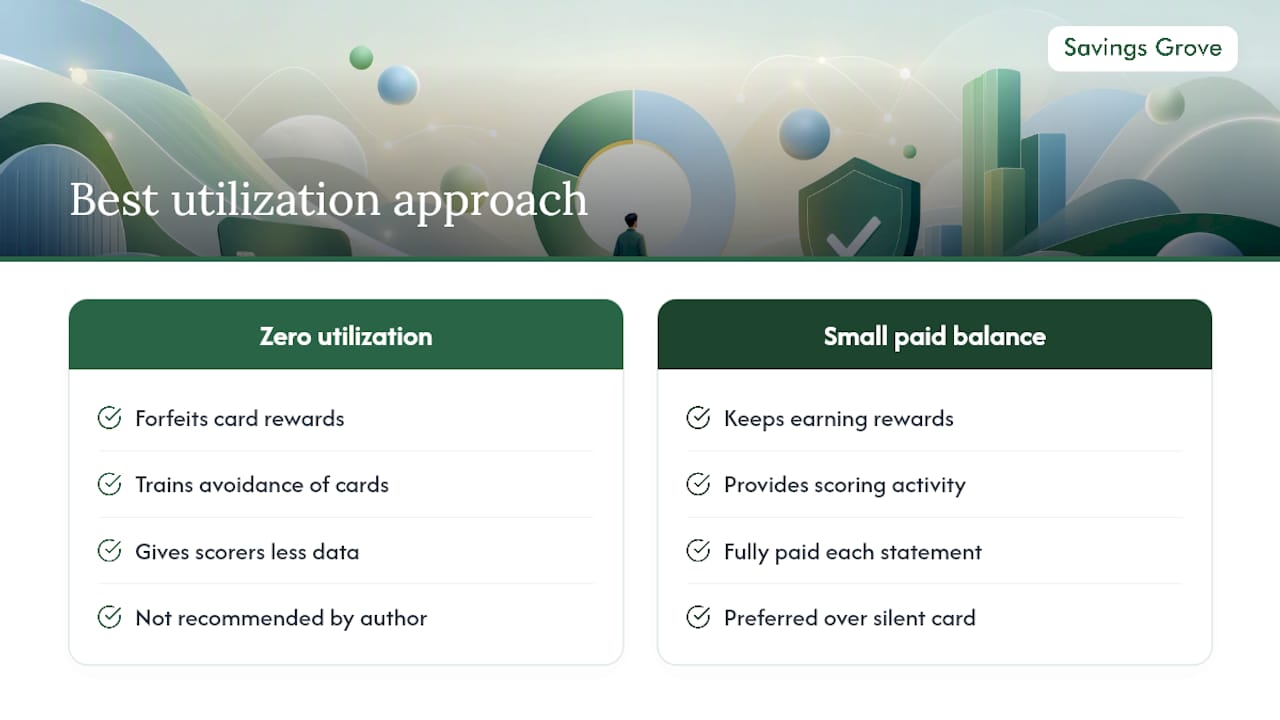
I’d argue the obsession with driving utilization to zero does more harm than good for a meaningful slice of readers, because it trains people to avoid using their cards at all, which forfeits rewards and gives scoring models less to work with. A small, fully paid balance beats a silent card every time.
If you’re prioritizing anything from this guide, prioritize statement timing over limit increases. A limit increase is a good secondary move, but it depends on issuer policy and carries inquiry risk. Paying down your balance before your statement closes costs you nothing and works with every issuer, every time.
— Mika L.
Let Savings Grove Help You Track and Improve Your Credit Standing
Savings Grove pulls together curated credit card comparisons and monthly product updates so you’re not piecing together credit strategy from a dozen scattered sources.
If your next move is choosing a card that fits your spending without tipping your utilization the wrong way, our guides break down which cards make sense for different balances and goals. Start on the Savings Grove homepage to browse current credit card roundups and monthly deal updates, then use the checklist above to calculate where you stand before you apply for anything new.
This article is general information, not a substitute for advice from a qualified financial advisor. Consult a qualified financial professional about your own circumstances before acting on anything here.
0 comments
Leave a comment
Reviewed before they appear. Your email is not shown.