

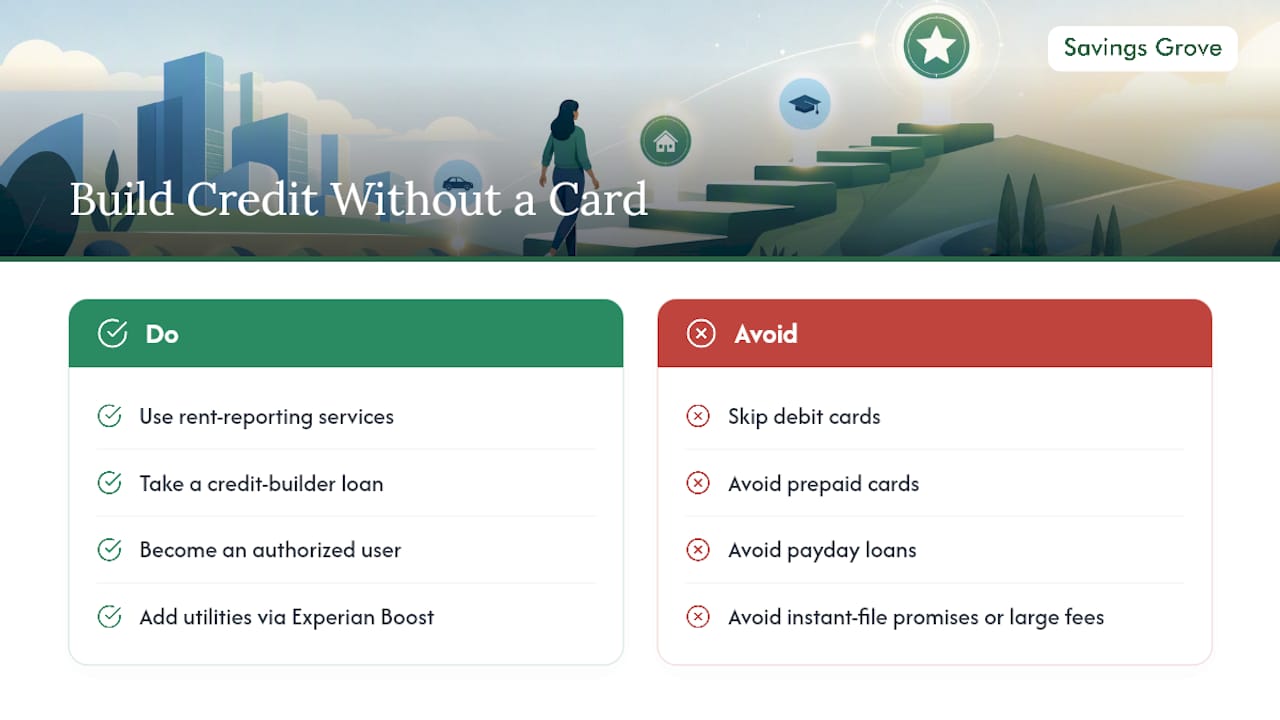
Yes, you can build credit without a credit card, and for many people it is the smarter starting point. The fastest, lowest-risk paths are becoming an authorized user, getting rent or bill payments reported to the bureaus (including through Experian Boost), and taking out a credit-builder loan. One rule ties all of it together: only accounts that actually report to the credit bureaus create a credit history.
- Authorized user status: instant history from someone else’s account
- Rent, utility, and bill reporting: turns payments you already make into credit data
- Credit-builder loans: small, low-cost loans built specifically to generate payment history
Key Takeaways
Building credit without a credit card works when payments are consistently reported to the bureaus through rent reporting, credit-builder loans, or authorized-user status.
| Point | Details |
|---|---|
| Reporting is everything | Only accounts that report to Equifax, Experian, or TransUnion create a credit history. |
| Rent reporting is underused | Fewer than 5% of tenants have rent reported automatically, so ask your landlord or use a service. |
| Credit-builder loans are low-risk | They combine forced savings with reported payments, typically visible in a score within three to six months. |
| Avoid non-reporting products | Debit cards, prepaid cards, and most payday loans build no credit history at all. |
Table of Contents
- Non-Card Ways to Build Credit and Who Each One Fits
- Make Bill Payments Count: Rent, Utilities, and Experian Boost
- Credit-Builder Loans: How They Work and Where to Find Them
- Become an Authorized User: Fast Visibility With Real Caveats
- Cosigners and Installment Loans: When They Actually Help
- What Doesn’t Build Credit (and Scams to Watch For)
- Timeline and Monitoring: When You’ll See Real Progress
- A Simple 90-Day Starter Plan
- Publisher Perspective: Prioritize Low Cost, Then Speed
- Frequently Asked Questions
- Sources
Non-Card Ways to Build Credit and Who Each One Fits
Not every method suits every situation, so match the route to where you’re starting from.
- Rent reporting works best for tenants with a solid on-time payment record and a landlord (or third-party service) willing to report it.
- Credit-builder loans fit people who want a structured, predictable way to build history and save money at the same time.
- Authorized user status is fastest for someone with a trusted family member or partner who has a strong, low-balance card.
- Installment loans or cosigned loans work for larger purchases, like a car, when a cosigner with established credit is available.
- Bill reporting through Experian Boost helps people who already pay utilities, phone bills, or streaming subscriptions on time.
Costs vary: rent-reporting services often charge a monthly or one-time fee, credit-builder loans carry modest interest and administrative costs, and authorized-user arrangements are usually free but depend entirely on someone else’s trust and financial habits.
Make Bill Payments Count: Rent, Utilities, and Experian Boost
Experian Boost lets you add on-time payments for utilities, phone bills, and some streaming services directly to your Experian file, often producing a score bump within minutes of connecting your bank account. Rent is trickier. Far fewer than 5% of tenants have their rent payments reported to the bureaus automatically, mostly because landlords aren’t required to report and most property managers never bother setting it up.
That gap is why third-party rent-reporting services exist. Platforms like the Zillow and Esusu partnership can report your rent going forward, and some let you back-report up to 24 months of past payments for a fee. Before signing up for any service, check three things:
- Which bureaus it reports to (one, two, or all three)
- Whether it reports positive-only history or your full payment record
- What it charges monthly, annually, or per lookback period
Pro Tip: Ask your landlord directly if they already use a rent-reporting platform. Many property management companies do this for free, and you could be missing out on months of unclaimed credit history.
Credit-Builder Loans: How They Work and Where to Find Them

A credit-builder loan flips the usual lending order. The lender holds your loan amount in a locked savings account while you make fixed monthly payments, and you get the money (often with interest) once the term ends. Every on-time payment gets reported the same way a car loan or personal loan would be.
Credit unions, community banks, and nonprofit lenders are the most reliable places to look; the FDIC is a solid starting point for finding an insured institution near you. Before signing anything, ask the lender three questions:
- Do you report to all three bureaus, or just one or two?
- What are the total fees and APR, per the TILA disclosure?
- How long is the term, and what happens if I pay late?
Pro Tip: Get the lender’s reporting policy in writing, then check your credit report about 60 days in to confirm the tradeline actually shows up.
Become an Authorized User: Fast Visibility With Real Caveats
Being added as an authorized user on someone else’s credit card can import that account’s entire payment history into your file, sometimes within one billing cycle. It’s one of the quickest ways to go from no credit file to having one.
The catch: this only works if the card issuer actually reports authorized users to the bureaus, which not all of them do, so confirm that before assuming it will help. The primary cardholder still carries full legal responsibility for the balance, and their habits become yours by extension. A missed payment or high utilization on their end can drag your new file down before it even gets going.
- Ask the issuer directly whether authorized users are reported
- Agree on a no-spend arrangement if trust is a concern
- Check your credit report monthly to confirm the tradeline appears correctly
Cosigners and Installment Loans: When They Actually Help
Student loans, auto loans, and personal loans all report payments as installment tradelines, functioning much like a credit-builder loan but usually for a larger, purposeful expense. A cosigner makes sense when you need financing you can’t qualify for alone, but understand that they share full legal liability if you fall behind.
Before pursuing this route:
- Confirm the monthly payment fits comfortably in your budget, not just barely.
- Choose a realistic term length rather than the shortest one available.
- Have a backup plan if income drops unexpectedly.
If a cosigner isn’t available, a credit-builder loan or a nonprofit lender program is a safer alternative that doesn’t put someone else’s credit on the line.
What Doesn’t Build Credit (and Scams to Watch For)
Debit cards, prepaid cards, most payday loans, and many “buy here, pay here” dealer arrangements typically don’t report to the credit bureaus at all, no matter how consistently you pay. Spending money on time through these products builds nothing on your credit file.
Watch for outright scams, too:
- CPN (credit privacy number) schemes claiming to erase bad history
- “Instant credit file” services demanding large upfront fees
- Anyone promising a guaranteed score increase for a price
Under the Fair Credit Reporting Act, you have the right to dispute inaccurate information for free. Start with AnnualCreditReport.gov, the only federally authorized source for free annual credit reports.
Timeline and Monitoring: When You’ll See Real Progress
A new tradeline, whether it’s a credit-builder loan or a reported rent payment, typically generates a usable FICO or VantageScore within three to six months of consistent reporting. Some services, like rent platforms offering back-reporting, can shorten that window if they add past payment history all at once.
To track your progress:
- Pull free reports from all three bureaus, Equifax, Experian, and TransUnion, through AnnualCreditReport.gov.
- Check whether your lender or landlord uses FICO or VantageScore, since the two models weigh factors slightly differently.
- Use free bureau or bank monitoring tools before paying for a subscription service.
Keep documentation as you go: proof of payment, your lease agreement, and any TILA disclosure from a credit-builder loan. That paperwork is exactly what you’ll need if you ever have to dispute an error.
A Simple 90-Day Starter Plan
Days 1 to 30: Pick one method, rent reporting, a credit-builder loan, or an authorized-user arrangement. Enroll, sign paperwork, or ask your landlord directly, and set up autopay immediately.
Days 31 to 60: Confirm the account is actually reporting. Connect Experian Boost if you’re eligible, and verify your first credit-builder loan payment posted correctly.
Days 61 to 90: Pull your credit reports, confirm the new tradeline appears, and dispute any errors you find.
- Choose your method and enroll
- Confirm reporting and set autopay
- Check your reports and fix mistakes
Pro Tip: Set a calendar reminder for day 45. That’s usually early enough to catch a reporting problem before it costs you a full billing cycle.
Publisher Perspective: Prioritize Low Cost, Then Speed
If you’re choosing one method to start, weigh cost before speed. Rent reporting or a credit-builder loan usually beats chasing an authorized-user arrangement that depends on someone else’s financial discipline. Verify reporting, automate your payments, and pull your free credit reports to confirm progress. For more on how credit products fit together once you’re ready for a card, Savings Grove’s guide on credit card tiers is a useful next stop.
Frequently Asked Questions
Can I build credit without a credit card? Yes. Rent reporting, credit-builder loans, and authorized-user status all create reportable payment history without requiring a card.
How long does it take to build credit without a credit card? Most people see a usable FICO or VantageScore within three to six months of consistent reporting, sometimes sooner with back-reported rent history.
Does paying my utility bills on time build credit? Only if reported. Experian Boost lets you add eligible utility, phone, and streaming payments directly to your Experian file.
Are rent-reporting services worth the fee? Often, yes, especially if a service offers back-reporting for past payments, but confirm which bureaus receive the data before paying.
What should I avoid when trying to build credit? Skip debit cards, prepaid cards, most payday loans, and any service promising an “instant” credit file or charging large upfront fees.
This article is general information, not a substitute for advice from a qualified financial advisor. Consult a qualified financial professional about your own circumstances before acting on anything here.