

A 529 plan is the most tax-efficient way for most U.S. families to save for college and other education costs, since after-tax contributions grow tax-deferred and qualified withdrawals come out federal income tax-free. It works well for parents, grandparents, and anyone saving toward postsecondary tuition, eligible K-12 costs, apprenticeships, or student loan payoff. State tax perks, fees, and plan rules vary widely, so the plan you pick matters as much as the decision to start.
TL;DR:
- State differences in fees and tax benefits significantly impact the overall value, making direct-sold plans with low expense ratios generally the best choice.
- Contributions to a 529 grow tax-deferred at the federal level and are tax-free when withdrawn for qualified education expenses, but non-qualified withdrawals incur taxes and penalties on earnings.
- The contribution limit is driven by state lifetime caps and gift-tax rules, with options like superfunding allowing large upfront contributions without immediate tax consequences.
- Using a 529 owned by a parent affects financial aid minimally, but grandparent-owned plans can trigger aid reductions unless carefully timed or converted.
- Investment choices are mainly age-based or static portfolios, with low-fee direct plans offering automatic risk mitigation and limited reallocation options.
Table of Contents
- 529 Plan Basics: The Key Takeaways
- What Is a 529 Plan and What Are the Two Main Types?
- How Does a 529 Plan Work for Taxes at the Federal and State Level?
- What Are the Qualified Education Expenses for a 529 Plan?
- How Much Can You Contribute to a 529 Plan?
- What Investment Options Do 529 Plans Offer?
- What Happens if You Withdraw 529 Funds for Non-Qualified Expenses?
- How Do 529 Plans Affect Financial Aid?
- How Do You Choose the Right 529 Plan?
- Why You Can Trust This Guide
- An Editorial Take on What Actually Matters Here
- Keep Planning: More Savings Grove Guides Worth Reading
- Where These Facts Come From
- Sources
529 Plan Basics: The Key Takeaways
Before you dig into the details, here’s what actually moves the needle when you’re deciding whether to open a 529 and which one to choose.
- Tax edge: contributions grow tax-deferred, and withdrawals for qualified expenses skip federal income tax entirely, according to the IRS.
- What counts: tuition, fees, books, room and board, a capped amount per year in K-12 tuition, registered apprenticeship costs, and a capped lifetime amount toward student loans.
- Two plan types: education savings plans (flexible, invest in the market) and prepaid tuition plans (lock in tuition rates at specific schools).
- The catch: fees differ enormously between plans, and non-qualified withdrawals get hit with taxes plus a penalty on earnings, though a newer rollover option to a Roth IRA has softened the “leftover funds” worry.
- Do this next: compare expense ratios across two or three plans, check whether your state offers a deduction or credit, and lean toward a direct-sold plan if fees are your main concern.
The rest of this guide walks through each of these pieces in plain terms, so you know exactly what you’re signing up for before you open an account.
What Is a 529 Plan and What Are the Two Main Types?
A 529 plan is a state-sponsored investment account authorized under Section 529 of the Internal Revenue Code, built specifically to help families save for education. Every state offers at least one, and the IRS confirms the core deal: you contribute after-tax dollars, the money grows tax-deferred, and you pay no federal tax on withdrawals used for qualified expenses.
There are two structurally different versions, and mixing them up leads to bad decisions.
Education savings plans are the version most families use. You contribute money, choose from a menu of investment portfolios, and the account balance rises or falls with the market. Funds can go toward tuition, room and board, books, and other qualified costs at eligible schools nationwide, not just in-state. This flexibility is why education savings plans dominate the market.
Prepaid tuition plans work differently. Instead of investing your money, you’re locking in today’s tuition rates at specific participating colleges, usually public universities in your own state. The Investor notes these plans typically carry residency requirements and guarantee a future tuition value rather than market returns.
The trade-off is straightforward: prepaid plans offer certainty but limit you to specific schools and states, while education savings plans offer flexibility but carry investment risk. If your child might attend an out-of-state school, or you’re not sure where they’ll enroll, an education savings plan gives you far more room to adapt.
How Does a 529 Plan Work for Taxes at the Federal and State Level?
Here’s the mechanic that makes 529 plans worth the paperwork: your contributions don’t get a federal tax deduction going in, but the earnings grow without being taxed year to year, and you never pay federal tax on withdrawals used for qualified expenses. The IRS is explicit about this structure, and it’s the single biggest reason 529 plans beat a plain taxable brokerage account for education saving.
State tax treatment is where things get more interesting, and more variable. Many states offer a deduction or credit for contributions, but that benefit usually applies only if you use that state’s own plan. If you live in a state with an income tax deduction and you buy an out-of-state plan instead, you likely leave that state benefit on the table. A handful of states offer no income tax at all, which makes the “home state” question irrelevant, and a few let you deduct contributions to any state’s plan regardless of where you live.
On the gift-tax side, there’s no federal cap on how much you can contribute to a 529 in a given year. But contributions count as gifts to the beneficiary, so they interact with the annual gift-tax exclusion. Go over that threshold in a single year and you may need to file a gift-tax return, even though you likely won’t owe actual gift tax unless you’ve used up your lifetime exemption. Because state rules shift year to year and household situations differ, it’s worth a quick conversation with a tax advisor before you make an unusually large contribution.
What Are the Qualified Education Expenses for a 529 Plan?
Knowing exactly what counts as a “qualified” expense keeps you from accidentally triggering taxes and penalties. IRS Publication 970 lays out the full list, and it’s broader than most people assume.
- Postsecondary tuition and fees at any eligible college, university, or vocational school.
- Required books, supplies, and equipment, including a computer if the school requires one for enrollment.
- Room and board, but only up to the school’s official cost-of-attendance allowance, and only if the student is enrolled at least half-time.
- K-12 tuition, capped at $10,000 per year in federal tax-free treatment per beneficiary, though some states treat this differently for state tax purposes.
- Registered apprenticeship program costs, including fees, books, supplies, and required equipment, per IRS Tax Topic 313.
- Student loan repayment, capped at $10,000 lifetime per beneficiary, and another $10,000 lifetime for each of the beneficiary’s siblings.
Notice what’s missing: transportation, health insurance, and application or testing fees generally don’t qualify. If you’re not sure whether a specific cost counts, check the expense against Publication 970 or ask your plan administrator before you withdraw funds, not after.
How Much Can You Contribute to a 529 Plan?
There’s no federal annual contribution limit on a 529 account, which surprises a lot of first-time savers who expect something like a 401(k) cap. Instead, contributions are treated as gifts to the beneficiary, so they’re measured against the annual gift-tax exclusion. Contribute more than the annual gift-tax exclusion amount to one beneficiary in a single year, and you’ll likely need to file a gift-tax return, even if no tax is actually owed.
States, not the federal government, set the real ceiling. Every plan has an aggregate lifetime contribution limit, which is the total balance allowed across all accounts for one beneficiary in that state’s plan. These limits vary widely from state to state, so check the specific plan’s disclosure documents rather than assuming a number.
Pro Tip: If you’re a grandparent or relative who wants to make a large, one-time contribution, ask about “superfunding.” This lets you front-load five years’ worth of the annual gift-tax exclusion into a single contribution without triggering gift tax, as long as you file the right paperwork and don’t make additional gifts to that beneficiary during the five-year window.
Superfunding is popular with grandparents who want to move a meaningful lump sum out of their estate while giving the investment more time to compound. It’s a niche move, but for families with the means, it’s one of the more efficient ways to jump-start an account balance.
What Investment Options Do 529 Plans Offer?
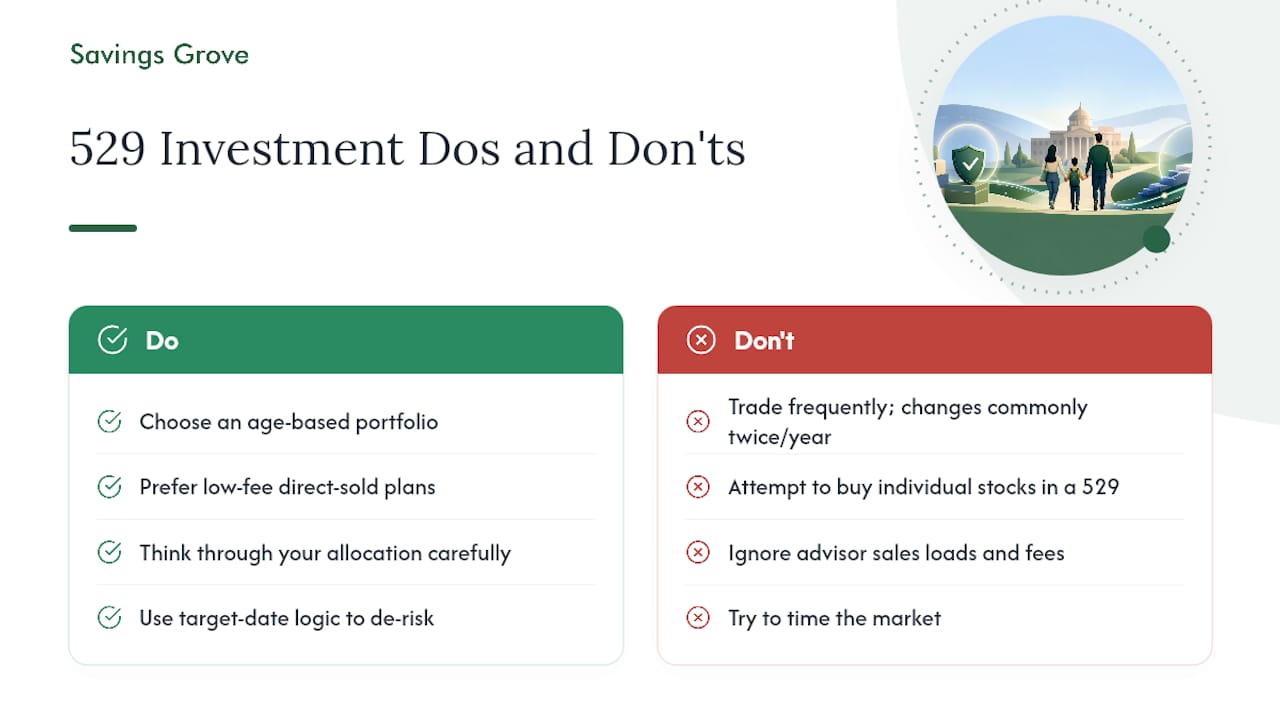
Every 529 plan hands you a menu, not a blank check. According to FINRA, you’ll typically choose among age-based portfolios that automatically shift from stocks to bonds as the beneficiary nears college, static portfolios that hold a fixed allocation, and sometimes individual index or actively managed fund options. You cannot buy individual stocks inside a 529, which keeps the accounts simpler but also more constrained than a regular brokerage account.
Plans also limit how often you can change your investment selections, commonly to twice per calendar year. That restriction exists because 529 accounts get favorable tax treatment, and the IRS doesn’t want them used as a vehicle for frequent trading. Practically, it means you should think through your allocation carefully rather than trying to time the market.
Fees are where the real differences show up. Direct-sold plans, which you open yourself through a state’s website, tend to carry lower expense ratios. Advisor-sold plans, purchased through a financial professional, often add sales loads and higher ongoing costs. FINRA’s investor guidance flags this explicitly: those extra costs compound over the life of the account and can meaningfully shrink what’s actually available for college.
For most families, an age-based portfolio in a low-fee, direct-sold plan is the simplest path. It automatically de-risks as enrollment approaches, similar to the logic behind target-date allocation strategies used in retirement accounts, so you’re not stuck manually rebalancing every year.
What Happens if You Withdraw 529 Funds for Non-Qualified Expenses?
Take money out for something that doesn’t qualify, and the earnings portion of that withdrawal gets taxed as ordinary income, plus an additional 10% federal penalty. Your original contributions come back out tax-free and penalty-free, since you already paid tax on that money before it went in.
Here’s the part that trips people up: you can’t cherry-pick and withdraw only your original contributions to dodge the tax hit. Every distribution is treated as a proportional mix of contributions and earnings, based on the account’s overall ratio at the time of withdrawal. Pull out $10,000 from an account that’s 60% contributions and 40% earnings, and $4,000 of that withdrawal counts as earnings subject to tax and penalty, regardless of what you intended to spend it on.
This is exactly the risk that made some families hesitate to overfund a 529, especially when a child gets a scholarship or skips college entirely. Recent legislative changes eased that concern significantly. Under the newer rollover option described by Investor.gov, families can now move unused 529 funds into a Roth IRA for the beneficiary, subject to a lifetime cap and other constraints, including a requirement that the account has been open for at least 15 years and limits tied to annual Roth contribution rules.

That rollover doesn’t erase every restriction. Annual amounts moved still count against the beneficiary’s regular annual Roth contribution limit, and the account has to meet the 15-year holding requirement first. But it converts what used to be an all-or-nothing bet into a more forgiving one, and it’s worth understanding if you’re weighing whether to keep contributing once a child is already in college.
How Do 529 Plans Affect Financial Aid?
Ownership structure matters more than most families realize when it comes to FAFSA treatment. A 529 owned by a parent counts as a parental asset, which the federal aid formula assesses at a low rate, generally capped around 5.64% of the account value. That’s a much gentler hit than assets counted directly in the student’s name.
Grandparent-owned 529 accounts used to create a bigger headache, since distributions counted as untaxed student income on a future FAFSA and could sharply reduce aid eligibility. Recent FAFSA formula changes have reduced that penalty for many families, but timing still matters. Coordinating with a school’s financial aid office before taking a distribution, especially in a student’s final two years of college, can help you avoid an unwelcome surprise on the following year’s aid offer.
If a beneficiary doesn’t end up using all the funds, you’re not stuck. Plans generally let you change the beneficiary to a sibling or other qualifying family member, roll the account into another 529 for the same beneficiary, or, as covered above, move a limited amount into a Roth IRA once eligibility requirements are met.
How Do You Choose the Right 529 Plan?
Picking a plan comes down to a handful of concrete comparisons, not brand recognition. Start with these criteria before you open anything:
-
State tax benefit: does your state offer a deduction or credit, and does it require you to use the in-state plan to get it?
-
Total fees: compare expense ratios across the age-based portfolios you’d actually use, not just the headline number.
-
Investment menu: are there enough age-based and static options to match your risk comfort?
-
Track record and reputation: has the plan had stable management and consistent investment options over time?
-
Ease of use: can you manage contributions, statements, and beneficiary changes online without friction?
Before you commit, pull the plan’s offering circular and check for specific answers: what’s the total annual expense ratio for the portfolio you want, are there residency requirements tied to the state tax benefit, how many investment changes are allowed per year, what are the exact rollover and beneficiary-change rules, and what’s the plan’s aggregate lifetime contribution limit?
Watch for red flags, too. High sales loads on advisor-sold plans, vague or hard-to-find fee disclosures, an investment menu with only one or two generic options, and slow or unresponsive customer service are all signs to look elsewhere.
Pro Tip: Shortlist two or three plans, pull each offering circular, and line up the expense ratio, state tax benefit, and lifetime limit side by side. The plan that wins on cost and matches your state tax situation is almost always the right call, even if it’s not the most heavily advertised option.
Once you’ve compared, the next steps are simple: open the account online, set up automatic contributions if the plan allows it, and revisit your investment mix every year or two as enrollment approaches.
Why You Can Trust This Guide
This guide was researched and written by Mika L. at Savings Grove, drawing on primary sources including the IRS, Investor.gov, and FINRA rather than secondhand summaries. Savings Grove updates its education and retirement guides monthly to reflect current IRS guidance and plan rule changes.
If you’re weighing 529 savings against other tax-advantaged goals, Savings Grove’s guides on qualified charitable distribution rules and the Mega Backdoor Roth strategy cover adjacent territory worth understanding before you lock in a savings plan.
An Editorial Take on What Actually Matters Here
The conventional advice on 529 plans spends too much time on investment performance and not enough on fees and ownership structure. Performance differences between two reasonably diversified age-based portfolios are usually small over a decade. Fee differences between a direct-sold and an advisor-sold plan are not, and they compound every single year the account exists.
The rollover-to-Roth change deserves more attention than it gets, too. For years, the biggest objection to funding a 529 aggressively was the fear of a scholarship or a kid who skips college, leaving parents stuck paying penalties to access their own savings. That fear is largely outdated now, within the lifetime cap and 15-year holding rule.
If you’re deciding where to focus first, skip the debate over which state’s plan has the flashiest marketing. Check your own state’s tax deduction rules, compare two or three expense ratios, and open a direct-sold plan if none of your state options beat that on cost. That’s the decision that actually changes your outcome.
— Mika L.
Keep Planning: More Savings Grove Guides Worth Reading
Opening a 529 is one piece of a larger education and retirement puzzle, and Savings Grove built its guide library to help you work through the rest of it. If you’re also trying to trim tuition costs directly, 5 Smart Ways to Save Money in College covers practical tactics that pair naturally with a 529, from tuition negotiation to overlooked aid sources.

If you’re balancing college savings against your own retirement priorities, Savings Grove’s guide on how to reduce taxes in retirement walks through how to sequence those two goals without shortchanging either one. And if you want a broader library of vetted financial guides, calculators, and monthly-updated product roundups, Savings Grove’s homepage is the hub for all of it. Start there, bookmark the guides that match your situation, and come back as your plan takes shape.
Where These Facts Come From
- IRS: 529 Plans Questions and Answers, federal tax rules
- Investor, SEC investor bulletin
- FINRA: 529 Plans, fees and investment guidance
- College Board: Trends in College Pricing, tuition cost data
- IRS Publication 970, qualified expense rules
This article is general information, not a substitute for advice from a qualified financial advisor. Consult a qualified financial professional about your own circumstances before acting on anything here.
0 comments
Leave a comment
Reviewed before they appear. Your email is not shown.