

You can deduct up to a capped amount of the interest you paid on student loans in 2026, taken directly off your taxable income even if you don’t itemize. You lose the deduction entirely if you’re married filing separately or if someone else claims you as a dependent. The write-off phases out once your modified adjusted gross income (MAGI) hits certain thresholds for single filers and married filing jointly, and disappears completely at the upper end of these ranges.
TL;DR:
- Filers cannot claim the deduction if they are married filing separately or claimed as a dependent, regardless of income or interest paid.
- Interest paid from loans used solely for qualified education expenses from federal or private lenders remains deductible, including refinanced loans tracing back to qualified debts.
- Loan servicers issue 1098-E forms only if interest exceeds $600; if under, you can still deduct interest using records like account statements.
- The deduction usually saves $200 to $500 annually for qualified mid-to-low income filers, but refinancing strategies or employer repayment assistance might offer greater financial benefit.
Table of Contents
- How Much Can You Deduct in 2026?
- Who Qualifies for the Student Loan Interest Deduction?
- Which Loans and Payments Actually Qualify
- How to Claim the Deduction on Your Tax Return
- A Worked Example: Single Filer Near the Phaseout Line
- Multiple Servicers, Missing Forms, and Other Filing Traps
- Why You Can Trust This Guide
- When This Deduction Actually Moves the Needle
- Where to Go Next for Calculators and Guides
- Sources
How Much Can You Deduct in 2026?
The student loan interest deduction is capped at a maximum amount per return, and it’s an above-the-line adjustment, meaning it reduces your adjusted gross income before you even decide whether to itemize. Topic 456 from the IRS, you deduct the lesser of $2,500 or the actual interest you paid, and that amount shrinks once your MAGI crosses into phaseout territory.
For 2026, single filers, heads of household, and qualifying surviving spouses phase out within a defined MAGI range. Married couples filing jointly phase out in a higher MAGI range, which is wider than the single-filer range. The math works on a straight-line formula: subtract your MAGI floor from your actual MAGI, divide by the phaseout width, then multiply that fraction by your interest paid to find the reduction.
| Filing Status | Phaseout Begins | Deduction Phases Out |
|---|---|---|
| Single / HOH / QSS | Starts at a defined MAGI level | Ends at a defined MAGI level |
| Married Filing Jointly | Starts at a higher MAGI level | Ends at a higher MAGI level |
| Married Filing Separately | Not eligible | Not eligible |
Who Qualifies for the Student Loan Interest Deduction?
You need to clear five hurdles before the IRS lets you claim a dollar of this deduction. Miss one, and the deduction disappears no matter how much interest you paid.
- You’re legally obligated to repay the loan, either as the primary borrower or a cosigner.
- You actually paid interest during the tax year, not just accrued it.
- The loan qualifies as a student loan under IRC §221.
- Your filing status isn’t married filing separately.
- Nobody else claims you as a dependent on their return.
Two of those rules are absolute bars, not soft guidelines. Married filing separately blocks the deduction outright, regardless of income or how much interest you paid. Being claimable as a dependent does the same, even if you’re the one who signed the loan documents and made every payment.
There’s a wrinkle worth knowing: the constructive payment rule. If a parent or relative pays interest on a loan you’re legally obligated to repay, Publication 970 treats that payment as if you made it yourself, and you can still claim the deduction as long as you’re not someone’s dependent.
Which Loans and Payments Actually Qualify
A “qualified student loan” under IRC §221 is one taken out solely to pay qualified higher education expenses for you, your spouse, or a dependent at the time the loan was made. That covers tuition, fees, room and board, books, and related costs at an eligible institution.
Most federal and private student loans clear this bar without issue. A few situations trip people up:
- Loans from a related party (say, a loan from your parents outside a commercial lender) generally don’t qualify.
- Money borrowed but not actually used for qualified education expenses loses eligibility for that portion.
- Refinanced loans usually stay qualified, as long as the original loan met the requirements and the refinance didn’t add non-qualified debt.
- Employer student loan repayment assistance that’s excluded from your taxable income can’t also generate a deduction for that same interest.
If you refinanced through a private lender to snag a lower rate, don’t assume you lost the deduction. The interest is still deductible as long as the underlying debt traces back to qualified education expenses.
How to Claim the Deduction on Your Tax Return
Claiming this deduction takes five steps, and none of them require special software beyond what you’re already using to file.
- Collect every Form 1098-E you received from loan servicers, showing interest paid during 2026.
- Calculate your MAGI, starting from AGI and adding back specific items detailed in Publication 970, like foreign earned income exclusions.
- Run the Student Loan Interest Deduction Worksheet in the Form 1040 instructions to apply the $2,500 cap and the phaseout formula.
- Enter your allowed deduction on Schedule 1 (Form 1040), line 21.
- Keep your 1098-E forms and loan statements with your tax records. Don’t attach them to your return.
Pro Tip: If you use tax software, it usually runs the MAGI and phaseout math automatically once you enter your 1098-E figures. Still, calculate it by hand once so you understand why the number came out the way it did. That way you can catch a software error if your income sits near a phaseout boundary.
A Worked Example: Single Filer Near the Phaseout Line
Here’s how the numbers actually play out for someone whose income sits inside the phaseout window.
- Sarah paid more interest in 2026, but the cap limits her starting point to the maximum deductible amount.
- Her MAGI is $92,000, which falls squarely inside the $85,000 to $100,000 phaseout range for single filers.
- Subtract the floor from her MAGI and divide by the phaseout width to get a fraction representing the reduction proportion.
- Multiply the maximum deduction by the reduction fraction to find the reduction amount, then subtract that from the maximum deduction to get the allowed deduction.
- Sarah enters $1,333 on Schedule 1, line 21.
For a filer in the 22% bracket, a $1,333 deduction saves close to $293 in federal tax. Most filers who qualify save somewhere between $200 and $500 a year depending on their bracket and how much interest they paid.
Multiple Servicers, Missing Forms, and Other Filing Traps
Loan servicers generally issue a 1098-E only if you paid $600 or more in interest to that servicer during the year. If you paid less, or your servicer simply didn’t send one, that doesn’t disqualify you. You can still deduct the interest you actually paid, provided you have records like account statements to back it up.
If your loans moved between servicers or you paid multiple lenders, add up the Box 1 amounts across every 1098-E first, then apply the $2,500 cap once to that combined total. The cap applies per tax return, not per form or per loan.
A few mistakes show up again and again:
- Filers claimed as a dependent try to deduct interest they paid, not realizing the dependent bar applies regardless of who wrote the check.
- Married couples filing separately assume a smaller deduction is still available. It isn’t.
- Borrowers double count payments when a cosigner and the primary borrower both try to claim the same interest.
Why You Can Trust This Guide
Every threshold and rule here traces back to primary IRS sources: Topic no. 456, Publication 970, and the statutory text of IRC §221. We cross-checked coordination rules against Studentaid to confirm how this deduction interacts with other education tax breaks.
Savings Grove updates its student loan and tax content monthly as the IRS issues new revenue procedures. The numbers in this guide, including the 2026 phaseout ranges, reflect the most current published thresholds rather than older figures still floating around on outdated blog posts.
When This Deduction Actually Moves the Needle
The student loan interest deduction matters most if you’re a mid-to-low income filer carrying a meaningful loan balance, not someone earning $180,000 with a small remaining balance from an old refinance. For most qualifying filers, the real-world savings land in the $200 to $500 range, useful, but not a reason to restructure your finances around it.
If you’re weighing refinancing against employer repayment assistance, run both scenarios first. A lower rate from refinancing can save more over time than the deduction itself, and employer assistance that’s tax-free may beat a taxable deduction outright. For repayment strategy specifics, our guide on paying off student loans faster walks through the tradeoffs in more detail.
— Mika L.
Where to Go Next for Calculators and Guides
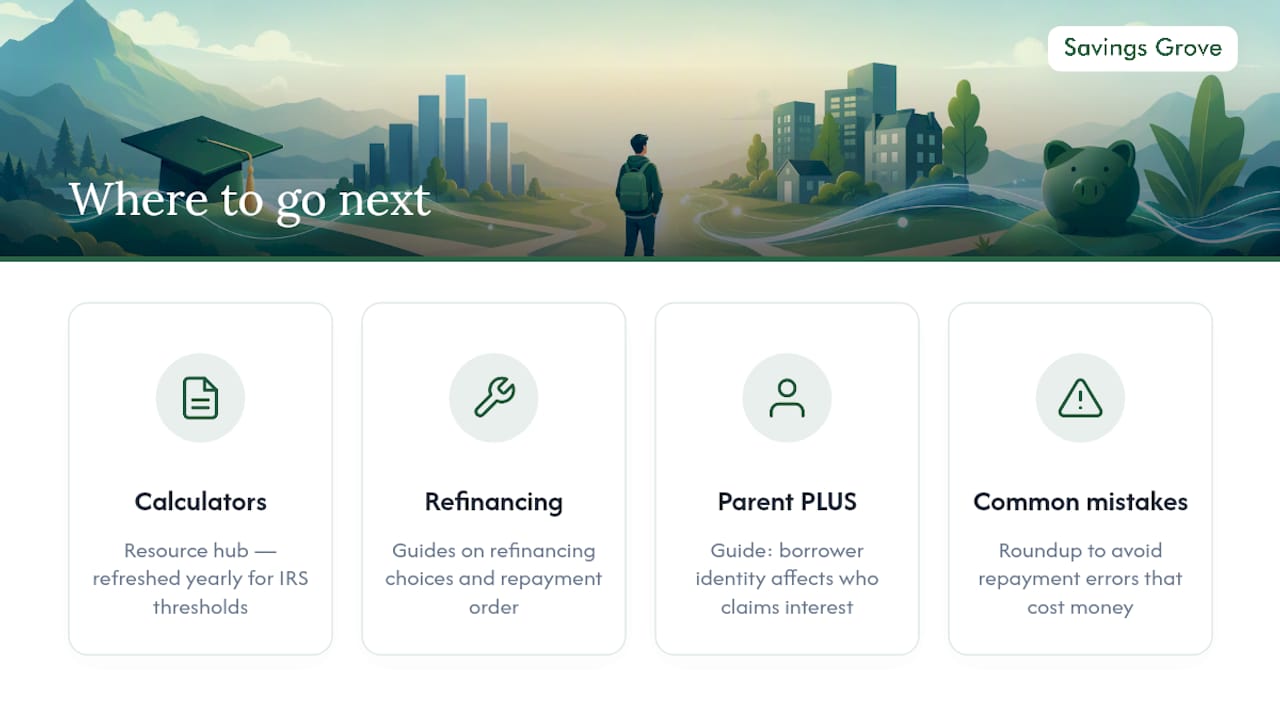
Running the phaseout math by hand works fine once, but nobody wants to redo that worksheet every filing season. Savings Grove keeps its student loan and tax resources updated year over year, so you’re not stuck hunting for last year’s thresholds when the rules shift again.

Beyond this deduction, Savings Grove covers the moves that often matter more over the long run: refinancing decisions, repayment order, and how loan strategy fits into your broader tax picture. If you’re a parent handling a Parent PLUS loan, our guide on refinancing Parent PLUS loans walks through how borrower identity affects who can actually claim the interest. And if you’ve made repayment missteps before, our roundup of common student debt management mistakes can help you avoid the ones that cost real money.
Head to the Savings Grove resource hub to find calculators and guides that get refreshed as IRS thresholds change each year. These are educational tools, not personalized tax advice, so pair them with your own tax situation before you file.
This article is general information, not a substitute for advice from a qualified financial advisor. Consult a qualified financial professional about your own circumstances before acting on anything here.
0 comments
Leave a comment
Reviewed before they appear. Your email is not shown.