

Start with these six: car maintenance, home repairs, holiday and gift spending, medical out-of-pocket costs, annual insurance premiums, and one flexible miscellaneous fund. Pick a dollar target for each, divide it by the number of months until you need it, and set up an automatic transfer for that amount every payday. That’s the entire system. Everything else on this page just helps you fine-tune it.
TL;DR:
- Focus on three to four key sinking fund categories initially, such as car repairs, home repairs, and seasonal expenses, before expanding.
- Use the formula target amount divided by months until expense to determine consistent monthly contributions for each fund.
- Store money in easily accessible and insured accounts like subaccounts or envelope systems, automating transfers on paydays.
- Regularly review and adjust fund targets annually, and avoid launching too many funds at once to prevent burnout and shortfalls.
- Keep track of actual versus targeted balances monthly, using simple tools like spreadsheets or budgeting apps to stay on top of progress.
Table of Contents
- How to Prioritize Your Sinking Funds List
- The Complete Sinking Funds Categories List
- Doing the Math: From Target Amount to Monthly Contribution
- Where to Keep Your Sinking Funds
- Common Mistakes That Derail a Sinking Funds System
- Why Sinking Funds Strengthen Your Overall Financial Plan
- Keeping Your Sinking Funds on Track
- An Editorial Take on Starting Small
- Get Sinking Fund Templates and Calculators From Savings Grove
- Sources
How to Prioritize Your Sinking Funds List
You don’t need thirty sinking funds on day one. You need the three or four that will actually save you from a bad month, and you can add the rest later once those are running smoothly.
Four questions help you sort a long sinking funds list into a short, useful one:
- Predictability — Do you know roughly when this expense hits? Car registration renews every year on a fixed date. A broken water heater doesn’t send a warning.
- Financial impact — Would this expense wreck your budget if it landed as a single charge? A $40 subscription renewal barely stings. A $1,200 furnace repair does.
- Frequency — Does this cost recur every year, or is it a once-in-a-decade event? Recurring costs deserve a permanent line item; rare ones can share a general fund.
- Replaceability — If you don’t save for it, what’s your backup plan? Credit card debt at 20%+ interest is not a backup plan worth relying on.
A solid starter pack looks like this: car maintenance, home repairs, holiday and gift spending, annual insurance premiums, and one catch-all miscellaneous fund. These five cover the categories that most commonly blindside households because they’re big, semi-predictable, and easy to forget between occurrences.
One distinction matters before you fund anything: sinking funds and emergency funds solve different problems. A sinking fund is money set aside for a known future expense. An emergency fund covers the unknown. If you don’t yet have three to six months of essential expenses saved, that comes first. Sinking funds work best as a second layer once your safety net exists. A guide to building an emergency fund walks through that sequencing in more detail.
Pro Tip: Fund your top three categories at half your target amount before adding a fourth. A partially funded car repair account beats a fully funded gift fund when your transmission fails in March.
The Complete Sinking Funds Categories List
A useful sinking funds list groups expenses by theme, not alphabetically. That way you can scan a section, decide which categories apply to your life, and skip the ones that don’t.
Annual bills and subscriptions
- Car registration and licensing — Renews yearly in every state; budget $50 to $200 depending on your state and vehicle type.
- Streaming and software subscriptions — Annual-plan discounts often get billed as one lump charge; set aside $10 to $30 a month depending on how many services you keep.
- Amazon Prime or membership renewals — A single $139 hit feels avoidable if you’ve saved $12 a month toward it.
- Domain names or professional dues — Small individually, painful when three renew the same week.
- Property taxes (if not escrowed with your mortgage) — Often the single largest annual bill homeowners forget to plan for; divide your last bill by 12.
Home and property
- Home maintenance and repairs — Financial planners commonly cite the 1% rule: budget roughly 1% of your home’s value per year for upkeep. That translates into several thousand dollars annually, or a significant monthly amount.
- HOA special assessments — Beyond regular dues, HOAs can levy one-time assessments for roof replacement or paving that run into the thousands with little warning.
- Appliance replacement — Refrigerators, washers, and water heaters rarely fail on schedule; $30 to $50 a month builds a cushion.
- Home furnishings — Furniture and décor wear out in cycles, not emergencies, which makes this an easy fund to underfund.
- Landscaping and seasonal maintenance — Gutter cleaning, tree trimming, snow removal contracts.
Vehicles and transportation
- Car maintenance — Consumer Reports’ research on car ownership costs shows maintenance and repair expenses run into the thousands annually depending on mileage and vehicle age. A monthly target of $75 to $150 covers routine service and softens the blow of a bigger repair.
- Tires — A full replacement set can run $600 to $1,200; saving $30 a month means you’re never caught flat.
- Car replacement or down payment — Even $100 a month adds up to $1,200 a year toward your next vehicle.
- Public transit passes or ride-share buffer — Relevant if you’re car-free but still face seasonal cost spikes.
Health and pets
- Medical and dental out-of-pocket costs — Even insured households face real cost-sharing; Health System Tracker data shows employer-plan enrollees regularly pay hundreds to over a thousand dollars out of pocket per year. Budget $50 to $100 a month if you have a deductible plan.
- Vision and dental care — Glasses, contacts, and cleanings that insurance covers only partially.
- Pet care and routine vet visits — Annual checkups, vaccines, and flea prevention add up even for a healthy pet.
- Pet emergency surgery — This is one of the most commonly forgotten categories on any sinking funds list. The American Animal Hospital Association has documented a real disconnect between what pet owners expect to spend and what emergency procedures actually cost, with surgeries easily running into four figures.
Life events and celebrations
- Holiday and gift spending — The classic sinking fund. If you spend $600 each December, that’s $50 a month starting in January.
- Birthdays — Multiply your average per-person gift by how many birthdays you celebrate each year.
- Weddings (attending or hosting) — Guest costs alone (travel, gifts, attire) can run $500 or more per wedding season.
- Anniversaries and special occasions — Small but recurring; easy to fold into a general “celebrations” fund.
Personal and household
- Clothing — Seasonal wardrobe turnover, work attire, kids’ clothing as they grow.
- Haircuts and personal care — Predictable in timing, easy to shortchange when cash is tight.
- Annual travel or vacation — Whether it’s one big trip or several small ones, dividing the total cost by 12 removes the need to charge it.
Business and freelance obligations
- Quarterly estimated taxes — Self-employed individuals need a dedicated fund here more than almost any other category, since the IRS doesn’t send a friendly reminder before the bill is due.
- Business software and licensing renewals — Similar to personal subscriptions, but often larger and tax-deductible.
- Professional development or certification renewal fees — Continuing education credits, licensing exams, association dues.
Miscellaneous and forgotten costs
- General miscellaneous fund — A catch-all for the expense you didn’t think to name. This is often the single most useful category on the entire list because it absorbs surprises without derailing your other funds.
- Legal or DMV fees — Passport renewals, notary fees, title transfers.
- Technology replacement — Phones and laptops die on their own schedule, not yours.
That’s a list of roughly 27 categories drawn from the same structure used in broader category catalogs, though almost no household needs to fund all of them simultaneously. Pick the ones that match your actual life and skip the rest.
Doing the Math: From Target Amount to Monthly Contribution
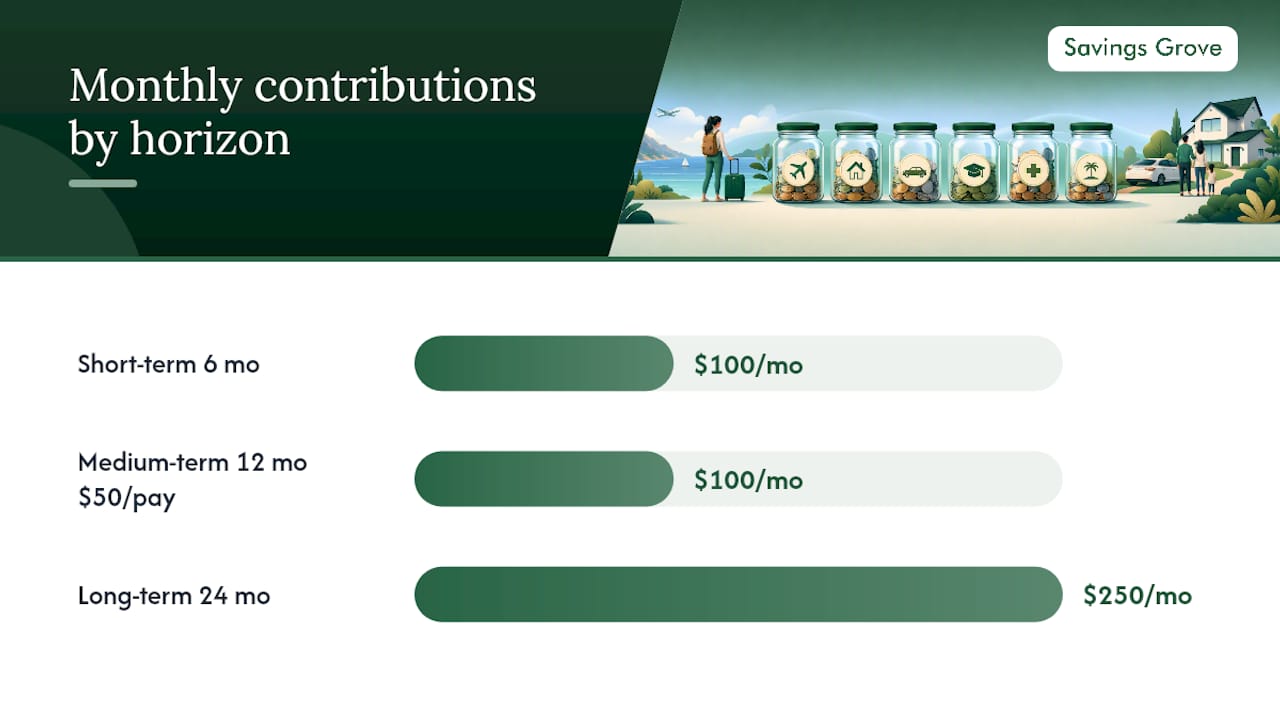
The formula behind every sinking fund is simple: target amount ÷ number of months = monthly contribution. That’s the entire mechanism behind how a sinking fund works, whether it’s a corporation setting aside money to retire a bond or a household saving for a new roof.
Three timelines cover most real-world scenarios:
Short-term (6 months): You need $600 for holiday spending by December. $600 ÷ 6 = $100 a month starting in July.
Medium-term (12 months): Your car insurance premium is $1,200, billed annually. $1,200 ÷ 12 = $100 a month, transferred every payday if you’re paid twice a month at $50 each.
Long-term (24+ months): You’re saving $6,000 toward a car replacement fund over two years. $6,000 ÷ 24 = $250 a month, or less if you stretch the timeline further.
A model household illustrates how this adds up in practice. One detailed budget breakdown from The Budget Bit tracks a two-adult, one-child, one-dog household running multiple sinking funds simultaneously:
That household’s full system runs close to $1,000 a month across seven funds, which is a useful reality check before you try to launch all of them at once.
Start with the three biggest predictable categories on your own list; car maintenance, home repairs, and one seasonal expense. Fund those completely, automate the transfers, and only then expand into the smaller categories. Trying to fund fifteen buckets from month one is how most people abandon the whole system by March.
Where to Keep Your Sinking Funds
Liquidity and safety matter more than yield here. You’re not investing this money; you’re parking it until a known bill arrives, so the account needs to be accessible without penalty and protected if the bank has problems.
Three storage approaches work, each with tradeoffs:
- Separate savings subaccounts — Many online banks let you open multiple named subaccounts under one login (Car Fund, Home Fund, Holiday Fund). This gives you visual separation without opening entirely new accounts.
- Labeled buckets within one account — Some budgeting apps and banks offer virtual envelopes inside a single balance. Simpler to manage, but easier to accidentally overspend across categories if you’re not disciplined about checking balances.
- Dedicated budgeting apps — Tools with envelope-style tracking sync your sinking funds against your actual bank balance, which helps if you’re prone to losing track of what’s already earmarked. A roundup of personal finance software compares several options built for this kind of tracking.
Whatever you choose, confirm the institution carries FDIC deposit insurance, which protects your balance up to the standard coverage limit per depositor, per bank. For funds you won’t touch for a year or more, such as a car replacement fund with a long runway, a short-term high-yield savings account or a short CD can earn a bit more interest. Just weigh that against the early-withdrawal penalty if your timeline shifts.
Pro Tip: Automate the transfer the same day you get paid, not at the end of the month. Money that sits in your checking account for two weeks has a way of disappearing before it ever reaches the sinking fund.
Common Mistakes That Derail a Sinking Funds System
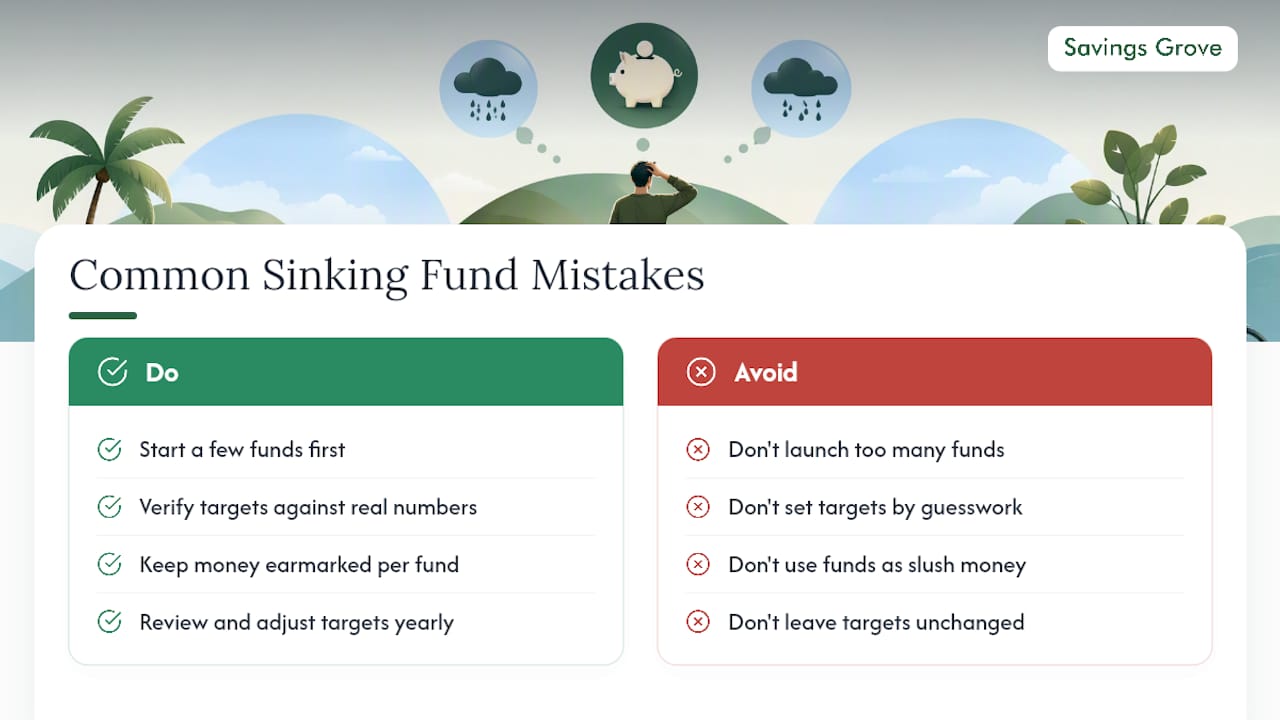
The most common failure isn’t lack of motivation. It’s launching too many funds at once and running out of cash to feed all of them, which leads to skipped transfers and eventually abandoning the whole system.
A close second: setting a target without checking it against real numbers. Guessing that home repairs “probably” cost $50 a month, when your actual annual average is closer to $250, guarantees a shortfall right when you need the money.
Some other patterns worth watching for:
Treating sinking funds like a slush fund. If your holiday fund quietly covers a grocery shortfall in October, it won’t have the money in December. Sinking funds only work when the money stays earmarked for its category.
Never adjusting targets as life changes. A car maintenance fund sized for a five-year-old sedan needs revisiting once that car turns twelve. Insurance premiums increase. Rent goes up. Review your targets at least once a year.
Skipping the automation step. Manually transferring money “when you remember” is the single biggest reason sinking funds fail. Automatic transfers remove the decision entirely.
Forgetting to reset the fund after spending it. Once you use your car repair fund for a $400 repair, the fund goes back to zero. If you don’t resume contributions immediately, you’re unprotected again.
Why Sinking Funds Strengthen Your Overall Financial Plan
Sinking funds don’t just prevent one bad month. They change how your entire budget behaves.
The clearest benefit is that they convert unpredictable expenses into predictable ones. A $1,200 annual insurance bill feels like a crisis if it arrives unplanned. The same bill, funded at $100 a month for a year, is just a line item you’ve already handled.
That predictability protects your other financial goals. Without sinking funds, big expenses tend to get paid from whatever account has the most cash, which often means your emergency fund or your credit card. Both routes cost you: the emergency fund loses its intended purpose, and credit card debt adds interest on top of the original bill.
Sinking funds also reduce decision fatigue. When the money for holiday gifts already exists, you’re not negotiating with yourself in December about whether you can afford to spend it. The decision was made months earlier, calmly, without the pressure of an actual bill in front of you.
Over a few years, a mature sinking fund system tends to reveal patterns in your spending that a monthly budget alone won’t show. You start to notice which categories consistently run over target and which ones you’ve been overfunding, and you can shift money accordingly.
Keeping Your Sinking Funds on Track
A sinking funds list only works if you actually look at it. Set a recurring 15-minute check-in, monthly for your top three categories and quarterly for everything else, to compare what’s in each fund against what should be there by now.
Track two numbers per category: the current balance and the target date balance. If your car fund should have $500 by June but only has $350, you’ll know that in June, not in the ten minutes before you need to write a check for a repair.
A simple spreadsheet works fine for this. So does a budgeting app with built-in envelope tracking, which automatically shows you the gap between “should have” and “actually have” without manual math. What matters isn’t the tool. It’s the habit of looking.
Review your targets annually, ideally right before you set next year’s budget. Insurance premiums change. Kids age into more expensive categories. A car that was reliable last year might be approaching the age where repairs get pricier. Building this review into your existing budgeting rhythm, rather than treating it as a separate task, is what keeps a sinking funds list from going stale within six months.
An Editorial Take on Starting Small
Most sinking fund advice tells you to build the perfect system before you start. That’s backward. The households that stick with this longest are the ones who funded one category imperfectly rather than seven categories perfectly on paper and zero in practice.
Here’s a one-month starting checklist worth following exactly as written: choose three categories from the list above, set a target for each based on your real past spending rather than a guess, automate the transfers on payday, and then don’t touch the system again until day 90. Ninety days is long enough to see whether the amounts feel right and short enough that you haven’t wasted a year on a plan that needed adjusting.
If you don’t already have a basic cash cushion for true emergencies, build that first using an emergency fund guide before layering on sinking funds. The order matters more than the amount.
— Mika L.
Get Sinking Fund Templates and Calculators From Savings Grove
There are ready-made calculators available that do the target-divided-by-months math for you the moment you plug in a number, so you don’t have to build a sinking fund spreadsheet from scratch or guess at formulas.
Beyond the calculators, detailed guides walk through setup details not fully covered here. If your existing budget already has cracks worth patching before you add new savings categories, start with common household budget mistakes to see what’s likely eating the cash you’d otherwise put toward these funds. If you need to free up money first, cutting household expenses quickly shows where that room usually hides. Visit the Savings Grove homepage to browse the current template library and pick the calculator that matches your first three categories.