

A rainy day fund is a small pool of savings set aside for minor, unplanned expenses that don’t fit your regular budget. It’s meant to catch the everyday surprises life throws at you before they turn into credit card debt.
- Primary use: Covering small, one-off costs like a flat tire, a vet bill, or a broken dishwasher.
- How it differs: Unlike an emergency fund, it’s not built for job loss or major medical crises.
- Target range: Most guides recommend $500 to $2,000 to start, scaling up based on your household.
The rest of this guide walks you through where to keep this money, how to build it without feeling the pinch, and the mistakes that quietly drain it dry.
Key Takeaways
A rainy day fund of $500 to $2,000, kept separate from checking and funded through automatic transfers, prevents small surprises from becoming high-interest debt.
| Point | Details |
|---|---|
| Know the definition | A rainy day fund covers small, irregular costs like car repairs, vet bills, and appliance fixes. |
| Separate from emergency fund | Use rainy day savings for minor surprises; save the emergency fund for job loss or major medical events. |
| Pick a realistic target | Aim for $500 to $2,000 to start, adjusting for household size and income stability. |
| Choose an FDIC-insured account | Keep the fund in a labeled high-yield savings account or app pocket for easy access and safety. |
| Automate the habit | Schedule a fixed transfer of $5 to $50 per paycheck to avoid the “save what’s left” trap. |
Table of Contents
- What A Rainy Day Fund Covers, Exactly
- Rainy Day Fund Vs. Emergency Fund: Which One Do You Tap?
- How Much Should You Put In A Rainy Day Fund?
- Where To Keep Your Rainy Day Fund
- How To Build A Rainy Day Fund Step By Step
- Common Mistakes That Drain A Rainy Day Fund
- Three Real-Life Rainy Day Fund Scenarios
- Why A Small Reserve Changes Your Financial Behavior
- What I’ve Learned Watching People Build These Habits
- Frequently Asked Questions
- Sources
What A Rainy Day Fund Covers, Exactly
Think of your rainy day fund as the buffer between “annoying” and “financially painful.” It exists to absorb the costs that are small enough to handle in cash but big enough to wreck your grocery budget if you’re not ready for them.
Real-world examples make this concrete. A rainy day fund typically covers things like:
- A $150 car repair after a warning light comes on
- A $75 copay for an urgent care visit
- A $200 appliance fix when the washing machine starts leaking
- A $60 vet bill for a minor pet issue
- A $40 towing or parking fee from a bad afternoon
These costs are common enough that you should expect them, but irregular enough that they never make it into your monthly budget line. Keeping this money separate from your checking account does something for you psychologically: it removes the mental math of “can I afford this without messing up rent?” You already decided the answer is yes, because you set the money aside for this exact purpose.
Pro Tip: Open a labeled sub-account or savings “pocket” specifically for this purpose. Naming it something like “Car & Vet Fund” makes withdrawing from it feel deliberate instead of accidental, which cuts down on impulse spending from your main savings.

Rainy Day Fund Vs. Emergency Fund: Which One Do You Tap?
The confusion between these two accounts costs people money, because using the wrong fund for the wrong problem either drains your safety net too fast or leaves small bills unpaid. An emergency fund is a cash reserve built for life-altering events, according to the Consumer Financial Protection Bureau, while a rainy day fund handles the small stuff.
Here’s the breakdown:
- Purpose: Rainy day funds cover predictable-but-irregular costs; emergency funds cover job loss, major medical bills, or long-term income disruption.
- Typical size: Rainy day funds usually sit between $500 and $2,000; emergency funds often target three to six months of living expenses.
- Examples of use: A flat tire draws from your rainy day fund. A layoff draws from your emergency fund.
- Liquidity: Both need to be accessible, but emergency funds are built to last months, not days.
The rule of thumb worth memorizing: rainy day money handles small, expected surprises, while emergency savings handle life-changing events or lost income. If the bill is under a few hundred dollars and won’t repeat monthly, it’s a rainy day problem. If it threatens your ability to pay rent for the next few months, it’s an emergency.
How Much Should You Put In A Rainy Day Fund?
There’s no single correct number, but most guidance clusters around $500 to $5,000, with $500 to $2,000 cited most often as a realistic starting target for most households.
Where you land in that range depends on a few practical factors: how steady your paycheck is, how many people (and pets) rely on your income, and how often you deal with repair-type expenses. A single renter with no dependents can often get by on the lower end, while larger households need more cushion.
A few quick examples show how this plays out:
- Single renter, no car: $500 covers most realistic surprises.
- Family of four with two cars and a dog: $2,000 to $3,000 gives room for multiple small hits in one month.
- Gig worker with irregular income: Aim for $1,500 minimum, since income gaps make even small bills harder to absorb.
Roughly a third of U.S. adults have tapped into some form of savings in the past year, which tells you these small emergencies aren’t rare exceptions. They’re the norm, and your target amount should reflect that reality rather than optimism.
Where To Keep Your Rainy Day Fund
The best place for this money strikes a balance between fast access and decent interest. You don’t want it locked in a CD, but you also don’t want it sitting forgotten in your checking account where it blends into your everyday spending.
Common options include:
- Regular savings account: Easy access, but often near-zero interest.
- High-yield savings account: Better interest, still accessible within a day or two, and widely available through online banks.
- Credit union savings account: Often competitive rates with a community-focused structure.
- In-app “pockets” or sub-accounts: Many banking apps let you carve out labeled savings buckets without opening a new account.
Whichever option you choose, confirm it’s protected. FDIC insurance covers deposits at member banks up to the standard limit, and credit unions offer equivalent protection through the NCUA. This matters even for a few hundred dollars. Small balances deserve the same protection as large ones.
Pro Tip: Give the account a specific name, like “Car & Small Repairs,” instead of leaving it labeled “Savings 2.” A named account creates a mental boundary that makes you think twice before spending from it on something unrelated.
How To Build A Rainy Day Fund Step By Step
Building this fund isn’t about willpower. It’s about removing the decision from your hands entirely. Here’s a sequence that works for most budgets:
- Pick a target. Choose a number between $500 and $2,000 based on your household size and expenses.
- Open a dedicated account. Separate from checking, ideally a high-yield savings account.
- Automate a transfer. Set up a scheduled transfer of $5 to $50 per paycheck, timed for the day after payday.
- Use round-ups if available. Many banking apps round purchases up to the nearest dollar and shuttle the difference into savings.
- Redirect windfalls. Tax refunds, cash gifts, or rebate checks are ideal one-time boosts.
If you automate $25 per paycheck on a biweekly schedule, you’ll hit a $1,000 target in about 20 pay periods, roughly nine to ten months. Bump that to $50 per paycheck and you cut the timeline in half.
Pro Tip: Splitting a fixed amount from each paycheck directly into savings bypasses the “save what’s left” trap, where good intentions get eaten up by everyday spending before the month ends.

Common Mistakes That Drain A Rainy Day Fund
The most common failure isn’t underfunding the account. It’s letting the money leak out for reasons that have nothing to do with emergencies.
- Using it for lifestyle upgrades, like a nicer dinner out or a spontaneous purchase, rather than true unplanned expenses.
- Never replenishing after a withdrawal, which leaves you exposed the next time something breaks.
- Mixing it with everyday spending money, which erases the psychological boundary that made it useful in the first place.
Guard against fund leakage with a few simple rules: keep the account separate and labeled, give yourself a 24-hour cool-off period before any withdrawal that isn’t clearly urgent, and cap how often you allow transfers out.
Pro Tip: Set a minimum threshold, such as $300, that automatically triggers a top-up transfer once your balance drops below it after a withdrawal.
Three Real-Life Rainy Day Fund Scenarios
Scenario one: A single professional’s car needs a $180 brake repair. She pulls the full amount from her rainy day fund, then sets up an extra $45 per paycheck for the next four pay periods to replenish it.
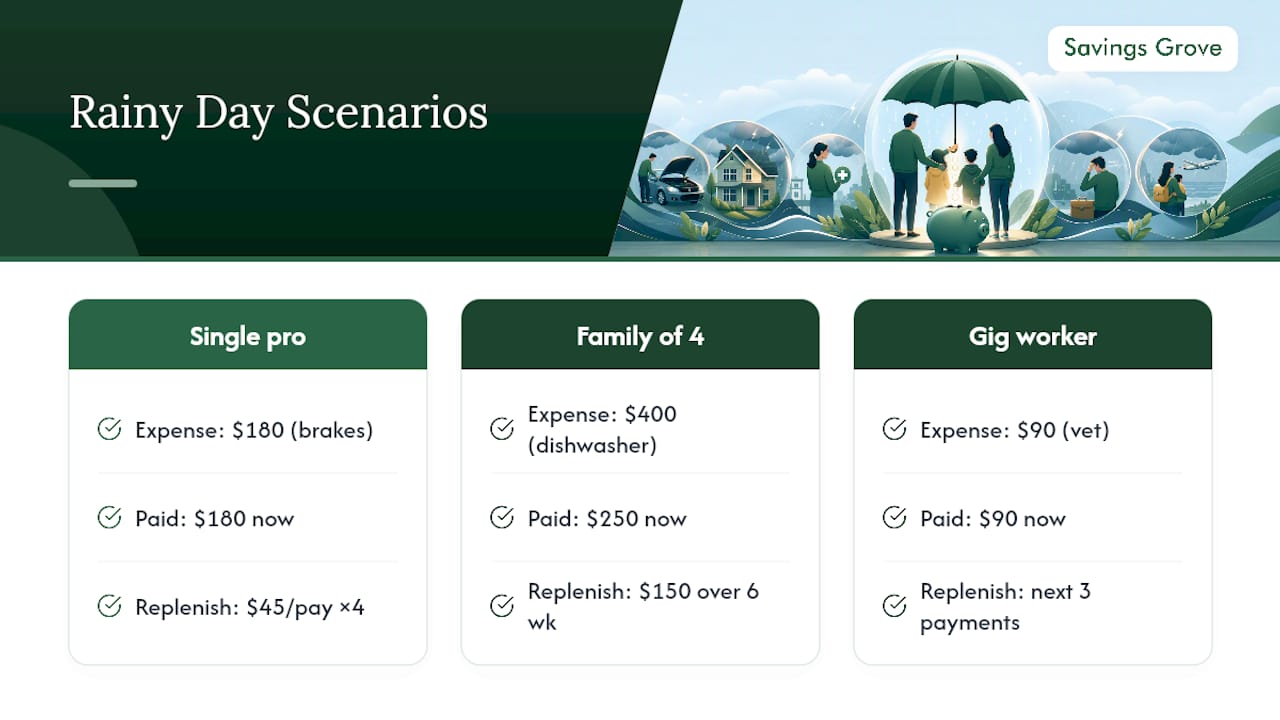
Scenario two: A family of four loses their dishwasher to a $400 repair bill. They split the withdrawal, covering $250 immediately and financing the rest through their next paycheck’s automatic transfer, replenishing over the following six weeks.
Scenario three: A gig worker faces a $90 vet bill during a slow income month. She logs the withdrawal in a simple notes app: date, amount, reason, then earmarks her next three payments to rebuild the balance before spending on anything else.
Why A Small Reserve Changes Your Financial Behavior
The real power of a rainy day fund isn’t the dollar amount. It’s what it prevents. Experts point to a behavioral shift that happens once this money exists: you stop reaching for high-interest credit cards to cover routine surprises, which breaks a cycle that quietly costs many households far more in interest than the original expense.
More than a third of Americans reported tapping into some form of savings in the past year to cover unexpected costs, according to survey data. That’s a strong argument for having a fund built before the bill arrives rather than scrambling afterward.
Pro Tip: Automation and labeling aren’t just convenience features. They’re the two tactics practitioners point to most often as the difference between a fund that grows and one that never gets past $50.
What I’ve Learned Watching People Build These Habits
The people who actually stick with a rainy day fund almost never start with a big number. They start with an automatic transfer small enough that they forget it’s happening, then adjust upward once it feels normal. That’s the real lesson here: momentum beats ambition.
If you’re looking for the next step after this one, Savings Grove has a deeper walkthrough on building an emergency fund once your rainy day cushion is solid, and a practical guide to setting up automatic transfers if you haven’t automated your savings yet. Start smaller than feels meaningful. The habit matters more than the number.
Frequently Asked Questions
What is a rainy day fund used for? It covers small, unplanned expenses like minor car repairs, vet visits, or appliance fixes that don’t fit into your regular monthly budget.
Is a rainy day fund the same as an emergency fund? No. A rainy day fund handles small, predictable-but-irregular costs, while an emergency fund covers major events like job loss or a serious medical bill.
How much money should I keep in a rainy day fund? Most guidance points to $500 to $2,000 for individuals, with larger households often targeting $2,000 to $5,000 based on typical repair and maintenance costs.
Where should I keep my rainy day fund? A high-yield savings account, credit union account, or labeled sub-account inside your banking app works well, as long as it’s FDIC or NCUA insured.
How do I avoid spending my rainy day fund on non-essentials? Keep it in a separate, clearly labeled account, add a short cool-off period before withdrawals, and set an automatic top-up rule once the balance drops below your minimum threshold.
This article is general information, not a substitute for advice from a qualified financial advisor. Consult a qualified financial professional about your own circumstances before acting on anything here.
0 comments
Leave a comment
Reviewed before they appear. Your email is not shown.