

Here’s the role of loan servicers explained simply: a loan servicer is the company that handles your loan day-to-day after it’s originated, on behalf of whoever actually owns it. That owner might be a bank, an investor group, or Fannie Mae itself. The servicer rarely holds the loan.
Three duties matter more than any others:
- Payment processing — collecting your monthly payment and applying it correctly.
- Escrow administration — paying your property taxes and insurance from funds it holds.
- Loss mitigation and customer service — helping you when you fall behind, and answering questions the rest of the time.
Your loan can move from one servicer to another without your interest rate, balance, or term changing at all. Only the name on your statement changes.
Key Takeaways
A loan servicer administers your payments, escrow, and loss-mitigation options on behalf of the loan’s actual owner, and understanding that distinction is what lets you resolve errors quickly instead of losing months to confusion.
| Point | Details |
|---|---|
| Servicer isn’t the owner | Your servicer manages the loan day-to-day; the investor or lender usually owns the debt itself. |
| Escrow errors are common | Review your annual escrow analysis closely since tax and insurance changes drive most payment increases. |
| Fees stay thin but real | Watch for late fees, payoff statement fees, and force-placed insurance charges on your statement. |
| Transfers don’t change terms | Verify your account number and reset autopay within days of any servicer-transfer notice. |
| Documentation wins disputes | A written QWR and a CFPB complaint carry more weight than a phone call when errors persist. |
Table of Contents
- How Loan Servicers Work: Payments, Statements, and Escrow
- How Servicers Get Paid and Fees You Should Watch
- Lender vs. Servicer: What Changes When Your Loan Transfers
- Fixing Servicer Errors: Documentation and Formal Disputes
- Loss Mitigation: What Servicers Offer When You Fall Behind
- What to Expect: The Timeline of a Typical Servicing Process
- Savings Grove’s Research Behind This Guide
- Why the Standard Servicer Advice Falls Short
- Sources
How Loan Servicers Work: Payments, Statements, and Escrow
Your monthly payment moves through a set order: interest first, then principal, then escrow, then any fees owed. That sequence explains why your loan balance barely moves in the early years of a 30-year mortgage. Most of the check goes to interest.
Here’s how the core servicing responsibilities break down in practice:
- Statements. Your monthly statement shows the payment breakdown, current balance, and any fees assessed. Read it every month, not just when something looks off.
- Payment channels. Servicers accept payments online, by phone, by mail, or through automatic draft. Pay only the servicer listed on your current statement. Sending money to a prior servicer after a transfer is a common way payments get lost.
- Escrow accounts. About 80% of mortgage borrowers have an escrow account their servicer manages. Once a year, the servicer runs an escrow analysis comparing what it collected against what it paid out for taxes and insurance. A shortage raises your payment; a surplus over the allowed cushion gets refunded.
- Customer service tasks. Payoff quotes, mailing address updates, name corrections after marriage or divorce, insurance verification. These land with the servicer, not the original lender.
- Credit reporting. Your servicer reports payment history to the credit bureaus every month. One 30-day-late mark can sit on your report for years, so timing matters more than most borrowers realize.
Pro Tip: Screenshot or download your escrow analysis every year. If your payment jumps and you don’t know why, that document is the fastest way to find out whether it’s a tax increase, an insurance premium hike, or a servicer error.
How Servicers Get Paid and Fees You Should Watch
Servicers don’t profit the way lenders do. They earn a servicing fee, typically between 1 and 44 basis points of your unpaid balance annually, depending on the loan type and how much work it requires.
That’s a thin margin, which is why servicers lean on volume and a few secondary income sources:
- Late fees charged when a payment misses the grace period.
- Payoff statement fees for generating a document you need to refinance or sell.
- Float income, or interest earned on your payment between the day they collect it and the day they remit it to the investor.
One practice deserves extra scrutiny: force-placed insurance. If your homeowner’s policy lapses and the servicer doesn’t get proof of coverage, it can buy a replacement policy on your behalf, usually at a far higher premium than you’d pay on the open market. Watch your escrow statement for a sudden insurance line-item increase; it’s often the first sign a policy lapsed without your knowledge. If you spot a fee you don’t recognize, call the servicer’s number on your statement and ask for a written explanation before you pay it.
Lender vs. Servicer: What Changes When Your Loan Transfers
The lender originated your loan or currently owns the underlying debt. The servicer is the administrator collecting payments and managing your account, and those are frequently two different companies. Loans get sold and transferred constantly, often because the investor consolidates servicing with a larger operator or the original lender exits the business.
Terms don’t change with a transfer. The account number and remittance address do. Federal rules require advance notice from both the outgoing and incoming servicer, which gives you a window to prepare.
When that notice arrives, work through this checklist:
- Confirm your new account number matches what’s printed on the transfer notice.
- Update autopay with your bank or the new servicer’s portal immediately. Don’t assume it carries over automatically.
- Verify your last payment to the old servicer posted before the transfer date.
- Save both transition notices (old and new servicer) in case a payment gets lost in the handoff.
- If you had a payoff request in progress, confirm with the new servicer that it’s still active.
Payment posting during a transfer window can lag by a few days. That’s normal, but it’s also exactly when misapplied payments happen, so monitor your account closely for about 60 days after any transfer.
Fixing Servicer Errors: Documentation and Formal Disputes
Most servicing errors get resolved with a phone call and a corrected statement. When they don’t, documentation is what turns your side of the story into something a servicer, or a regulator, has to act on.
- Collect everything first. Statements, payment receipts, bank confirmation numbers, and any emails or portal messages from the servicer.
- Send a Qualified Written Request (QWR). This is a formal, written notice identifying the error and asking for correction. A QWR triggers a required acknowledgement from the servicer and starts a clock on when it must investigate and respond.
- File a complaint with the CFPB if the QWR doesn’t resolve things within a reasonable window. The CFPB complaint portal routes your case directly to the servicer and requires a company response.
Pro Tip: Send your QWR by certified mail with return receipt, and keep a screenshot of every portal confirmation number. If the dispute escalates, a paper trail with dates beats a memory of a phone call every time.
Loss Mitigation: What Servicers Offer When You Fall Behind
When you can’t make a payment, the servicer, not the loan owner, is who decides what relief is available and administers it. Fannie Mae requires servicers to evaluate borrowers case by case rather than apply one rigid formula, which means two borrowers with similar hardships can get different outcomes depending on documentation and timing.
Common remedies include:
- Forbearance — a temporary pause or reduction in payments.
- Repayment plans — spreading missed payments over several future months.
- Loan modification — permanently changing the rate, term, or balance.
- Short sale or deed-in-lieu — options when keeping the home isn’t realistic anymore.
Before you call, gather your recent pay stubs, a hardship letter explaining what changed, and two to three months of bank statements. Servicers can only act within investor guidelines, so foreclosure becomes a real possibility once a loan sits multiple missed payments past due without a mitigation plan in place. Acting in month one, not month four, is what keeps your options open.
What to Expect: The Timeline of a Typical Servicing Process
Loan servicing runs on predictable clocks, and knowing them helps you tell a normal delay from an actual problem.

Payment posting usually happens within one to three business days of the servicer receiving your funds, faster for electronic payments than mailed checks. If a posting takes longer than five business days, that’s worth a call.
Escrow analysis runs once a year, typically triggered by your loan’s anniversary month. You’ll get a notice showing the prior year’s activity and any adjustment to your payment going forward, usually with 30 to 45 days before the new amount takes effect.
Servicer transfers require notice from both servicers, generally delivered before the transfer date, with a grace period afterward during which you can’t be penalized for sending a payment to the old servicer by mistake.
Dispute resolution through a QWR follows a defined sequence: acknowledgement first, then an investigation period, then a written response. Complaints filed through the CFPB portal typically get a company response within a set window after the servicer receives it.
None of these timelines are instant, which is exactly why documentation matters. If you’re also working through repayment strategy while dealing with a servicer issue, a resource like how to pay off student loans faster can help you decide whether to push extra payments now or wait until a dispute clears.
Savings Grove’s Research Behind This Guide
Savings Grove builds its guides on the same regulatory sources cited throughout this piece, cross-checked monthly against Fannie Mae and CFPB updates so recommendations stay current. Beyond servicer mechanics, the site’s student debt guides walk through common repayment mistakes borrowers make when juggling multiple loan accounts. This piece was researched and written by Mika L., a contributing writer covering personal finance and consumer lending topics for Savings Grove.
Why the Standard Servicer Advice Falls Short
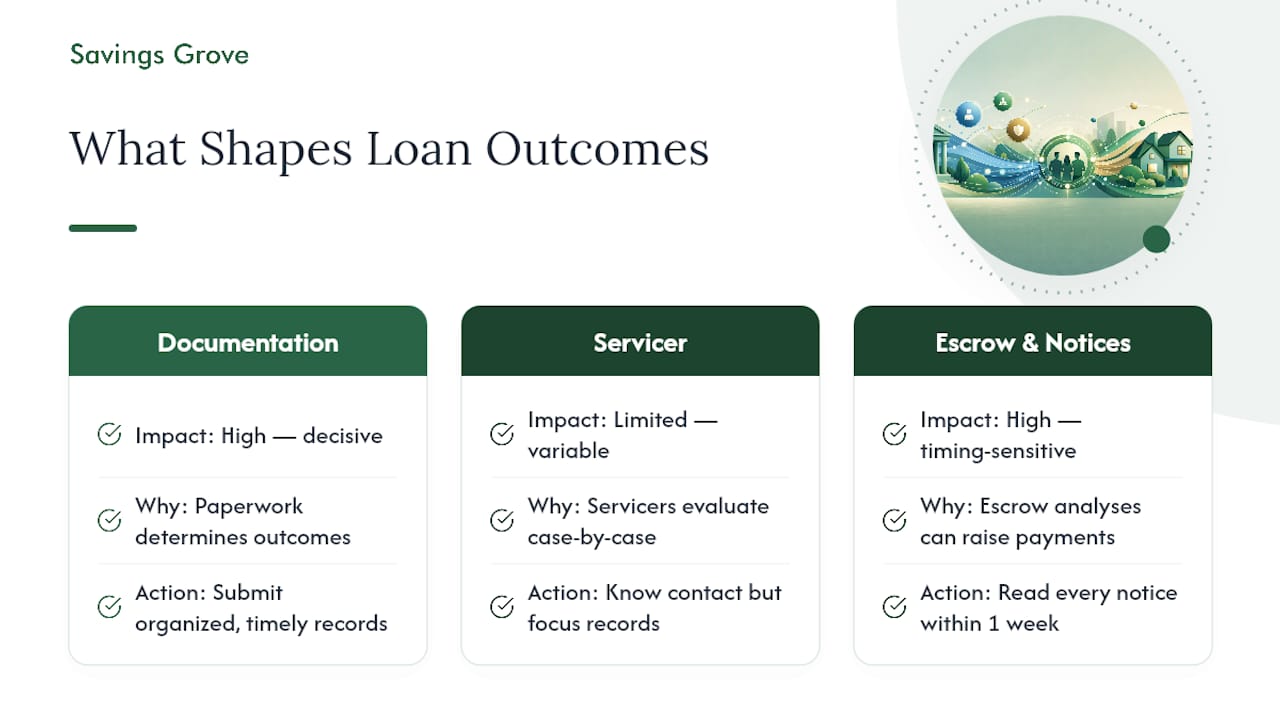
Most explainers stop at “know your servicer’s phone number.” That’s not enough. The research behind this guide points to a sharper truth: outcomes depend far more on your documentation habits than on which servicer you happen to get. Fannie Mae’s own guide gives servicers latitude to evaluate hardship case by case, which sounds borrower-friendly until you realize it also means two people with identical circumstances can walk away with different results based purely on what paperwork they submitted and when.
The conventional advice undersells escrow monitoring, too. Borrowers treat the annual analysis as junk mail, then get blindsided by a payment jump that a five-minute review would have explained months earlier. If there’s one habit worth prioritizing above all others here, it’s this: read every notice your servicer sends within a week of receiving it. Transfers, escrow analyses, and fee changes all come with response windows, and the borrowers who lose the most time are the ones who let those windows close before they even open the envelope.
— Mika L.