

Income-driven repayment sets your student loan payment based on how much you earn and how many people you support, not on your loan balance, and it can bring your bill to $0 a month. Currently, there are five income-driven repayment plans: SAVE, IBR, PAYE, ICR, and the new Repayment Assistance Plan (RAP) set to start in 2026. Because SAVE is tangled up in litigation, your first move is simple: log into StudentAid.gov, confirm you’re eligible for a plan that’s actually operating, and turn on autorecertification so your payment never resets without warning.
TL;DR:
- Starting July 1, 2026, new borrowers will primarily have access to RAP and IBR, while options like PAYE, ICR, and SAVE for new enrollees will be phased out or paused in litigation.
- The next few years will involve ongoing policy transitions, with additional rules expected through 2028, requiring borrowers to monitor their plan eligibility and recertify income regularly.
- Borrowers with income fluctuating year to year should recertify manually to ensure payments remain accurate and keep qualifying for Public Service Loan Forgiveness if needed.
- Consolidating Parent PLUS loans into ICR is necessary for eligibility, and filing separately from a spouse can significantly affect payment calculations for income-driven plans.
- Acting early and documenting payment history is crucial, especially for PSLF applicants, since forbearance periods may not count toward forgiveness unless plans are actively processing qualifying payments.
Table of Contents
- What Are the Main Income-Driven Repayment Plans?
- What Do the 2026 Repayment Changes Mean for You?
- How Is Your Monthly Payment Actually Calculated?
- How Do You Apply and Recertify Your Income?
- Which IDR Plan Actually Fits Your Situation?
- Savings Grove’s Practical Take on Repayment Uncertainty
- Let Savings Grove Help You Stay Ahead of These Deadlines
- Sources
- FAQ
What Are the Main Income-Driven Repayment Plans?
Every income-driven repayment plan uses the same basic idea from Federal Student Aid: take a slice of your discretionary income, stretch payments over 20 to 25 years, and forgive whatever balance remains. But the formulas, protections, and current availability differ enough that picking the wrong one can cost you thousands.
| Plan | Payment formula | Term to forgiveness | Eligibility limits | Current status |
|---|---|---|---|---|
| SAVE | Payment rate varies based on income above a poverty guideline threshold | Long-term repayment period | Eligible Direct Loans | Paused in litigation; borrowers in forbearance do not earn PSLF credit |
| IBR | Payment rate based on a percentage of income above a threshold | Long-term repayment period | Direct and FFEL loans | Operating; protected by statute |
| PAYE | Payment based on income above a threshold | Set repayment period | Eligible Direct Loans with financial hardship | Mostly closed to new enrollees |
| ICR | Payment based on a percentage of income | Extended repayment period | Direct Loans including Parent PLUS via consolidation | Operating; less commonly the lowest payment option |
| RAP | Tiered formula with a payment floor applies | Extended repayment period | New borrowers and others under 2026 rules | Phased rollout starting July 1, 2026 |
A few patterns stand out once you line these up side by side under 34 CFR § 685.209:
- IBR tends to suit borrowers who want a plan that Congress, not a court, controls.
- PAYE rarely accepts new applicants anymore, so it mostly matters if you’re already enrolled.
- ICR is the fallback for Parent PLUS borrowers who consolidated, since it’s the only IDR option many of them can access.
- RAP will become the default entry point for new borrowers taking out loans after July 1, 2026, replacing several older options for that group.
If you’re a brand-new borrower after that date, SAVE, PAYE, and ICR largely won’t be on your menu. IBR and RAP become your practical choices.
What Do the 2026 Repayment Changes Mean for You?
July 1, 2026 is the date to circle. Starting then, new IDR enrollment narrows sharply, and RAP begins replacing several existing plans for new borrowers under the transitional rules laid out by TICAS. Further adjustments continue rolling out through 2028, so this isn’t a single cutover, it’s a multi-year phase.
Key numbers to watch: SAVE borrowers currently sitting in administrative forbearance are not earning qualifying months toward Public Service Loan Forgiveness, according to IBRCalcs’ plan comparison. If you’re counting on PSLF, every month on hold is a month you don’t get back.
Here’s what to track between now and 2028:
- Now through mid-2026: Confirm whether you’re enrolled in SAVE. If PSLF matters to you, consider switching to IBR even though it may raise your short-term bill.
- July 1, 2026: New borrowers lose access to PAYE, ICR, and (pending litigation outcomes) SAVE. RAP becomes available.
- Through 2028: Expect additional transition rules for borrowers moving between older plans and RAP.
- Ongoing: Recheck your status at studentaid.gov every few months, especially if you get a notice about your plan.
Acting early beats waiting for the “optimal” plan to reveal itself. Nobody knows exactly how the SAVE litigation resolves, and borrowers who sat still waiting for clarity in past disputes often ended up with the least favorable outcome by default.
How Is Your Monthly Payment Actually Calculated?
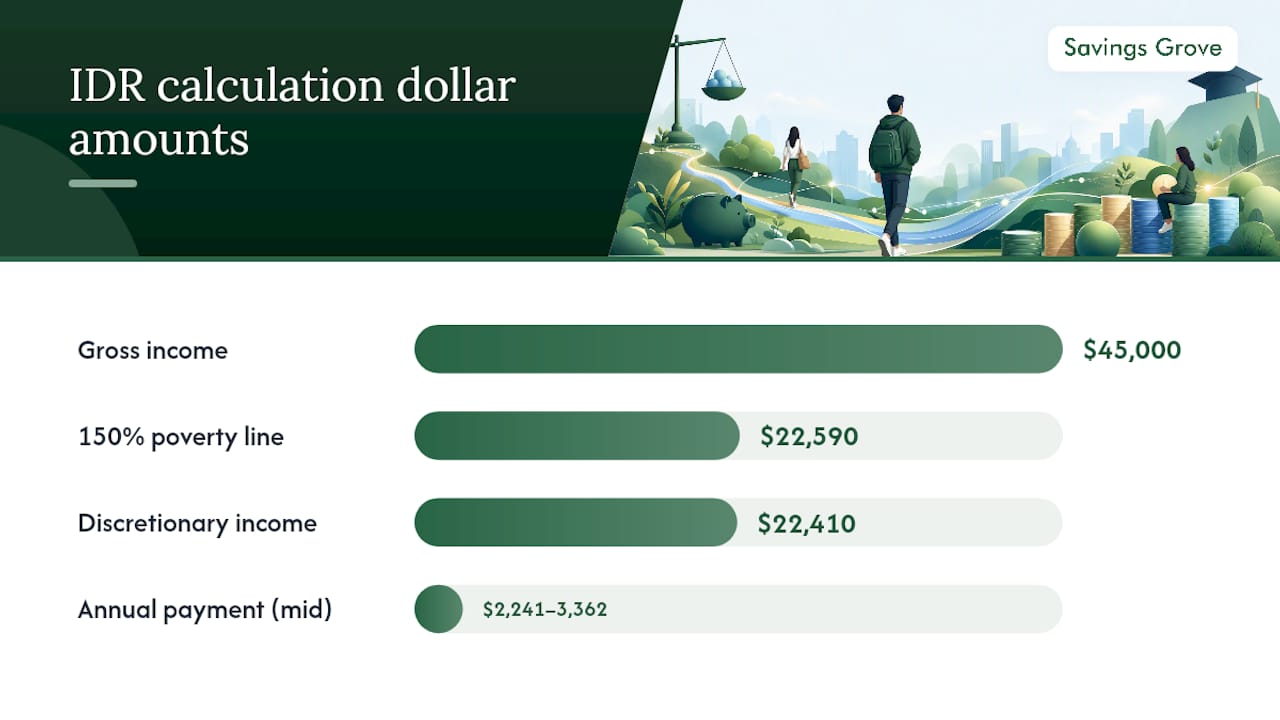
IDR plans calculate your discretionary income as the difference between your income and a poverty line percentage that varies by plan; different plans use different percentages of the federal poverty guideline for your household size to determine this.
Here’s how that plays out with real numbers:
- Single borrower earning $45,000, household size of one. Under IBR, discretionary income is roughly $45,000 minus 150% of the poverty line (about $22,590 in 2026), leaving about $22,410. At 10-15%, the annual payment lands between $2,241 and $3,362, or roughly $187 to $280 a month.
- Borrower earning $70,000 with a spouse and one child, household size of three. The poverty line threshold rises with each additional person, which lowers the discretionary income figure and, in turn, the payment, even though gross income is higher.
Two details trip people up constantly. First, if you file taxes jointly, spouse income usually gets included in the calculation under most plans, sometimes pushing payments up significantly. Filing separately can lower your reported household income, though it may cost you certain tax benefits elsewhere. Second, loan type matters: Direct Loans qualify broadly, but Parent PLUS loans only become IDR-eligible through consolidation into ICR, and FFEL loans need consolidation into a Direct Loan for most plans except IBR.
How Do You Apply and Recertify Your Income?
You apply for any income-driven repayment plan through a single form at Federal Student Aid’s IDR Plan Request. The process takes about ten minutes if you have your tax information handy, and here’s exactly how it works.
- Log into StudentAid.gov and select “Income-Driven Repayment Plan Request.”
- Choose your plan or let the tool recommend one based on your income and loan type.
- Give consent for IRS data retrieval. This lets the Department of Education pull your tax data directly each year, which is how autorecertification works.
- Submit and confirm your servicer received the request. You’ll get a notice before your recertification date each year, and your billing statement will reflect the updated payment.
Pro Tip: If you’re pursuing PSLF, save a PDF or screenshot of every payment confirmation and your loan servicer’s payment history each year. Documentation is your best defense if a servicer error or a plan disruption threatens your qualifying payment count.
Which IDR Plan Actually Fits Your Situation?
Choosing the right plan comes down to a handful of decision points, not a universal “best” option.
- Pursuing PSLF? Prioritize a plan that’s statutorily protected and currently processing qualifying payments, like IBR, over one with a lower theoretical payment that’s paused in court.
- Income that swings year to year? Recertify manually rather than relying solely on prior-year tax data if you expect a sudden drop.
- Married and filing jointly? Model your payment under both joint and separate filing before committing, since the difference can be substantial.
- Have Parent PLUS loans? You’ll need to consolidate before any IDR plan, including ICR, becomes available to you, a nuance covered in Savings Grove’s parent loan refinancing guide.
| If your priority is… | Consider… | Watch out for… |
|---|---|---|
| PSLF progress | IBR | SAVE forbearance months don’t count |
| Lowest possible payment today | SAVE (if litigation resolves favorably) | Currently paused, uncertain timeline |
| New borrower after July 2026 | RAP | Fewer alternative options available |
| Parent PLUS borrower | ICR after consolidation | Consolidation resets some loan terms |
Red flag: if your notice shows you’re in SAVE-related administrative forbearance and you’re counting PSLF months, that’s your cue to switch plans now rather than wait for a court ruling.
Savings Grove’s Practical Take on Repayment Uncertainty
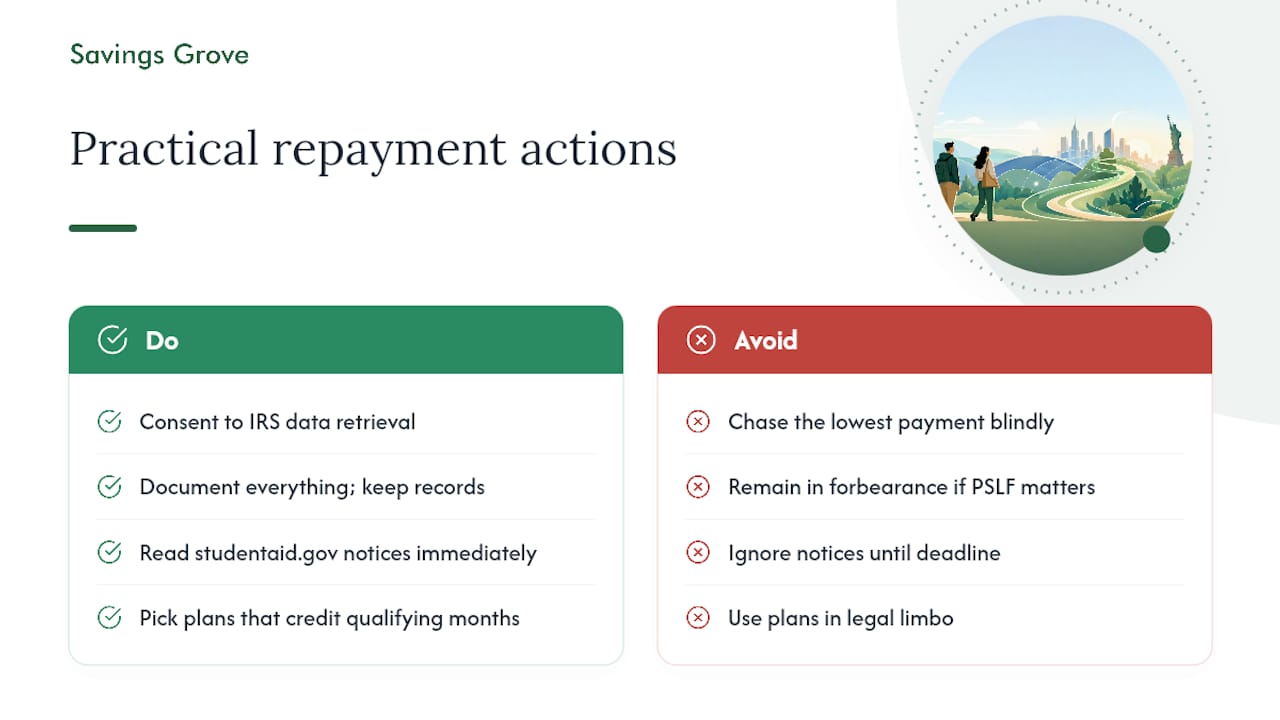
Chasing the mathematically lowest payment makes sense in a stable system. This isn’t one. If PSLF is part of your plan, a slightly higher payment on a plan that’s actually crediting qualifying months beats a lower payment sitting frozen in forbearance.
Consenting to IRS data retrieval for autorecertification is the single most protective step most borrowers skip, and it costs nothing. Given how much is still moving through the courts and Congress, the safest posture right now is conservative: document everything, avoid plans in legal limbo if forgiveness timing matters to you, and treat every studentaid.gov notice as something to read the day it arrives, not the week before a deadline.
— Mika L.
Let Savings Grove Help You Stay Ahead of These Deadlines
This site tracks the fine print on federal loan policy so you don’t have to dig through legal filings just to keep your payment from spiking. Between the SAVE litigation, the RAP rollout, and shifting recertification rules, this is exactly the kind of moving target our monthly research updates are built to cover.
If you’re weighing whether to pay down debt aggressively or ride out the lowest IDR payment, our guide on paying off student loans faster walks through the tradeoffs in plain terms. Borrowers whose balances eventually get discharged should also check our breakdown of the student loan interest deduction, since tax treatment on forgiven amounts isn’t always what people expect. Head to Savings Grove and subscribe for the monthly update. It’s the fastest way to catch a policy shift before it hits your bill.
This article is general information, not a substitute for advice from a qualified financial advisor. Consult a qualified financial professional about your own circumstances before acting on anything here.
Sources
FAQ
Are Income-Driven Repayment Plans Going Away?
No single plan is disappearing entirely, but access is narrowing. SAVE is paused in litigation, PAYE and ICR are closing to most new borrowers after July 1, 2026, and RAP is replacing them for new borrowers going forward.
How Much Is the Monthly Payment on a $70,000 Student Loan?
Your payment depends on income and family size, not loan balance, so your monthly payment depends on your income and family size, not directly on your loan balance. A single borrower earning $45,000 under IBR would pay roughly $187 to $280 a month, and the calculation changes with household size and filing status.
Did Trump Take Away Student Loan Repayment Plans?
Policy changes taking effect starting July 1, 2026 restructure which IDR plans are available to new borrowers, closing off PAYE, ICR, and pausing SAVE while introducing RAP as detailed by TICAS. Existing borrowers on other plans like IBR generally keep their access.
Do Student Loans Really Get Forgiven After 25 Years?
Yes, IDR plans forgive remaining balances after 20 to 25 years of qualifying payments, though borrowers may owe income taxes on the discharged amount depending on the discharge date and tax law in effect at that time, per Federal Student Aid’s FAQ.