

Switching to biweekly mortgage payments usually shortens your loan term and cuts total interest, because 26 half payments equal 13 full monthly payments a year instead of 12. That extra payment goes toward principal, so you build equity faster. The catch: your actual savings depend on how your servicer applies the money and whether they charge a setup fee, so confirm both before you enroll.
TL;DR:
- Confirm whether your mortgage servicer applies biweekly payments immediately to principal or holds funds in suspense, as batching can negate the payoff advantage.
- Be aware that some lenders charge setup or processing fees for official biweekly plans, which might offset the interest savings, especially in early years.
- If paid biweekly, using the servicer’s program is convenient; if paid monthly, managing extra payments yourself often avoids fees and delays.
- Making one extra full payment annually or adding a small amount to each monthly payment can replicate biweekly benefits without additional setup costs.
- Evaluate your overall financial situation first, ensuring high-interest debt is paid down and emergency funds are adequate, before adopting accelerated mortgage payment strategies.
Table of Contents
- How Do Biweekly Mortgage Payments Work?
- Calculator and Worked Example: How Much Could You Save?
- Pros and Cons of Biweekly Mortgage Payments
- How to Set Up Biweekly Payments With Your Lender
- Alternatives to Biweekly Mortgage Payments
- Is a Biweekly Mortgage Schedule Right for You?
- A Practical Take on Biweekly Payments
- More Tools to Help You Pay Off Your Mortgage Faster
- Sources
How Do Biweekly Mortgage Payments Work?
A true biweekly plan splits your monthly payment in half and withdraws that amount every two weeks. Since a year has 52 weeks, you end up making 26 half payments, which adds up to 13 full payments instead of 12. That extra payment is what shortens your term and reduces total interest when it’s applied to principal.
Don’t confuse this with a bimonthly or semimonthly plan, which pays twice a month for a total of 24 payments a year, no extra payment at all. The terminology distinction matters because a bimonthly schedule offers none of the payoff benefit people expect from “paying twice a month.”
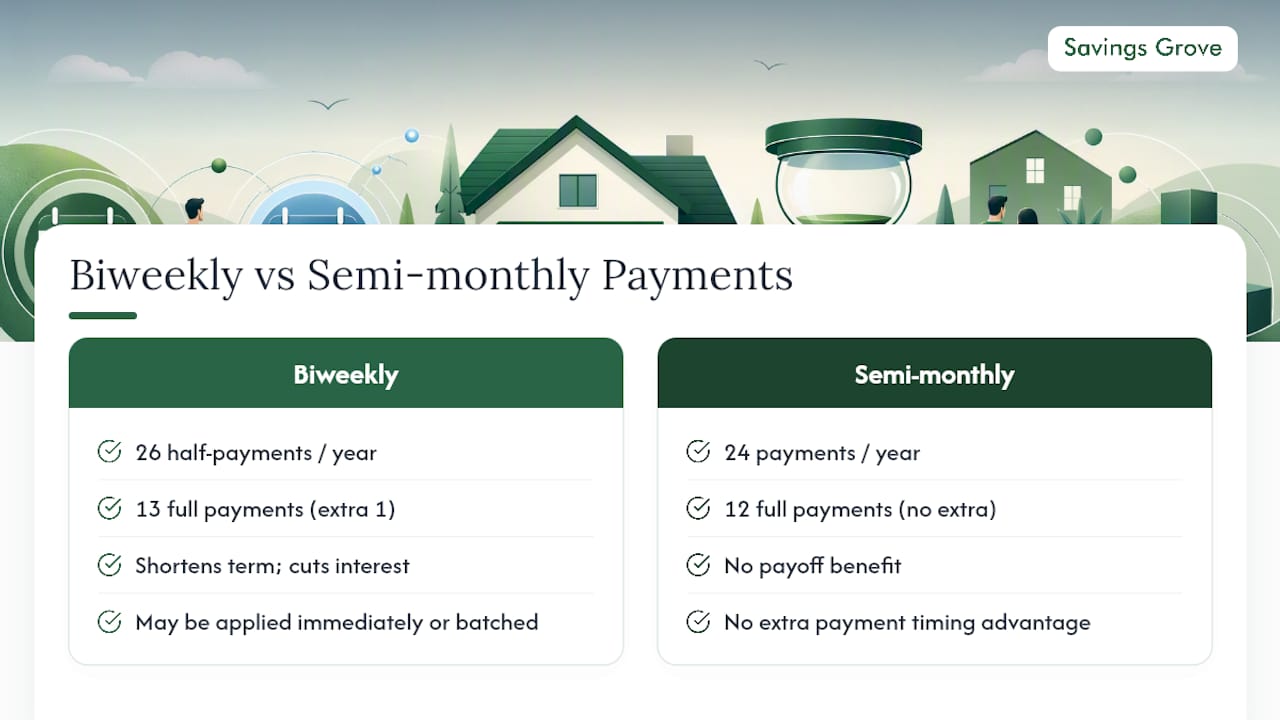
Here’s where things get tricky: some servicers don’t apply your half payments the moment they arrive. Instead, they hold both halves in a suspense account and only credit your loan once the full monthly amount accumulates. That batching practice can erase the timing advantage you were counting on, since your money isn’t reducing principal any faster than a standard monthly payment would.
Biweekly plans tend to fit best with borrowers who are actually paid every two weeks. If your paycheck lands on a monthly or semimonthly cycle, forcing a biweekly mortgage schedule can strain your cash flow, even though the long-term math still works in your favor.
Calculator and Worked Example: How Much Could You Save?
Numbers make this real. Paying monthly, you’d pay a monthly amount and substantial total interest over the full loan. Switch to biweekly payments of $948, applied promptly to principal, and you cut roughly four to five years off the term while saving tens of thousands in interest, a pattern consistent with the multi-thousand-dollar savings shown in standard amortization examples.
Your own numbers will vary depending on where you are in the loan. A biweekly switch in year two of a 30-year mortgage saves far more than the same switch in year 20, since less principal remains to compound interest against.
When you run your own numbers through a biweekly mortgage calculator, four inputs drive the result:
- Current loan balance — the remaining principal, not the original loan amount
- Interest rate (APR) — even a half-point difference changes the payoff math meaningfully
- Remaining term — years left, not the original 30-year term
- Payment posting frequency — whether your servicer applies funds immediately or batches them
The gap between those two payoff timelines is exactly why confirming your servicer’s posting rules matters more than the math itself.
Pros and Cons of Biweekly Mortgage Payments
Biweekly payments deliver a real, structural advantage: one extra full payment every year, applied consistently, which speeds up equity growth and can trigger PMI removal sooner if you’re still paying mortgage insurance. If your paycheck lands every two weeks, the schedule can also feel easier to budget around than a lump monthly bill.
The trade-offs are worth weighing before you commit:
- Setup or processing fees that some lenders charge just to enroll you in their official biweekly program
- Prepayment penalties, most common in the first three to five years of a mortgage, that could offset your interest savings
- Payment batching, where a servicer holds your two half payments until both arrive before crediting your loan
- Reduced short-term liquidity, since more of your money leaves your account sooner
Pro Tip: Watch for third-party payment processors who offer to “manage” your biweekly payments for a recurring fee. Many of them are simply withdrawing your money on your behalf and forwarding it to your servicer twice a month, something you can do yourself for free.
How to Set Up Biweekly Payments With Your Lender
Setting this up correctly takes three conversations, not one blind sign-up form.
- Call your servicer and ask directly whether they offer a biweekly program and whether it carries a setup or processing fee. Get the fee amount in writing.
- Confirm how extra funds are applied. Ask specifically whether your half payments post immediately to principal or sit in a suspense account until both halves arrive.
- Choose your path. Enroll in the servicer’s official program if it’s free and applies payments promptly, or manage extra payments yourself if fees or batching make the official plan less attractive.
Before you commit either way, run through this checklist:
- Does the loan servicer confirm no prepayment penalty applies to your loan?
- Is the biweekly program free, or does it carry an enrollment or per-payment fee?
- Will extra principal payments show up on your next statement within one to two payment cycles?
- Can you get the servicer’s answers confirmed in an email or account note, not just a phone call?
Alternatives to Biweekly Mortgage Payments
You don’t need a formal biweekly program to get the same result. Making one extra full payment each year, whether as a lump sum in December or by saving one-twelfth of your payment each month, replicates the exact math of a biweekly schedule without any setup fee.
Other low-cost paths to the same goal:
- Round your monthly payment up to the nearest hundred dollars and mark the extra as “principal only”
- Add a fixed extra amount, even $50 or $100, to each monthly payment
- Refinance to a shorter term if current rates and closing costs make a 15 or 20-year loan worthwhile
Each of these gives you full control over timing, with no risk of a processor holding your money or charging you to move it.
Is a Biweekly Mortgage Schedule Right for You?
Run through this order before committing to any accelerated payoff plan.
- Check your emergency fund and other debts first. If you’re carrying high-interest credit card debt or lack three to six months of expenses saved, pay that down before accelerating a mortgage that likely carries a lower rate.
- Run the calculator math against the fees. Estimate your interest savings, then subtract any setup fee or potential prepayment penalty. If the net savings clearly outweigh the costs within a few years, it’s worth pursuing.
- Match the schedule to your paycheck. If you’re paid biweekly and comfortable with money leaving your account every two weeks, a servicer’s official program can be convenient. If you’re paid monthly or semimonthly, self-managed extra payments usually fit better.
Pro Tip: If you’re unsure which category you fall into, default to the self-managed extra payment. You keep full control, pay zero fees, and can pause anytime a job change or emergency requires it.
A Practical Take on Biweekly Payments
Biweekly plans work best for disciplined borrowers who want the extra payment to happen automatically rather than trusting willpower. Our take: verify your servicer’s rules in writing, skip any paid third-party processor, and default to self-managed extra payments if you have any doubt about fees or batching.
— Mika L.
More Tools to Help You Pay Off Your Mortgage Faster
Running the numbers on your own loan is the real next step, not just reading about someone else’s example. Savings Grove’s home buying and savings planning guide walks through how to structure your budget around extra payments without straining your emergency fund.

If you’re paid every two weeks and want to align your mortgage with that rhythm, the weekly and biweekly paycheck budgeting guide breaks down exactly how to time transfers so extra principal payments never bounce a bill. And if amortization schedules still feel like a mystery, the plain-English amortization explainer shows exactly how each extra dollar shifts your payoff date. Head to the Savings Grove homepage for the full library of calculators and payoff strategies built for homeowners figuring out their next move.
Sources
- Should You Make Biweekly Mortgage Payments? – Forbes Advisor
- Biweekly Mortgage: What it Means, How it Works — Investopedia
- Biweekly mortgage payment calculator — Bankrate
This article is general information, not a substitute for advice from a qualified financial advisor. Consult a qualified financial professional about your own circumstances before acting on anything here.