

The average U.S. credit card sits at a 20.94% APR across all accounts as of May 2026, according to the Federal Reserve, while weekly tracking from Bankrate puts new-offer rates closer to 19.56%. If you carry a balance, your real cost is likely higher than either number suggests, since accounts charged interest run above the all-account average.
TL;DR:
- The Federal Reserve’s all-account average APR is 20.94%, but active balances often carry higher rates, closer to 22.15%.
- Offer-level data shows new credit card APRs around 23.80% to 24.94%, averaging higher than the rate for existing accounts.
- Your personal APR varies mainly by credit score, card type, and issuer, with credit unions offering significantly lower rates than big banks.
- Carrying a $5,000 balance at 20% APR costs roughly $950 annually, which can double with high-interest minimum payments.
- You can reduce your interest by transferring balances, negotiating rates, or using promotional 0% offers, with calculations recommending action based on specific costs.
Table of Contents
- Average Credit Card APR 2026: The Numbers You’ll See Cited
- What’s Your APR Based on Card Type and Credit Score?
- How Much Does a High APR Actually Cost You?
- Why Credit Card Rates Moved in 2026
- How to Lower Your Credit Card APR This Month
- How These Averages Are Measured
- Where Savings Grove Sees This Heading
- Get More Ways to Cut Your Credit Card Costs
- Sources
Average Credit Card APR 2026: The Numbers You’ll See Cited
You’ll run into at least four different “average APR” figures this year, and they’re not measuring the same thing. That’s not a data error. It’s a reflection of how differently each tracker samples the market.
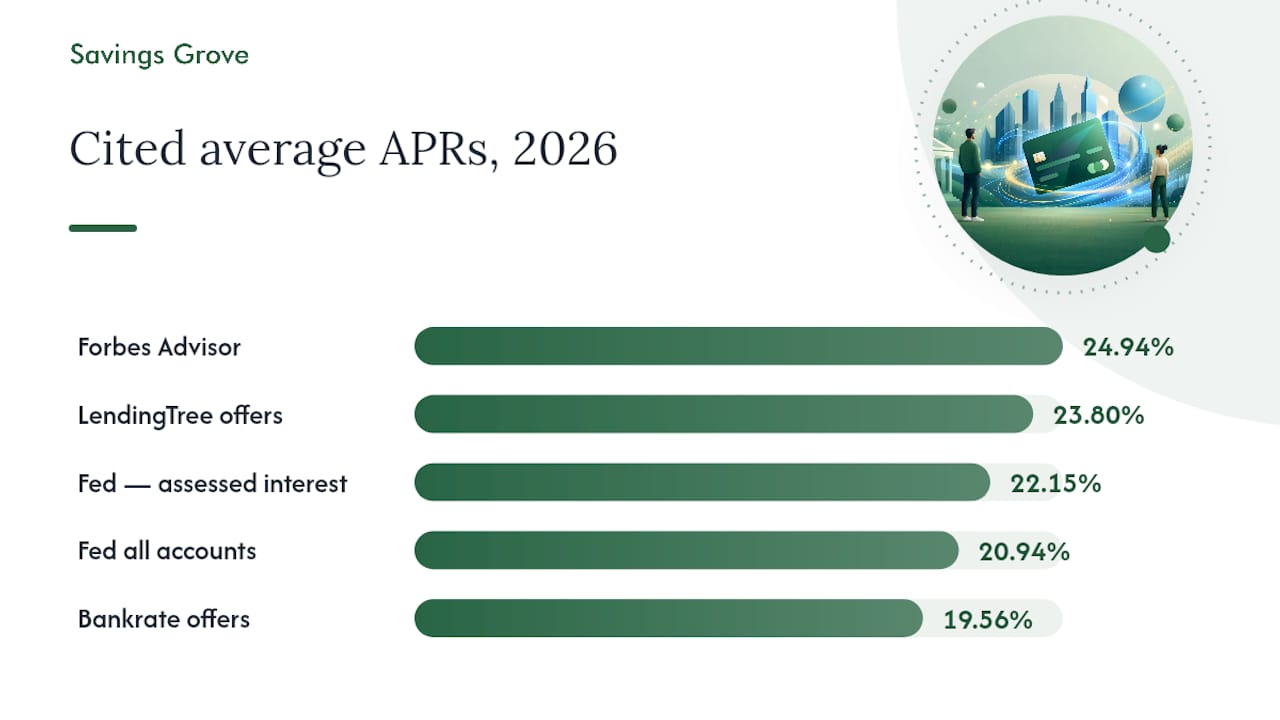
The Federal Reserve’s TERMCBCCALLNS series is the most cited government benchmark. It pulled 20.94% for May 2026, based on interest rates banks actually report across all their credit card accounts, including ones sitting at a $0 balance and paying nothing. That’s why it tends to read lower than what someone actively carrying debt experiences.
Bankrate’s weekly index tells a different story. Its national average landed around 19.56% in mid-August 2026, built from a rolling sample of new-offer rates tied to a roughly 700 FICO score profile. It’s a snapshot of what a decent-credit applicant might get approved for today, not what existing cardholders are paying on old balances.
Then there’s the offer-level end of the spectrum. LendingTree’s tracking shows average APRs on new card offers running near 23.80% as of an August 2026 snapshot, with the same source citing 20.94% across all accounts for the second quarter. Forbes Advisor’s weekly figure has run even higher, around 24.94%, while the Fed’s own measure for accounts assessed interest sat near 22.15% in May.
A few things drive the spread between these figures:
- Sample composition. All-account averages include dormant and zero-balance cards, pulling the number down.
- New offer vs. existing balance. Offer-level trackers reflect what’s advertised today, not what people are actually paying on debt from two years ago.
- Card mix. A snapshot weighted toward rewards and travel cards will skew higher than one that includes more secured or credit-union cards.
- Timing. Weekly indices react faster to rate cuts or hikes than monthly government series, which can lag by several weeks.
If you’re comparing your own statement APR against “the average,” match the measure to your situation. Shopping for a new card? Bankrate’s or LendingTree’s offer-level numbers are more relevant. Already carrying a balance? The Fed’s accounts-assessed-interest figure near 22.15% is the closer comparison.
What’s Your APR Based on Card Type and Credit Score?
Your APR depends far more on your credit profile and card category than on the “national average” you see in headlines. Averages are a starting point, not a personal forecast.
Rewards and travel cards tend to sit at the higher end, often in the low-to-mid 20% range, because issuers price in the cost of points and perks. Cash-back cards land in a similar band. Category-based rewards cards can still be worth the APR if you pay in full, but the math flips fast if you carry a balance.
Low-interest and secured cards are built for a different purpose entirely, and they typically price lower to attract or rebuild credit. Student cards often carry more moderate APRs than general rewards cards, since issuers are betting on a long-term relationship rather than maximizing short-term interest income. Business cards vary widely depending on whether they’re secured against personal credit or issued based on business revenue.
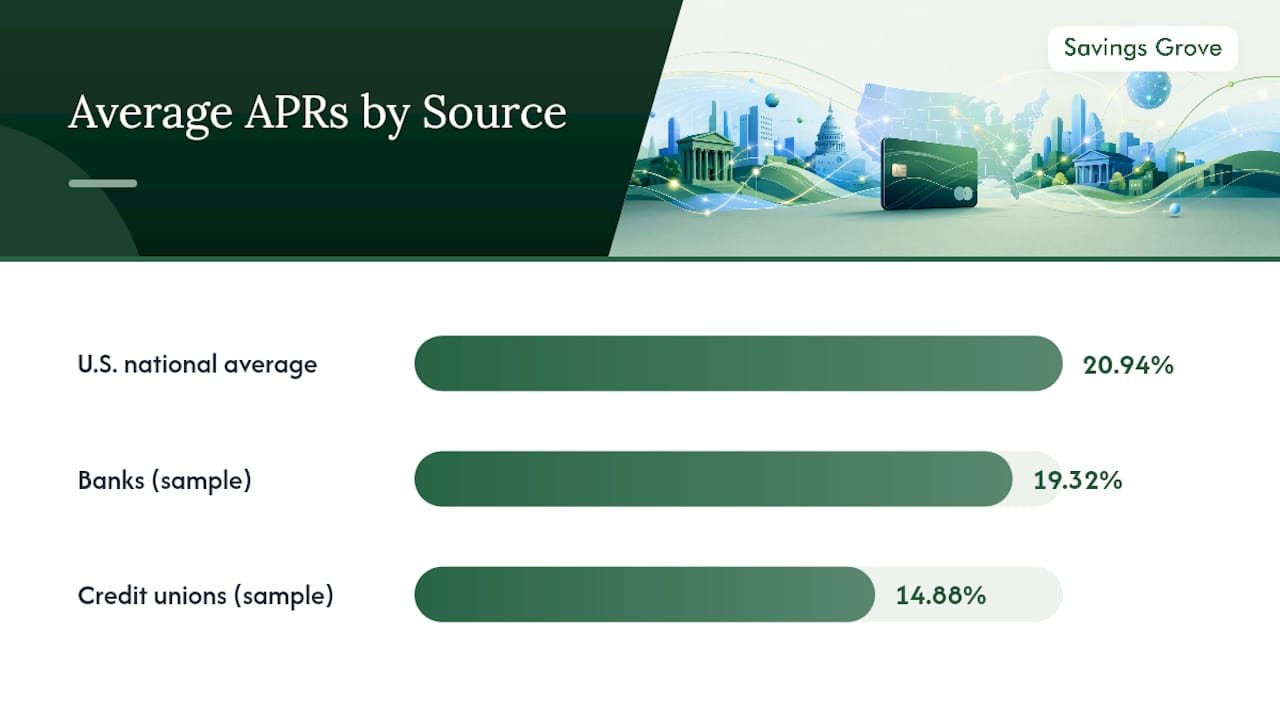
Issuer type matters too. Experian’s tracking shows credit unions issuing cards at meaningfully lower average APRs than big banks, with one recent sample showing banks near 19.32% against credit unions closer to 14.88%. That gap is one of the most overlooked levers in this entire conversation. Credit unions run on a member-owned model with lower overhead and profit targets, and it shows up directly in the rate you’re offered.
Your credit score band still does most of the heavy lifting on any individual offer:
- Excellent (740+): Often qualifies for the lowest advertised APRs and the best 0% intro offers.
- Good (670 to 739): Solid access to mainstream rewards cards, though rarely the rock-bottom rate.
- Fair (580 to 669): Higher APRs, fewer 0% offers, and a real chance of needing a secured card first.
- Poor (below 580): Secured cards or credit-builder products are usually the realistic entry point.
How Much Does a High APR Actually Cost You?
A $5,000 balance at 19% APR costs about $79 in interest in a single month if left untouched.
Stretch that same $5,000 across 12 months of interest-only carrying (no new charges, no payments toward principal) and the gap widens dramatically:
- 19% APR: Roughly $950 in interest over the year.
- 24% APR: Roughly $1,200 in interest over the year.
- 26.99% APR: Roughly $1,350 in interest over the year.
That’s before you factor in the real killer: minimum-payment-only repayment. Making only the minimum on a $5,000 balance at a rate in the mid-20s can stretch payoff past a decade and roughly double or triple the total interest paid compared with a fixed, aggressive payoff plan.
Pro Tip: Pull your last statement and find your “interest charged” line. Multiply it by 12. That’s roughly your annual cost of carrying that balance at your current rate, and it’s usually a bigger number than people expect.
The Fed’s May 2026 data shows accounts assessed interest averaging 22.15%, a full point and a half above the all-account average. If you’re paying interest at all, that’s the number that describes your real cost, not the lower headline figure.
Why Credit Card Rates Moved in 2026
Credit card APRs track the prime rate closely, and the prime rate tracks the Federal Reserve’s policy rate with only a short lag. When the Federal Reserve adjusts the federal funds rate, that move shows up in most cardholders’ APRs within one or two billing cycles, since the vast majority of cards carry a variable rate pegged to prime plus a margin set by the issuer.
Inflation data plays a supporting role. When CPI readings run hot, markets price in fewer or slower rate cuts, which keeps card APRs elevated even without a fresh Fed hike. When inflation cools, the opposite happens, and issuers sometimes trim margins to stay competitive even before the Fed officially moves.
Issuer behavior adds another layer that’s easy to miss. Even with a stable prime rate, some issuers widen their margin over prime during periods of rising default rates or economic uncertainty, effectively raising APRs on their own initiative. This is part of why Forbes and LendingTree snapshots can run higher than the Fed’s own series, even when both are technically measuring similar time periods.
A few indicators worth watching through the rest of 2026:
- FOMC meeting statements, which set the tone for where prime rate is headed next.
- Monthly CPI releases, which shape market expectations between Fed meetings.
- Bankrate’s weekly index, which reacts faster than monthly government series.
- Your own card’s disclosure, since issuer-specific margins can shift independently of the broader market.
How to Lower Your Credit Card APR This Month
You don’t have to wait for the Fed to cut rates to pay less interest. Several options are available right now, and most take less than an hour to act on.
- Request a balance transfer. A 0% intro offer typically runs 12 to 21 months, with a balance transfer fee usually between 3% and 5% of the transferred amount. Do the math before you commit: a $5,000 transfer at a 3% fee costs $150 upfront, which is almost always cheaper than a year of interest at 20%-plus.
- Call and negotiate your rate. Reference your payment history, your tenure with the issuer, and any competing offers you’ve received. A direct call to your issuer sometimes shaves several points off your APR, particularly if you’ve never missed a payment.
- Consider a personal loan for consolidation. Fixed-rate personal loans can undercut card APRs, especially for borrowers with good credit, though origination fees and a hard credit pull are worth weighing first.
- Improve your credit score deliberately. Paying down utilization below 30%, disputing errors, and avoiding new hard inquiries for a few months can shift you into a better rate tier on future applications.
- Use 0% promotional periods strategically, and pay in full whenever possible so the APR you’re comparing never actually applies to your wallet.
Pro Tip: Before transferring a balance, calculate your break-even point: divide the transfer fee by your current monthly interest cost. If the fee pays for itself in under three months, it’s almost always worth doing.
How These Averages Are Measured
Every figure in this article comes from a named, public data source, and each one measures something slightly different. The Federal Reserve’s TERMCBCCALLNS series is a monthly, bank-reported average across all commercial bank credit card accounts. Bankrate’s Monitor index, tracked through the St. Louis Fed’s ALFRED database, updates weekly and reflects new-offer pricing.
The CFPB’s 2025 consumer credit card market report adds market-structure context, including how account behavior varies across card types and issuer sizes. LendingTree and Forbes Advisor publish more frequent snapshots pulled from sampled card offers rather than full market data.
- Watching for a new card offer? Use Bankrate or LendingTree’s offer-level numbers.
- Already carrying a balance? The Fed’s accounts-assessed-interest figure is closer to your reality.
- Want the broadest market view? FRED’s all-account series is the steadiest long-run benchmark.
Where Savings Grove Sees This Heading
Every one of these figures changes month to month, and no single number tells you what you’re actually paying. Consult your card’s own statement APR before making any decision. Balance transfers pencil out for some people and not others, and negotiating with your issuer costs nothing but a phone call. Check your rate this month, run the break-even math, and act on whichever lever fits your numbers.
— Mika L.
Get More Ways to Cut Your Credit Card Costs
Comparing APR data is a good first move, but pairing it with the right tools makes a bigger dent in what you actually pay. Savings Grove tracks credit card rates, rewards structures, and issuer offers every month, then rebuilds its guides around what’s genuinely changed, not what sounds new.
If a balance transfer looks promising after running your break-even math, Savings Grove’s debt payoff guide walks through nine tactics for getting there faster. If your next move is a phone call to your issuer, the negotiation guide covers what to say and what to reference. And if you’re shopping for a card with a friendlier starting APR rather than fixing an existing one, the student card roundup and business card comparisons on Savings Grove get refreshed monthly with current rate data. Start with your own statement, then see which guide matches where you’re headed next.
This article is general information, not a substitute for advice from a qualified financial advisor. Consult a qualified financial professional about your own circumstances before acting on anything here.
0 comments
Leave a comment
Reviewed before they appear. Your email is not shown.