

Chase will likely deny your application if you’ve opened several personal credit cards in a recent 24-month period. That’s the Chase 5/24 rule. If you’re unsure where you stand, don’t apply yet. Pull your credit reports at Annualcreditreport first and count your recent account openings before you waste a hard inquiry.
TL;DR:
- Accounts opened within the past 24 months, including closed and authorized-user accounts, count towards the five-card limit for Chase approval.
- Business cards generally do not count unless they are reported to your personal credit report, which varies by issuer.
- Product changes may or may not reset the 5/24 count depending on whether a new account number or a hard pull is involved.
- Waiting for accounts to exit the 24-month window or removing unauthorized-user listings can improve your eligibility faster.
- The 2/30 rule limits you to two personal and one business Chase approvals every 30 days, operating independently of the 5/24 count.
Table of Contents
- How the Chase 5/24 Rule Actually Works
- Which Cards and Accounts Count Toward 5/24
- Do Product Changes or Upgrades Reset the Count?
- How to Check and Calculate Your Own 5/24 Status
- Workarounds and How Reliable They Actually Are
- Application Timing and the 2/30 Rule
- If You’re Over 5/24: What to Do Next
- Savings Grove’s Take: Build the Habit, Not Just the Workaround
- Verify the Details Yourself
- Sources
How the Chase 5/24 Rule Actually Works
Chase has never published the 5/24 rule in any official policy document. It exists because thousands of applicants compared notes over the years and noticed the same pattern: get to five new personal cards within a 24-month window, and Chase starts rejecting you across almost its entire personal card lineup, regardless of your credit score. Financial outlets have reverse-engineered the rule from this crowdsourced data, and it has held up consistently enough that it’s now treated as fact in the credit card world.
Here’s what Chase actually checks: the “date opened” field on your credit report. It doesn’t matter if you closed the card six months after opening it. If it opened within the past 24 months, it counts. It also doesn’t matter how many hard inquiries you’ve racked up. Chase isn’t counting inquiries, it’s counting opened accounts, which is why the rule confuses so many first-time applicants who assume a single “no” pull from another issuer might be the problem.
Why does Chase bother? Anti-churning. Sign-up bonuses cost the bank real money, and without a velocity limit, reward chasers would open new Chase cards every few months purely to farm bonus points and never carry a balance. The 5/24 rule caps that behavior at the door. It’s worth remembering, though, that 5/24 is just one gate. Clearing it doesn’t guarantee approval. Chase still evaluates your credit score, income, existing debt, and overall relationship with the bank before saying yes.
Which Cards and Accounts Count Toward 5/24
Not every card on your credit report weighs the same in Chase’s math. Some accounts you’d never think to count actually do, and some you’d expect to count don’t.
- Personal cards from any issuer: Every personal credit card opened in the past 24 months counts, whether it’s from Chase, American Express, Capital One, or a store card you forgot about.
- Closed accounts still count: Closing a card doesn’t erase it from your report. If it opened within the 24 month window, it’s still in your total.
- Authorized-user accounts: If someone added you as an authorized user on their card, it can show up on your credit report and count toward your 5/24 total, even though you never applied for it yourself.
- Most business cards don’t count: Business cards typically report to your business credit profile, not your personal one, so they usually stay outside the count. But some issuers, including certain products from Capital One, Discover, and TD, do report business accounts to personal credit files, and those exceptions can quietly push you over.
- Denials don’t count: An application Chase rejects never opened, so it never adds to your total.
Do Product Changes or Upgrades Reset the Count?
Whether a product change counts toward 5/24 depends on how Chase processes it behind the scenes. If Chase gives you a new account number and runs a hard pull, that’s treated as a new account opening and adds to your total. If it’s a true product change, same account number, no new hard pull, it typically doesn’t add a new entry to your report at all.
- Check your credit report a few weeks after any product change to see whether a new account line appeared.
- Targeted “Just for you” offers you see when logged into your Chase account sometimes bypass 5/24 entirely, since they’re pre-screened.
- In-branch applications occasionally get manual review that a website denial wouldn’t receive.
- A reconsideration call can help if your denial stemmed from a stray authorized-user account you can explain or have removed.
Pro Tip: Before calling reconsideration, remove yourself as an authorized user on any card you no longer use. Ask the primary cardholder to request removal, then wait for the update to hit your report before you reapply.
How to Check and Calculate Your Own 5/24 Status
You don’t need a subscription or a special tool to figure out where you stand. This takes about fifteen minutes.
- Go to AnnualCreditReport.com and pull all three bureau reports (Experian, Equifax, TransUnion) free of charge.
- Sort each report by account open date and list every personal card opened in the past 24 months, closed or not.
- Cross-check with Experian or a free service like Credit Karma, since bureaus sometimes report slightly different open dates for the same account.
- Flag any authorized-user accounts you don’t recognize as your own applications, since these inflate your count without you realizing it.
- Mark the date each account rolls past 24 months old. That’s the day it drops off your count, and the first day of the following month is typically when you become eligible again.
A simple spreadsheet with card name, open date, and “drops off” date keeps this organized far better than trying to remember it.
Workarounds and How Reliable They Actually Are
If you’re over 5/24, a few tactics come up constantly in credit card communities. Some work reasonably often. Others are more myth than method.
- Targeted “Just for you” offers: These pre-screened links, often found when logged into your Chase account or received by mail, sometimes approve applicants who’d otherwise get an automatic decline. Community reports suggest they work more often than cold applications, but they’re not guaranteed and not always available.
- In-branch applications: A banker can occasionally push a borderline application to manual underwriting, which sometimes catches context an algorithm misses. This isn’t a reliable bypass, just a slightly better shot for edge cases.
- Business cards that don’t report to personal credit: Applying for a Chase Ink card, for instance, doesn’t add to your personal 5/24 count in most cases, and it gives you access to Chase’s ecosystem without tripping the rule. The risk: you still need a legitimate business purpose, and issuer reporting practices can change.
- Applying elsewhere instead: If you’re deep into 5/24 territory, forcing a Chase application usually just burns a hard inquiry for nothing. Other major issuers don’t enforce anything like 5/24, making them a more productive use of your application slot right now.
Chase can also revise unpublished restrictions without warning. The lifetime and 48-month rules attached to Sapphire cards changed materially in 2025, which is a reminder that today’s workaround might not exist next year.
Application Timing and the 2/30 Rule
Beyond 5/24, Chase enforces a separate, faster-moving limit that community trackers call the 2/30 rule: no more than two personal card approvals in any rolling 30-day window, and no more than one business card approval in that same window. This gate operates independently of 5/24, meaning you have to clear both to get approved, not just one.
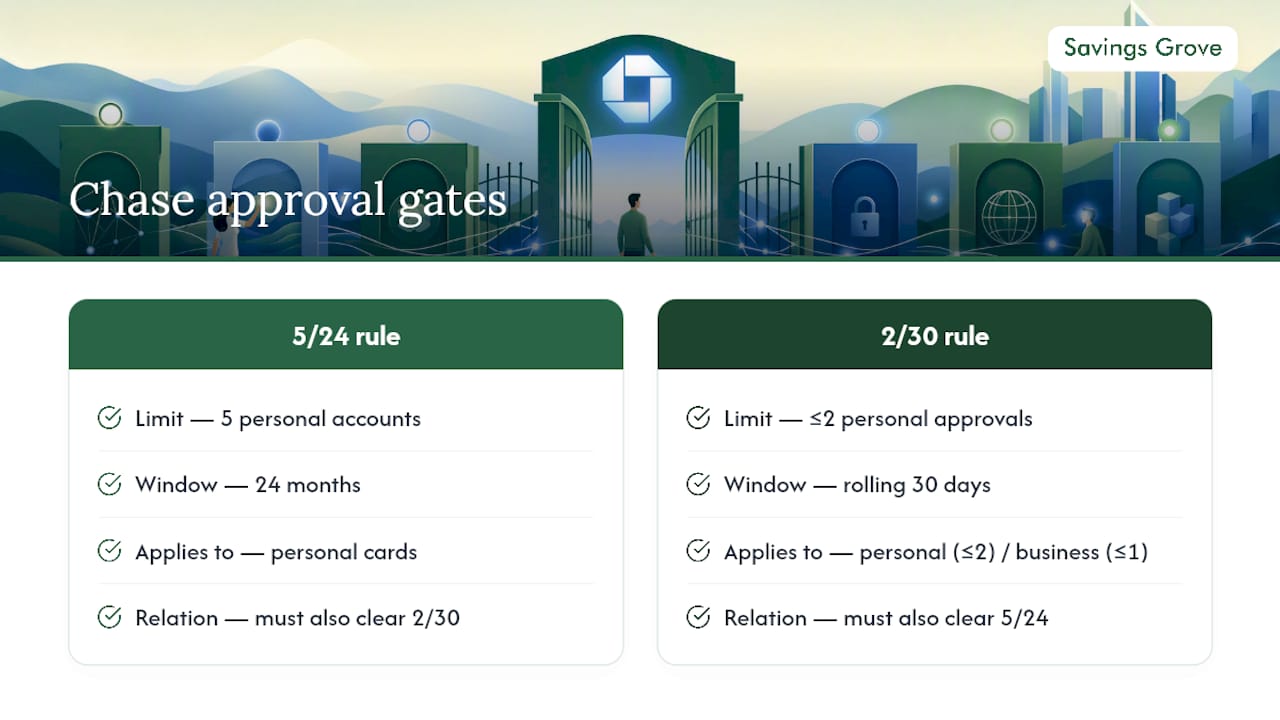
If you’re planning multiple Chase applications, apply for the card you want most first. Then space subsequent applications by at least 31 days rather than submitting them back to back. Two same-day applications can trigger an automatic decline on the second one even if your 5/24 count is fine, simply because it violates 2/30.
If You’re Over 5/24: What to Do Next
Being over 5/24 isn’t permanent. It’s a countdown, and knowing exactly when it ends changes your entire strategy.
- Calculate your reset date first. Find your oldest card within the 24-month window; that account’s anniversary date is when your count drops back toward eligibility.
- Weigh waiting versus applying elsewhere. If your reset date is weeks away, waiting usually beats forcing an application you’ll likely lose. If it’s a year or more out, other issuers deserve your attention now.
- Remove authorized-user listings you don’t need. This can shave your count down faster than waiting out a card you never personally opened.
- Prioritize your Chase wish list. Decide which Chase card you want most before you’re eligible again, so you apply for it first the moment your count clears.
Savings Grove’s Take: Build the Habit, Not Just the Workaround
The mistake most people make isn’t misunderstanding 5/24. It’s treating it as a one-time puzzle to solve instead of an ongoing constraint on their financial calendar. Verify your reports before every application cycle, not just when you get denied. Clear authorized-user clutter proactively. And if Chase cards matter to you, apply for them early in any run of new accounts rather than saving them for last, since you’ll likely burn through your five slots on other issuers first if you don’t plan the order.
Pairing that discipline with smart category spending choices on the cards you already hold gets you more value while you wait out any reset period.
— Mika L.
Verify the Details Yourself
Pull your free reports at AnnualCreditReport.com, monitor open dates through Experian, and review Chase’s own guidance on application frequency before you submit anything new.

This article is general information, not a substitute for advice from a qualified financial advisor. Consult a qualified financial professional about your own circumstances before acting on anything here.
0 comments
Leave a comment
Reviewed before they appear. Your email is not shown.